

"I don't know anything, but I do know that everything is interesting if you go into it deeply enough." ~ Feynman '79 Curiosity compounds. ∫ · ∂ · Ψ · H₀ · ℏ
Mainz
Joined March 2012
- Tweets1.3K
- Following2.8K
- Followers230
- Likes3.2K


Pinned Tweet
I release Point Five. Yet another CMS event viewer.
Real detector geometry, real open data collisions, in the browser: tracks bending in the 3.8 T field, ECAL crystals and HCAL towers lighting up where the energy actually landed.
cms.sponde.de

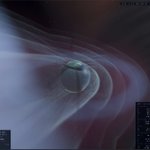
DSCOVR reports Bz -8.8 nT at 535 km/s from L1, and Dst sits at -125 nT. The magnetosphere is compressed (standoff r0 9.84) and the ring current is loading. The causal chain from Bz through reconnection to Dst plays out right in the scene. aegis.sponde.de #SpaceWeather
I'm in tears.
Hero of my youth.
The epitome of a strong, composed, and principled character.
In Star Trek, just as in real life.

In lieu of flowers, memorial contributions may be made to:
Johns Hopkins Alzheimer’s Disease Research Center Fund
alzresearch.org/giving/
Alzheimer’s Foundation of America Caregiver Resources
alzfdn.org/donate/
Photo Credit: Tommy Garcia


The Neutron Piano.
Listen to cosmic rays in real time:
25 neutron monitors worldwide, one piano key each.
Demo: sponde.de/neutron-piano
Code (MIT): github.com/Kracht/neutron-pi…
#Sonification #SpaceWeather #CosmicRays
S.Kracht retweeted

ALERT: X-Ray Flux exceeded M5
Threshold Reached: 2026 Oct 08 1546 UTC
Noaa Scale: R2 - Moderate
Comment:
Issue Time: 2026 Oct 08 1547 UTC
bit.ly/3wVgAKH
Code, plus a document listing every deliberate approximation:
github.com/Kracht/point-five
Geometry CC BY-NC-SA 4.0 (Alex Iribarren), event data CC0 from the CERN Open Data Portal. Neither CMS nor CERN endorse works produced using these data
A postdoc builds a weekend project showing how late your ICE actually ran last week from DB's own CC-BY data. DB response: block the requests.
If your punctuality is 50%, don't book Streisand on top.
Oh btw last time DB "got creative with data", it cost them a CEO. 2009.

DB hard-blocked DelayBahn at 1:35 PM today.
100,000+ people used DelayBahn in the last 7 days, and I guess we finally got noticed 😅
I pushed a workaround and we’re back online, but this will likely happen again.
If you know someone at DB who could help us find a sustainable solution, please DM me.
Would love to work with DB, not around them 🚆❤️

🤦 realized a main feature was hidden, F4 shows the causal chain (compression + storm branch), nobody could find it. Also: individual data fields now flag when their NOAA feed is lagging, so it reads as "value gap"
aegis.sponde.de
github.com/Kracht/AEGIS

If you are into SDR/HAM/SIGINT you‘ll love Artemis! One of my favorite companion apps for signal identification.


Released 𝗦𝗼𝗹𝗮𝗿𝗗𝗮𝘀𝗵: real-time space weather in your terminal.
NOAA storm scales, solar wind graphs, braille world map with live OVATION aurora oval, Kp/Dst, flares, HF band conditions, launch countdowns. Linux + Windows binaries: github.com/Kracht/Solardash
#spaceweather

Live Data is back after NOAA endpoint change, also implemented @GFZ_Potsdam Hp30 data stream as ghost trace beside the modelled aurora driver
github.com/Kracht/AEGIS
Demo: aegis.sponde.de/
#spaceweather #spacewx

Bz: -10.4 nT southward. Solar wind 450 km/s. Dst: -127 nT * moderate geomagnetic storm in recovery. Magnetopause compressed to ~10.4 Re. Polar cusp funnel wide open, funneling solar wind plasma directly into the high-latitude ionosphere. #SpaceWeather [via DISCOVRR/NOAA SWPC]


planform.sponde.de
WebGL experience running Wilson-Cowan field equations as artistic interpretation of mathematical transformation in primary visual cortex
Thx @taylor_sntx @yuruyurau @HAL09999 @j2rgb for inspiration, and @algekalipso for his work @QualiaRI

Lateral excitation in a Wilson-Cowan E/I field, solved as ODEs on a 2D grid, driving vertex displacement on a parametric mesh. The interference pattern is what V1 recurrent amplification looks like when inhibition can't keep up, point cloud rendering at the instability boundary.
