

Building https://nitter.cf/t.co/fLae4gGo8V - AI & Media ex @huggingface @radiocanadainfo @ledevoir
Montreal
Joined February 2008
- Tweets35.4K
- Following6.7K
- Followers10.7K
- Likes2.7K






How do you avoid having to restart your laptop every day because Codex and/or Claude end up eating up all your available disk space? I go from 40 GB free to just a few MB every day, which is pretty annoying.
We just made it possible to go from "I’m obsessed with this topic" to "I have a curated newsletter about it."
Because every obsession deserves its own newsletter 🤪

Some things can’t be unseen (or why keeping a human in the loop doesn’t guarantee independent human judgment
anthropic.com/research/agent…

Is Rest of World the first official casualty of the rise of AI chatbots and summaries?
It had donors and a patient backer. I can't imagine the impact on more fragile media orgs.
This is really sad. RoW brought much-needed diversity to tech coverage and broke important stories

The 5 failure modes of overengineered multi-agent systems according to @AnthropicAI:
1. Context exchange
2. Subagent sprawl
3. The Frankenprompt
4. Unvetted, overly localized evals
5. Latency
One agent with the right skills and tools > an army of specialized subagents

I put Jev 1.14’s new Box feature through a plane spotting test
10 photos, 3 airlines, 30 checks
At a 50% presence threshold, Jev detected 10 of the 11 genuine airline appearances. 90.9% recall. 4 false positives and sometimes put the box in the wrong place


Personal agent is the new chatbot


Your regular reminder that small, specialized open models can do so much. Google dropped EmbeddingGemma 2. Then:
- A dev built DigUp, which is basically what search on your Mac should be.
- Google shipped Foresight, a local Granola-like
Some really good takes here


Assorted things I've been mulling over regarding agents in the economy:
• Companies are in some sense the original superintelligence. It's often the case that they can use their amortized cognitive surplus to advance their interests against those of certain consumers: relative to the optimization capacity of companies, consumers can be inattentive, underinformed, irrational, etc. (Think, say, of some of the classic insurance upsells at the end of a booking process, which is typically priced substantially above what a regular policy would cost.) Herbert Simon introduced the idea of bounded rationality, and firms often end up benefiting from it. Thanks to personal agents, we will probably get somewhat more rational in how we engage with companies.
• How exactly will outcomes change? Well, certain kinds of price discrimination will work less well (how do coupons work if every agent hunts fastidiously for them?), and certain kinds of customer cross-subsidy will change (today, people who forget to cancel subscriptions subsidize those who don't). Taken across the economy as a whole, I'm not sure what the incidence of all of this will be.
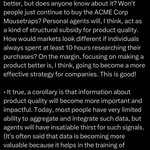
• In corporate strategy, people have long debated the relative importance of distribution and product quality. Perhaps you've made something better, but does anyone know about it? Won't people just continue to buy the ACME Corp Mousetraps? Personal agents will, I think, act as a kind of structural subsidy for product quality. How would markets look different if individuals always spent at least 10 hours researching their purchases? On the margin, focusing on making a product better is, I think, going to become a more effective strategy for companies. This is good!
• It true, a corollary is that information about product quality will become more important and impactful. Today, most people have very limited ability to aggregate and integrate such data, but agents will have insatiable thirst for such signals. (It's often said that data is becoming more valuable because it helps in the training of models. That's obviously true, but I think there's a secondary way in which it's more valuable simply as a complement to cheaper intelligence.)
• A big question is whether agents will increase superstar effects (rational agents all settle on the same product) or increase dispersion (because everyone has slightly different tastes and preferences, which agents are good at eliciting, finally overcoming the artificial clustering we've been subjected to).
• Many internet companies have monetized demand routing, which is in turn often predicated on short attention spans. "I'll click on the first thing I see." This has led to some amount of inefficiency, as companies try to propitiate capricious ranking algorithms and incur various placement fees. It's not all deadweight loss (willingness to pay is itself a kind of signal, which is valuable to buyers), but it's not great. How will the nature and value of this routing change in a world of personal agents? I don't know the answer, but I think that the effects might be pretty big.
• Much of what I'm writing hinges on the assumption that personal agents will be on the consumer's side. I suspect that that will be the winning strategy, but whether it's true, and what it means to be true, involves a lot of other questions.
Taken as a whole, the market is a massively parallelized, decentralized, and highly imperfect value attribution machine, and, taking stock of all of the effects, it seems to me that the quality point may well be the biggest: that agents will change the nature of the backpropagation such that the rewards for better products increase. Maybe this is too optimistic, but I suspect (and hope) that companies that make things that they're proud of will feel that the universe is a little more partisan in their favor.
so... an Iran-based op set up 7 fake journalist personas wit chatgpt. and they landed ~100 articles across more than a dozen publications 🤯
check your sources. always.

ChatGPT’s app store moment? OAI shipped Plugins and you shouldn't sleep on it.
We've built one for Mizal, and it's my favorite way to use it so far. You can browse the content, ask questions and check the receipts inside the chat.
Anthropic just gave a masterclass in how to lose potential enterprise customers forever with a single email, and it’s insane! 🤯


Liquid content is here: you can turn a 3½-hour podcast into an interactive format with a single prompt. “till you’re proud of it.”

I asked Opus 5.5 to make an interactive website companion for the latest @AcquiredFM Home Depot episode. It came out pretty nice!
Water color illustrations all drawn by Claude, too: claude.ai/artifact/RdE6uE7Wo…
Episode here: acquired.fm/episodes/home-de…

Marie Kondo your ai setup. Models evolve; your setup should too.
Does that instruction still spark useful work? If not, bin it


