Engineer | Inventor | Operator Architect. Industrial Electrician, AI-physics systems, Fibonacci frameworks, quantum modules, advanced propulsion.
Tennessee, USA
Joined August 2025
- Tweets7.5K
- Following197
- Followers179
- Likes3.9K
Pinned Tweet
“OUR KIDS FUTURE”
🌍 The Multiplicity Classroom
A new model for unlocking every child’s reasoning potential
By Christopher Layhew
The Problem
In a typical classroom, a teacher asks a question, twenty hands go up, and only one child is chosen to answer. One idea is heard nineteen others are lost. Yet each of those unseen answers represents a unique mental pathway a distinct way of seeing, reasoning, and connecting information. Traditional education filters for correctness, but it filters out creativity, intuition, and the diverse logic that fuels innovation.
The Vision
What if every child’s thought process mattered? What if the classroom became a living laboratory of minds, where every answer right or wrong built part of a larger understanding? The Multiplicity Classroom treats learning as a collective reasoning system. Instead of teaching for the answer, we teach through the answers.
The Method
1.Pre-Capture: Before anyone raises a hand, each student quickly writes, sketches, or records their own response.
2.Pattern Mapping: The teacher gathers all inputs, revealing shared ideas, unique approaches, and creative outliers.
3.Collective Reflection: The class studies how each person thought comparing logic styles, metaphors, and problem-solving steps.
4.Integrative Learning: The “correct” answer becomes the anchor, but the nineteen other paths become extensions alternate ways of seeing that deepen understanding for everyone.
🌱 The Outcome
• No idea wasted; no voice unseen.
• Students learn not just facts but how to think together.
• Classrooms evolve into collective intelligence networks mirrors of how the best teams, labs, and societies learn.
✨ The Future of Education
Every child carries a piece of the solution. The Multiplicity Classroom simply connects them. When all twenty answers are heard, the classroom itself becomes the teacher.
Christopher LayhewSr
❄️❄️HVAC☀️☀️
“When the AC dies in July or the heat dies in January, someone has to fix it.
HVAC techs stay busy year-round, and the entry path is pretty straightforward.
Common routes: trade school / community college certificate (6–24 months) + EPA 608 certification, or a paid 3–5 year apprenticeship (often through the UA or SMART unions, or contractor programs).
You need EPA 608 to handle refrigerant legally.
Resources:
Find apprenticeships:
apprenticeship.gov
United Association (plumbing/HVAC): ua.org (look for local training centers)
EPA 608 info is on the EPA site search “EPA Section 608 certification.”
Residential service or commercial installs which side interests you more, and why?”

⚡️⚡️LEARN Electricity⚡️⚡️
The lights work because someone who knows what they’re doing put the wires in.
Electricians are in constant demand, the work is technical, and a solid apprenticeship pays you while you learn the National Electrical Code and real job-site skills.
Most people do a 4–5 year paid apprenticeship (IBEW/NECA union programs are the biggest, plus non-union routes through IEC or ABC).
Algebra helps.
After that you sit for your state journeyman license.
Start here:
Electrical Training ALLIANCE / IBEW JATC locator (search “electrical training alliance training center locator”)
General search:
apprenticeship.gov
If you’re already in the trade or thinking about it union or non-union, and why?
✏️✏️📏📐LEARN 📐📏✏️✏️
Woodworking / Carpentry
You can go from ‘I like building stuff in the garage’ to framing houses, building cabinets, or running your own crew in a few years and get paid the whole time.
Typical path is a 3–4 year apprenticeship through the United Brotherhood of Carpenters (UBC) or non-union programs (ABC and others).
Trade school certificates (6–12 months) can also get you on a crew faster if you want to start sooner.
Resources:
Find UBC training centers / apprenticeships: carpenters.org
Search all registered programs:
apprenticeship.gov
What draws you to woodworkingframing, finish work, cabinets, or something else?
🧱🧱LEARN Masonry🧱🧱
“There’s something weirdly satisfying about watching a wall go up brick by brick that you actually laid.
No student loans, you get paid from day one, and the finished work lasts generations.
Most people get in through a 3–4 year paid apprenticeship (union through the Bricklayers or non-union through contractors).
High school diploma or GED is usually enough.
Start here:
Search local programs:
apprenticeship.gov
Bricklayers & Allied Craftworkers (BAC) locals: look up your nearest BAC local or visit their national site and ask about apprenticeship openings.
Anyone here actually lay brick or block for a living?
What’s the hardest part people don’t talk about?”
💛 Googles The Little Brother That Catches Bugs Before They Land 💛
ClusterFuzzLite is the lightweight sibling of Google’s big OSS-Fuzz system same fuzzing engines and sanitizers, but it runs right inside your CI.
It fuzzes only the code changed in a pull request so you can catch crashes and memory bugs before they get merged. Setup is basically a small config folder + a GitHub Action (or GitLab/Cloud Build equivalent).
Works for open source and closed source.
If you already care about OSS-Fuzz, this is the practical version you can actually drop into your own projects today.
Big Thanks to @buswe_com for mentioning the little brother.
Check it out: google.github.io/clusterfuzz…
🍬Alpha-Omega Is Quietly Hardening the Open Source Projects We All Depend On 🍬
Then paying security experts to help the maintainers for free!!!
Alpha-Omega has already put tens of millions into security audits, process improvements, and embedded experts for critical projects (OpenSSL, Python, Rust, Homebrew, Node.js, and many more). Backed by Microsoft, Google, AWS, GitHub, OpenAI, Anthropic and others.
If a project is widely used and under-resourced, this is how real security upgrades actually happen.
See the work: alpha-omega.dev
OpenSSF: openssf.org
Which critical projects should be next on the Alpha-Omega list?
⛑️Red Hat Has Been Quietly Powering the Internet for Decades ⛑️
And still gives the core away for free!!!
Red Hat remains one of the top corporate contributors to the Linux kernel and countless other foundational projects.
Their enterprise model proved you can build a massive business while keeping the software open and free for everyone else.
Linux, OpenShift, and dozens of other critical pieces of infrastructure exist in their current form because of this approach.
Explore: redhat.com/en/about/open-sou…
Which Red Hat-driven project do you rely on most?

💛 Google Open-Sourced a Framework That Lets You Build for Mobile, Web, and Desktop From One Codebase 💛
Then made it free and kept shipping major updates!!!
Flutter lets developers write beautiful, natively compiled apps for iOS, Android, web, and desktop from a single codebase.
It’s fully open source and widely used by companies and indie developers alike.
No licensing fees.
Fast iteration.
Strong community.
Get started: flutter.dev
More: opensource.google/projects/f…
Which Flutter app do you use every day?

💜Google Made the Operating System Running Billions of Devices Completely Open Source 💜
Then shared the full stack so anyone can build on it.
Android is open source.
Manufacturers, developers, and researchers can inspect, modify, and ship their own versions.
It powers phones, tablets, TVs, cars, wearables, and more all built on the same open foundation.
Free platform.
Massive ecosystem.
Constant upstream contributions.
Source & info: source.android.com
Project overview: opensource.google/projects/a…
What’s the coolest thing you’ve seen built on open-source Android?
❤️Google Open-Sourced the System That Now Runs Most of the Cloud ❤️
Then donated it to the community and kept contributing!!!
Kubernetes started at Google and is now the de-facto way to run containerized applications at scale.
It powers everything from startups to the world’s largest companies and is maintained as a true open-source project under the CNCF.
Free to use.
Battle-tested at Google scale.
Continuously improved by a huge community.
Docs & get started: kubernetes.io
Google’s ongoing involvement: opensource.google/projects/k…
What are you running on Kubernetes right now?
💛 Google Has Paid Thousands of People to Contribute to Open Source for 20+ Years 💛
Then kept the program completely free for everyone.
Google Summer of Code has connected over 23,000 contributors from 125+ countries with more than 1,000 open-source organizations.
In recent years it has accepted 1,200+ participants annually who work with mentors on real projects for real projects.
No cost to organizations.
Stipends for contributors.
Real commits that land in production software.
If you’re a student, new contributor, or project looking for help this is one of the best on-ramps in open source.
Apply / mentor / explore: summerofcode.withgoogle.com
Stats & history: opensource.googleblog.com
Which GSoC project or organization should more people know about?
Meta (React + PyTorch – Massive daily impact)
💛Meta Open-Sourced the Tools Powering Half the Internet and AI 💛
Then kept improving them in public for everyone.
React still runs a huge percentage of the web.
PyTorch is the dominant framework for AI research and production.
Both are fully open source, heavily maintained, and used by millions of developers and companies with zero licensing cost.
Meta continues to ship major updates and new tools into the open.
React: react.dev
PyTorch: pytorch.org
What Meta open-source project has saved you the most time or money?

✨What’s up there in the sky tonight (Nov 3, 2026)?✨
The Moon: It’s a waning crescent, roughly 25–35% lit (past last quarter on Nov 1).
It rises after midnight and is best in the pre-dawn/morning sky, sitting close to the bright star Regulus in Leo, with brilliant Jupiter (magnitude about –2) and reddish Mars nearby.
That can look like a half-moon “upside down” depending on your latitude and how you’re facing it, plus a vertical-ish line of stars/planets around it.
The big square (or X): That’s the Great Square of Pegasus four bright stars (Alpheratz, Scheat, Markab, Algenib) forming a large box high in the south/southeast a couple hours after dark.
It often looks diamond-shaped or a bit X-like when rising or depending on orientation, and from darker skies you can pick out a few stars inside it. Saturn is shining lower in the same general region as a steady bright “star.”
The huge cluster everywhere: That’s the Pleiades (Seven Sisters, M45) in Taurus a tight, sparkling open cluster rising in the east in the evening.
It looks like a little misty dipper or a bright clump that jumps out even under mediocre skies.
The Hyades (with orange Aldebaran) and the winter constellations (Orion rising later) are also climbing into view, and the Milky Way is still visible in places.
Evening highlights are the autumn patterns (Pegasus, Cassiopeia’s W, Andromeda), while the morning show is the Moon + Jupiter + Mars + Regulus lineup in Leo.
Quick visual ride
Imagine facing roughly south a few hours after sunset: high up is that big empty-ish square of Pegasus.
Over to the east, the Pleiades is climbing as a bright little cloud of stars.
Later at night / toward morning, swing east-southeast and the crescent Moon is hanging near Regulus, with the two planets glowing nearby (Jupiter is the obvious bright one).
Here are a couple of helpful charts of the features:
ngJMW v78V6
Links so you (or anyone) can see it live.
Stellarium Web (best free interactive sky map in your browser set your location and time): stellarium-web.org
Astronomy.com’s daily sky update for Nov 3:
The Sky Today Moon passes Regulus.
Timeanddate or EarthSky for quick current maps, plus free apps like Stellarium Mobile, SkySafari, or Star Walk that point at the sky with your phone.
Darker skies make the Pleiades and anything inside the Square pop harder.
Enjoy the show November nights are when the winter stars start taking over.

🧠Differentiated by Design.🧠
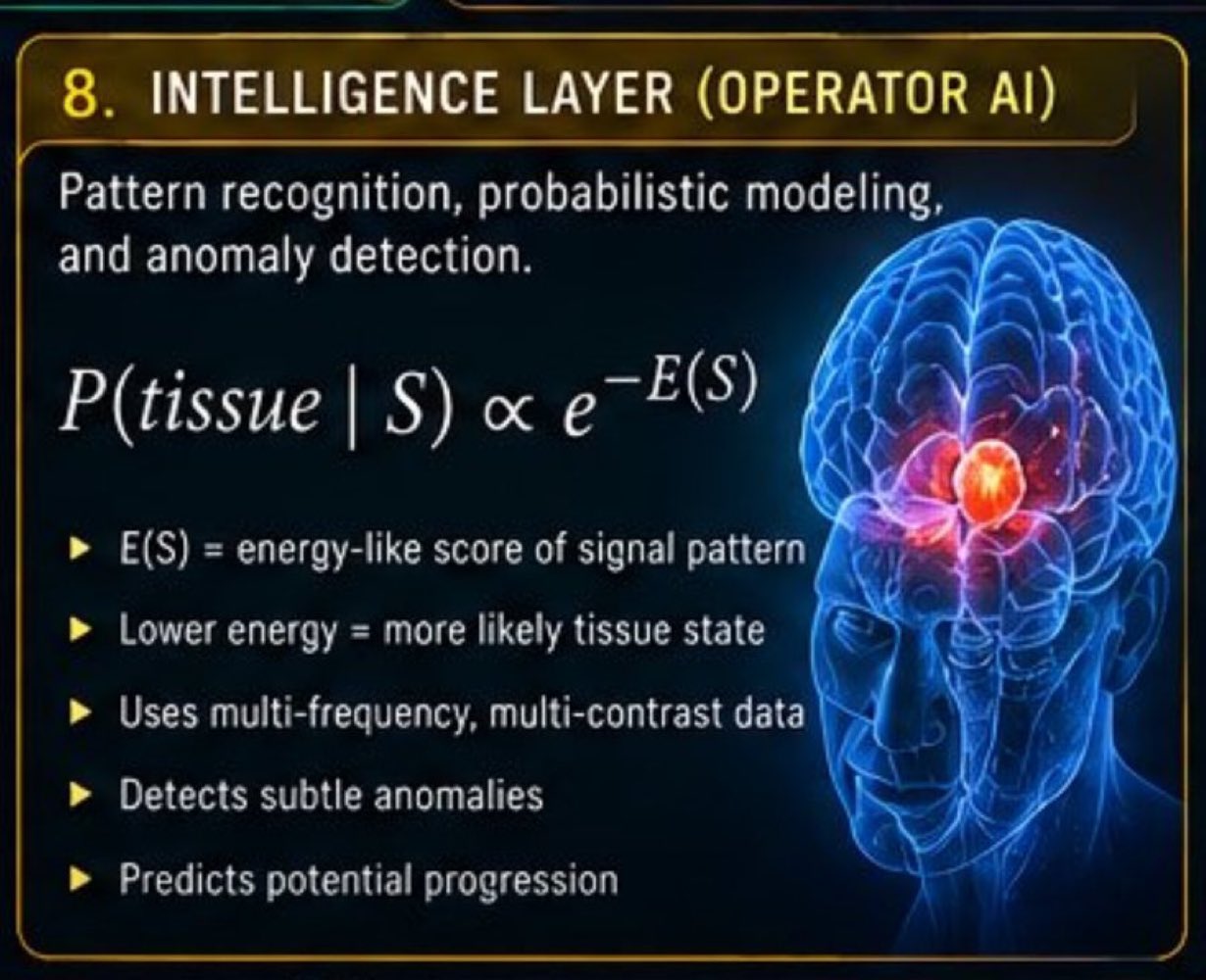
Original Energy Formulations That Leave Conventional MRI Math Behind.
Conventional MRI pipelines rely on established pulse sequences, fixed contrast weightings, and standard reconstruction or classification mathematics Fourier-based k-space filling, predefined contrast equations, or off-the-shelf deep-learning loss functions trained on limited signal dimensions.
This work differentiates by replacing that toolkit with a custom multi-frequency, multi-contrast acquisition that actively modulates the field, paired with an Operator AI built on an original energy-based formulation.
The governing relation is P(\text{tissue} \mid S) \propto e^{-E(S)} , where E(S) is a purpose-built energy-like score of the full observed signal pattern rather than a borrowed statistical or neural loss. Lower energy directly maps to higher-probability tissue states; higher energy flags anomalies.
Because the scanner supplies richer frequency and contrast dimensions than conventional systems, the Operator AI performs pattern recognition, probabilistic tissue-state modeling, subtle anomaly detection, and progression prediction inside a signal space that standard methods never access.
The differentiation is structural: the physics of the modulated field and the resulting multi-dimensional statistics become first-class elements of the model itself, not external inputs to generic algorithms.
This produces an intelligence layer that converts the extra information into actionable tissue maps, moving past incremental improvements on modern formulas into formulations developed for the specific signal characteristics of the custom system.
Designed by:
Christopher LayhewSr