
Gagan Mac retweeted

Have you ever wondered why catching Starship is so much harder than catching Super Heavy, even though they both return to the same launch tower? 🔥
💡 The answer comes down to four major engineering challenges that make Starship’s recovery fundamentally different 👇
⚡ The first problem is shedding an enormous amount of energy
At hot staging, Super Heavy was traveling at roughly 5,800 km/h (3,600 mph). Starship, meanwhile, had to return from orbital speeds of roughly 27,500 km/h (17,100 mph).
That’s nearly five times faster. Because kinetic energy increases with the square of velocity, each kilogram of Starship at orbital speed carries roughly 22 times the kinetic energy of a kilogram of Super Heavy at separation.
That works out to nearly 30 million joules per kilogram.
Almost all of that energy has to be dissipated before Starship can safely reach the tower.
One option would be to use rocket propulsion to cancel out its orbital velocity. However, scrubbing off roughly 7.7 km/s of speed using Raptor engines alone would require a massive amount of propellant.
The rocket equation makes this approach especially punishing. Every extra kilogram of landing propellant has to be hauled into orbit first, dramatically increasing the fuel needed at liftoff.
Instead, SpaceX uses Earth’s atmosphere to bleed off almost all of Starship’s orbital velocity.
That saves an extraordinary amount of propellant, though it introduces another major hurdle.
🔥 Surviving extreme atmospheric heating comes next
As Starship plunges into the atmosphere at hypersonic speeds, powerful shock waves compress and heat the surrounding air to blistering temperatures.
Thousands of ceramic heat-shield tiles protect its stainless-steel structure from the intense heat.
Simply keeping those tiles attached isn’t enough, though. Superheated gas can seep into the gaps between them, risking damage to the underlying structure.
For Flight 15, SpaceX carried forward upgrades from Flight 14, including extra tile-retention hardware in vulnerable areas and redesigned curved tiles that reduce heating between adjacent tiles.
Because Super Heavy never reaches orbital velocity, its return doesn’t expose it to anything close to the same thermal stress.
And there’s another complication.
A heat shield that survives one reentry isn’t necessarily ready to fly again. Starship’s thermal protection system must eventually withstand repeated missions without major repairs or refurbishment.
That’s critical, since rapid reusability is one of the core reasons SpaceX designed Starship to be caught rather than discarded.
Yet surviving reentry still isn’t enough. Starship also has to arrive at the exact right spot.
🎯 Hitting a precise target from orbit raises the stakes even further
About 56 minutes before the catch, a single Raptor engine fired for just 10 seconds to initiate Starship’s return.
That brief deorbit burn wasn’t meant to eliminate orbital velocity. Instead, it nudged the spacecraft’s trajectory so atmospheric drag could take over the much larger job of slowing it down.
Starship then entered the upper atmosphere thousands of kilometers away over the Pacific Ocean.
From there, its four aerodynamic flaps controlled its orientation and fine-tuned the forces acting on the vehicle.
Super Heavy uses grid fins to steer during its return, but Starship’s flaps have to handle a far wider range of flight conditions.
As Starship decelerates from hypersonic through supersonic and down to subsonic speeds, its guidance system continuously adjusts its attitude and flight path.
The challenge is maintaining the right balance of altitude, speed, and trajectory while aerodynamic forces shift dramatically throughout reentry.
For Flight 15, the return corridor crossed sparsely populated parts of northern Mexico and South Texas.
Starship maneuvered around major population centers in the Rio Grande Valley, passed north of South Padre Island, headed offshore over the Gulf of Mexico, and made its final turn toward Pad 2 at Starbase.
Think about the guidance precision required.
A spacecraft returning from orbit must dissipate nearly all of its immense kinetic energy while threading a carefully controlled trajectory straight back to a single launch tower.
It also has to arrive at a low enough speed, in the proper orientation, and with enough propellant remaining to pull off the final maneuver.
That brings us to the most visually spectacular part of the entire recovery.
🚀 Executing the landing flip with pinpoint precision is the final test
Super Heavy approaches the launch tower already vertical, using its grid fins and Raptor engines to guide its final descent.
Starship comes in belly-first.
It has to rapidly swing its massive frame upright, stabilize its attitude, and align itself precisely between the tower’s mechanical arms.
SpaceX’s official Flight 15 timeline allotted just 18 seconds between the start of Starship’s landing burn and the catch.
During those 18 seconds, three sea-level Raptor engines ignite to kick off the maneuver.
The spacecraft rotates upright while its flight computers constantly regulate engine thrust and vehicle attitude.
The engines then step down from three to two, giving the vehicle finer control as it nears the chopsticks.
Finally, it transitions to a single engine for the last moments of descent before shutting down as the tower takes its weight.
Consider the coordination involved.
The guidance system must balance translation, rotation, thrust, and descent rate while positioning a massive spacecraft within a narrow capture envelope.
Unlike a conventional vertical rocket landing, Starship must first transition from an aerodynamically controlled, belly-first glide to an engine-powered vertical approach.
All of this unfolds within seconds, right after the vehicle has completed one of the most punishing atmospheric reentries ever attempted by a reusable spacecraft.
🧠 What makes SpaceX’s approach so ingenious is how seamlessly the entire recovery system works together
Trying to solve every phase of the return with rocket propulsion would carry a crushing propellant penalty.
Instead, SpaceX delegates the toughest parts of the recovery to systems purpose-built to handle them.
The atmosphere dissipates most of the orbital kinetic energy without consuming onboard propellant.
The heat shield protects Starship from the intense thermal loads of that deceleration.
The four aerodynamic flaps provide the control authority needed to manage its attitude, energy, and trajectory throughout atmospheric flight.
And the Raptor engines take over once aerodynamic control alone can no longer deliver the precision needed for the final catch.
That division of labor allows SpaceX to recover an orbital spacecraft without carrying enough fuel for an all-propulsive return.
Yet the engineering trade-off goes deeper than saving propellant.
SpaceX is shifting much of the cost of returning from orbit away from expendable propellant and toward reusable hardware built to endure extreme thermal and mechanical stress.
The potential economic payoff is enormous.
Cutting back on the propellant reserved for recovery frees up more of Starship’s mass capacity for useful payload. However, that advantage only becomes truly meaningful if the heat shield, flaps, engines, and other systems can survive repeated flights without extensive refurbishment.
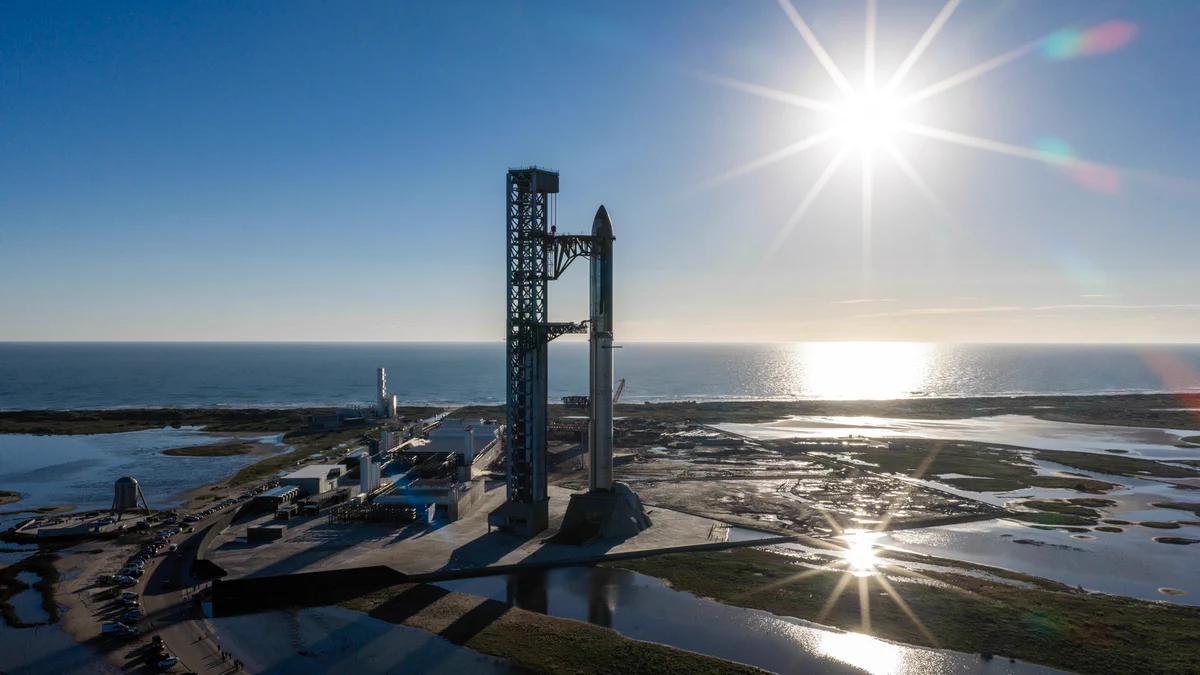
That’s why catching Ship 42 is such a landmark milestone.
SpaceX has proven that its thermal protection, aerodynamic controls, propulsion, and guidance systems can work in concert to recover an orbital upper stage right at the launch site.
The next engineering hurdle is proving that the same spacecraft can do it repeatedly.
If SpaceX can bring Starship home, inspect it, refuel it, and launch it again without rebuilding major systems, the economics of getting payload to orbit could change dramatically.
That first catch proves the recovery architecture works. Repeated reflights will determine just how much of its economic potential SpaceX can unlock.
Gagan Mac retweeted

The articles backtracked from their original incendiary, and now clearly false, claims to something more like "Jensen did lawful things that powerful people didn't like". It still appears the original claims came from a single competing Big Tech lobbyist.
The reporting successfully disrupted corporate governance processes, with a running cost of $1.8 trillion in losses to American pension funds and shareholders.
Here's what I fear is being lost in these articles: The proper interface between government and private citizens and their corporations is rule of law. Laws are passed, and if wrongdoing as alleged, then there's due process: an investigation followed by facts and evidence presented in open court. Due process should happen here: let the facts come out whole, and not as a trickle of dubious claims.
Press takedowns full of sketchily sourced claims and backtracking narratives are not the way. It's what we see outside of the free world, and is no model for The United States of America.
In particular, if the Jensen takedown succeeds on the basis of these journalistic failings, which is not by any means certain as Sam Altman's case shows, then it foreshadows an economically and institutionally ruinous new playbook to be adopted with no end in sight.
Imagine a weekly stream of takedowns emerging from opportunistic alignments between corporate lobbyists and political interests which, given the new partisan split between the executive and legislative branches, will attack in all directions, undermining not only the US economy but American leadership in the world.
I hope cooler heads prevail this coming week as they did not on Thursday November 12. And I urge anyone who happened to oppose Jensen, open models, and the underlying trade policies in question, to recognize that this isn't a win for "team regulation". It's a change in the game from a transparent rules-based one to a sinister new form centered around politicans and lobbyists.

Gagan Mac retweeted

Consider two industries, aviation and space launch, both highly complex, where safety is paramount.
Two modes of pursuit, government and private.
Space launch:
NASA budget is $25 billion annually, stolen from taxpayers
SpaceX budget is $20 billion, private capital stolen from nobody
NASA operating for 70 years, SpaceX for 20
Despite more money, and decades of head start, NASA has atrophied and slid backwards, doing nothing interesting for decades
And while the government's Air Traffic Control wants $50 billion to "upgrade their software" and arguably doing a worse job than they did 20 years ago, SpaceX is flying rockets and catching them back on Earth
Markets and private industry are how civilization progresses.
The State is why it doesn't seem to.


Gagan Mac retweeted

Watch live: After being in orbit for more than 21 hours, Starship is preparing for its deorbit burn, reentry, and for the first time ship's return to launch site and catch at Starbase
Gagan Mac retweeted

For my first post, I’m sharing a letter @NVIDIA signed on why open models matter.
AI will transform every industry, power every company, and be built by every country.
Open models strengthen safety and cybersecurity, accelerate innovation and diffusion, and enable sovereignty.
The world needs both frontier closed models and frontier open models.
images.nvidia.com/pdf/Open-W…


Gagan Mac retweeted

Why are old stories that were not even covered up all that well become sudden international and geopolitical news?
The timing is suspicious, so worth asking: who benefits and why now?
If Jensen, the premier champion of open models, is taken out then anyone who wants AI closed, centralized, and controlled might benefit.
Why now? The midterms seem relevant. But also perhaps the upcoming IPOs.

Breaking: Nvidia’s board is preparing to oust CEO Jensen Huang after he had two extramarital affairs, including one with a suspected Chinese spy. on.wsj.com/4jcpr01

Gagan Mac retweeted

Great News!
@BVNKFinance is live on @Arc.
Through @Circle Onramp Kit, builders can give users a bank-transfer path to fund wallets and receive @USDC on Arc without managing separate payment processor integrations.
A more complete first-mile funding experience for apps built on Arc.
I wrote about it on Arc House here: community.arc.io/home/blogs/…

Gagan Mac retweeted

I had this idea for a while and finally decided to give it a try with @arc Studio
Its called Finalight and the idea is to show real $USDC transfers on Arc as stars around the Earth. Every star is a real transfer and you can tap it to see what's happening
still working on it but honestly it's been a lot of fun bringing this idea to life
I really like how Arc Studio lets you take an idea and start building something with it
Gagan Mac retweeted

I think the agents found nanopayments…3.2M payments in the last 24 hours, the biggest day to-date!
On @arc @Circle Gateway Nanopayments are:
-Gas-free USDC payments
-Txn sizes from $0.000001 to $1M+
-Settled in milliseconds
-Built for agents that pay per call
🤖Agents have always loved @USDC (99.6% of agentic payments use it), and now they’re starting to discover the magic of nanopayments.


Gagan Mac retweeted

Results are out for Q3, which brought platform milestones and strong financial results.
→ Arc Mainnet launched Sept 16 with 11 founding validators and 100+ apps
→ CPN annualized TPV grew 15.2x YoY, with 205 financial institutions enrolled
→ Announced the planned acquisition of Tazapay, pending regulatory approvals, which is expected to bring USDC to the last mile and to accelerate CPN
→ Partnerships with Binance and Chelsea FC expand USDC’s global reach
Full results: investor.circle.com


Gagan Mac retweeted

Circle and Tether did a Great job this time.
The crypto industry, including exchanges and stablecoin issuers, should work together to build an industry-wide security response mechanism.
We need a real-time alert system that allows participants to share information immediately when a hack occurs, coordinate a rapid response, and temporarily freeze suspected stolen funds before they can be moved or laundered.
Speed is critical. We should establish standardized protocols, clear responsibilities, and appropriate safeguards to ensure we can act within minutes, not hours or days.
Protecting users and their assets should be a shared responsibility across the entire industry, not just individual platforms.

Gagan Mac retweeted

At @ycombinator, we're excited to fund more crypto startups solving financial needs including AI capital raising, stablecoins, trading, and agents.
Here's our latest crypto request for startups. Our next application deadline is Monday.


Gagan Mac retweeted
Circle Match is now available to eligible Circle Mint customers.
Every hour, Circle Match brings institutional mint-and-redeem USDC demand together in an auction inside Mint.
When orders match, mints earn a rebate and redemptions clear at a price you set.
Same USDC flows. New economics.
circle.com/blog/circle-match…

Gagan Mac retweeted
Arc 🤝 @Aster_DEX
Aster now supports USDC collateral on Arc, with USDC-margined perpetual futures on BTC, ETH, and SOL now live.
For the first time, USDC is a trading and margin asset on Aster.

