

Co-Author of Superabundance and the Simon Abundance Index. Senior Fellow at the Discovery Institute, Adjunct Scholar @CatoInstitute. Tweets are mine.
superabundance.com
Joined May 2009
- Tweets11K
- Following866
- Followers2.6K
- Likes3.1K





Current LED technology is 255,673 times more abundant than 1800 candles. Global population is 8.3 times larger.
Every one percent growth in population corresponded to a 35,023 percent increase in personal light abundance.
Let there be astonishing light abundance.

Wow! Just finished "Messy Jobs" by @lugaricano, Jin Li and Yanhui Wu, and I've been recommending it to everyone around me since.
It's about AI, jobs and the future economy and society
Here's the core of the book and my notes in 15 cards as a primer but you should totally read the whole thing 🧵


1
13
266
Gale Pooley retweeted

Wow! Just finished "Messy Jobs" by @lugaricano, Jin Li and Yanhui Wu, and I've been recommending it to everyone around me since.
It's about AI, jobs and the future economy and society
Here's the core of the book and my notes in 15 cards as a primer but you should totally read the whole thing 🧵
From 1986 to today U.S. population increased by 43 percent. At the same time the time price of a Thanksgiving dinner decreased by 44 percent. Every one percent increase in population corresponded to a one percent decrease in the time price. How would Thanos explain this?

Read more: humanprogress.org/the-second…

Gale Pooley retweeted

There are 103 million more Americans to feed this Thanksgiving than there were in 1986.
Yet, at average blue-collar wages, earning enough to buy Thanksgiving dinner for the entire US population would require 20.6 percent fewer hours of work.

Gale Pooley retweeted

Grand Theft Auto VI is the most affordable GTA release relative to the median wage of its target demographic: men ages 25-34
economistwritingeveryday.com…

What counts is not how much money it costs, it’s how much time it takes to earn the money. Time prices are the true prices.

Tomorrow, when you sit down to eat, take a moment to appreciate what’s actually on your plate — the miracle of free markets.
johnstossel.com/thank-you-ca…

Gale Pooley retweeted
Nominal prices went up, but real prices tell a different story. Once you account for inflation, this year's Thanksgiving dinner is the second-cheapest the Farm Bureau has ever recorded, behind only last year's.

Gale Pooley retweeted

What got worse and what got better since @mattwridley's 2010 book The Rational Optimist (which everyone should read). @DisruptionHedge has the receipts: substack.com/@stephenmcbride…

Remember in 2021 the Biden-Harris administration signed the Broadband Equity Access and Deployment Program authorizing $42.45 billion to provide universal high-speed broadband by 2030.

BREAKING: SpaceX is turning down about $738 million in federal broadband subsidies.
Instead of taking the money, SpaceX will connect rural homes with Starlink at no cost to taxpayers. This runs through a new NTIA agreement, published November 23, that states can adopt.
What SpaceX commits to at these locations:
- free Starlink equipment for new customers, no upfront hardware cost
- speeds of at least 100 Mbps down and 20 Mbps up
- a low-cost plan for eligible households
- service for 10 years
- the same speed and performance testing BEAD requires of everyone
In return, SpaceX is freed from most BEAD paperwork, financial audits and procurement rules, while still being tested on how the network actually performs.
NTIA says the model could save taxpayers hundreds of millions of dollars while speeding up rural internet.
Source: NTIA Model Zero Outlay Agreement


10
296
Gale Pooley retweeted

If you wanted a sprinkle of economics into your GTA discourse, check my Substack out!
Touch on money estimates, GTA Abundance (a la @Galepooley and @Marian_L_Tupy), and what's wrong with the so-called productivity loses people warned about.
debunkingdegrowth.substack.c…
Gale Pooley retweeted
.@Galepooley calculates that "the time price for a blue-collar worker’s Thanksgiving dinner fell 44.4 percent, from 3.22 hours in 1986 to 1.79 hours in 2026."
Read about it here: humanprogress.org/the-second…
How about that? Now ammonia is superabundant, not because we have more atoms, but because we have more knowledge. Nice.

Shrinking ruthenium catalysts boosts ammonia production rate up to 57-fold | The Korea Advanced Institute & Technology, Phys .org
Ammonia is drawing renewed attention as a "magic container" for safely storing and transporting hydrogen, a promising clean energy source of the future, as well as a carbon-free fuel that does not emit greenhouse gases when burned. However, for ammonia to be widely used as a key fuel, improving the efficiency of its production process is essential.
In the Journal of the American Chemical Society, Korean researchers present a new approach that enables ammonia to be produced rapidly and in large quantities while using a much smaller amount of the expensive and scarce precious-metal catalyst.
The team, led by Professor Minkee Choi from the Department of Chemical and Biomolecular Engineering, greatly improved metal-use efficiency by reducing the particle size of ruthenium (Ru) catalysts used for ammonia synthesis.
Ammonia has long been used as a key raw material for fertilizers, but recently it has attracted even greater attention as a critical material in the hydrogen economy. This is because converting gaseous hydrogen into ammonia makes it much easier to store and transport, after which hydrogen can be extracted again when needed or ammonia itself can be used directly as a fuel.
However, conventional ammonia production requires extremely high temperatures and pressures, resulting in high energy consumption.
Ruthenium (Ru), a metal that exhibits excellent performance in ammonia synthesis, is an expensive and scarce precious metal. It is therefore important to achieve high productivity using as little ruthenium as possible.
Smaller particles strengthen the electron effect
The research team found a solution by dividing the precious metal into extremely small particles. In general, when metal particles are made smaller, their surface area increases, naturally creating more sites that can participate in chemical reactions.
The researchers revealed that as the particles become smaller, each individual reaction site itself also becomes significantly more active. The key lies in an "electron promotion effect." To produce ammonia, the strong bond between nitrogen atoms in nitrogen molecules must be broken, and an electron-rich catalyst actively facilitates this process.
The research team further conducted comparative experiments by adding barium oxide (BaO), which helps supply electrons, to ruthenium (Ru) catalysts of different particle sizes.
The results showed that as the particle size decreased, electrons transferred much more effectively from barium oxide (BaO) to the ruthenium (Ru) surface, maximizing the "electron promotion effect." The increased abundance of electrons on the catalyst surface made it easier to break the bonds in nitrogen molecules, greatly accelerating the ammonia synthesis reaction.
Ammonia production rises 57-fold
In particular, a catalyst with a particle size of 1 nanometer (nm) achieved an ammonia synthesis rate per reaction site 4.4 times higher than that of a 10 nm catalyst.
As a result, two effects occurred simultaneously: the number of available reaction sites increased, and the performance of each individual site improved. Consequently, when the same amount of ruthenium (Ru) was used, the overall ammonia production rate increased by as much as 57-fold, dramatically improving production efficiency relative to the amount of precious metal used.
Choi said, "This study identifies a principle for increasing ammonia productivity by using expensive precious metals more efficiently." He added, "Going forward, we will extend this work to develop catalysts that enable ammonia production with lower energy consumption, even at low temperatures and pressures."
Yaejun Baik, a Ph.D. student in the KAIST Department of Chemical and Biomolecular Engineering, led the study as the first author, while Choi participated as the corresponding author.
Read more:
phys.org/news/2026-11-ruthen…

5
203


Look at the time prices of almost everything. Personal abundance is doubling every 20-30 years. Has been for the last 200 years. The poor benefit from innovations the most. Because they now have much more time.

Joe Lonsdale, co-founder of Palantir, on what happened to working class wages the last time productivity shot up:
Joe Kernen: "Everybody's going to get wealthier? Because only the wealthy have been getting wealthier."
Joe Lonsdale: "That's not true. The most important comparison: 1870 to 1900, the Second Industrial Revolution, the last time productivity shot up a lot...
The average working class American was twice as wealthy in real terms within one generation, and that's what happens when productivity goes up. Everyone gets wealthier.
We teach economics very poorly in this country."
@JTLonsdale
nitter.cf/IterIntellectus/status…

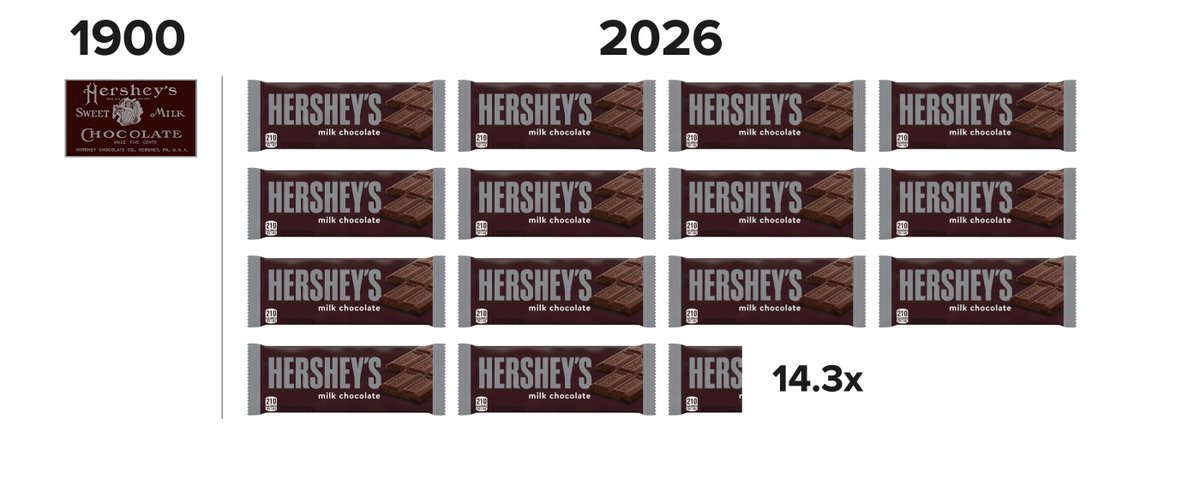
We don’t realize how rich we’re getting because everyone else is getting rich right along with us. We should compare ourselves to our ancestors, not our neighbors. Then you replace envy with gratitude.
Gale Pooley retweeted

From a frustrating laboratory “failure” to inexpensive household necessity, Super Glue demonstrates how new knowledge, not more resources, make the world richer.
cc: @Galepooley
thedailyeconomy.org/article/…


