

I was a Content Creator. Now I answer phones and maintain spreadsheets. Upskilling into software development.
Melbourne, Victoria
Joined March 2011
- Tweets5.7K
- Following230
- Followers384
- Likes3.8K





John McLeish retweeted

2020-2022 was all about skipping fundamentals and learning the minutia of specific web frameworks
2025+ will be all about knowing how architecture, performance, and good software actually works. The minutia of frameworks and API specifics is exactly what LLMs are good at doing for you
good take, John

My prediction for software engineering over the next 3 to 5 years.
Computer science and software engineering fundamentals will become far more valuable than knowing the latest frameworks.
If AI can write code in almost any language, knowing the nuance of another framework becomes less of a competitive advantage.
But understanding algorithms, data structures, networking, operating systems, databases, architecture and security?
That's a different story.
You still need to know:
- Why a particular architecture is appropriate.
- Why an API might fail.
- Why a database won't scale.
- Why an apparently working solution might be insecure.
A coding agent can build a solution.
But you need the knowledge to evaluate the trade-offs and recognise when it's wrong.
So, I think we'll see a renewed emphasis on the fundamentals of computer science and software engineering.
TL/DR: Learning how computers and software systems work will matter more than memorising how to use them.
What do you think?
John McLeish retweeted

A somewhat common but strange response to the consumer request for AI disclosures on products is to suggest that if you did this, you should have to disclose all sorts of other things (how many people worked on the product, what other software you used, what hardware it was made on, etc.)
I can understand that some people don't like the idea of having AI disclosures, so they immediately try to think of arguments against it. But respectfully, this one makes no sense.
Product labeling requirements are driven by demand, either from consumers or from competitors. There is no significant cross-section of the public asking to know if a game was made on machines with AMD or Intel hardware. There is no significant cross-section of the industry demanding that their competitors list whether or not they used Adobe Premier.
Product labeling is not about giving you a complete set of information about how a product was made. It's about giving the consumer information that a significant number of them might want to know before making a purchase. Which ones of these get codified can be driven by consumer demand, competitor demand, or - most commonly - a combination of the two.
This is not weird. It's good, actually.
And it's especially good if an industry takes proactive steps to voluntarily label their products accurately, because then they avoid the inevitable alternative, which is that the consumer demand for the missing labeling produces a political movement which ends with mandatory labeling designed by a political body.
John McLeish retweeted

The "whiteboard defense:" I should be able to pull you aside at any moment and ask you to explain any customer-facing system you've shipped. You should be able to clearly explain how it works and defend the decisions you made. This is my benchmark for responsible AI usage.
I don't expect line-level familiarity with the code. I don't care if you remember the exact function name or implementation detail. You may not even know it. I don't care.
But if I ask "why did you do X instead of Y?", "what happens if this actor behaves maliciously?", "what data structure did you use here and why?", or "where does this fail?" you should be able to answer confidently.
For PoCs, demos, experiments, whatever: I don't care. Generate 100% of it and understand none of it. Speed over quality every time in those specific scenarios.
But if you're shipping customer-facing work, you can't be shipping things you don't understand at a high level.
John McLeish retweeted
I can’t stress enough how little an idea matters compared to the agency of the people executing the idea.
I have had the privilege of knowing and sometimes even working with some of the most successful people (by various metrics).
The difference between mediocre and excellent work and outcomes is predominantly one of agency.
In practice this means: they dont wait for things to happen to them they go out and make things happen for them.
They don’t wait for someone else to do something, for someone to teach them, for someone to give them the path, etc. They just go out and find a way to do it.
I think the single biggest superpower these people have is the realization/belief that the world around them is completely mutable. Most everything that happens is because a person made it happen.
I used to tell people to look around the room you’re sitting in. Look at everything. Every noun. It almost all exists because a person willed it into existence. Nothing is stopping you from doing the same.
I see people online all the time dismissing someone else’s success because “I had that idea first” or whatever. I mean… yeah? If so then the difference is… you. So a bit of a self own whenever I hear that.
Number one tip: act with agency.

Using video games to learn a new language is great. The gameplay loop reinforces vocabulary.
Particularly turn based games like FF where you can take your time to look stuff up when you need to.
All this to say: The prophecy in Final Fantasy 1 hits different in Spanish.

ALT A screenshot from Final Fantasy 1 Pixel Remaster. The king is reciting the prophecy of Luka to the party. The text on the screen reads: "Cuando reine la oscuridad en el mundo, llegarán los cuatro Guerreros de la Luz." "When darkness reins in the world. Four warriors of light will arrive."
1
24
John McLeish retweeted
Good moment today to remind everyone to stay frosty with AI. I was working on making a server stoppable via the CLI, and Codex decided the best path forward was to implement an unauthenticated network API to every server to shut itself down. Excellent work.
I responded with "I don't know about that." (I usually give more direct feedback but this was so absurd) and it thought for like 20 seconds and responded "Server stopping should not be part of an unauthenticated network API." Yes. lol.
By the way, the result I was looking for was that we automatically start a locally discovery Unix-socket bound server so I wanted it to discover that (using prior mechanisms already made) and gracefully stop that.
The driver is absolutely accountable here (me). My lazy prompting led AI to think I wanted to be able to stop ANY configured server I was talking to. Shame on me for thinking it was obvious here. But, I also reviewed it and found this idiocy, so, that's where good AI drivers come in. Also me.
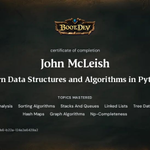
I just completed the Learn Data Structures and Algorithms in Python course on @bootdotdev!
Pretty proud of this one. I've been working on it for a couple of months and I'm so happy to not only complete it, but feel confident in what I learned.
boot.dev/certificates/a3734b…

13
Note to self: Don't write recursive functions at midnight. It's gonna make your thinky bits hurt no matter what time of the day it is, so don't add being tired the next day to that.
9
John McLeish retweeted

yeah.. i’m doing this to my nuggies nitter.cf/MutiaAmeli/status/2086…
You did it kids, you got your meme in the training data. So even an LLM will sneak in a 6 7 joke if the opportunity arises.

1
24
John McLeish retweeted
"It's kinda hard, but you can do hard things, son."
Telling people its easy often also leads to them giving up when its harder than expected. We need to acknowledge the difficulty in life, and in many cases NOT simply try to eliminate it for others (especially those in training/learning), but challenge ourselves and our students and out children to rise to the occasion and meet it.

Hotter take:
We have created a world where we coddled and told everyone that everything is too hard, including using the DOM. Second order effects on peoples ability to care about software and now we are shocked pikachu that people don't care about software.
Devs being lazy therefore we should use robots is a piss poor excuse. Determine the type of software you are building, the levels of slop and chaos you are willing to have, and then build to that level. The rest is SVLarping
John McLeish retweeted
AI Agents basically change nothing about what you need to learn to be a great developer. If anything, you need to learn a bit more, because you also need to learn how to use an agent well.
But once you know how it all works, they certainly make you a lot more productive.
I really learned a lot from it. This is a fantastic course, an amazing square one for people new to AI and how to use it effectively.
The course is a solid mix between maximising the effectiveness of your prompts, and compliance with policies and ethical frameworks.

1
28
John McLeish retweeted

The fucking PRESIDENT OF ARGENTINA forgot to unschedule his victory tweet
There is NO celebration
ARGENTINA LOST LMFAO

I'm a fan of macro keys and dials, and I don't understand the market for the Codex Micro.
The use case in the video is using a MacBook on it's own, violating the minimalism of that setup.
It doesn't have it's own mic. How do I talk to chat gippity?
It's Codex fan merch.

Meet kbd-1.0-codex-micro, built with @work_louder.
Map the buttons and joystick to your workflow, and keep your pinned chats in view.
Get yours before stock returns 410.
1
186

John McLeish retweeted

As someone who loves Star Trek and Magic: the Gathering...the art choice for this card in the upcoming set in November is both brilliant and messed up. Good job!

