
Climate policy researcher | Climate adaptation @ClimateInstit | PhD alumni @SFU_REM @SFU_START Views are my own
Kelowna, British Columbia
Joined October 2020
- Tweets49
- Following70
- Followers26
- Likes260


Viviane H Gauer retweeted

Today’s MOU between the federal government and Alberta risks unravelling Canada’s climate policy. Read our full statement ⬇️
climateinstitute.ca/news/mou…

Why we urgently need a climate policy reset at both the federal and provincial/territorial levels 👇
Canada is off track, but every megatonne of emissions reduced counts

NEW: Our early estimate of Canada’s national emissions is out and shows progress stalled in 2024.
The country’s 2030 targets are now out of reach, emphasizing the need for a coordinated policy reset with the federal and provincial governments. ⬇️
climateinstitute.ca/news/202…
Climate change is supercharging wildfires, and we are seeing yet another destructive wildfire season threaten communities across Canada 🔥
My colleague Zach Carriere and I outline five key actions govs can take to reduce wildfire risk in this article 👇
The reach of fires across the country could not make it more clear: Canada must shift from reacting to wildfires to preparing for them.
Viviane Gauer and Zach Carriere lay out five key actions governments can take to reduce wildfire risk ⬇️
climateinstitute.ca/five-way…
Viviane H Gauer retweeted
There are many ways a wildfire can start, but it’s climate change that’s driving the conditions for them to grow bigger, faster, and more dangerous. A spark alone won’t start a firestorm—but in a tinder-dry forest, it can ⬇️
vancouversun.com/opinion/op-…

Viviane H Gauer retweeted
Climate change is fueling devastating wildfires burning across Manitoba, Saskatchewan and Alberta through intensified heat, drought and atmospheric conditions. 🧵⬇️
cbc.ca/news/canada/saskatche…


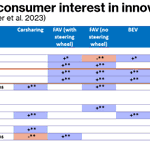
Why are some countries more reliant on conventional vehicles, while others lead the way towards new mobility patterns? Our new study contributes to this topic by comparing consumer perspectives in Canada and Germany.
#Transportation #ElectricVehicles
doi.org/10.1016/j.erss.2023.…
However, the relationship between these trends is similar btw the two countries - consumers who are more car-dependent and more concerned about car use impacts are more likely to be interested in #AutonomousVehicles and #ElectricVehicles in both countries.

The rising share of SUVs worsens the climate and safety issues we already face in our transport system. Why are SUVs such a trend, and what can be done about it? Check out this piece by researchers from @SFU_START:
theconversation.com/the-risi… via @ConversationCA

Novel research from @SFU_START explores the link between consumer engagement with aspects of automobility and consumer interest in shared, automated, and electric mobility.
The paper - my first PhD study - was recently published in TRD: doi.org/10.1016/j.trd.2022.1…
Where does Canada stand on net-zero targets and what actions are needed to get there? Tom Gunton lays it out in this brief piece:

#Opinion: To meet its climate objectives, Canada must set binding carbon targets, eliminate subsidies for the oil and gas sector, and halt development of major fossil fuel infrastructure projects. cbc.ca/1.6224139
Viviane H Gauer retweeted

REM's @JonnAxsen has been named a member of the Royal Society of Canada (RSC) for his extensive work in sustainable transportation. Membership in the RSC is Canada’s highest academic honour.
Congratulations!
ow.ly/awPF50G6r6o
@RSCTheAcademies #SFUResearch #rscBRAVOsrc

Viviane H Gauer retweeted

PhD students @gauer_h and @Zoe_E_Long will be presenting at this free, online event on September 22 at 12pm PST. Come learn about START's research and why #EVs are sustainable solutions.
eventbrite.ca/e/how-sustaina…
Viviane H Gauer retweeted
The latest research from @JonnAxsen looks at the evidence for how road pricing can be used for effective GHG reduction: it can be effective in the short & long term, but careful implementation will improve equity & acceptability,
doi.org/10.1016/j.enpol.2021…

The differences in impacts between 2 and 3 degrees of global warming are just shocking. This is the time to act.

The difference between 1.5°C, 2°C or 3-4°C average global warming can sound marginal.
In fact, they represent vastly different scenarios for the future of humanity.
(Thread 1/5)
#ClimateEmergency

Viviane H Gauer retweeted

Our report for David Suzuki Foundation on the contribution cities can make to GHG reduction. For some things, like ZEVs, do need collaboration with senior levels of government.
davidsuzuki.org/science-lear…