

Investor Learner Observer
Joined September 2023
- Tweets30.6K
- Following97
- Followers21.2K
- Likes3.9K








Pinned Tweet
And finally…
Q2FY27 Result Season comes to an end! 🙏
What a quarter! 🔥
What an incredible set of performances!
What an absolutely crazy few weeks!
One hell of a results season! 👏
Time to take a deep breath and reflect
Until next quarter! 😊
Senco Gold — Festive Season Business Update
#senco #Nifty
✓ Dhanteras & Diwali Festive Sales NSV ₹2,426 Cr (+26% YoY) over 41 days (Oct 1–Nov 11, 2026)
✓ Retail revenue growth 25%
✓ Same-store sales growth (SSSG) 17%
✓ Gold price rise (+17% YoY)
✓ Growth driven by higher footfalls, more transactions, new customer acquisition and healthy growth in company-owned and franchise showrooms
✓ Diamond Jewellery Revenue Growth 26% YoY; Volume Growth 18%
✓ Stud Ratio improved to 9.6% vs 9.4% last year
✓ New Customer Acquisition 37.3% of total customers vs 35% last year; double-digit growth in new customer acquisitions
✓ Two target segments: wedding-led customers and young, aspirational customers (lightweight, everyday-wear across gold, diamond and platinum)
✓ Durga Puja and Diwali campaigns drew encouraging responses and repeat customers
✓ Coin and bullion sales stayed in single digits and below 7% of overall sales
✓ 10 new showrooms opened during the 41-day festive period: 3 COCO, 3 FOCO and 4 FOFO (company’s split: 3 owned, 7 franchise)
✓ 3 to 4 more showrooms expected, taking total additions in the year to about 27 to 28


Panorama Studios International — Q2FY27 Results 🔔
#Q2Results #Q2FY27 #Panorama
Revenue ₹397.68 Cr vs ₹77.86 Cr
(+410.78% YoY┃+117.23% QoQ)
EBITDA ₹15.07 Cr vs ₹2.48 Cr
(+506.64% YoY┃-24.73% QoQ)
EBITDA Margin 3.79% vs 3.19% YoY & 10.94% QoQ
PBT ₹10.47 Cr vs ₹1.54 Cr
(+580.09% YoY┃-38.17% QoQ)
PAT ₹7.80 Cr vs ₹0.84 Cr
(+829.62% YoY┃-38.65% QoQ)
PAT After Minority interest ₹8.66 Cr vs ₹2.04 Cr
(+324.63% YoY┃-36.27% QoQ)
Other Income ₹1.89 Cr vs ₹3.38 Cr YoY & ₹2.09 Cr QoQ

1
8
2,359
Senco Gold
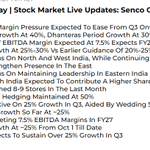
Q2 Margin Pressure Expected To Ease From Q3 Onwards
FY27 EBITDA Margin Expected At 7.5% Expects FY27 Revenue Growth At 25%-30% Vs Earlier Guidance Of 20%-25%
Gold Hedging Maintained At 50%
Positive On 25% Growth In Q3, Aided By Wedding Season
Q3 Growth So Far At ~25%
Source:- CNBC TV18

2
7
2,472
Caliber Mining and Logistics
On Track To Achieve ₹2,500 Cr Revenue, ₹580-600 Cr EBITDA & ₹205-210 Cr PAT
Post-IPO, ROI Has Declined But Is Expected To Improve On Strong Demand
Source:- CNBC TV18

6
2,131
The Cloaked Gaze 👀 retweeted
And finally…
Q2FY27 Result Season comes to an end! 🙏
What a quarter! 🔥
What an incredible set of performances!
What an absolutely crazy few weeks!
One hell of a results season! 👏
Time to take a deep breath and reflect
Until next quarter! 😊
‘AI Can Accelerate Cancer Drug Discovery’: Manas AI CEO Dr. Siddhartha Mukherjee Says AI Can Cut Early-Stage Discovery From Nearly Eight Years to Three or Four Months; Customised Blood Cancer Treatment in India Costs ~$35,000 vs $500,000 in the US
Core Theme
Mukherjee argues AI can collapse early-stage cancer drug discovery from years to months and make treatments far cheaper, as shown by a $35,000 Indian cell therapy versus $500,000 in the US, but says clinical trials, manufacturing and regulation must also be reformed for the gains to reach patients.
The Core Claim: Speeding Up Discovery
Artificial intelligence is compressing early-stage cancer drug discovery from nearly eight years to three or four months, according to Dr. Siddhartha Mukherjee, an oncologist and co-founder and chief executive of Manas AI, an American drug discovery startup
He spoke at the Hindustan Times Leadership Summit 2026 in New Delhi on Saturday
Mukherjee: healthcare is the single most critical proving ground for AI
For decades, the pharmaceutical sector has faced rising development costs alongside fewer new drug approvals, a trend known as Eroom’s Law
Mukherjee: “I truly believe, India, with appropriate regulatory and technological reform, can reverse Eroom’s Law”
How Manas AI Works
Manas AI combines machine learning with basic rules of physics and chemistry
Instead of testing billions of existing chemicals one by one, the software finds weak spots on disease-causing proteins, much like identifying a keyhole on a lock, and builds new drug molecules from scratch out of atoms to block them
Finding a target spot on a pancreatic cancer protein, a task that previously took human researchers a decade, now takes Manas AI’s algorithms just two hours
By pairing AI molecular design with automated robotic lab testing, the company completes each design-and-test cycle in three weeks, yielding experimental cancer candidates up to 200 times stronger than existing competitor drugs on the market
Limits and Cautions
Mukherjee cautioned that cancer cannot be cured in one fell swoop because every cancer is biologically distinct
Remarkable progress has been achieved against specific cancers such as breast cancer, leukemia and lymphoma, but complex diseases like pancreatic and stomach cancers remain formidable challenges
Speeding up early lab discovery is only half the battle: human clinical trials, manufacturing and government approvals still take years and drive up costs
“AI buys time and cost in the front end, but what it does not change yet is the cost of running a trial and the regulatory clock”; he urged India and China to streamline testing rules without compromising safety checks
Real-World Impact: Immuneel Therapeutics
Mukherjee pointed to Immuneel Therapeutics, the Bengaluru-based cell therapy company he co-founded with Kiran Mazumdar-Shaw
By placing an automated, hospital-adjacent manufacturing facility next to doctors and using AI-designed binders, the team developed customised blood cancer treatments costing roughly $35,000 in India compared with $500,000 in the United States
The approach successfully cured patients such as a young boy from Kolkata who had exhausted all standard leukemia therapies
Cancer Burden: The Numbers
According to the WHO and its cancer research agency (IARC) 2026, the world sees an estimated 20.6 million new cancer cases and nearly 10 million deaths every year
In India, the same report estimates 1.56 million new cases and over 900,000 deaths annually, with 3.32 million people living with the disease over a five-year period
Separate data from the Indian Council of Medical Research (ICMR) projected 1.57 million cases for 2025, noting that one in nine Indians faces a lifetime cancer risk

Hitachi: Has Optimism Overshot? Shares Surge Over 10% on 64% Revenue Growth and 86% Jump in Orders, but Margin Miss and a 91x FY27 P/E Raise Valuation Concerns
Core Theme
Hitachi Energy is delivering 64% revenue growth, an 86% jump in orders and a ₹33,300-crore backlog, with exports, services and data centres broadening the story, but a margin miss and a 91x FY27 multiple after a 73% rally leave the stock exposed to any slip in margins or HVDC execution.
Q2 FY27 Results: Strong Top Line
Shares of Hitachi Energy India surged over 10% on Friday, after the company reported another quarter of strong revenue growth and order inflows, with upbeat management commentary on growth outlook
Revenue rose 64% year-on-year to almost ₹3,000 crore in the September quarter, aided by strong execution; this follows 69% revenue growth in Q1
Ebitda, excluding foreign exchange impact, grew at a slower 55% to ₹462 crore, impacted by higher material costs and an adverse product mix
In Q1, Ebitda growth was far higher at 158%, aided by improved operating leverage and a favourable base
Total inflow in Q2 jumped 86% Y-o-Y to ₹4,100 crore, taking the order backlog to ₹33,300 crore, or around 3.2 times trailing twelve months revenue
Growth Outlook
Investors can expect near-term revenue growth to sustain, aided by a ramp-up in execution of high-voltage direct current (HVDC) projects and higher revenue recognition from these orders
Beyond the near term, growth should be supported by continued investments in transmission infrastructure and rising demand from data centres and battery energy storage systems (BESS)
Management indicated on the Q2 earnings call that four to five HVDC projects could be awarded over the next 12-24 months
Amid robust demand, management sees business visibility extending at least to 2035
Rising share of exports and services, along with improved operating leverage, should support profitability
Export orders rose 41% Y-o-Y in Q2, contributing 25-30% of total order inflow; these orders typically fetch 300-400 bps higher margins than domestic orders
The services business order inflow grew 77%, accounting for around 7% of total inflows, while railways, metro and renewables saw some moderation
Hitachi introduced a pre-engineered grid-to-rack solution to shorten data centre execution timelines
It is undertaking capex of ₹4,000 crore, including a ₹2,000 crore greenfield facility for large transformers at Karjan in Gujarat; most projects are expected to be completed by 2028, with a focus on technology localization
Margin Story
Hitachi’s Ebitda margin stood at 16.1% in H1 FY27 and 15.4% in Q2 FY27 (versus 15.4% in FY26 H1 per Mint’s text), with the Q2 margin missing estimates
Higher input costs and HVDC project execution could weigh on gross margins in the near term
Motilal Oswal Financial Services expects operating leverage and a higher share of exports and services to offset lower gross margin in HVDC projects; it is factoring in an Ebitda margin of 16.9%, 18.0% and 18.5% over FY27, FY28 and FY29
Jefferies India: “We believe 30%+ revenue growth continuing should see operating leverage-linked margin expansion of 760 bps over FY26-29 to 23%”; it expects earnings per share to grow at a 54% CAGR over this period
Investors will closely watch how margin recovery pans out
Valuation: Has Optimism Overshot?
Hitachi’s shares have gained 73% so far in 2026, and trade at 91 times estimated FY27 earnings, according to Bloomberg
A rise in competitive intensity due to industry-wide capacity expansion, or a delay in HVDC order execution, could lead to higher costs and margin erosion, acting as a dampener for the stock
Valuation may have entered an overheated zone

1
1,840
JSW Motors Ties Up With Over 50 Local, Global Players to Drive Out First Vehicle: Plug-In Hybrid SUV, Built on a Chery Platform, to Be Unveiled Next Month; Telematics Localised With Tata Elxsi, Data Hosted on AWS in India
Core Theme
JSW Motors is launching its first plug-in hybrid SUV on a proven Chery platform while building an Indian supplier and data ecosystem around it, with over 50 partners, localised telematics and India-hosted data, and is already lining up Google and OpenAI for its software-defined future models.
The Launch: First Vehicle
Sajjan Jindal-led JSW Motors has partnered with more than 50 suppliers and technology firms from India, Europe, Japan, China and South Korea to bring its first vehicle on road
The plug-in hybrid sport utility vehicle will be unveiled next month
The SUV is built on a platform from China’s Chery Automobile, and has been engineered and calibrated for Indian roads with local suppliers, the company said
CEO Ranjan Nayak (to ET): “We chose a proven platform because it brings world-class plug-in hybrid and electric technology to Indian customers from day one”
Nayak: “What we have built around it, from the engineering and software to our suppliers and our factory, is rooted in India, and every partner we add, Indian or global, deepens India’s own supply chain”
The Partners
Indian partners: Motherson, Uno Minda, Tata Elxsi, Bharti Airtel and KPIT Technologies
Global partners: Bridgestone (Japan), Kwangjin (Korea), Saint-Gobain (France), FEV and BASF (Germany) and IDIADA (Spain)
Connected-Car Technology and Data
The car’s telematics control unit, which links it to the cloud, is being localised with Tata Elxsi, and vehicles will connect through Airtel SIM cards on Indian networks
All connected-car data, including footage from in-car cameras, will be hosted on Amazon Web Services (AWS) servers located in India, under JSW Motors’ control
Nayak: none of the data will be transferred to, stored in or accessed from another country; its storage, processing and sharing will be governed by the company’s security policies and Indian law
Future Products
JSW Motors is also in advanced talks with Google and OpenAI for independent future products, covering software-defined vehicles, autonomous drive and agentic integration, he said

5
1,996
FinMin Mulls Uniform Customs Rules for Battery Storage Projects: Ministry Considers Letting BESS Developers Defer Customs Duty and GST on Imported Equipment Under MOOWR; Combined Burden of ~31% of Import Value at Stake
Core Theme
The finance ministry is looking to give battery storage developers a uniform, nationwide route to defer customs duty and GST under MOOWR, as inconsistent customs rulings threaten a roughly 31% up-front tax hit on projects already squeezed by rising cell costs and fixed-tariff bids.
The Proposal: A Uniform Approach
The finance ministry is considering a uniform approach to allow battery energy storage projects to defer customs duty and GST on imported equipment under the Manufacture and Other Operations in Warehouse Regulations (MOOWR), 2019
The move follows concerns over differing decisions by customs authorities across states, people familiar with the development said
It follows representations from battery storage developers highlighting inconsistent customs treatment across jurisdictions
The Dispute: Is Storage an “Other Operation”?
The dispute centres on whether battery storage qualifies as an “other operation” under Section 65 of the Customs Act, 1962, which permits manufacturing as well as other operations in a bonded warehouse
Some customs offices have allowed duty deferment on imported battery systems, while others have denied the facility or kept applications pending for months
Developers face a potential additional tax burden of nearly 31% of import value
Officials said a clarification may not work; the CBIC is examining the whole list and says this may require tweaks in rules to ensure uniformity and clarity
A senior official: “We are examining the concerns by the industry and working on ensuring the law is uniform across jurisdictions and without any ambiguity,” adding this may require tweaking the definition and list under the law
How MOOWR Works
The MOOWR rules allow companies to defer customs duty and GST on imported equipment kept in approved bonded warehouses and used for permitted operations
The tax becomes payable when equipment is cleared from the warehouse, reducing the up-front funding requirement for capital-intensive battery projects
Why It Matters: Cost Pressure on Developers
Experts say the combined customs duty and GST burden can amount to around 31% of import value
Since electricity supply is exempt from GST, developers generally cannot claim input tax credit on the GST paid on imported equipment, making it a direct addition to project costs
Saurabh Agarwal, Tax Partner, EY India: “The more pressing issue is the bids. Developers priced projects on the law as it stands, often without escalation”
A refusal adds roughly 31% in up-front duty and IGST, which becomes a change-in-law claim that discoms ultimately bear; “A uniform processing of pending applications would remove this uncertainty and would help in aligning its overall objective of the Indian government,” he added
Landed battery cell costs in India have reportedly increased from around $42 per kWh to $55 per kWh in 2026, driven by higher lithium, copper and aluminium prices and changes in China’s export incentives
Several developers that won projects through competitive bidding in 2025 are now facing equipment costs above their original estimates
With many contracts offering limited scope for tariff revisions, the additional tax burden could further squeeze project returns

1,674
Smaller Towns Charge Up Electronics Business: Non-Metros Growing 7.4% vs 3.8% for Metros, Tier-3 Markets Growing at 3x the Pace of Metros; Rising Aspirations, Deeper Retail and Better Power Drive Demand
Core Theme
Tier-2 and tier-3 towns are now the growth engines of consumer electronics, growing at up to three times the metro pace, as better power, roads, EMI access and retail reach turn rising aspirations into first-time and premium purchases, with metros still larger in absolute demand.
The Shift: Smaller Towns Lead Growth
Smaller towns are emerging as the new growth engines for consumer electronics and household appliances, with sales increasing nearly twice as fast as in metros, driven by rising aspirations, deeper retail penetration and improved quality of electricity
The trend is also extending to AI-enabled and smart products, according to industry executives and a new market study
The study by Tata-owned retailer Croma and consulting firm Kearney found that non-metro markets were growing at 7.4%, compared with 3.8% by metros
Tier-3 markets are leading the charge, growing at three times the pace of metros
Smaller towns are no longer merely catching up but increasingly pulling ahead, although metros continued to account for a much larger share of total demand
Shibashish Roy, chief executive of Croma: “Consumers in smaller towns have always bought the latest gadgets and appliances, but often during visits to cities. With retail expanding deeper into these markets, aspirations are now translating into local demand”
What Is Selling
While TV and refrigerator sales in smaller towns are increasingly driven by premiumisation, given their higher penetration, demand for air-conditioners and washing machines is largely coming from first-time buyers
Gaming devices, wearables and kitchen appliances are also growing two to three times faster in tier-2 and -3 markets than in metros
EMI schemes are now available across markets; Roy: “A lot of Gen Z consumers are entering the consumption class and socialising over gaming. This is driving sales of gaming devices, hearables and wearables in smaller towns”
Kamal Nandi, business head (appliances) at Godrej Enterprises Group: both mass-market and premium products grew during the festive season, but smaller towns led growth in the mass
segment while metros drove premium sales; “Mass-segment growth has jumped from negative last year to 53-55% this year”
Why Now: Structural Enablers
Kaushika Madhavan, chairman of Kearney India, attributed the shift to rising prosperity, near-universal electrification and improved power supply, with electricity now available for more than 23 hours a day in many smaller towns
Better road infrastructure has expanded the retailer’s delivery reach; Roy: “Earlier, we could travel less than 100 km to deliver a refrigerator without damaging it. Now we can easily cover 350 km”
Non-metros’ share of Croma’s total sales rose 12 percentage points in three years
Hotspots Across Regions
The Croma-Kearney study found growth shifting towards mid-sized towns in Maharashtra, while in the South, metro markets had plateaued, while Vizag and Mangalore were accelerating
Faridabad is growing five times faster than Delhi, while Indore’s smartphone market is expanding 28%, outpacing every metro
Thrissur in Kerala has emerged as the fastest-growing AC market, with growth exceeding 30%
Aurangabad has become the country’s fastest-growing market for overall consumer electronics, outpacing all metros

2
1,747
‘Fabs Alone Won’t Cut It, India Eyeing Full Chip Ecosystem’: Invest India MD Nivruti Rai Says Policy Stability, Scale and Innovation Matter More Than Low Costs; Semiconductor Is Among Three “Big Bets” That Could Draw $90 Billion
Core Theme
Rai argues India’s semiconductor push must go beyond fabs to a full ecosystem of equipment, materials, packaging and memory, building on its 70% share of design activity with the US, with policy stability and scale, not cheap costs, as the main draw for global firms and the sector forming part of a $90 billion big-bet investment pipeline.
The Core Message: Ecosystem Over Fabs
India cannot build a sustainable semiconductor industry by focusing only on fabs and chip assembly projects, said Nivruti Rai, managing director of Invest India (interview with ET)
It needs an ecosystem of equipment makers, materials suppliers, packaging companies and manufacturers of memory and passive components
Rai: “No country can build a fab and meet its own demand. We have to have an ecosystem and we have to look at global demands”
Rai on control: “I do want to see a sovereign chip, sovereign data centres that we have control over... Information control is power”
Government Targets and Invest India’s Role
IT minister Ashwini Vaishnaw recently set a target to attract three major semiconductor equipment makers and five large materials makers to India under India Semiconductor Mission (ISM) 2.0
Invest India, the government’s investment promotion and facilitation agency, is seeking to bring semiconductor equipment and materials companies to India, while also developing domestic suppliers of chemicals, minerals, gases, wafers, packaging materials, capacitors and resistors
Rai named Japan’s Shin-Etsu and Tokyo Electron, US-based Lam Research and Teradyne, and Dutch firm ASML among machinery and materials suppliers the agency is pursuing
Rai: “I am flipping the bill of materials,” referring to the agency’s effort to identify and attract companies across the semiconductor supply chain
The complete value chain would include industrial grade water, chemicals, gases, minerals, ingots, wafers, packaging and testing, plus suppliers of passive components such as capacitors and resistors
The ecosystem approach is being applied to other manufacturing sectors as well
Where India Can Build Capabilities Quickly
Packaging and memory are two areas where India could build capabilities relatively quickly
Packaging could scale faster than other parts of the value chain, starting with relatively simple wire-bond and flip-chip packages before moving towards advanced 2.5D and 3D packaging
In memory, the country could target products ranging from DDR memory for mobile devices to high-bandwidth memory for the booming data centre industry
India’s Design Moat
India is strong in semiconductor design, with around 70% of design activity taking place between India and the US
Semiconductor is among nine strategic “big bets” Invest India is working on, which have the potential to attract $90 billion in investment over the next three to five years
These bets combine foreign direct investment, joint ventures, technology partnerships and the development of Indian suppliers, as part of a wider effort to raise India’s annual FDI inflows to $150 billion by 2030
Invest India had already enabled $13.3 billion in investments and helped create more than 140,000 jobs over the past three years; it facilitated more than $6 billion in equity FDI last year
Rai said India’s scale, engineering talent, capabilities, market and policy stability would be more important in attracting global companies as they adopt a China+1 strategy than low costs


2
1,674
D2C Brands Weighing Price Hikes as Soaring Input Costs Squeeze Margins: Raw Material Prices Up 7-15%, Packaging Costs Up 30-40% and Whey Protein Costs Up 15-20%; FMCG Majors Absorb Costs While D2Cs Turn to Price Hikes, Leaner Packaging and AI
Core Theme
Rising crude-linked costs, especially plastic packaging (up 30-40%) and whey protein (up 15-20%), are squeezing margins across consumer categories, and while scale lets FMCG majors absorb the hit, smaller D2C brands are being pushed to raise prices, trim packaging and lean on AI to protect profitability.
The Squeeze: Input Costs Surge
Direct-to-consumer (D2C) brands in India are reassessing their pricing and packaging strategies to safeguard profit margins as rising crude oil-related raw material costs put pressure on profitability, according to founders and industry experts
Sectors like FMCG, beauty and personal care (BPC) and consumer durables, and categories like whey protein, luggage and packaging, have been hit by input cost hikes over the past year
Plastic raw material prices have risen sharply, pushing packaging costs up by 30-40%, said experts
Raw material prices have risen between 7% and 15%, depending on the sector, over the past year, said Ashish Dhir, senior director, market intelligence firm 1Lattice
Whey protein costs are up 15-20% over the past year
Established Players vs D2C Brands
After multiple rounds of price hikes, consumer goods companies like ITC, Hindustan Unilever and Emami are absorbing the rise in input costs rather than resorting to blanket price hikes, to protect demand and sustain recovery in volume growth, ET had reported on November 9
Dhir: “Larger companies have scale, allowing them to absorb costs on a per-unit basis and negotiate better prices with suppliers. The impact is, therefore, relatively lower for established players than for D2C brands”
D2C brands are gradually passing on higher input costs to consumers amid margin pressures this fiscal, as the price hike is expected to weigh on their bottom line this fiscal year
D2C Founders’ Responses
Sudip Ghose, founder of Accel-backed luggage maker Uppercase: “Crude and plastic are related, so obviously there is a pressure on the gross margins. We have increased our price by 15%. We have still been able to maintain our gross margins since we don’t operate in the value segment”
Wellbeing Nutrition (owned by USV Pharma) has absorbed about 10% of the cost hike and passed on the other 10% to consumers over three price hikes
Founder Avnish Chhabria: “Almost 95% of our raw materials are imported from the US and Europe. What we locked in as a batch for June does not hold true in September. We are passing on the additional cost to consumers and being true to them”
According to Chhabria, the cost of whey proteins has risen by 15-20% over the past year, and this has led to product maximum retail prices going up by 1.5 times

2
2
1,704
Fusion CX on a Buying Spree to Up Global Footprint & AI Chops: Recently Listed CX Firm Targets Both Tuck-In Acquisitions and Larger Buyouts; Latest Deal for Germany’s impacx Adds ~250 Employees; 15-20% of Revenue Now Outcome-Based
Core Theme
Fusion CX is using acquisitions of all sizes, most recently Germany’s impacx, to widen its geographic reach and add AI capabilities, while leaning on AI-driven productivity and a growing outcome-based pricing mix to deepen its share of customer spending.
The Strategy: Tuck-Ins and Buyouts
Fusion CX is pursuing both small tuck-in acquisitions and larger takeovers to expand its geographical presence and add capabilities, as the recently listed customer experience services firm looks to push growth, chief executive Pankaj Dhanuka told ET
Dhanuka: “There is a desire now to do tuck-in acquisitions to grow our existing footprint, because the risk of integration is less, but we are putting our energy towards bigger acquisitions as well”
The company is targeting both tuck-in and buyouts alongside AI-led growth
Fusion CX typically looks for companies with an existing customer base and opportunities to improve profitability and cross-sell services
Latest Deal: impacx in Germany
The company’s latest acquisition of German customer experience group impacx for 2 million marks its entry into Germany and neighbouring countries
The deal adds around 250 employees, customers across six to seven countries and a German-language AI platform to Fusion CX’s operations
AI and Organic Growth
Alongside acquisitions, the company is looking to grow its existing business by using AI to improve productivity and expand its share of customers’ spending
Around 15-20% of Fusion CX’s revenue comes from outcome-based pricing, the CEO said

3
1,661
IPO Index Gives Stellar Returns This Yr, But Experts Stay Cautious: Nifty IPO Index Up 21.41% Year-to-Date With P/E Expanding to 93.5x; Analysts Warn the Index Tracks Post-Listing Rather Than Issue-Price Gains
Core Theme
The Nifty IPO index has returned 21% this year on the back of Lenskart, Groww, Meesho and other new-age listings, but a 93x P/E dominated by loss-making, richly valued names, concentrated top weights and listing-price-based tracking lead experts to caution that investors may be better off picking individual IPOs.
The Performance: Recent Listings Lead
It has been a tough year for investors, and even though largecap indices were down, midcaps gave good returns; the real winners have been firms that listed over the last two years, which have managed to give some of the best returns in the market
Most of these issues were at least partly offers for sale (OFS), where private equity investors were looking for exits and in some cases promoters also saw an opportunity to sell some shares
The Nifty IPO index closed at 2,473.30 and the BSE IPO index at 19,618.43 on Friday
The Nifty IPO index gained 21.41% year-to-date this year and 16.85% over a one-year period; it is up 18.40% in six months, 5.50% in three months and 4.13% in a week
Over the long run, ecommerce and asset management company sectors, which dominate the index, are expected to grow the fastest
Heavyweights: Nifty IPO Index View
Lenskart Solutions: LTP ₹727.0; weight 10.22%; market cap ₹1.26 trn; 1-year return 81.7%
Groww: ₹225.0; weight 10.18%; ₹1.41 trn; 63.4%
Meesho: ₹257.1; weight 8.2%; ₹1.19 trn; 51.1%
ICICI Pru Asset Management: ₹3,040.4; weight 6.4%; ₹1.50 trn; 17.6%
INDO-MIM: ₹1,276.4; weight 3.91%; ₹0.63 trn; 72.1%
Lenskart is up 82% with a weight of 10.2% in the index; Groww is up 63% and Meesho up 52%; Shadowfax Technologies has been the best performer among the top weights, with a return of 158%
The index’s top 10 constituents account for about 52.8% of the index, per NSE Indices’ factsheet as of October 30; the four biggest weights together make up about 35.1%
Valuation Concerns
Per NSE Indices’ factsheet, the index’s price-earnings (P/E) ratio was 93.51 and price-to-book (P/B) was 8.84 on October 30, meaning the P/E has risen about 17% in two weeks; as of Friday, it has seen the sharpest expansion in P/E among the indices tracked
The P/E makes the index expensive because some of the initial public offerings (IPOs) trade at very high valuations: Physicswallah is the most expensive, at about 401 times earnings, followed by Lenskart Solutions (about 160 times) and Pine Labs (about 126 times)
Of 127 recently listed stocks with available issue prices, 88 trade above their issue price and 39 below; the median stock is up 24%, and 16 have at least doubled
Of 126 stocks with listing-day closing prices, 74 now trade above those levels; the median gain over the listing-day close is 7.5%
Longer-term returns are more modest, as NSE data showed the index has delivered a five-year price return of 4.46% a year and 8.70% since its January 2017 base date
Expert Views: Caution
Geetanjali Kedia, IPO expert at SPTulsian Investment Advisers: “We would not recommend investors put their money in an IPO index. This is primarily because the index would track the performance of these companies from their listing price rather than their issue price. It means investors would miss out on the listing gains in many of these IPOs”; investors are better off applying for quality companies rather than investing in a broad-based index
Kedia feels that investors can miss potential upsides due to quarterly rebalancing
Abhay Agarwal, founder and fund manager, Piper Serica: “The IPO market performance is directly related to secondary market performance, and that has been recovering. There is always room for good companies to go public and list... Some loss-making companies have dragged up the P/E multiple, particularly the larger-sized new economy IPOs. The IPO index has high weightage on these firms which makes the index look more expensive. But the P/E would be fairer if you take them out of the picture”

2
2
2,015
Norwest Bets on India’s Value-Added Manufacturing: US Investment Firm, Which Just Closed a New $4 Billion Fund, Targets Growth-Capital Deals of $30-150 Million With a Sweet Spot of ~$75 Million; Healthcare Is Its Second Big Bet
Core Theme
Norwest is steering its new $4 billion fund toward India’s maturing family-run manufacturers, which are winning long-term global contracts on quality and need $40-100 million to scale and eventually list, while healthcare, driven by an ageing population and hospital shortfalls, is its second major thesis.
The Fund and India Strategy
US-based Norwest, a multi-stage investment firm, is betting big on “value-added manufacturing” in India
This came even as the firm announced the closure of a new $4 billion fund, its largest ever, covering India, the US and Israel, on Thursday
Niren Shah, managing director and head of Norwest India: “Within India, we do a fair amount of growth capital with investment of $30-150 million. And, the sweet spot is around $75 million”
The firm has been looking at which area will outperform, and one such area it has identified is value-added manufacturing and manufacturing services to support it
Why Manufacturing
Historically a lot of people came to India for cost and routine manufacturing, but that is changing toward making quality products
Supply chains do not want to be only with China; Shah: “Right now, we are seeing Indian companies striking long-term agreements of five to eight years with global companies who say we will be procuring from India because of quality”
Government policy support, such as GST cuts, has also helped manufacturing
In areas such as precision components or engineering, companies are offering high return on capital employed (RoCE) and Ebitda margins on businesses built over time that are now hitting critical mass
Family Businesses: Norwest’s Sweet Spot
Many of these family businesses have taken a decade moving slowly from making one component to another, which has helped them get comfortable handling multiple OEMs, though they are still in the early stages
They now want to expand faster, bring in new talent, build new manufacturing facilities and ask for help to talk to potential OEMs in the US
As much as 50% of Norwest’s investments are in companies run by families where multiple members are involved, and it comes in when it is already profitable
Shah: “They want $40 million to $100 million, and in four years, they want help in taking their company public. And, that is where we are strong”
Second Big Bet: Healthcare
Shah says that currently hospitals built are not even 20-30% of overall requirements as India ages
“And, artificial intelligence (AI) has no impact on this business as human beings have taken care of it,” he says


1
1,853
Air Purifier Sales Surge as Delhi-NCR AQI Stays ‘Very Poor’: Demand Shifts From Panic Buying to Proactive Adoption; Croma Volumes More Than Double in 2026, Amazon India Sales Double in a Week, Xiaomi Sees 4x Growth
Core Theme
Air purifiers are moving from a niche, panic-driven buy in Delhi-NCR to a more proactive, year-round purchase spreading across India, with Croma volumes doubling, Amazon sales doubling in a week and Xiaomi growing about 4x as consumers respond to persistently poor air quality.
The Surge: Demand Spikes After Diwali
With Delhi-NCR and adjoining areas of North India reeling from worsening air pollution, air purifier sales have surged as manufacturers and retailers report a spike in consumer enquiries and purchases, particularly after Diwali
The demand, triggered by seasonal pollution spikes, is increasingly shifting from panic-driven buying to more proactive adoption, with consumers viewing air purifiers as a year-round necessity rather than a seasonal purchase
The segment, earlier considered niche and largely confined to top metropolitan cities, is now witnessing demand from other parts of the country
Delhi-NCR continues to dominate the category, having accounted for nearly 80% of total sales volumes until 2025
Company Data Points
Infiniti Retail (Tata group, operates Croma): air purifier volumes have more than doubled in 2026; CEO and MD Shibashish Roy said North India, particularly Delhi-NCR, remains the strongest market, while Mumbai also sees an uptick during periods of poor air quality
Amazon India: air purifier sales on Amazon. in have doubled in the last week, said a company spokesperson; consumers are exploring different models based on room size, filter types and features such as live AQI sensors through its AI-based shopping assistant
To cater to immediate requirements, Amazon has expanded its air purifier selection on Amazon Now, offering products from Philips, Honeywell and Eureka Forbes within minutes across more than 120 cities
Versuni India (formerly Philips Domestic Appliances India): buyers are increasingly investing before the seasonal pollution peak rather than waiting for air quality to deteriorate sharply; Chief Marketing Officer Pooja Baid: “While the number of severe pollution days in 2026 has reduced compared to last year, demand is becoming more consistent, signalling a shift from reactive, panic-driven buying to more proactive adoption”
Xiaomi India: Associate Director of Product Marketing Gautam Batra said the Indian air purifier market is expected to grow by around 20% year-on-year, with demand moving beyond seasonal pollution concerns toward a broader understanding of indoor air quality; Xiaomi has seen approximately 4x Y-o-Y growth in air purifier sales, supported by improved product availability and inventory planning
Air Quality Backdrop
Delhi’s 24-hour average AQI stood at 367 on Saturday, placing it in the ‘very poor’ category
Of the 59 monitoring stations reporting data, 17 recorded ‘severe’ air quality, 38 ‘very poor’, three ‘poor’ and one ‘moderate’
The Air Quality Early Warning System has forecast a decline in PM 2.5 and PM 10 concentrations over the next two days

1
3
1,852
Mahindra Finance to Cut Mobility Loan Share, Scale Up Newer Segments by FY31: MD & CEO Raul Rebello Targets 16-18% AUM Growth Annually, RoA of 2.2-2.5% and Mobility Share Down From 80-85% to ~70%; AUM Could Exceed ₹3 Trillion
Core Theme
Mahindra Finance is working to reduce its reliance on mobility loans, from about 80-85% of the book to roughly 70% by FY31, by scaling secured housing and MSME lending, targeting 16-18% annual AUM growth and 2.2-2.5% RoA while avoiding unsecured loans, diversifying funding beyond banks and holding buffers against El Niño and drought risks.
Diversification: Why and Where
Mahindra & Mahindra Financial Services (Mahindra Finance) is looking to reduce its dependence on vehicle financing by expanding into affordable housing and secured lending to micro and small enterprises
Raul Rebello, MD and CEO (interview with Aathira Varier, Subrata Panda and Manojit Saha): the franchise has a strong position in rural and semi-urban mobility, and protecting that remains the priority
Operating predominantly in one segment naturally limits long-term growth potential, so diversification has to be value-accretive
Two adjacent segments identified: affordable housing and select prime-mortgage lending, and secured lending to micro and small enterprises, since many mobility customers are entrepreneurs, transporters, single-vehicle operators and small business owners
The strategy is largely focused on secured lending; the company remains committed to a secured model and does not intend to enter unsecured lending
On gold loans: an attractive asset category, but there are concerns around business volatility and competition has intensified with several players entering; the company will evaluate costs and returns before entering
Growth Targets: FY27-FY31
The company has doubled its loan books from around ₹60,000 crore to ₹1.30 trillion under the FY31 plan and improved asset quality, though it fell short of its targeted net interest margin
For FY27-31, it is targeting 16-18% annual compounded AUM growth, credit costs within 1.3-1.7% and RoA of 2.2-2.5%
Medium-term goal: return on equity of 15%, with scope for further improvement through leverage
Between FY27 and FY31, the share of mobility in the portfolio is expected to decline from 80-85% to about 70%, with the balance increasingly contributed by newer segments
Today, more than 80% of business is concentrated in the wheels and mobility segment; as a scaled player, growth in the mobility portfolio will broadly track the underlying industry opportunity, with faster growth from newer businesses, particularly mortgages and MSME lending, which have a longer growth runway
At a 16-18% compounded growth rate, loan books could exceed ₹3 trillion by FY31
Risks: Weak Monsoon and El Niño
Targeted credit-cost range of 1.3-1.7% and the business model have the capacity to withstand even a weak monsoon
The company has built additional provisions of around ₹852 crore as buffer against potential downcycles, including an adverse El Niño outcome
It has also strengthened its liquidity, with a buffer of around ₹17,000 crore, which provides flexibility even if funding conditions tighten
Drought in certain states: no stress seen so far
Funding Strategy
The RBI has been encouraging NBFCs to diversify funding; Mahindra Finance’s objective is to diversify through retail deposits and capital markets while optimising cost of funds
Bank borrowings are around 51% of the funding mix; the company wants to look beyond direct bank loans to instruments such as non-convertible debentures, securitisation and direct assignments
The deposit-taking licence provides another source of funding, and focus on deposits is being stepped up
Banks will remain an important source for structural reasons: the company is the largest tractor financier and a leading used-vehicle financier, giving banks access to a substantial pool of priority-sector lending assets they are eager to hold
Insurance Distribution and IRDAI Paper
On the IRDAI consultation paper: the company participates in the insurance-revenue pool in several capacities and is moving towards insurance manufacturing, having submitted views to the regulator
Its central argument: expanding insurance coverage, ensuring fair policies and improving claim settlements require a broader focus than commissions alone
Distribution involves more than selling a policy; it includes advising customers and helping them choose suitable products
With a significant presence in rural and semi-urban markets, the company understands the cost of serving these customers and has called for appropriate commission rates and a phased implementation; rural and semi-urban markets may require somewhat higher commissions to support the broader objective of “Insurance for All by 2047”

1
1,748
AI Usage Norms for Capital Markets Soon: Sebi Chairman Tuhin Kanta Pandey Says Detailed Guidelines on Responsible AI Use Are Coming; Regulator Strengthens Cybersecurity, Studies Quantum Risks and Reviews Startup-Friendly IGP Platform
Core Theme
Sebi is preparing guardrails for AI in capital markets built around disclosures, accountability and human oversight, while hardening its cyber defences, taking stock of quantum-era cryptographic risks and rethinking the Innovators Growth Platform to draw long-gestation deeptech and biotech startups to public markets.
AI Guidelines: What Is Coming
Markets regulator Sebi will soon issue detailed guidelines for the responsible use of Artificial Intelligence (AI) in the capital markets, its chairman Tuhin Kanta Pandey said, emphasising the need to balance technological innovation with investor protection
The proposed guidelines would focus on establishing appropriate guardrails for AI use, including disclosures, accountability of regulated entities and a “human-in-the-loop” approach to ensure critical decisions are subject to human oversight
In June 2025, Sebi floated a consultation paper proposing guiding principles for responsible usage of AI/Machine Learning (ML) applications/models in securities markets
The principles are intended to optimise benefits and minimise potential risks associated with integrating AI/ML-based applications in securities markets, to safeguard investor protection, market integrity and financial stability
Pandey spoke at the inauguration of Sebi’s pavilion at the 45th India International Trade Fair (IITF) 2026, organised by the India Trade Promotion Organisation (ITPO), on Saturday
Cybersecurity and Emerging Threats
The regulator has been continuously strengthening its cybersecurity framework to address rising cyber threats
Pandey highlighted growing concerns over cyberattacks targeting financial institutions and cryptocurrency platforms, as well as digital frauds involving social media influencers
Following emerging threats, the regulator introduced a structured incident response mechanism in May this year, aligned with the Financial Stability Board’s FIRE reporting template
Quantum Computing Risks
On quantum computing-related risks, Pandey said Sebi is undertaking an inventory of cryptographic systems and identifying areas where cryptography is being used to assess potential vulnerabilities
Markets globally are preparing for the risks posed by quantum computing, with concerns expected to become more pronounced around 2032-35, and he stressed the need to complete preparations well in advance
AI Supervision Tools
On AI adoption, Sebi has also developed several supervisory tools, including its ‘Sudarshan’ tool, which is being demonstrated at international regulatory forums
The regulator is also working on strengthening its AI capabilities through international initiatives and supervisory toolkits
Pandey said Sebi is reviewing the regulatory framework to ensure that the use of AI by market participants does not compromise investor protection, market safety or integrity
Startups and the Listing Framework
Sebi has formed a working group to examine ways to make the Innovators Growth Platform (IGP) more attractive for startups, particularly deeptech and biotech companies that require long gestation periods before generating profits
Pandey said the existing platform has not gained the desired traction, and the regulator is reviewing potential changes to help such companies access public markets at an earlier stage

1
2
1,662
Bhagwati Plans Foray Into Display Making in 2027: Micromax Arm Bhagwati Products Expands Beyond Smartphone Assembly Into Displays and Precision Moulding After ECMS Approval; Also Eyes Servers, IT Hardware and Automotive Components
Core Theme
Bhagwati is using ECMS backing and a TXD acquisition to move from phone assembly into displays by 2027, with servers, IT hardware and auto parts to follow, funded internally and driven by customer demand, even as memory costs and a softer domestic smartphone market test the sector.
The Expansion: Moving Upstream
Micromax Informatics’ assembly arm and EMS company Bhagwati Products plans to start display manufacturing in 2027 as it expands beyond smartphone assembly into core components
The company is also preparing to foray into servers, IT hardware and automotive components over the next two years, co-founder Vikas Jain said
Bhagwati recently received government approval under the Electronics Component Manufacturing Scheme (ECMS) for investments in display manufacturing and precision moulding
Jain: “EMS is just the base. We have to go upstream also. We have to go downstream also”
Display and Moulding Plans
The display business will be developed through an acquisition, while the company plans to build its precision moulding capabilities organically
Bhagwati is acquiring TXD’s existing manufacturing setup and plans to invest more in technologies including chip-on-glass (COG) and film-on-glass (FOG), and is in talks with suppliers to potentially introduce more advanced display technologies
The display business is expected to become commercially operational in 2027, with production targeted for Q4 FY27 or Q1 FY28; precision moulding will take longer
Investments will also support entry into IT hardware (laptops, networking equipment and servers), with automotive components another area of interest
Jain said Bhagwati would initially focus on either IT or automotive over the next 18-24 months before expanding into the other
The proposed entry into servers comes amid rising investments in AI infrastructure and growing demand for computing equipment; Bhagwati plans to leverage its joint venture partner’s expertise, including bringing in expatriate personnel
The diversification will be driven by customer requirements rather than an independent push: “When you are into EMS and ODM business, you have to align with your customer. I would not be incubating something out of a vacuum”
Smartphone Market Backdrop
Bhagwati shipped around 3 million units in October 2026, compared with 48,000 units in June 2024, when it acquired its existing manufacturing setup
It is preparing to operationalise another unit at Kasna in Uttar Pradesh by the end of 2026, and has leased 400,000 sq ft at Oppo campus
Analysts estimate smartphone volumes in India have declined by around 20% over the past couple of months amid price increases, but Jain does not expect the slowdown to significantly affect contract manufacturers and expects Bhagwati’s volumes to rise in the current year as brands continue to outsource
The outsourcing trend has gathered pace over five years, with brands such as Oppo and Vivo shifting a larger share of production to contract manufacturers
Jain expects memory prices to remain elevated for at least the next four quarters, though the pace of increases is unlikely to repeat; “We don’t foresee next year’s volume going dramatically low in spite of increasing prices”
He expects smartphone exports from India to increase substantially from 2027 as capacities expand beyond domestic needs; India’s annual smartphone market of around 150 million units currently absorbs much of the available production capacity
Jain said process capability and efficiency will define who gets what kind of market share
Funding
Bhagwati remains largely debt-free and plans to fund its expansion via internal accruals
It is not actively seeking financial investors, though it would consider strategic investors who could bring new customers, markets or technology partnerships


1
1,611