

Swedish linguist. Poet-philologist. 22.
Stockholm, Sweden
Joined March 2017
- Tweets4.5K
- Following1.2K
- Followers3K
- Likes57K



Viking Age Icelandic law distinguishes between two types of duels: the highly regulated holm-ganga (”holmgong, islet-walk”) and the unregulated ein-vígi (”single combat”). The former was the more common, but could end with as little as a cut to the finger. See thread for more!


If you’re not willing to use it with prejudice and lethal intent, carrying a knife may arguably be more dangerous than not, because it 1) gives you a false sense of security and 2) immediately justifies lethal retaliatory violence against you if you pull it out.


Konrad 🇸🇪 retweeted

The GAC were mobile, almost agro-pastoral, had cults and religion (and economy?) centered around Cattle, and constructed massive burial cists for their kings, all much like the Corded Ware and Yamnaya.
They were also rather violent, as mass-graves such as Koszyce show.


Konrad 🇸🇪 retweeted
Europe before the Indo-Europeans:
The Blonde Cist Builders who invaded the Yamnaya, and Won.
A simplified Map and Thread on the Globular Amphora Culture (GAC), the most important and successful non-IE culture during the times of the IE Invasion of Europe.

Konrad 🇸🇪 retweeted
Bellman is definitely the single most readable 18th century Swedish author, both because of his linguistic skill and because he is the only one who dares have his own style rather than (poorly) replicate continental models in a way that clashes with the Scandinavian language.


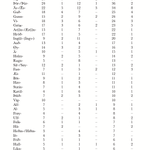
The most common first elements in dithematic names from Viking Age runic inscriptions. The majority of the first elements concern either war (sigr 'victory', Gunnr 'war, a walkirie', gęirr 'spear') or religion (Þórr 'Thunder', ǫ́ss 'god', guð 'god', ví 'sanctuary', Ingvi 'Ing').

ALT Lena Peterson, Nordiskt runnamnslexikon

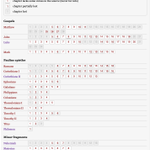
The majority of the surviving Gothic corpus, from wulfila.be. Not included: the Bologna fragments, late Gothic graffiti, short runic inscriptions.


Konrad 🇸🇪 retweeted
Yamnaya, Corded Ware and Bell Beaker haplogroup similarity.
20 / 135 (14.8%) of Corded Ware have a clade from Yamnaya
156 / 179 (87.2%) of Bell Beaker have a clade from Corded Ware
Using a clade depth of 11 from the first 3 digits


Konrad 🇸🇪 retweeted

this is Middle English & delightful to read; as you can see, it is not so difficult.
Old English is more difficult of course but there is fascination in the evolution of language -- how do languages evolve? why do languages evolve? where do words "come from"?--language being a creation of the human brain, so mysterious, & anonymous.
in graduate school in English, it used to be the case that some students would fall in love with Old English, & never want to leave; others, Middle English. vocabularies are small, the very world seems small, as if in miniature.
pushing on, into centuries to come, especially the 19th century, felt like opening a door to a cyclone-- & the roof is blown off....


Very interesting new project. Maybe my esteemed Icelandic followers will submit something in Old Norse. I will, in any case, submit a few dróttkvætt stanzas.


