

IT, Cyber Security, IS Audit, HR, ISO, Business & Finance Consulting.
Minbhawan, Kathmandu, Nepal
Joined October 2013
- Tweets1.3K
- Following228
- Followers122
- Likes4






Security gaps rarely live inside one department.
A new employee joins.
HR creates the account.
IT provisions access.
The manager decides what the employee needs.
Security defines the requirements.
The application owner controls the system.
#Greentick #GTN

1
3
Then the employee changes roles.
And suddenly, everyone assumes someone else is responsible for updating the access.
This is where information security gets complicated.
The problem isn't necessarily a missing policy.
#Compliance #InformationSecurityManagement
3
In digital forensics, every minute has value.
Not because investigators work against the clock.
Because evidence does.
A VPN session expires.
A cloud workload is terminated.
A temporary authentication token becomes invalid.
Logs reach their retention limit.
#Greentick #GTN

1
19
An employee restarts a laptop.
An attacker deletes a scheduled task after completing their objective.
None of these events look dramatic.
But each one removes a small piece of the story.
By the time an investigation officially begins, parts of that story may already be gone.
4
6
Sometimes...
It simply disappeared while everyone was deciding what to do next.
#DigitalForensics #DFIR
4
They're the ones that recognise something unusual, preserve the right evidence early, and begin the investigation before time works against them.
In digital forensics, losing evidence doesn't always happen because someone deleted it.
#IncidentResponse #CyberSecurity
5
It's about preserving what won't be available for long.
The organisations that recover from incidents most effectively are rarely the ones with the most sophisticated tools.
#DigitalEvidence #ForensicReadiness #CyberResilience
2
This is why experienced investigators ask for evidence as early as possible.
Not because they expect to solve the case immediately.
Because they know today's evidence may not exist tomorrow.
Digital forensics isn't just about analysing what's available.
#ThreatInvestigation
3
Getting ISO 27001 certified is difficult.
Keeping it can be even harder.
Many people assume that once an organisation earns ISO 27001 certification, it's set for the next three years.
That's not how it works.
#SecurityLeadership #Greentick

1
13
Every year, surveillance audits examine whether the Information Security Management System is still operating as intended.
Not whether the certificate is hanging on the wall.
Auditors don't expect perfection.
They expect consistency.
#Compliance #BusinessResilience
5
5
That's where nonconformities begin to appear.
ISO 27001 isn't designed to freeze an organisation in time.
It's designed to evolve with it.
The organisations that get the most value from ISO 27001 aren't the ones that pass an audit once.
#InformationSecurity
2
But the documentation, risk assessments, and control ownership stay exactly as they were during the certification audit.
Gradually, the gap between how the organisation works and how the ISMS says it works gets wider.
The biggest reason organisations struggle isn't because they suddenly become insecure.
It's because the business changes faster than the ISMS.
New offices open.
Cloud platforms are adopted.
Vendors are replaced
AI tools become part of daily work.
Teams restructure.
#CyberSecurity
3
Has the risk assessment been reviewed?
Are corrective actions actually closed?
Are internal audits taking place?
Is management reviewing the ISMS?
Are security controls still aligned with how the business operates today?
#Governance #RiskManagement
1
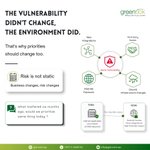
A vulnerability report is a snapshot.
Too often, it's treated like a permanent record.
Here's why that matters.
Imagine a penetration test identifies a low-severity issue in an internal application.
#SecurityTesting #CyberRisk #Greentick #GTN

1
5
It doesn't expose sensitive data, isn't internet-facing, and the business decides to address it later.
Six months pass.
The application is integrated with a customer portal.
A third-party vendor is given access.
New APIs are exposed.
#ApplicationSecurity #InformationSecurity
4
6
Because in cybersecurity, vulnerabilities don't age.
They evolve with the environment around them.
The real question isn't:
"What vulnerabilities did our last VAPT find?"
It's:
"If we assessed our environment today, would we prioritise those findings the same way?"
#CyberSecurity
4
Testing shouldn't be viewed as a one-time exercise that produces a report to archive.
It should be part of a continuous process of understanding how changes in the business affect security risk.
A finding that was acceptable six months ago may deserve immediate attention today.
4