

Sign up for my twice-weekly newsletter, WSJ Economics, here (it's free!): https://nitter.cf/t.co/EBsOw4LSoO
Washington, D.C.
Joined January 2011
- Tweets16.6K
- Following881
- Followers84.3K
- Likes3.3K




Greg Ip retweeted

Two @FAANews air-traffic officials were removed recently after objecting to the rollout of a new AI-driven flight-routing system in the Washington area. Our piece:
nytimes.com/2026/11/18/us/se…

Greg Ip retweeted

What this system could use is a few billion autonomous agents.


Greg Ip retweeted

Wow who knew that the entire U.S. economy was built on supplying cutting-edge chips to China. Seems like not a great growth strategy if true

Greg Ip retweeted

The idea that US economic growth existentially depends on the illegal sale of chips to China is a remarkable revelation from the former AI Czar’s bestie
Greg Ip retweeted

“We don’t have one single permitting problem, we have many that stack on top of each other.”
BPC’s @XanFishman spoke with @WSJ's @greg_ip about what the Bipartisan American Affordability and Jobs Act could mean for transmission lines, solar farms, and the projects that power the economy. Read the full column: ow.ly/48UE5107pot

Greg Ip retweeted

As Fed Governor Chris Waller said its "One Transitory Shock After Another": federalreserve.gov/newsevent…

Greg Ip retweeted

Greg IPs teriffic piece on Rahm: a free thinking pol with his own ideas (which don’t include demonizing capitalism) and is not cravenly seeking applause. ://www.wsj.com/politics/rahm-emanuel-is-betting-america-wants-a-radical-centrist-as-president-9a914708?st=LnDGAN
Greg Ip retweeted

ICYMI
-The White House ordered federal officials to approve the release of detained, illegal Chinese vapes onto the U.S. market
-Chris LaCivita and his son have been advocating for the importer
-The White House specifically James Blair told officials to knock off large-scale raids against Chinese vapes last year
wsj.com/politics/policy/chin…

Greg Ip retweeted

"Can the AI boom make enough money to sustain itself?" — I work through that question in a long-read for this week's @TheEconomist.
A few of the big ideas there:
-- Model-maker run-rate revenue today is in the low hundreds of billions. What's priced in to the data centre buildout is a rise to trillions, over the next few years.
-- Which is why, despite the continued advances in capabilities, data suggesting revenue growth may be coming down a little, from providers like Ramp, is so worrying.
-- The other danger is pattern-matching too much on extraordinary economics of SaaS, which had high switching costs and a low marginal cost of additional users: which meant wide moats and big returns to scale. AI is different: models are easy to switch between, and every new user costs money to serve.
-- So far, frontier models have been far enough ahead of the pack that AI companies have been able to charge healthy margins on them. That may continue, and their lead could even deepen as training costs get high enough to become their own sort of moat, and crackdowns on distillation hurt Chinese rivals—but could go the other way too.
-- The prototypical big-spender on AI is still a venture-backed company using agentic tools for coding. To get revenue in the trillions, the rest of the economy will need to be brought along.
Lots more in the piece, do take a look:
economist.com/briefing/2026/…

Greg Ip retweeted

My (very late) PR take: reporters shouldn’t be dismissive of the people who have all the information.
And remember: Good reporters and PR people both spend a hefty portion of their days launching phone calls and emails into the void.
There is a measure of solidarity in the rejection we must all endure to get our jobs done.
RT @lizrhoffman: Nvidia’s CEO having saying his dealings with the suspected Chinese spy he turned out to be having an affair with were “nor…
Greg Ip retweeted

Part of the problem with “economic populism” discourse is it simultaneously means broadly accepted ideas on the left like raising taxes on the wealthy & corporations, regulating social media companies & AI companies, and increased government intervention in the healthcare market. (All of this mainstream lib economists agree with)
And then there is this intellectual vanguard that also call their project economic populism but they are focused on eliminating the influence of economists, resurrecting tariffs, and treating tons of normal private market activity as presumptively suspect/worthy of govt intervention.

Greg Ip retweeted

Fact: 84% of the House districts Dems are on track to flip this year contain a Cracker Barrel, and just 59% are home to a Whole Foods.
By contrast, 67% of the districts Dems flipped in 2018 contained a Whole Foods, and just 56% were home to a Cracker Barrel.
Greg Ip retweeted

A 🧵on the curious case of Americans electing Muslims to Congress - with comparisons to India and Pakistan.
Only 1.5% of the US population is Muslim, yet Americans just elected 8 Muslims to the 535-member Congress - that's also 1.5% of all seats.
This is somewhat of a puzzle.
1/6
Greg Ip retweeted

This is a smart thought that DC policymakers have yet to fully process ...

Greg Ip retweeted

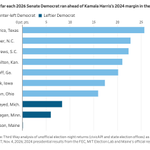
Did more centrist or leftist Dems swing Congress?
Results so far: Swing of House seats R-to-D:
-Candidates backed by mods: 26
-Candidates backed by Bernie: 3
-Backed by both: 3
Senate R-to-D:
-Mods: 5
-Bernie: 1
-Both: 1
from @greg_ip

Greg Ip retweeted

Greg Ip (@greg_ip) is one of my favorites at WSJ. For those concerned that the blunami is going to produce far left policies, you may want to think again.
"The startling rise of candidates backed by Sen. Bernie Sanders and New York City Mayor Zohran Mamdani, both Democratic socialists, may leave the impression that the incoming Congress will be hellbent on a far-left agenda of wealth taxes, Medicare for All and a Green New Deal."
"Not so fast. Judging by the candidates who delivered their majorities, Democrats may be moving toward the center."
As an economist, the worst thing Dems could do would be to try to reverse all of the positive economic policy by the Trump administration (yes, there are some) & increase uncertainty for US businesses.
We'll see if Schumer and Jefferies can surf the blunami wave without wiping out.
BTW, I'm putting together my outlook on the election and it's impact on the economy, policy & markets. Will send after some of the House races finish and dust settles.
wsj.com/politics/elections/a…

Greg Ip retweeted

LETTER TO THE EDITOR
Greg Ip is right that moderate Democrats were the majority-makers. But that does not establish his larger suggestion that the Democratic Party is moving toward the center.
Those are two different questions.
If you want to know what kind of Democrat can win a Republican or purple district, study flipped seats. Naturally, candidates capable of persuading Republican and independent voters will tend to be more moderate.
But if you want to know where the Democratic Party itself is moving, the better laboratory is its firmly held districts—places where Democratic voters can choose among Democrats without worrying that a Republican will win.
There, the picture looks very different.
As of Friday, eight of the ten DSA-endorsed candidates for the U.S. House had already won their races. Several progressive and democratic-socialist candidates displaced more established Democrats in safely Democratic territory. In other words, where Democrats needed the political center, they nominated candidates capable of reaching it. Where they did not, Democratic voters repeatedly chose candidates further to the left.
That is the more revealing result. In competitive districts, the electorate constrained Democrats toward the center. In Democratic strongholds, where those constraints disappeared, voters showed us their unconstrained preference—and it was further left. That is consistent with the longer-term data: Democratic voters today identify as liberal at record levels, after decades of substantial leftward movement. The 2026 election therefore looks less like a Democratic return to moderation than a continuation of the party’s leftward ideological movement wherever electoral geography permits it.
Electoral reach is not ideological direction. Moderates may have built the Democratic majority at its edges, while the party’s secure core continued moving in precisely the opposite direction.
If we want to know who is shaping the future of the Democratic Party, its strongholds—not its flips—may tell us much more.
Greg Ip retweeted
There's a lot to focus on right now, but "The richest man to ever live just spent $200 million to support the Republican Senate candidate in Texas, and his man lost by double-digits in a statewide wipeout" is a completely insane sentence.
Put another way, the most expensive US Senate race before 2020 was $200 million. *One guy* spent that amount in Texas, and it doesn't seem to have made any difference. It might have hurt in a kind of Streisand effect way, in that the spending level was seen as obscene to people sympathetic to the argument that billionaires shouldn't "buy" elections.
The implications here seem pretty interesting! Especially re the limits of billionaire political power and/or the diminishing returns of money in politics.