


Pinned Tweet
Heads and Hands. Lets analyze them in ways that can be useful for an artist/designer. Here are some ideas. I hope you like them!! #drawing


Some ideas about exercises that can be helpful, to warm-up and to improve motor-control / line-accuracy. Note: There are many more. I may post more later. #drawing


4

Studying the back of the hand. Some poses sure can have a lot of curvature, on that surface. #drawing


Exploring this pose. And emphasizing the 1D Action, 2D Boundaries and 3D Volumes. #drawing


It is useful to develop a Simplified-Abstraction of the nose. Then try to draw it from many different viewing angles - in clean/strong perspective. #drawing #illustration
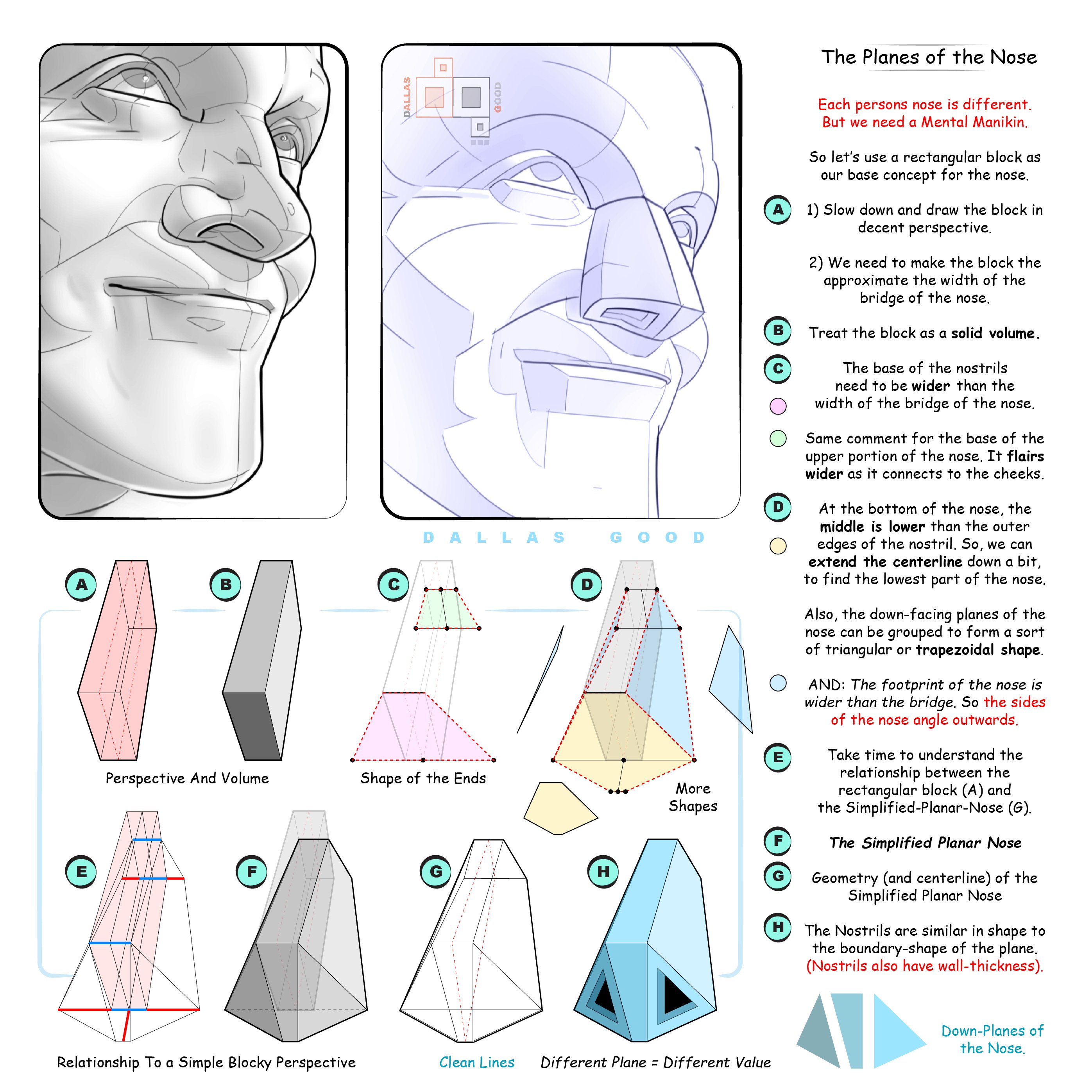
I like to find the inner corners, whenever possible. then indicate them once they are found. #drawing

Each form has a unique orientation. It can often be simplified to a single-angular-movement. Try to find that angle (for each form). #drawing #illustration


Finger and Hand Abstractions. Blocky forms are easier to "invent" and pose - without reference. And we can dress-up the simple volumes with more detail, like muscles, tendons and wrinkles. #drawing #illustration

1
12
Because the face is rounded, we can include depth-cues, to get the forms to have some realism. Ideas like foreshortening, overlap and convergence. This page touches on some of this. #drawing #illustration

Back to the basics. It is good to get a solid understanding of the two main movements of a cylinder. It can help us put fingers in perspective. And of course, other cylindrical objects, of which, the world is full of them. #drawing

Notice that some of the ellipses are shallower, and some are fuller. This suggests how much the cylinder is moving towards the viewer, as opposed to being a sideview of the cylinder/finger. #illustration
Just like faces, body parts are also unique and interesting. Each artist often has a mental-manikin, that develops from their studies and preferences. And it is a factor in making that persons art-style unique & individual. I like the variety.
This post is from an account that no longer exists. Learn more
4
Studying the hand. Seeing the fingers as cylindrical volumes. Turning those volumes "in space" to simulate "perspective". Tricky but rewarding, when it starts to come together. #drawing

Thumb Stuff for today. I am starting to like the thumb, despite it's challenges. It is such an interesting form. The form with the most "character", of all the forms in the hand. I think so. Of course, the "hand in total" tells the real story. #drawing #illustration

1
23
The hand can take many poses. And the forms are rounded. So, the surfaces roll away and towards the eye. And when the forms pinch and stretch, the surfaces do some tricky things. Here are some ways that I explore these issues. #drawing #illustration

Things that affect the lighting. 1) Light Direction 2) Viewing angle. 3) Rotation/orientation of the form. 4) Shape of the form. Also: I included a bit of light logic here. Example: Group the lights & keep the light side light. Group the darks & keep the dark side dark. #drawing

Drawing the back of the hand can be challenging. Here is some info on it. Yay! #drawing #illustration

