

Doctor Endocrinologist - explains the handle सत्यं ज्ञानम् अनन्तं explains everything else
Chennai
Joined April 2010
- Tweets20.7K
- Following1K
- Followers6.3K
- Likes13.9K



Pinned Tweet
Pinning this. The PM noticing the wanderlust in me should count for something afterall 😊

Guess the puram corpus is out of syllabus
Palyagasalai mukkudumi peru vazhudhi says hi!
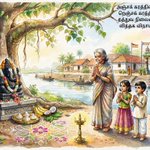
பரிசில் மாக்கட்கு வரிசையின் நல்கி,
பணியியர் அத்தை, நின் குடையே முனிவர்
முக் கட் செல்வர் நகர் வலம் செயற்கே!
இறைஞ்சுக, பெரும! நின் சென்னி சிறந்த
நான்மறை முனிவர் ஏந்து கை எதிரே!
வாடுக, இறைவ! நின் கண்ணி ஒன்னார்
நாடு சுடு கமழ் புகை எறித்தலானே!

The belief is that the hill is shiva - if u believe it then giri pradakshina is a perfect form of worship

I am strong believer. And a devout saivite. I wear the Annamalaiyaar Rudraksham forever. Having said all that, I seriously start to feel the #girivalam is being overhyped and simply being performed as a #wannabe
Anybody agree with me ?
Even though I don't do medical posts - I urge you to read about self harm in the young - question to your favorite information source should do.
It's remarkably high and often amongst the leading causes of death in that age group - also important to note that India is an outlier with a disproportionately high self harm rate.
If any our focus needs to be on how we look that this - it's not just an IIT issue - much more.
Second - the importance of imparting a reasonably formed set of values social coping and resilience skills to the young before they leave home. And certainly the attitude that failure or its fear is no reason to cheat or take your life
Our ineritors seem to be desperate to take this world over immediately - the haste and terms that they are using - many of us will find going against our upbringing - values - culture and way of life.
But more than a generational conflict this looks like they want a ajatasatru solution to their perceived problems
Won't end well for any of us - let alone the future of this civilisation
Sometimes I ve wondered if leaving full time academia was a good idea ... reminded that continuance would have been a bad one ..
Definitely paarpana sadhi the mudi should rejine

🚨🚨Noel Tata calls Chandra re-appointment vote ‘illegal'
Huge, Noel Tata to Moneycontrol
“I voted against Chandra's appointment as chairman. My veto was wrongfully overridden on the basis of a legal opinion. The decision is illegal. I recorded my dissent,”
moneycontrol.com/news/busine…

Woah! Speaking of Coup de etat! Or is it paarpanna sadhi?

#BreakingNews | #TataSons board has cleared the listing of the company and a five-year term for #NChandrasekaran as Tata Sons chairman. Tata Trusts chairman Noel Tata was outvoted by others at the board.


In the sixth anuvakam (1.1.6) an old conflict
In an older era, an existential war broke out between the Devas and the Asuras.
Realizing that the outcome of the battle was uncertain and fearing potential defeat, the Devas sought a secure place to safeguard their most precious divine essence—their vāmaṁ vasu.
But Agni could not sustain the total weight of that concentrated treasure alone(ekatra soḍhum aśaktavān). Therefore, he divided it into three equal portions and deposited one-third among cattle (paśuṣu), one-third in the waters (apsu), and one-third in the Sun (āditye).

The Devas ultimately vanquished the Asuras. Having secured victory, they sought to retrieve (*avārurutsanta* / *avāroddhum aicchan*) the three portions of their deposited wealth.
To reclaim each portion from its cosmic hiding place, they fashioned three specific oblations corresponding to the three forms of Agni:
They offered an eight-potsherd cake to Agni Pavamāna. Cattle, indeed, are Agni Pavamāna (embodying self purification) ; whatever portion of their treasure resided among cattle, they secured through that offering. Next, they offered an oblation to Agni Pāvaka. The Waters, indeed, are Agni Pāvaka (active purification force) ; whatever portion resided in the Waters, they secured thereby. Then they offered to Agni Śuci. The Sun, indeed, is Agni Śuci (embodying luminous purity) ; whatever portion resided in the Sun, they secured through that third offering.

The brahmavadins debated Is the Agnyādhāna complete with just the main cake, or does it require these supplementary offerings? They argue 'These Pavamānādi oblations are the limbs, while the eight-potsherd Āgneya cake is the body/trunk (ātman/tanū) of the fire-installation.' If one offers only the main Āgneya cake and omits these Pavamānādi offerings, it would be as if a trunk existed without limbs!
Verily, by performing both together, the sacrificer secures both strength aindriyam) and potency vīryam

Moving to the next anuvaka (1.1.4) as we explore stories from the taittriya brahmanam - we encounter manu - and his daughter Ida
In this narrative, Iḍā is portrayed as yajnānūkāśinī—she who possesses divine insight into the cosmic order and the correct procedures of sacrificial worship.
Ida heard that the Asuras were installing their sacrificial fires and went there. They installed the Āhavanīya first, then the Gārhapatya, then the Anvāhāryapacana.
She said: 'Their prosperity has gone backward. Though they become prosperous at first, they will ultimately be ruined.'
She then heard that the Devas were installing their fires and went there. They installed the Anvāhāryapacana first, then the Gārhapatya, then the Āhavanīya.
She said: 'Their prosperity has gone forward. They will become prosperous and reach the heavenly world, but they will not obtain progeny on earth.'
🤖 Made with AI

Perceiving Manu to be terrified by this decree, Iḍā said to Manu: "I shall establish your fires for you in such a perfect, integrated sequence that you will progressively generate offspring, cattle, and coupling mates (mithunaiḥ — pairs that ensure constant reproduction) and multiply throughout the Earth, remain firmly established in this earthly world, and also conquer the heavenly world!'
(Bhatta Bhaskara says) manu heard this with his head bowed and hands folded and followed her advice and set the fires in the correct order securing both earthly abundance and celestial victory:
First, the Gārhapatya Fire (Gārhapatyam agra ādadhāt): By establishing the Gārhapatya first, she secured progeny, livestock, and domestic continuity on Earth for Manu
Second, the Anvāhāryapacana / Dakṣiṇāgni Fire (Athānvāhāryapacanam): By setting up the Southern Fire second, she anchored Manu firmly in this earthly realm (asminn eva tena loke pratyatiṣṭhat).
Third, the Āhavanīya Fire (Athāhavanīyam): By establishing the Eastern Āhavanīya fire third and last, she conquered and secured the heavenly world (tenai 'va suvargaṁ lokam abhyajayat).
🤖 Made with AI

When the purvacharyas set to establish their sampradayas - there were three kinds of discussion
vada - jalpa-vitanda
The first was to establish the truth - which was most common - the second was to establish victory - usually to win over an important disciple (eg mandana mishra) the last vitanda was a destructive cavil - it was never used for discourses with vaidika margas - the reason is obvious
Debate if u must - but do not try to be destructive with another vaidika marga .. it's another question whether we have the credibility to debate

Shaṇḍa and Marka were the twin Asura preceptors (sons of Śukrācārya) who tried to claim or destroy the primary Soma offerings—specifically the Śukra (pure/bright) and Manthin (stirred/clouded) grahas (cups)
By declaring "Nirastaḥ śaṇḍaḥ, nirasto markaḥ", the sacrificer severs the influence of these Asuric priests from the ritual field along with sahaamunaa (sahāmunā — "along with that one") any other human adversary who may have malafide intentions toward the sacrifice
(TB 1.1.1.5)

An older thread with some more information
nitter.cf/hormndoc/status/156534…

Most of us know Kalady by hearsay. But hardly anyone outside the sampradaya knows monumental task of rediscovering and establishing Kalady was driven by the deep vision and painstaking efforts of the 33rd Jagadguru of the Sringeri Sharada Peetham, Sri Sacchidananda Shivabhinava Narasimha Bharati Mahaswamiji (1858–1912).
Kalady was obscured and forgotten precisely due to the shapa (curse) pronounced by Adi Shankara himself upon the local community, which required extraordinary tapas by the Sringeri Jagadguru to unveil and redeem centuries later.
Inside the sampradaya, the disappearance of Kalady from living memory is not seen merely as historical negligence, but as the direct consequence of this divine curse and the subsequent tapo-shakti required to reverse its veil.
When Sri Shankara sensed his mother Aryamba’s impending passing, he kept the promise he made before taking sannyāsa and returned to her bedside. However, when she left her mortal body, the orthodox local Nambudiri community strongly opposed him. Citing shastras, they argued that a sannyasin who had renounced the ritual fire had no right to perform funeral obsequies (antyeshti).
So the next rightful adhikari to do anythesti as per shastras is the neighbours themselves. Now, the neighbours refused to provide sacrificial fire and would not help carry Aryamba's mortal remains to the cremation ground.
Left entirely alone, Shankara lit the funeral pyre in the backyard of his own ancestral home using his yoga agni.
Overcome by righteous indignation at their callousness and failure to see matru-bhakti, Adi Shankara placed a curse upon the village:
1. May you become unfit and incompetent to study the Vedas.
2. May no Sannyasin ever visit your settlement or accept bhiksha here.
3. May you be forced to cremate your dead within your own residential compounds rather than common cremation grounds.
Because of this shapa, sadhakas and sanyasi orders completely bypassed the settlement for centuries. Without the patronage of wandering mendicants or sannyasins, the sacred memory of Shankara’s janmastanam faded, and the region gradually fell into spiritual obscurity and dense overgrowth.
The Mahaswamiji engaged in rigorous tapas and prayers to Adi Shankara and Goddess Sharadamba, seeking divine grace to identify the exact coordinates obscured by the curse.
The curse had ordained that no sannyasin would set foot in Kalady. By physically entering Kalady in 1910, the Jagadguru, holding the supreme seat of Shankara's Southern Amnaya Peetham, symbolically broke the spiritual embargo.
The primary anchor for the search was the Madhaviya Shankara Digvijaya, a 14th-century hagiographical work composed by the 12th Acharya of Sringeri, Jagadguru Sri Vidyaranya. This text provided specific topographical markers of Shankara’s birthplace, such as its proximity to the Poorna River (now the Periyar River) and to the Vadakkunnathan temple or the Vrishachaleswara temple in Thrissur.
When the Sringeri Mahaswamiji shared his sacred intent to trace the location, the Dewan of Mysore, Sir K. Seshadri Iyer, immediately mobilised resources. Initial inquiries in the Malabar/Travancore region revealed a major challenge: there were three different places named Kalady.
To locate the true Janmabhumi, state officials and researchers meticulously cross-referenced the geographical data from the Digvijaya.
They verified which Kalady sat precisely on the banks of the deep-flowing Poorna (Periyar).
Then they located the ancient Sri Krishna Temple, traditionally recognised as the shrine where young Shankara and his parents worshipped.
Further, they identified the exact ground where Adi Shankara broke monastic convention to perform the final rites for his mother, Aryamba.
Following the absolute verification of the site, the Maharaja of Travancore, Sri Moolam Thirunal Rama Varma, acquired the land and donated it to the Sringeri Peetham.
According to historical records, His Holiness built two temples, one for Goddess Sharadamba and one for Sree Sankara. The Kumabhishekam was performed on the auspicious Magha Shukla dwadasi in the year 1910, and consecrating the Samadhi of Mother Aryamba, the Mahaswamiji restored the sacred flow of punya to the land.
It is funny how the world now is mesmerised by shorts and reels, believing the fake narratives or claims. Melpazhur is the ancestral home of Ma Aryamba, but what proof do you have that Melpazhur is the place where Adi Shankara was born? What kind of apathy is this?

We linger with the early anuvakas of TB1.1 to examine the vedic relationship with palasha tree -
At an ancient time, Soma was located in the third heaven above this earthly plane. For the benefit of the gods, Gāyatrī, assuming the form of a bird (eagle sayana), flew up and brought the creeper down from that celestial realm.
As Gāyatrī was flying away carrying the Soma-creeper, Kṛśānu, the celestial guardian of Soma, shot an arrow shaped like a tusk (bhatta bhaskara) which severed a single leaf (parṇa) of that Soma plant [TB 1.1.3.10]. Falling onto the earth, that leaf transformed into the Parṇa or Palāśa tree. Because it grew from the fall of that leaf, the tree was named Parṇa.
Whosoever gathers its wood as a ritual Sambhāra, that sacrificer directly secures the fruit of the Soma-draught (Soma-pītha) TB 1.1.3.11].
The Palāśa is the physical manifestation of Soma's flight Thus the Palāśa tree is the direct terrestrial reservoir of celestial Soma [TB 1.1.3.10]. By touching its wood or placing its bark on the altar, the householder establishes a direct bridge to the celestial Soma-sphere (Soma-pītha)
🤖 Made with AI

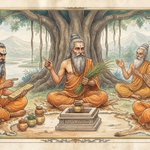
On another occasion, the gods came to this realm to debate and discourse (avadanta) the nature of Brahman [TB 1.1.3.11].
The nearby Parṇa (palasha) tree overheard (upāśr̥ṇōt)their discussions with absolute attention
It therefore obtained the glorious name Suśravas (possessing beautiful fame or pristine hearing - bhatta bhaskara).
Since the Parṇa-made substance is gathered for the ritual, the sacrificer indeed secures spiritual luster (Brahma-varcasam) [TB 1.1.3.11].
(I have heard from other sources that it became trilobate as it absorbed the three vedas)
The continuing liturgical tradition: During the Upanayana samskara, the initiate (brahmacārī / vaṭu) is formally presented with a daṇḍa by the initiating ācārya.
When the young student receives the Palāśa staff he holds it upright in front of him and says: O Suśravas (thou of glorious hearing / fame)! Make me glorious with the same sacred knowledge. O glorious one, just as thou art glorious among the gods (devas), so may I become glorious with the wisdom of Brahman among the Brahmins
This mantra is the direct liturgical application of the Brāhmaṇam passage in TB 1.1.3.11.
By holding the Palāśa danda, the student is metaphysically tapping into the tree's primordial receptive and retentive capacity (smṛti). Because the Palāśa tree "grasped" and "held" the whole of sacred knowledge when the gods were debating, the staff acts as a spiritual conduit for the Vedic mantras that the student is about to acquire.
🤖 Made with AI
