

Assistant Professor @ Mahidol University | Genetic Epidemiologist; Opinions are my own.
Bangkok, Thailand
Joined April 2008
- Tweets2K
- Following1.1K
- Followers280
- Likes1.6K







Bhoom Suktitipat, MD, PhD retweeted

Anthropic Engineer Andrej Karpathy:
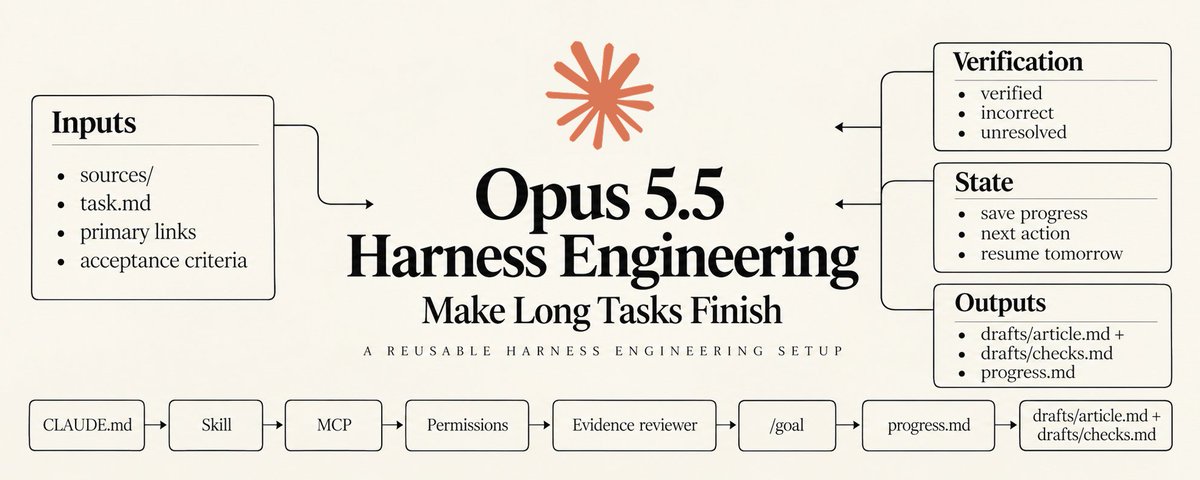
"The biggest mistake in AI right now - people are forcing agents to work instead of mastering the harness engineering for model first
We made that mistake in 2016 at OpenAI - It cost us 5 years "
Opus 5.5 → Prompts → Agents → Graphs → Harness
what Karpathy actually means:
step 1 → stop forcing your agent to do everything, understand the model underneath first
step 2 → demos are easy - products take a decade. self-driving proved it - if you skip the foundation, everything breaks
step 3 → the agent is not the product. the foundation is. build that - and agents emerge on their own
"you building agents right now - you're at the forefront. not OpenAI. not DeepMind. you "
Watch it today before it gets buried
Then read the full Opus 5.5 harness engineering guide below ↓

Bhoom Suktitipat, MD, PhD retweeted

"The longevity industry is a goldrush without gold."
and other strong words about 2 delusions @TheLancet
thelancet.com/journals/lance…


Bhoom Suktitipat, MD, PhD retweeted

We'll be spending a lot more time trying to understand the outputs of language models. A few thoughts, tips & tricks:
Writing. Something I've had success with: Ask your LLM to explain something in ASD-STE100, it's a controlled language specification originally developed for aerospace maintenance documentation. LLMs well-versed in this language and it comes with heavy constraints on clean writing style that I often find a lot more readable. Sometimes I've tried to soften it a bit e.g. ask for "80% of the way to ASD-STE100" because the spec is quite stringent. But even better:
Diagrams / images. Instead of writing, ask your LLM to create a diagram. These can be a lot easier to process, parse, and understand. But even better:
Web pages. Ask for output "in HTML" to get a beautiful, interactive webpage. LLMs are getting really good at frontend and can create beautiful experiences, animations, etc. But even better:
Explainer videos. The output format I am most bullish on is fully custom / bespoke explainer videos generated on any arbitrary topic. Experiment with things like "Create a 3b1b style video explainer on X. Use my ElevenLabs API key for audio narration". (you'd need an API key for the latter or you can ask your LLM to find you decent free alternatives that use your local compute). This is actually starting to work!
In summary:
- As LLMs get better, they will do more and more of the legwork autonomously, and a lot more of our work will rise up the abstractions into oversight and understanding.
- Luckily, LLMs can help here too because as intelligence and code are increasingly abundant, you can ask for large, custom, discardable software artifacts (e.g. web apps, video explainers) that would have never made sense to create before. Push the boundaries here and you'll be surprised.

Bhoom Suktitipat, MD, PhD retweeted

this is pure f*cking treasure
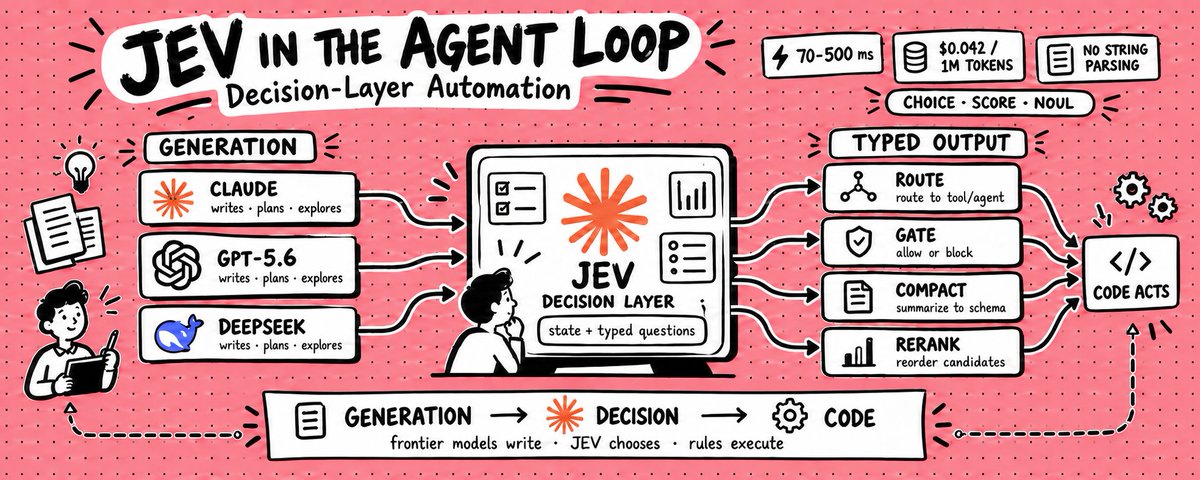
A Stanford AI research group has found a way to use JEV to make your LLM run 24/7 at a lower cost in x444
the LLM only does what needs words. everything else is a typed decision:
> worth reading? Jev answers yes or no before a single token is spent
> which desk? papers, repos or market, one Choice
> rerank: embeddings pull 20 sources, Jev keeps the 5 that matter
> claim holds? every claim checked against its source, the weak ones dropped
> new or known? duplicate, related, revises or contradicts, checked against the vault
the LLM writes one note, 5 to 12 lines, one claim
> judge: confident verdicts pass, unsure ones go up to a frontier model
> matters to you? only the top scores make the morning brief
the judge rule comes straight from Carnegie Mellon's JEV-as-a-Judge paper: escalate only the unsure 34%, keep 99.6% of the accuracy at 47% of the fee
and the fees are the whole point
> Jev: $0.044 per 1,000 judgments
> GPT-6: $12.182 for the same 1,000
a whole day of decisions on a frontier model costs dollars. the same day on Jev costs cents
you stop reading 300 sources. you read one brief

Bhoom Suktitipat, MD, PhD retweeted

A paper in Nature introduces Paper2Agent, an automated framework that converts research papers into AI agents that functions as a virtual corresponding author. go.nature.com/4hgRMBH

ALT This is figure 1, which gives an overview of Paper2Agent.
ต้องลองแล้ว

OpenScience is now the #1 scientific agent.
Today it's out of beta and live on Product Hunt, with:
• A new IDE: a faster, fully redesigned research workspace
• OpenScience Ace: 30+ hand-picked models, including GPT-6 Astra, Claude Opus 5.5, Grok 4.7, Kimi K3, GLM-5.3, and DeepSeek V4.1 Flash, in one pay-as-you-go wallet
• Autoresearch: give it a metric and it hill-climbs through experiments on its own
• One-click OAuth to bring your ChatGPT or Codex subscription
• 300+ research skills, 50+ scientific tools and databases, and NVIDIA BioNeMo built in
Already in use at 30+ universities and research labs. Free and fully open source.

17
Bhoom Suktitipat, MD, PhD retweeted

🚨 Chinese scientists just detected an unexplained 71-terahertz vibration inside mitochondria — the microscopic "powerhouses" of living cells.
The work was published by researchers at the University of Shanghai for Science and Technology.
The signal, which oscillates 71 trillion times per second, was detected in living human cells and mouse tissues but vanished completely once the cellular structures were dried or disrupted.
This dependency on structural integrity led the scientific team to propose that mitochondria may utilize a quantum hybrid state, known as a polariton, created by light-matter coupling inside their highly folded inner membranes to optimize how they function.
To test this theory, the scientists stimulated human cell cultures with weak infrared light tuned to specific frequencies associated with this quantum state. The experiment yielded a stunning 10 percent jump in the production of adenosine triphosphate (ATP), the vital molecule that fuels almost every biological function in our bodies.
While the study was published as a bioRxiv preprint and is still awaiting peer review, it represents a monumental leap for quantum biology. If verified, the ability to manipulate these quantum channels could pave the way for revolutionary treatments targeting metabolic diseases, aging, and chronic genetic conditions.
source: Song, B., et al. (2026). A quantum state of mitochondria in the living cell. bioRxiv.

Bhoom Suktitipat, MD, PhD retweeted

ยิ่ง AI เก่งขึ้น มนุษย์ยิ่งต้องเก่งอะไร? สำรวจทักษะ 4 ด้าน เพื่อเตรียมพร้อมคนไทยสำหรับยุค AI
[เรื่อง: ประกาย ธีระวัฒนากุล]
โลกที่ผ่านมา คนที่มีทักษะสูงกว่า ย่อมมีโอกาสมีงานที่ดี รายได้ที่สูงขึ้นและเส้นทางอาชีพที่มั่นคงกว่า แต่วันนี้ Artificial Intelligence หรือ AI กำลังเปลี่ยนสมการนี้อย่างรวดเร็ว
คำถามจึงไม่ใช่เพียงว่า “AI จะมาแทนมนุษย์หรือไม่” แต่คือ “ในวันที่ AI เก่งขึ้นเรื่อย ๆ มนุษย์เราต้องเก่งอะไร เพื่อสร้างคุณค่าและโอกาสใหม่ให้ตัวเอง?”
World Economic Forum ประเมินว่า ภายในปี 2030 ทักษะที่ใช้ในการทำงานปัจจุบันประมาณ 39% จะเปลี่ยนแปลงหรือล้าสมัย
ขณะที่ International Labour Organization ประเมินว่า แรงงานประมาณหนึ่งในสี่ของโลกอยู่ในอาชีพที่ได้รับผลกระทบจาก Generative AI ในระดับหนึ่ง แต่มีแนวโน้มเป็น “การเปลี่ยนลักษณะของงาน” มากกว่าการทำให้งานทั้งหมดหายไป
หากจะเตรียมคนไทยสำหรับยุค AI เราอาจต้องมองทักษะเป็น 4 ชั้นที่เชื่อมต่อกัน
📌 1. Foundational Skills พื้นฐานที่ขาดไม่ได้
ข้อมูลของ World Bank ร่วมกับกองทุนเพื่อความเสมอภาคทางการศึกษาและมหาวิทยาลัยธรรมศาสตร์ ชี้ว่า ประเทศไทยกำลังเผชิญช่องว่างของทักษะพื้นฐานอย่างมีนัยสำคัญ โดยประชากรวัย 15-64 ปีจำนวนมากมีทักษะด้านการอ่านและทักษะดิจิทัลต่ำกว่าเกณฑ์ที่ควรจะเป็น นี่คือประเด็นสำคัญ เพราะเราไม่สามารถกระโดดจาก “พื้นฐานยังไม่แข็งแรง” ไปสู่ “AI-ready workforce” ได้ในทันที
AI Literacy ต้องสร้างบนรากฐานที่แข็งแรง และนี่ทำให้การลงทุนในทักษะพื้นฐาน ไม่ใช่เรื่องของการศึกษาขั้นพื้นฐานเพียงอย่างเดียว แต่เป็นส่วนหนึ่งของยุทธศาสตร์เศรษฐกิจและแรงงานแห่งอนาคตด้วย
📌 2. AI & Technical Skills ใช้เทคโนโลยีให้เป็น
ทักษะที่ทำให้คนสามารถทำงานร่วมกับเทคโนโลยี ได้แก่ Digital Literacy, Data Literacy, AI Literacy การใช้เครื่องมือ AI การตั้งคำถามหรือ Prompt การใช้ระบบอัตโนมัติ มีข้อจำกัด มีความเสี่ยงอะไร คนทำงานต้องสามารถตรวจสอบความถูกต้องของข้อมูล ประเทศอย่างสิงคโปร์และสหราชอาณาจักรจึงไม่ได้พัฒนาทักษะ AI เฉพาะนักเทคโนโลยี แต่กำลังยกระดับ AI Literacy ของแรงงานวงกว้าง
📌 3. Human Skills ยิ่ง AI เก่ง มนุษย์ยิ่งต้องเป็นมนุษย์
Human Skills อย่างน้อย 5 ทักษะจะมีความสำคัญมากขึ้น ได้แก่
(1) Creativity - ความสามารถในการมองเห็นความเป็นไปได้ใหม่ เชื่อมโยงสิ่งที่ยังไม่เคยเชื่อม และสร้างคำตอบที่ยังไม่มี
(2) Critical Thinking - ความสามารถในการตั้งคำถามกับข้อมูล ตรวจสอบสมมติฐาน และแยกแยะว่าอะไรน่าเชื่อถือ
(3) Empathy - ความสามารถในการเข้าใจมนุษย์ ความต้องการ ความกลัว ความหวัง และบริบทที่ตัวเลขหรืออัลกอริทึมอาจมองไม่เห็น
(4) Judgment - ความสามารถในการเลือกว่าจากหลายทางเลือก “อะไรควรทำ” โดยคำนึงถึงคุณค่า จริยธรรม ผลกระทบ และความรับผิดชอบ
(5) Collaboration - ทั้งการทำงานร่วมกับคนที่แตกต่าง และการออกแบบการทำงานร่วมกันระหว่าง Human + AI
ดังนั้น ยิ่ง AI เก่งขึ้น Human Skills ไม่ได้ลดความสำคัญ แต่กลับกลายเป็นตัวสร้างความแตกต่างของมนุษย์มากขึ้น
📌 4. Adaptive & Futures Skills เก่งพอที่จะเปลี่ยนตัวเองได้
ในโลกที่เราไม่รู้ว่าอาชีพใหม่ในอีก 10 ปีจะหน้าตาอย่างไร ทักษะสำคัญที่สุดคือ ความสามารถในการเรียนรู้ใหม่และปรับตัว เรียนรู้ตลอดชีวิต รวมถึงความสามารถในการ Learn-Unlearn-Relearn และเหนือไปกว่านั้นคือ Futures Literacy หรือความสามารถในการคิดถึงอนาคตหลายแบบ ไม่ยึดติดกับสมมติฐานเดิม และใช้ภาพอนาคตมาช่วยตัดสินใจในปัจจุบัน
อ่านต่อ: bangkokbiznews.com/opinion/1…
#กรุงเทพธุรกิจ #InsightForOpportunities #กรุงเทพธุรกิจTech #กรุงเทพธุรกิจAI #กรุงเทพธุรกิจColumnist

Bhoom Suktitipat, MD, PhD retweeted

Introducing MONAI Physio at #MICCAI2026.
3D and 4D medical images ➡️ personalized cardiac and respiratory digital twins.
This open-source Project MONAI toolkit lets researchers model how the heart beats and lungs move for simulation, visualization, and reproducible research.
Explore the project 👉 nvda.ws/3VLmJFq
Bhoom Suktitipat, MD, PhD retweeted

AI titan Anthropic has launched a biology ‘wet lab’ where human scientists and AI agents will work together to design and conduct experiments. The company has released one of the team’s first finds: a peculiar pattern of DNA in the genomes of several giant viruses.
go.nature.com/46K4qmC


Bhoom Suktitipat, MD, PhD retweeted

How have software engineering fundamentals changed with agentic coding? Here is our AI Engineering Skills map for software engineering fundamentals.

Bhoom Suktitipat, MD, PhD retweeted

Finding clinical signals in large-scale health sensing data streams is quite challenging. We introduce a biomarker discovery framework that pairs hypothesis generation with adversarial validation to discover rigorous digital biomarkers alongside human experts. Read more: goo.gle/4gavroG

ALT Overview of the Biomarker Discovery Framework. (a) The system ingests time series data from consumer wearables and clinical labs. (b) A closed-loop architecture orchestrates six phases mirroring the human biomarker prioritization lifecycle. (c) An Orchestrator agent decomposes natural-language research directives into execution plans.
Bhoom Suktitipat, MD, PhD retweeted
The most important skills in Building and Deploying AI Applications.

Bhoom Suktitipat, MD, PhD retweeted

Homework scores once predicted exam performance; now those who score highest are, perversely, more likely to do worse in exams.

หากผลงานชิ้นเอกต้องแลกมาด้วยสุขภาพ คุณคิดว่าคุณจะยอมแลกไหม?
Sean Paul สมัยนี้คงต้อง Aderal สินะ

สำรวจกิจวัตรของฌ็อง-ปอล ซาร์ตร์ หนึ่งในนักปรัชญาอัตถิภาวนิยม ที่ทรงอิทธิพลที่สุดของศตวรรษที่ 20 ผู้เขียน ‘Being and Nothingness’ ที่วางรากฐานความคิดเรื่องเสรีภาพและการมีอยู่ของมนุษย์ และเจ้าของบทละครเรื่อง Huis Clos หรือในชื่อภาษาอังกฤษว่า No Exit
อ่านบทความได้ที่: thematter.co/brief/263778/26…

22
Bhoom Suktitipat, MD, PhD retweeted

ANTHROPIC LEAKED A SETUP WHERE 6 FILES CUT TOKENS BY 84% AND RAISE ACCURACY BY 39%
engineers at Google and Microsoft have been running this for a while - they pay $3 where you pay $20.
decisions → contracts → dead ends → state → sources → open questions
memory moves outside the window - what enters the context is a pointer to a file, not the history.
raw history refills the window to 200k every single turn - six pointers take 8k and leave 96% free.
same work, same five turns: 1,000,000 tokens against 40,000.
decisions written to a file kill the endless "wait, why did we do it this way".
written dead ends kill the second lap around the same circle - the agent never walks in there twice.
a stable prefix keeps the cache warm - a cache read costs 0.1x of normal input.
that's why 20 turns cost 3.15x instead of 20x - one write and nineteen reads.
save this and paste it into Claude Code - and your agent stops paying for what it already knew ↓

Bhoom Suktitipat, MD, PhD retweeted

5.6 Sol much better in chat now
and unlimited text chat for free users!

