

Building @Botanika_sol and the data infrastructure behind AI.
Seoul, Korea
Joined March 2019
- Tweets3.5K
- Following825
- Followers42.9K
- Likes4.5K






A little Halloween horror story from Binance: $4.3 billion later… 💀🎃

Binance's initial investigation suggests that the security incident may involve a compromised DevOps engineer’s laptop, which allowed an attacker to gain access to a service container and submit unauthorized withdrawal transactions. We have found no evidence of any wallet private key leak. We will share a detailed technical post-mortem once the investigation is complete and the facts are fully verified.
The estimated total impact sits at around $6.3B. We have worked with blockchain partners to freeze affected assets, with ~$3 billion frozen on-chain so far.
Binance will cover all losses from the SAFU fund and the company’s funds. User funds are safe. We will also publish an updated Proof of Reserves once the remediation is complete.
As an immediate precaution, Binance has:
- temporarily suspended deposits and withdrawals while security checks are completed;
- revoked the affected address authorisation;
- engaged law enforcement and blockchain intelligence partners to trace and recover funds.
Our teams are working around the clock to resolve this issue safely and thoroughly. We are working closely with our law enforcement partners to confirm the identity of these criminals and bring them to justice.
Please rely only on official Binance channels for updates. Please feel free to contact Binance Customer Support if you have any further questions.
binance.com/en/support/annou…

👻 Halloween is almost here, and AI infrastructure has its own horror stories
Here are five worth reading:
⚡ 10 years: the wait some UK data centers may face for a grid connection.
⚡ 11%: the rise in US residential electricity prices since January 2025.
💸 $3.5T: AI infrastructure spending Gartner says could face impairment by 2030.
🏚️ 80%: the share of neocloud providers Gartner expects to stop operating independently by 2030.
🔓 $177M: the AT&T data breach settlement now sending checks to affected customers.

Putting together the 2026 AI founder starter pack and i'm pretty sure i'm missing something important.
Drop the item you'd add in the replies and i'll make a part two with the best ones 👇

We’re taking the time to get the foundations right. Mainnet readiness comes first, and we’ll share the next steps once the final audits are complete. Thank you for your patience and continued support 🙏

Token Sale Update
The $BONSAI token sale will no longer take place on October 28.
As we prepare for Botanika’s mainnet launch, we are completing final audits to ensure the network is ready to support the next phase of The Omni Data Layer for AI.
The token launch will move forward alongside the network launch.
A new sale date will be announced once the audit is complete.


Replication: keep 3 full copies. 3 TB of disk for every 1 TB you store. simple, fast, expensive.
Erasure coding: split data into 6 pieces + 2 parity pieces. ~1.33 TB of disk per useful TB. survives the same 2 dead nodes.
The catch: rebuilding one lost piece means pulling from 6 other nodes. more CPU, more bandwidth, more latency.
P.S. Good systems use both. Replication for hot data, erasure coding for cold.


AI is going to need an enormous amount of physical infrastructure. Whoever owns that layer will shape what gets built on top of it, who gets access and at what price.
I don't think it has to end up concentrated by default. But distributing it is the harder route.
It's slower. I think it's worth it.


People often ask me why Botanika started with hardware instead of a protocol.
My honest answer: demand doesn't care how elegant your token model is. It cares whether the capacity exists, where it sits and what it costs to keep online.
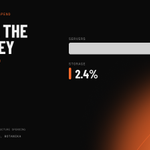
The number in the image isn't a projection or a market-size slide. It's demand already waiting for the network, and it's the number our whole team plans around.
Big week ahead for us.


In 2017, Tesla unveiled the next-generation Roadster and promised deliveries in 2020.
Yesterday, it finally showed a redesigned version that can perform mid-air manoeuvres using SpaceX-developed thrusters. Production is now targeted for 2028.
Nearly nine years between the original reveal and the latest demonstration.
It’s a fascinating case study in technological ambition. The vision stayed alive long enough for the technology around it to evolve, but the timeline also shows how difficult it is to turn a radical concept into a production product.
#Tesla #Roadster #SpaceX #technology


Everyone's building an AI agent rn 👀
The real plot twist? agents are starting to enter the economy.
They need data. compute. APIs. other agents to delegate work to. and eventually, a way to pay for all of it.
That's where crypto gets interesting.
Stablecoins let software pay for services 24/7. wallets give agents a way to transact within defined limits. onchain records make those transactions verifiable.
CoinDesk reported this week that AI agents have made 138M crypto payments.
We're still early, and transaction counts alone don't tell us how much real economic value is being created.

What if we could test a drug on a virtual human cell before entering a laboratory?
Biohub, Google DeepMind, Meta and US research agencies are backing a $1.8B initiative to make this possible.
The goal is to train AI models on massive biological datasets to predict how cells respond to drugs, mutations and environmental changes.
And it all starts with data.
@biohub, @Google, @Meta
10 years of data evolution in 30 seconds.
From 2016 to 2026:
2016 | Cloud storage makes data more accessible.
2018 | Big data becomes mainstream.
2020 | Real-time analytics transforms decision-making.
2022 | Data platforms become essential to AI.
2023 | Vector databases power semantic search.
2024 | Lakehouses unify data storage and analytics.
2025 | AI agents demand reliable, structured data.
2026 | Data becomes the infrastructure behind AI.
2030 → ?
What comes next?

Microsoft and Google are backing Apache Ossie, an open-source project designed to make analytics models portable across different tools.
Could this be the future of data analytics?
