







the biggest issue with sales navigator scrapers is that they require your linkedin account
you put yourself at risk, it’s your cookies
ours fully runs on the cloud
blows my mind that more local service businesses aren't using public data to find customers...
you can detect events that CREATE demand for your service and find potential customers BEFORE they even start looking.
hailstorms = roofers, window installers
renovation permits = electricians, contractors
new business licenses = cleaners, signage
property sales = movers, landscapers
here's how i'd build it:
1. Python + weather .gov/NWS to monitor storms and severe weather reports
2. ArcGIS/Socrata APIs + county records to pull permits, licenses and property sales
3. Regrid API + PostGIS to match events to properties and identify owners
4. BatchData to skip trace homeowners and enrich business contacts separately
5. Postgres + cron to detect new events, deduplicate and score leads
6. Python + an LLM to classify records and generate relevant outreach angles
might be worth building this instead of dumping thousands into the same recycled leads every other contractor is buying lol


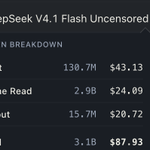
i've burned through 3 BILLION tokens on uncensored deepseek v4.1 flash in the past 24 hours for $87
if you're still defaulting to claude and chatgpt for everything you're ngmi
PLEASE spend a weekend going down the chinese open-weight model rabbit hole. deepseek, qwen, kimi, glm, uncensored fine-tunes, abliterated models, local inference, all of it
the price/performance on some of this shit is genuinely ridiculous and 99% of people have no clue it even exists
you can run smaller models locally with Ollama, LM Studio or MLX. larger models through Venice AI or other inference providers. plug them into OpenCode and suddenly you have a coding agent with terminal access, browser tools, filesystem access, whatever you configure
YOU DO NOT NEED TO BE LOCKED INTO ONE MODEL OR PROVIDER
here's a prompt. literally paste this into your coding agent:
"research the current chinese open-weight model ecosystem. deepseek, qwen, kimi, glm, plus uncensored and abliterated variants.
inspect my hardware and figure out what i can run locally with Ollama, MLX or llama .cpp. for anything too large, compare hosted providers including Venice AI.
compare actual output tokens/sec, TTFT, context limits, input/output pricing, cache pricing, coding ability and tool-calling reliability. find the best options for my actual workloads, not benchmark leaderboards.
set up OpenCode with the best local and hosted models for my budget. configure the providers, test tool calling, optimize context usage and benchmark identical tasks across endpoints.
show me the fastest, cheapest reliable setup you can actually get working. verify everything before changing my existing configuration."
ALSO PLEASE understand that the model and the inference provider are two different things
you can have the EXACT same weights running at wildly different speeds depending on who's serving them. check real decode speed, not advertised throughput
prefix caching, context compaction, quantization, model routing. look into this shit. your agent could be spending more money rereading old tool outputs than actually solving anything
and stop using expensive reasoning models for tasks a tiny local model or 20 lines of python could handle
there's so much money being wasted on AI subscriptions by people who haven't even tried running a model outside a chat window
it's actually insane


>gives ai access to bank
>gives ai access to slack
>doesn't put restrictions in place
>ai sends slack message with bank details
>"wtf!!!"


caiden retweeted
0-100k: freelancing or a service you do yourself. trade time for money, stack cash, learn how to sell
100k-1m: agency or productized service. hire people to do the fulfillment, you focus on sales and systems
1m-10m: info products, coaching, or software. something with leverage where you're not adding headcount for every dollar of revenue
10m-50m: software or holding company model. acquire or build assets that print without you
50m-100m: PE, rolling up businesses, or exits. you're playing a different game now - it's about capital allocation not operations
100m-1b: investing, venture, mega exits. at this point you're not building you're deploying capital into things that compound
the mistake is trying to skip steps
everyone wants to jump to software or investing before they've stacked the cash and skills from the earlier stages
each level teaches you something you need for the next one


caiden retweeted

Before Drake became who he is today, he was spending $5k/month renting Rolls Royce Phantoms
He’d also borrow his uncle’s car and drive women through the wealthiest neighborhoods in Toronto
At face value, it may come off as if he was just larping, or perhaps acting out of insecurity
But the truth is much simpler
Drake understood the psychological advantage of removing the novelty from the things you desire
As long as a certain life remains completely foreign to you
Some part of your mind will continue rejecting the possibility of it ever becoming your “normal”
So the ulterior lesson is that manifestation will remain nothing but mental masturbation so long as it isn’t followed by aggressive, and oftentimes risk-laden action

anyone who's turbo autistic and riddled with ADHD has to actively resist starting a new company every time something interesting catches their attention
AI can now clone a competitor's frontend and core backend in a day
dangerous amount of freedom to give us LOL

if you're using claude to build web scrapers, feed it this context before letting it write another 800 lines of Playwright
some interesting rabbit holes worth going down:
HAR diffing
capture two network sessions, change ONE variable between them and have claude compare the request bodies, parameters, response structures and dependency order.
repeat across searches, filters, pagination etc.
you can start piecing together the underlying query model without having to automate every interaction through the browser.
AST analysis
rather than manually digging through 40,000 lines of compiled javascript, have claude parse the relevant bundles into an abstract syntax tree using Babel or Acorn.
trace request constructors, shared API clients, pagination handlers and response transformations. have claude correlate what it finds against your HAR captures.
source maps
check for exposed `.js.map` files containing `sourcesContent`.
depending on the build configuration, these can reconstruct portions of the original readable frontend source.
feed claude the recovered modules alongside your network captures and have it map the API clients, field transformations and application state.
minification ≠ encryption.
hydration payloads
inspect the initial HTML for `__NEXT_DATA__`, Nuxt payloads and React Server Component flight data.
some frameworks serialize application state into the initial document, meaning the records you're looking for might already be present before client-side hydration even begins.
have claude compare these against subsequent network responses.
schema inference
capture 20–30 DIFFERENT JSON responses. different searches, record types, filters, etc.
have claude generate a union schema, identify optional fields, nested attributes, inconsistent types and null behaviour.
last thing you want is an extractor that works beautifully on your first 100 records and silently drops useful attributes across the next million.
response transformations
compare raw server responses against the actual records displayed in the UI.
frontend code can merge objects, rename attributes, calculate additional values or discard fields entirely before rendering.
have claude reconstruct those transformations and map the original response fields.
occasionally the interface is showing you substantially less information than the server actually returned.
incremental acquisition
look into ETags, Last-Modified, update timestamps, stable identifiers and content hashing.
where supported, these can help identify which records actually changed instead of collecting and processing the same dataset every single run.
especially interesting once you're dealing with millions of records and recurring refreshes.
data reconciliation
take samples from multiple sources and have claude construct a canonical schema.
normalize company domains and identifiers, compare timestamps, preserve field-level provenance and assign confidence scores where information conflicts.
also please stop deduplicating companies by name alone. you are going to merge 14 unrelated businesses called Apex Solutions into one entity.
extraction observability
have claude build checks for schema drift, unusual null rates, unexpected pagination behaviour, duplicate inflation and sudden changes in record counts.
a scraper crashing is whatever.
a scraper running successfully for 3 weeks while quietly producing incomplete datasets is a much more expensive problem.
also worth having it generate a small validation report after every acquisition rather than trusting a successful exit code.
there's a LOT more to scraping than making a browser click buttons.
understand the data pipeline before you automate it.
