

Tips and advice on #paganism and #polytheism. Not an interactive account. 💞 Giving offerings to the Gods is the core of #theurgy. 💞 All clipart from Canva.
- Tweets406
- Following0
- Followers646
- Likes0




ALT Why Worship Gods? Platonists are fond of saying that the world is full of Gods, quoting from a pre-Socratic philosopher named Thales. Platonists like Proclus add that everything prays, each in its own way, just by nature of being what it is — like a sunflower following the sun. So, if every life form in the universe is already praying, why do anything extra? The infographic sections have been appended as additional tweets because they exceed the alt text character limit.

ALT Text reads: “Virtue might be described as the perfection of the soul and proper balance of its life and as the highest and purest activity of reason and intellect and discursive intelligence. Let the acts of virtue be taken, above all, as being boniform, excellently fine, intellectual, noble, full of moderation, participant in appropriateness, promoting moral advancement, aiming at the best end, and graceful.” Iamblichus, Letter 16: To Sopater, “On Virtue,” trans. Dillon and Polleichtner. Image shows hands gripping wrists and forming a circle.

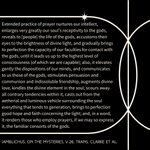
ALT "Extended practice of prayer nurtures our intellect, enlarges very greatly our soul’s receptivity to the gods, reveals to [people] the life of the gods, accustoms their eyes to the brightness of divine light, and gradually brings to perfection the capacity of our faculties for contact with the gods, until it leads us up to the highest level of consciousness (of which we are capable); also, it elevates gently the dispositions of our minds, and communicates to us those of the gods, stimulates persuasion and communion and indissoluble friendship, augments divine love, kindles the divine element in the soul, scours away all contrary tendencies within it, casts out from the aetherial and luminous vehicle surrounding the soul everything that tends to generation, brings to perfection good hope and faith concerning the light; and, in a word, it renders those who employ prayers, if we may so express it, the familiar consorts of the gods."

ALT Image is of a woman with a finger over her lips. Text is from Proclus on Plato’s Parmenides, 718: Nor do we think it proper to put in speech all that we think of, for there are many matters that we keep secret and unexpressed, preferring to guard them in the enclosures of our minds. Nor do we put in writing all that we express in speech; we want to keep some things in our memories unwritten, or deposit them in the imaginations and thoughts of friends, not in lifeless things. Nor do we publish indiscriminately to all the world everything that we commit to writing, but only to those who are worthy of sharing them, indulging with discrimination our eagerness to make our treasures common property with others.

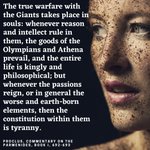
ALT Image is of a woman looking to one side, dirt covering her face. Text reads, “The true warfare with the Giants takes place in souls: whenever reason and intellect rule in them, the goods of the Olympians and Athena prevail, and the entire life is kingly and philosophical; but whenever the passions reign, or in general the worse and earth-born elements, then the constitution within them is tyranny.” Proclus, Commentary on the Parmenides, Book I, 692-693

ALT Text reads: “Thus, my friend, when someone actualises what really is the most divine activity of the soul, and entrusts herself only to the ‘flower of the intellect’ and brings herself to rest not only from the external motions, but also from the internal, she will become a God as far as this is possible for a soul, and will know only in the way the Gods know everything in an ineffable manner, each according to their proper one.” Proclus, Ten Problems Concerning Providence, §32. Image is of a woman at rest with her eyes closed.

ALT A woman stares up at a cliff and a leafless, scraggly tree. Text is from Damascius, on Plato’s Phaedo, §130. Like Kore, the soul descends into genesis; like Dionysos she is scattered by generation; like Prometheus and the Titans she is chained to the body. She frees herself by acquiring the strength of Herakles, gathers herself together through the help of Apollo and of Athena the savior — by truly purifying philosophy — and she elevates herself to the causes of her being with Demeter.

ALT Image is of an older girl/teen dancing and skipping in what is presumably a shoreline rock situation. Text reads, “[T]he finest and truest of all principles, in my view — which is that for the good person, in the natural order of things, sacrifice to the gods, contact with them by means of prayers and offerings, and religious observance of every kind is at all times finest and best, the most likely to result in a happy life, and far and away the most appropriate thing for [them].” Athenian Stranger, Plato, Laws, 716d

ALT Text reads: “The fountain of honey is that of pleasure, because of its sweetness and the ecstasy it brings; hence the Pythagorean saying that souls fall down into genesis through honey; the fountain of water is that of intelligence because of its sobering quality.” Damascius, On the Philebus, §229. Background is a honeycomb.


ALT Text reads: “Nothing human is worth as much as a clear conscience. A person should indeed live together with their fellow-humans in a decent manner, and if the true good is contrary to the apparent good, never prefer the latter nor give greater importance to anything other than Truth — not the danger of an impending struggle, nor a difficult task from which one turns away in fear; nor the profit gained from undeserved praise; nor a long-standing friendship nor the obligations which arise from family connections.” Damascius, Philosophical History/Life of Isidore, §146

ALT Text reads: “We must be able to refute falsehoods and to do this without being vehement or haughty; rather we must pursue the truth with gentleness and refute falsehood with gracious methods of argumentation, ‘gently withdrawing’, as the poem says here. ‘And if some falsehood be told’, we should not concede that it is as said but listen without getting angry. For ‘take it lightly’ does not mean we have to assent to falsehood, but rather that we lend a tolerant ear and not be ‘perplexed’ if there are certain people who have fallen away from the truth to their harm.” Hierocles, Commentary on the golden verses of Pythagoras, trans. Hermann S. Schibli. Background is a keyboard, with hands typing.