

Co-founders in your journey of Wealth creation SEBI Registration links: https://nitter.cf/t.co/R0VqTRH8aP https://nitter.cf/t.co/eqn419wqdD
Mumbai
Joined March 2024
- Tweets1.1K
- Following7
- Followers8.5K
- Likes534
Pinned Tweet
It’s time to take a step back and get a second opinion first.
Whether you are a founder making an exit or a parent planning your child's education, the biggest financial decisions of your life always invite many opinions. But your wealth needs someone who understands your ambitions.
That’s where Ionic Wealth AI comes in. It puts institutional-grade wealth intelligence at your convenience.
It reads your financial history, remembers every conversation you have had, and reasons across your entire financial life before answering a single question.
It will sometimes tell you to wait, and occasionally it will disagree with you outright. We consider that the point, because the decisions you choose not to make matter as much as the ones you do.
You still decide everything yourself. Ionic Wealth AI ensures you never do it blindly.
So, take a step back and get a second opinion first.
Download the Ionic Wealth app to begin: ionicapp.onelink.me/O8Xg/cjx…
The BOJ’s decision to hold rates comes amid a broader pause in monetary tightening by major central banks, thereby signalling a data-dependent and calibrated policy approach. Persistent inflation risks from the Middle East conflict, alongside already elevated bond yields, have encouraged policymakers to assess the transmission of previous tightening. The case for further normalization remains intact, with yen depreciation, wage growth and persistent supply-side constraints keeping upside inflation risks elevated.
The dissenting vote in favour of a 25-bps hike to 1.50% underscores differing views within the committee on the pace of normalization, while a recent Bloomberg survey points to a potential rate hike in December. BOJ remains proactive in curbing yen depreciation, with USD/JPY near 160 a key level at which Japanese authorities could step up FX intervention. While yen volatility could weigh on foreign flows, fiscal support, AI-related demand and reasonable valuations (19.8x fwd P/E) underpin our constructive view on Japanese equities.
Read More: ionic.in/blogs/global-invest…

The ECB's decision to hold rates was in line with market expectations, as it continues with a data dependent, meeting by meeting approach. Although the ECB President acknowledged concerns around economic growth, the tone remains hawkish, with inflationary pressures continuing to outweigh downside risks to growth. Having said that, heightened global macro uncertainty, given continued unrest between the US and Iran and the ongoing conflict between Russia and Ukraine, may prompt the ECB to raise rates further to curb inflation.
Any further rise in rates could put additional pressure on Eurozone yields, which are already elevated. All three major central banks, the US Fed, the ECB and the BoJ, remain on a path of tighter policy, with the Fed and the ECB choosing to pause at their current meetings. With inflation and interest rates likely to stay higher for some time, we believe a more diversified approach across asset classes and geographies remains favourable.
Read More: ionic.in/blogs/global-invest…
The future of uranium demand is closely tied to how the world’s energy needs are evolving. Nuclear power is becoming an increasingly important part of that picture.
As countries look for reliable sources of electricity, existing nuclear reactors are expected to operate for longer, while new projects continue to take shape. Both developments matter for uranium: reactors that stay operational need a steady supply of fuel, and new reactors will add to that demand as they come online.
The scale is significant. Of the 423 GWe of nuclear capacity currently in operation, 403 GWe is projected to remain operational through 2036. Beyond these existing reactors, projects under construction, planned and proposed could provide further support for future uranium demand.
The market is already reflecting this longer-term outlook. The long-term uranium price indicator has reached USD 97 per pound, as utilities secure fuel supplies through multi-year contracts.
With existing reactors expected to run for longer and new nuclear capacity in the pipeline, uranium is drawing attention as countries plan for their future energy needs.
To explore the trends shaping uranium demand and its long-term outlook read Investing Pantheon October 2026 report.
Read More: ionic.in/blogs/global-invest…

For four decades, the 60:40 portfolio rested on one assumption: when stocks fell, bonds would rally.
That assumption no longer holds.
First, the equity leg now rides on a single theme.
* The Magnificent Seven make up roughly a third of the S&P 500, up from about 12% in 2015.
* Nvidia alone is worth more than the bottom 150 constituents combined.
* Even in emerging markets, Korea and Taiwan dominate as suppliers to the same AI capex cycle.
Most ‘global’ equity allocations simply add more of the same AI trade under a different label. The S&P 500 index now tracks seven balance sheets and one capex cycle more closely than it tracks the American economy.
Second, bonds no longer act like the umbrella they once were.
When a slowing economy hit stocks, central banks reduced repo rates, bond prices rose, and the umbrella opened.
Today, bond prices answer to government borrowing. US debt crossed $40 trillion in August 2026, and heavier issuance pushes yields up, whatever the economy is doing.
Today's bond yields are also a function of AI-related borrowings.
The umbrella now opens on some days and stays shut on others.
In 2022, a 60:40 portfolio lost 17.5%, its worst year since 1937, as bonds and stocks fell together. By mid-2026, the stock-bond correlation had turned positive again.
In our latest Substack, Ankita Pathak, Head of Global Investments at Ionic Asset, looks at whether the 60:40 portfolio still makes sense today. She also sets out an alternative allocation strategy that handles volatility better while still leaving room for growth.
Read: ionicwealth.substack.com/p/w…

Second meeting following the September 2026 rate hike, the US Fed decided to hold the rates steady, signalling a calibrated, data-dependent approach. Overall economic growth and labour markets remain sufficiently strong, giving the US Fed time to focus on price stability for now. December 2026 hike seems likely, aligning with the dot plot published in the last policy. US treasuries yields have softened from extremely elevated levels amid renewed safe-haven demand.
Market focus now shifts to upcoming policy decisions from ECB and BoJ, alongside potential volatility ahead of the US midterm elections on November 3, 2026. While both central banks are expected to maintain current rates, any unexpected hawkish shift could pressure the USD. Domestically, India has also decided on a tighter policy and may continue to hike rates in order to curb both inflationary pressures and INR depreciation.
Read More: ionic.in/blogs/global-invest…

The world’s investment opportunities extend far beyond the markets we see every day.
But where are the opportunities emerging? What are global investors watching? And how can Indian investors look beyond borders to build wealth?
World Wide Wealth brings global perspectives closer to home, through conversations with the people whose expertise brings clarity to the forces shaping global markets.
Hosted by @ankitapathak_ , Head of Global Investments at Ionic Asset.
Coming soon!
Anthropic’s S-1 filing ahead of its planned IPO offers a rare look inside the economics of one of AI’s fastest-growing businesses.
From $376 million to $11.6 billion in revenue over just six quarters, nearly a 31-fold increase - Anthropic’s growth reflects the scale of opportunity emerging across AI. Yet, the faster an AI business grows, the more important it becomes to understand what lies beneath its revenue numbers.
For Anthropic, the story extends beyond rapid growth. Improving compute efficiency and stronger operating leverage offer a path towards better margins and cash generation, even as substantial fixed costs and long-term infrastructure commitments shape the road ahead. Though much will depend on how effectively the company scales inference while continuing to develop best-in-class AI models.
In this edition of #TuesdayTechTrivia, we explore the economics behind Anthropic’s expansion, the balance between growth and investment, and what could shape its path towards sustainable profitability.
Read More: ionic.in/blogs/global-invest…

The next two weeks could be a defining test for Indian equities.
India’s September-quarter earnings season so far appears to have delivered strong growth across market-cap segments, reinforcing the underlying strength of corporate earnings. However, the near-term outlook is becoming more complex as a series of global events converge between 27 October and 5 November.
From key central bank decisions by the Fed, ECB, BoJ and BoE to the US midterm elections, the coming days could have significant implications for market sentiment, crude oil prices, currency movements and liquidity flows.
With strong earnings on one side and heightened macroeconomic and geopolitical uncertainty on the other, the key question is how these competing forces could shape the next phase of Indian equities.
Our Chief India Strategist @harshmadhusudan breaks down the risks and opportunities across different scenarios, the critical market levels to watch and the factors guiding our current positioning.
Read the full analysis here: ionic.in/blogs/market-perspe…

Lula’s runoff win has disappointed markets, likely unwinding part of the rally that followed Flávio Bolsonaro’s first-round lead. Brazilian assets had performed strongly heading into the vote, with MSCI Brazil rising 32.2%, Ibovespa rising 28.2% and the Brazilian real appreciating 9.1% year to date. Continuity in a spending-led policy approach raises questions over debt sustainability and fiscal targets, and could weigh on the real and push up bond yields, while higher imported inflation could slow or pause Selic cuts. Bolsonaro’s refusal to concede adds near-term political noise.
A right-leaning Congress, however, should check more expansionary policies. Key signals will be the choice of finance minister, the 2027 budget and spending cap, and the 4th November Copom decision. Fiscal policy is only one part of the Brazil thesis: valuations remain undemanding (12M Fwd PE at ~9.3x), earnings momentum is strong (12M Fwd EPS grown by ~25% YTD) and the market may continue to benefit from exposure to agriculture and energy exporters, which could gain from a weaker real, as well as from diversification away from AI-concentrated markets.
Read Here: ionic.in/blogs/global-invest…

Ionic Wealth retweeted

SIFs are a year old and have grown to Rs 38,224 crore.
How have they done against mutual funds and the Nifty YTD?
Hybrid SIFs: +9.6% (BAFs: -1.5%)
Equity long-short SIFs: -1.8% (Large caps: -6.9%)
Ex-top 100 SIF: +13.1% (Small caps: +11.4%, Mid Caps: 1.9)
Nifty 50: -11.7%
#SIF Writes @imNavneetDubey

Europe’s gas market is facing a winter test, and the margin for error is shrinking.
Gas storage across Europe has fallen to 72% of its long-term average, well below the 86.7% benchmark. In simple terms, Europe has less gas in reserve than it would typically have had at this point, leaving it with less room to handle a sudden rise in demand or a disruption in supply.
But the concern is not just about having enough gas. It’s also about how much Europe will have to pay for it. Gas prices in Europe are relatively higher than that in the US, thereby adding to the cost pressures faced by energy-intensive industries.
With Russian pipeline supplies still limited, Europe is relying more on liquefied natural gas (LNG) imported from global markets. If winter turns colder than expected, demand could rise, supplies could tighten and gas prices could climb further.
The impact could extend beyond energy bills. Higher gas prices can increase production costs for industries, squeeze business profits and put further pressure on Europe’s economic growth.
As temperatures drop, Europe will need to balance the need for reliable gas supplies with the challenge of keeping energy affordable.
To understand the evolving European gas market and its wider economic implications, read the Investing Pantheon October 2026 report.
Read More: ionic.in/blogs/global-invest…

SIFs have completed one year, and the industry has grown nearly 19-fold since its first official monthly data in October 2025.
According to AMFI data, SIF assets under management (AUM) stood at ₹38,267 crore in September 2026, up from ₹2,010 crore in October 2025.
Hybrid SIFs remain the largest category, accounting for 63% of industry assets. But other categories are also coming up. For context, hybrid SIFs had 75% share in March, suggesting other categories are gaining ground.
Curious to see how SIFs have stacked up against mutual funds over the past year? We’ve compared their performance across MF categories in our latest Substack.
Substack: ionicwealth.substack.com/p/s…

AI’s next bottleneck may not be computing power, but the energy and infrastructure needed to sustain it.
As AI workloads grow and data centre racks become denser, power availability and heat management are becoming increasingly critical. This is driving demand for advanced cooling systems, power equipment and more efficient ways to manage energy.
The result? Power and cooling are emerging as key parts of the AI infrastructure investment story, creating opportunities for equipment providers while bringing new capacity constraints into focus.
So, what is driving this demand? Which technologies are helping data centres manage rising power and cooling requirements? And which companies stand to benefit?
In this edition of #TuesdayTechTrivia, we continue our AI data centre series by exploring AI’s energy equation - from power requirements and cooling technologies to infrastructure bottlenecks and the companies positioned to benefit.
Read More: ionic.in/blogs/global-invest…

As SIFs complete their first year, we look at how they have performed against mutual funds in similar categories.
We compared returns across three periods:
1) The market downturn between 2 January and 30 March, when the Nifty 50 fell 15.2%;
2) The recovery between 30 March and 3 August, when it rose 10.9%; and
3) Year-to-date returns, as of October 15.
The numbers reveal an interesting pattern.
SIFs have generally held up better than mutual funds during the downturn, but lagged them during the recovery.
Here’s how the two stack up. (See table below)
Disclaimer: Past performance is not indicative of future returns.
Read: ionicwealth.substack.com/p/s…

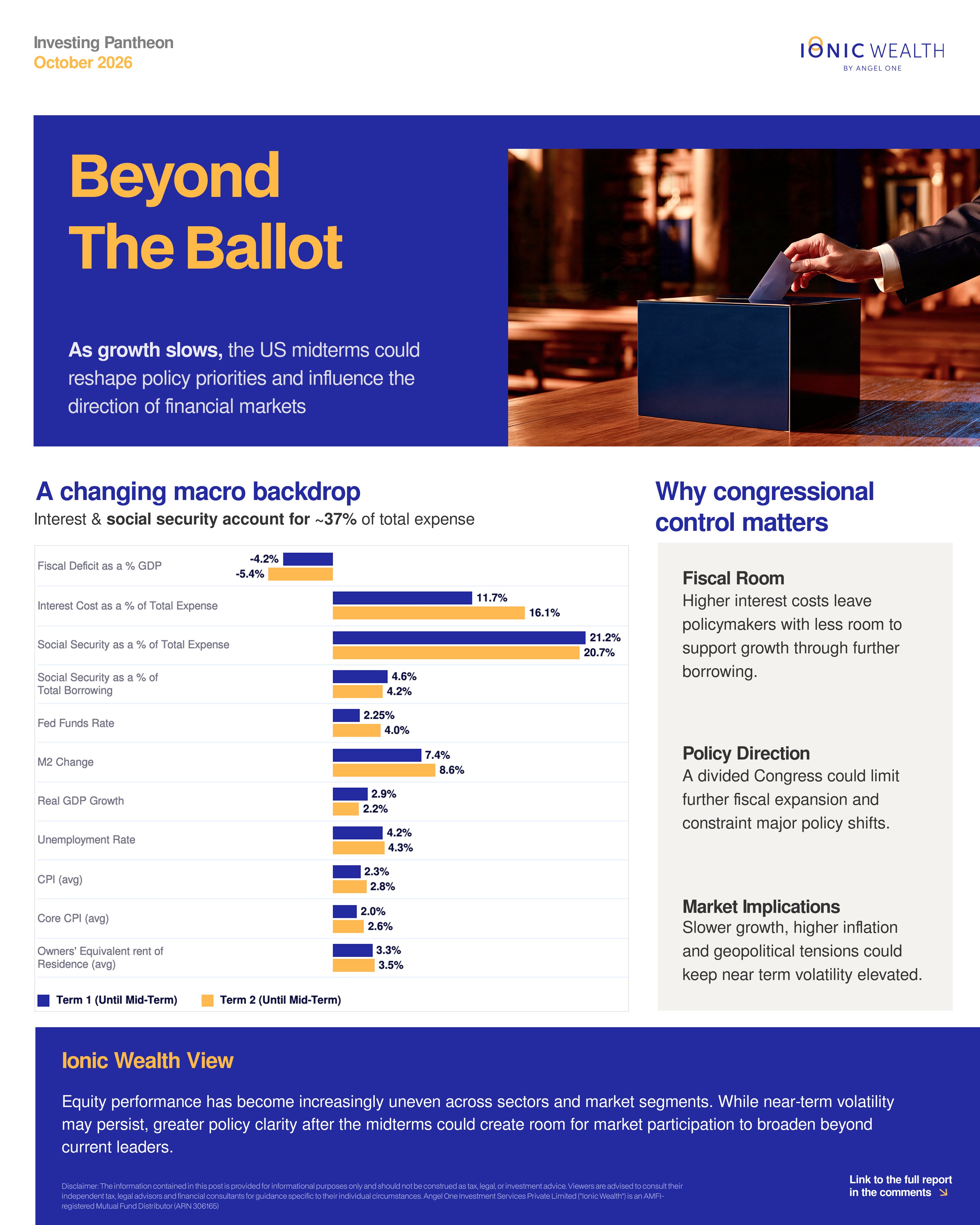
What happens if the people making economic policy no longer have the votes to push it through?
That is the question facing markets as the US heads into its midterm elections on November 3.
With economic growth slower in President Trump’s second term than in the first, the direction of policy becomes an important part of the outlook. With control of Congress at stake, the outcome could influence how easily the government moves forward with spending plans and economic policies over the next two years.
A divided Congress could change the direction of fiscal policy, with potential implications for inflation, interest rates and equity market performance.
What’s more the effects may not be uniform, with different sectors responding differently to evolving policy priorities and market expectations.
For investors, the focus goes beyond who wins or loses. It is about understanding how the interplay between economic growth, political control and policy direction could shape the market outlook.
To understand how the evolving US economic and policy landscape could influence global markets, read the Investing Pantheon October 2026 report.
Read More: ionic.in/blogs/global-invest…
Wealth management is not just a growing industry. It’s also evolving rapidly.
Over the past quarter, we’ve seen how AI is reshaping industries, improving how we live and work while making some activities redundant.
At Ionic Wealth, we believe progress is about more than headline numbers. It’s also about staying ahead of change and helping shape the future of wealth management.
In that regard, the past three months have been action-oriented. We have reported strong numbers, and on top of that, we’ve built strong pillars for what's ahead, including:
1) Launch of Ionic Wealth AI - institutional-grade investment thinking via wealth intelligence in our app.
2) Making investment opportunities more accessible - through digital accreditation and for global access via GIFT City.
3) We are also looking forward to what’s ahead, with tailwinds from the new regulatory framework around portfolio management.
As these changes take shape, our focus remains on combining technology, investment expertise and evolving market opportunities to help investors make better-informed decisions.

The market regulator has allowed global allocation in PMS schemes.
Starting April 1, 2027, PMS managers can include global securities in investors’ portfolios.
But why does it matter?
Research shows that, over time, a traditional 60:40 portfolio of domestic equities and debt underperforms portfolios that allocate part of their investments to global securities.
Indian investors understood this and increased their allocation to global securities. But PMS managers could not invest outside India.
Investors who wanted global exposure had to open a foreign brokerage account and pick foreign stocks themselves or buy an overseas fund. PMS remained limited to domestic allocation.
For the PMS industry, this is similar to the ‘Mark 50’ moment. Remember Mark I, the first Iron Man suit, built inside a cave and armed with little more than a flamethrower? It did the job, but Tony Stark kept updating the suit.
By Mark 50, he had added nanotechnology, arguably the biggest upgrade to the Iron Man suit. The PMS industry has also evolved, but allowing global securities could be the change that makes the PMS structure a game-changer.

Read the full post on the Ionic Wealth Substack.
A new post every Saturday.
Here: ionicwealth.substack.com/p/i…
AI data centres may be built around powerful GPUs, but networking determines how efficiently they work together.
As AI workloads grow, the need to move massive amounts of data between GPUs is driving demand for faster switches, higher-bandwidth connections and advanced optical technologies. At the same time, the shift towards larger AI clusters is creating new opportunities across the networking ecosystem, from Ethernet and InfiniBand to optical interconnects.
The result? Networking is becoming an increasingly important part of the AI infrastructure investment story.
So, what is driving the surge in AI networking? How are rising speeds reshaping the demand for copper and optical connections? And which technologies and companies stand to benefit the most?
In this edition of #TuesdayTechTrivia, we continue our AI data centre series by exploring the networking layer of the stack - from switches, NICs and cables to bandwidth, emerging technologies and the competitive landscape.
Read More: ionic.in/blogs/global-invest…
