
Bristlemoon Capital | https://nitter.cf/t.co/GvT4Tt3YPW | Views are my own and not investment advice
Australia
Joined July 2018
- Tweets819
- Following401
- Followers3.7K
- Likes258







$FICO CEO just lost the plot on Q4 earnings call!
“Ashish, I guess I can't blame you for asking the question, but maybe it's time for me just to explain a little bit of a change in philosophy and in how we talk about our pricing and our programs and so on. I know, I think you all know, it's no secret that transparency and detail on our programs and pricing have not been particularly helpful for FICO. We were of a view for many years that because the FICO score at $10 or $4.95 or whatever we were charging, was such a tiny fraction of overall closing costs, we really didn't think that the price was a very big deal. We thought that the value so far exceeded the price that why not share details around the pricing just so that everyone understands how little it is in the scheme of things? As you all know from watching events over the last several years, we've really been attacked for, you know, what we consider to be, you know, not very good reasons. We're attacked because we're transparent and clear about our score price. As you all know, the credit files cost a lot more, credit evaluation costs are much more.
In fact, every other element of the closing is a lot more than what FICO charges. Yet somehow FICO has become the poster child for affordability in housing, which is just a crazy thing. Internally, we have had a lot of conversations about has this transparency been helpful, and the conclusion is no, it has not been helpful. I think you guys know that we have probably been in the top decile of open transparent, help everyone outside understand what we are doing inside, but it has not really worked very well for us. On a go-forward basis, our intention is to not share every detail. We are not going to share every pricing program. We are not going to share what the prices are. We are not going to share all of the terms. They are going to be customized, but by customer to meet customer needs. We are just not going to provide all that kind of information. To your very specific question, is the average price of a FICO Score going up, down, or sideways? We are not going to answer that. You guys who have been watching us and watching the industry can understand exactly why we are not going to answer that.”
Yikes 😬
Based on Elon’s Law, this is what will happen.
First TSMC, then the Dems, will prevent an AI infra bubble.

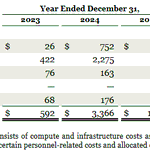
So $ANT has spent just over $19B on compute basically since inception. Gross this up to the equivalent of $80-100B of capex.
For the cost of one year of Reality Labs, we got Mythos 5, Opus 5.5, Fable 5.5, whatever 6th gen models Ant is using internally.
1) Is this bullish or bearish for the AI infrastructure trade?
2) Is this bullish or bearish for any org that is spending $100B+ capex per year chasing the frontier?
Two things from $SPCX today.
[preface this with Elon's singular ability to secure funding - so let's assume he's good for whatever amount this will cost]
1) If SPCX can bring 10GW online in 2027 as an exclusive $NVDA customer, that's probably ~40% of ccs data centre revenue for NVDA. If Jensen allows this level of single-customer concentration, the compute market will likely remain extremely tight in 2027 because maybe 20% of incremental compute flops is going to a single hyperscaler that also doesn't have much 1P model inference to serve. (and >half of incremental TPU flops prob goes to a single customer as well)
If that's the case, compute available to rent in 2027 should also remain extremely tight, which means the $40-50B/GW scarcity pricing SPCX is getting on its short-term rentals might persist for longer than anyone expects (maybe Elon is not bullshitting with $500B ARR). This constrains competing frontier labs' access to compute (except Meta) while giving XAI multiple GW of training compute that can be paid for with ~1Y of GPU rental revenues (e.g. 4/6GW rental/training split).
This could also prove hugely beneficial to the smaller neoclouds. If the party that corners most of the rental compute market is renting out at $40-50B, this should help the neoclouds secure higher pricing for their multi-yr contracts (say >$25B/GW) and possibly better prepayment / backstop terms. Anything that makes the NVDA neoclouds less fragile is a tick in Jensen's books.
Maybe even Zuck gets in on the rental action, which should mitigate the inevitable (IMO) disappointment with Muse adoption and retention (let alone monetisation).
2) Surely a single hyperscaler (which wasn't even on the scene a year ago) confident in bringing on 10GW incremental power in 2027 and gunning for 20GW stretch target using "every other source of power we can obtain" is a big tailwind for a broad swathe of the power equipment vendors?
Daniel Wu retweeted

I've been critical in the past of AI compute indexes and the willingness to price compute based on the spot rental price, but now that the AI reset is sinking into the repricing of AI buildout debt its time to realize that the cost of capital is what determines the price of compute.
The most important number in GPU pricing right now isn't $/GPU-hour. It's the gap between what a hyperscaler pays to borrow (~90bp over Treasuries) and what a neocloud pays (~1,100bp).
The cost of compute is now set by the cost of capital, and the spot rental rate no longer tells you much.
The price of an H100 isn't one number. The same chip in the same rack costs a different amount depending on whose balance sheet it sits on. A ~1,000bp funding gap is a structural cost advantage that no amount of operating skill closes.
For example, take one GPU-hour apart. Most of it isn't power or space. It's paying back the chip, the interest on the loan that bought it, and the return the equity expects. A $40–55k all-in GPU, 75% debt-funded, at ~7,000 utilized hours a year is a financing instrument that happens to do matrix multiplication.
As the +500bp on neocloud debt (10%→15%) adds $0.20–0.30 to the break-even cost of every GPU-hour, which is then added on to the rental price.
That's 8–10% of the H100 index, from a credit spread alone, driven almost entirely by the cost of capital.
That means that the compute spot index is a derivative of the AI infra debt credit curve and the squeeze on neocloud margins.


Daniel Wu retweeted

市场被7月惊吓之后,有点不太敢炒缺货 ie MLCC一直缺货涨,Murata/Taiyo也没大涨
As you known, Im not a fan of bottleneck trade 我也炒,但明白“可炒,不可投资”
相同部件纯靠涨价—就是周期股的定义。卡脖子三年,不代表股票能涨三年。相反,股价会在短期打满涨价缺货预期
一、在缺货预期出现后继续涨,你必须证明
1. 能进一步无序涨价
2. 或确定缺货周期更长
3. 产能可以“持续”显著提高,且能保持“持续”涨价(这本身就有矛盾—如果真可以就不是周期股了,是NV了)
即使3点中你认为有可能,跟买marginal benefit也太低
因为,会存在“变数”包括
——谣言谁谁又delay了—本质你没有“拿5年删IB”的信心(挑战)
——可能竞争与类似的rumors:投入研发、产能拼一个别人占领技术、产能高点的存量市场无异自杀。但很多零部件公司的绝对垄断过去就是建立在上述存量市场上的,当AI大需求浪潮席卷过来。后起之秀的试错成本就变得很低了—-看看CXMT
二、所以缺货trade最靠谱的是“先信”
买在无人问津处,等他缺货预期起来,连X都知道缺货了就跑。这样marginal benefit才值得
我不会跑在盈利最高,因为盈利周期和股价周期lag很大。更高赔率的是跑在预期落地。我承认上述1/2/3都很可能发生,但是鱼为有肥有瘦
三、切记是“炒”
与需求无关,别“炒”缺货还说需求,你都定义是瓶颈了
与盈利无关,缺货票盈利真爬坡就该跑了
要知道瓶颈是机会也是挑战
机会是让公司忽然莫名其妙赚居多钱;让本来要死的后发者,在提价能吃残羹剩饭也能活好、能站稳脚
挑战是因为你掐脖子,所有产业中优秀的人都会研究怎么“优化”使用你、有没有替代方案
周期大浪平息之后,必然一地鸡毛(所以没人敢拿5年)
四、“投资”什么
投资产品持续迭代
1. 由良率提高、产品迭代持续提高毛利的公司
2. 因为本身产品迭代在带动行业进步,供货商/客户设计是围绕你的R&D进步迭代的。由一圈公司形成生态,门槛不是自己而是产业
现在半导体中就一句话总结:你这个公司是不是在贡献token deflation,并且还能在这个过程中提毛利、提收入
这才是正向飞轮
ps 比较下LITE COHR这种就不是炒瓶颈,AXTI是(虽然他有些政策特殊性)

$NVDA presumably the $160B QoQ jump in supply commits are predominantly related to memory LTAs?
At end of Q1 it was $119B total with $95B due in remainder of F27. Q2 COGS + chg in inventory and prepaid was ~$30B so lets say there should be $65B left in 2H27. Some portion of this goes into inventory while the rest goes into COGS (plus some of existing inventory moves into COGS as well).
Instead there's now $92B due in 2H27, which is close to $30B increase. How much of this is for memory LTA prepayments? I assume NVDA had not made these prepayments as of q/e because no item on the BS jumps out.
If ~$65B is still the right number for COGS in 2H27, then there's only the typical $3-4B/qtr upside to ccs. But if it's a higher number because less than 100% of the ~$65B -> $92B increase is due to LTA prepays, there could be as much as $20-30B upside to current Q4 ccs...
(not that the market cares because NVDA is a zero)

TSMC gonna become artisanal.

What Jalapeño made me realize is just how much lower the barrier to chip design is going to become.
Ultimately, manufacturing will be where the real moat remains—at least until we have robots capable enough to change that.
Design and engineering outside of manufacturing will gradually lose their moat. Even when it comes to the semiconductors that form the foundation of AI.
That’s the feeling I keep coming back to.
What does this even mean? Of course $SKHY is going to qualify its HBM for $INTC EMIB. How else can it supply HBM to an XPU customer that chooses EMIB over CoWoS?
Does the media really think Google signed a 3 million TPU packaging deal with Intel without Samsung having its HBM qualified for EMIB?

Intel secures another major order for advanced packaging; SK Hynix's next-generation HBM will incorporate EMIB technology.
"South Korean memory giant SK Hynix announcing that it will incorporate Intel's EMIB advanced packaging technology into its next-generation high-bandwidth memory (HBM)."
"Industry analysts believe that when Intel previously introduced its EMIB 2.5D solution, it mentioned that the EMIB-T version incorporates TSV technology to enhance vertical power supply and support design conversion from other packaging technologies. This aligns perfectly with SK Hynix's direction of releasing HBM4 towards doubling the number of I/Os and adding TSV technologies, which is likely one of the reasons why SK Hynix adopted Intel's advanced EMIB packaging."
$INTC $SKHY


Has anyone made sense of the $SNDK FY28-30 outlook? I know it is a pump job, but:
1) Rev growth mid-high teens with mid-high teens bit growth target implies avg ASP is flat.
2) GM 80% avg vs ~85% today means ASP must come down by >30% after including annual bit cost-downs. But because avg ASP is flat in FY28-30, ASP must come down by FY28 i.e. GM must approach 80% entering FY28. CFO also said NBM floor GM is ~80%, so ASPs must be already testing the NBM floor price by FY28...
So basically the outlook requires ASP to peak by mid-CY27 and start declining sharply Q/Q thereafter, yet I doubt this is the message that mgmt intended to send with the LT outlook. If mgmt believed ASP was set to plummet from 2H27, I don't see why hyperscalers rushed to sign 4-5 yr LTAs already.
And if ASPs don't fall to NBM floor levels by FY28, I don't see how GM in FY28-30 can fall to 80%.

Daniel Wu retweeted

The $crwv A100 renewal narrative wrapper is fascinating. Think they have like 5k of these which is basically sub 1% rev capacity. Supreme had a good supply-side take on this yesterday. Today, I was less interested in the inference decode competitiv pricing element and more curious who commits to these through 3-4 more gens of gpu. Supreme gave me four prospects which u can see below. Anyway, says a lot about mkt that this clearly rounding error contract moved the useful life bull&bear debate across the entire sector, got tweeted into an aircraft finance analogy, and then wedged into the heart of $500B financing announcement whose collateral assumption is GPU's 4 EVER. Really we learned absolutely nothing about what half trillion in silicon vintages will look in year 4 w maybe several trilly trailing in newer vintages or bothered to ask for some clarification. So much progress...
1)Certification-locked buyers — government, defense, healthcare, financial risk systems validated on a frozen hardware/driver/CUDA stack, where upgrading means costly re-certification. The 2G smart-meter dynamic.
2)Legacy production inference — products built on A100s circa 2022 with stable revenue and no engineering budget to migrate. Migration risk exceeds the rent savings indefinitely. The COBOL dynamic.
3)Grant-cycle buyers — universities and national labs whose funding applications specified A100 clusters years ago, with multi-year budget lines that lock procurement regardless of current perf/$.
4)FP64 scientific compute — CFD, molecular dynamics, seismic. Nvidia's roadmap is de-prioritizing double precision for AI math, so discounted older silicon can remain the best FP64-per-dollar even in 2029. The four new chips between now and then aren't built for them.

We wrote a deep dive on $TTD back in 2024 explaining why we thought it was a bad biz. Think a lot of the reasons why we didn’t like it ended up playing out. And this was before AI killed the open web.
JG tops Benioff as master BS artist.
bristlemoonresearch.com/p/th…


I've given myself a hard time for missing $AVGO.
I knew it was run by a great manager, it traded at a very cheap valuation at the time (high teens multiple), and that they had several franchises that were hard to disrupt.
I passed though because I couldn't figure out the RF chip risk from Apple in-sourcing (that was a big part of their business at the time)
One of my take-aways was that you won't always be able to see 3 years ahead and if you trust management, then you have to trust that they will be able to deal with it.
In other words it wasn't my place to try to understand how to build a high frequency RF chip and every start-ups attempt to do so. In a technical industry, you have to trust the engineers to be ahead of any potential paradigm shifts... I wasn't going to figure it out with my zero electrical engineering knowledge.
However, now I am rethinking my lesson.
I also looked at $TDD around 2020 and kicked myself as I watched it double in price. I had a lot of respect for Founder Jeff Green, but I just never really felt like I understood their ad tech business.
Every time I was getting familiar with it, there would be a new acronym I had to look up or some new dynamic I didn't know about. So I passed.
There is a good chance if I applied my lesson from $AVGO (which came later) to $TDD I would have ended up owning the stock.
So now I am no longer sure what the lesson is. Maybe $TDD just got very unlucky and $AVGO was very lucky.
As humbling as a thing it is to say as someone who spends literally thousands of hours a year researching, I am learning more and more that there is a lot that research can't help you know.
Ultimately (and as uncomfortable of a thing as it is to say) luck does play a large role.
$AVGO was in the perfect place to be an AI beneficiary. That was not on my radar at all in 2020.
A portfolio of both stocks would have done fine so maybe there is something to that too.
What do you think?
I am considering doing a deep dive on $TDD more so as a case study. Any interest in that?
Ackshully that is precisely how ROIC should be judged. Asset comes into service and starts generating revenue and depreciating. If no further assets come online in future, depreciation does not magically increase in future periods because that’s not how straight line depreciation works.
We can debate at what point enough compute comes online such that deflation offsets everyone’s favourite English economist’s empirical observation. But this finance theoryjerking adds nothing useful to the AI ROIC debate.
@viggy_krishnan

It is a good writeup with some good points, but I don’t agree that we can judge the ROIC by comparing the incremental investment to one year’s incremental profit increase, because the profit has a depreciation expense that is much lower than what it will be going forward. I that understates the profits and overstates the ROIC. But we won’t know for sure until the results actually come in. How much cash is actually getting produced over time from this investment? That’s the question and we won’t know for a few more years