

Building AI products in public — code, metrics, and the failures too. First project ships this month.
India
Joined June 2026
- Tweets378
- Following73
- Followers47
- Likes377










Most "AI crypto wallets" are a demo video and a waitlist. INTENT LAYER isn't. I typed 'send 5 USDC to 0x…' into a chat box — it planned the route, signed in my browser, landed on-chain. Real tx, non-custodial. Testnet, three ecosystems, no token. Building it in public.


Jack — building in public retweeted
if it can't be verified, it doesn't get signed.
that's the rule under intent-layer, on testnet. it signs the intent it can verify and refuses the one it can't — "sell if tesla drops 20%" never signs, because it can't price tesla. no override.
keys never leave the device.
if it can't be verified, it doesn't get signed.
that's the rule under intent-layer, on testnet. it signs the intent it can verify and refuses the one it can't — "sell if tesla drops 20%" never signs, because it can't price tesla. no override.
keys never leave the device.
Jack — building in public retweeted
a finance guy joined a video call with his cfo and coworkers and wired out $25m. every face was fake. his was the only real one. we hardened the keys and left the person in the grass — and ai just aimed a factory at the person.

a finance guy joined a video call with his cfo and coworkers and wired out $25m. every face was fake. his was the only real one. we hardened the keys and left the person in the grass — and ai just aimed a factory at the person.
Jack — building in public retweeted
everyone's fixated on the $8.5m term labs lost. the number i can't shake is 0.5 — half an ETH of voting power. no bug, no phished key. the contracts obeyed the vote. "the DAO voted" needs to stop being a get-out-of-jail card.

everyone's fixated on the $8.5m term labs lost. the number i can't shake is 0.5 — half an ETH of voting power. no bug, no phished key. the contracts obeyed the vote. "the DAO voted" needs to stop being a get-out-of-jail card.
if you're serious, the economics run backwards: you already paid fable 5 for the compute, so letting flash regenerate just tosses the quality you bought. the money-saver is the flip — flash first, escalate to the big model only on the hard ones (cascading / speculative decoding, real thing). if it's a bit, ignore me.
the scary answer isn't on the list: the supply chain. npm, actions, provenance — a huge share of the world's software installs and builds through github. lose that and half of everything just can't ship that morning. "personal projects" is the rounding error.
the api layer everyone wants to skip is also the security boundary — where auth, scoping, and "no, you can't touch that table" actually live. let an agent hit the db directly and build its own api per task, and you've removed the thing that says no.
so where does the "no" live in your version?
hard agree on shipping the embarrassing version. only line i'd draw: "mediocre" means rough edges, not the stuff that loses a user's money or data. ship the ugly ui; keep the floor.
where do you draw that line when you're moving fast?
AI made the fun 10% free — the demo. the unglamorous 90% is exactly as hard as ever: not losing someone's data, staying up on monday, owning it when it breaks. the 90% is the startup.
what flipped a weekend project into the real thing for you?
this is the security version of the same shift. when writing code is basically free, restraint becomes the scarce skill — the feature you don't build is attack surface that never exists, the data you don't collect can't leak.
what's the last thing you talked yourself out of shipping?
hard agree — show me the thing before you hype the thing. a product you can't touch or verify is just a mood with a waitlist.
this maps straight onto security. it's all uncomfortable work everyone defers — delete the data you don't need, scope the key, patch the dependency — until the avoidance comes due as a breach. every postmortem i read is that same list, itemized.
what actually makes people do the uncomfortable thing: a scare, or a system that forces it?
in security that boring repetition IS the result. rotate the key, scope the token, delete the data you don't need — none of it ships, all of it shows up missing in the postmortem. the unglamorous reps are the ones that save you.
what's the one you keep skipping?
tired-me doesn't just write worse code, tired-me cuts the safety corner. "i'll scope that key later." "it's probably fine." the shortcuts i actually regret all have a timestamp after 11pm.
do you keep a hard stop, or is it more that you feel it and bail?
Jack — building in public retweeted
safepal's breach cracked zero wallets. it leaked 39,798 buyers' names and home addresses off a checkout plugin instead. the safe held. somebody just mailed the map. wrote about the merch table nobody in this space guards.
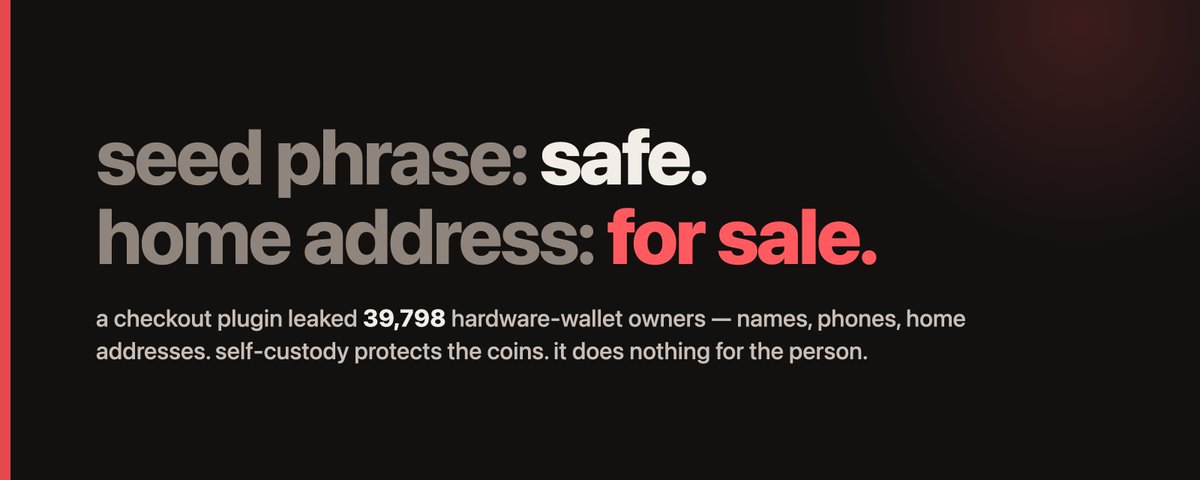
safepal's breach cracked zero wallets. it leaked 39,798 buyers' names and home addresses off a checkout plugin instead. the safe held. somebody just mailed the map. wrote about the merch table nobody in this space guards.