

Product at Nethermind! | Professor at Duke! | Exploring the intersection of distributed compute, cryptography, and finance. | BanklessDAO OG
Joined December 2014
- Tweets5.2K
- Following3.1K
- Followers1.7K
- Likes43.7K











Excellent site.

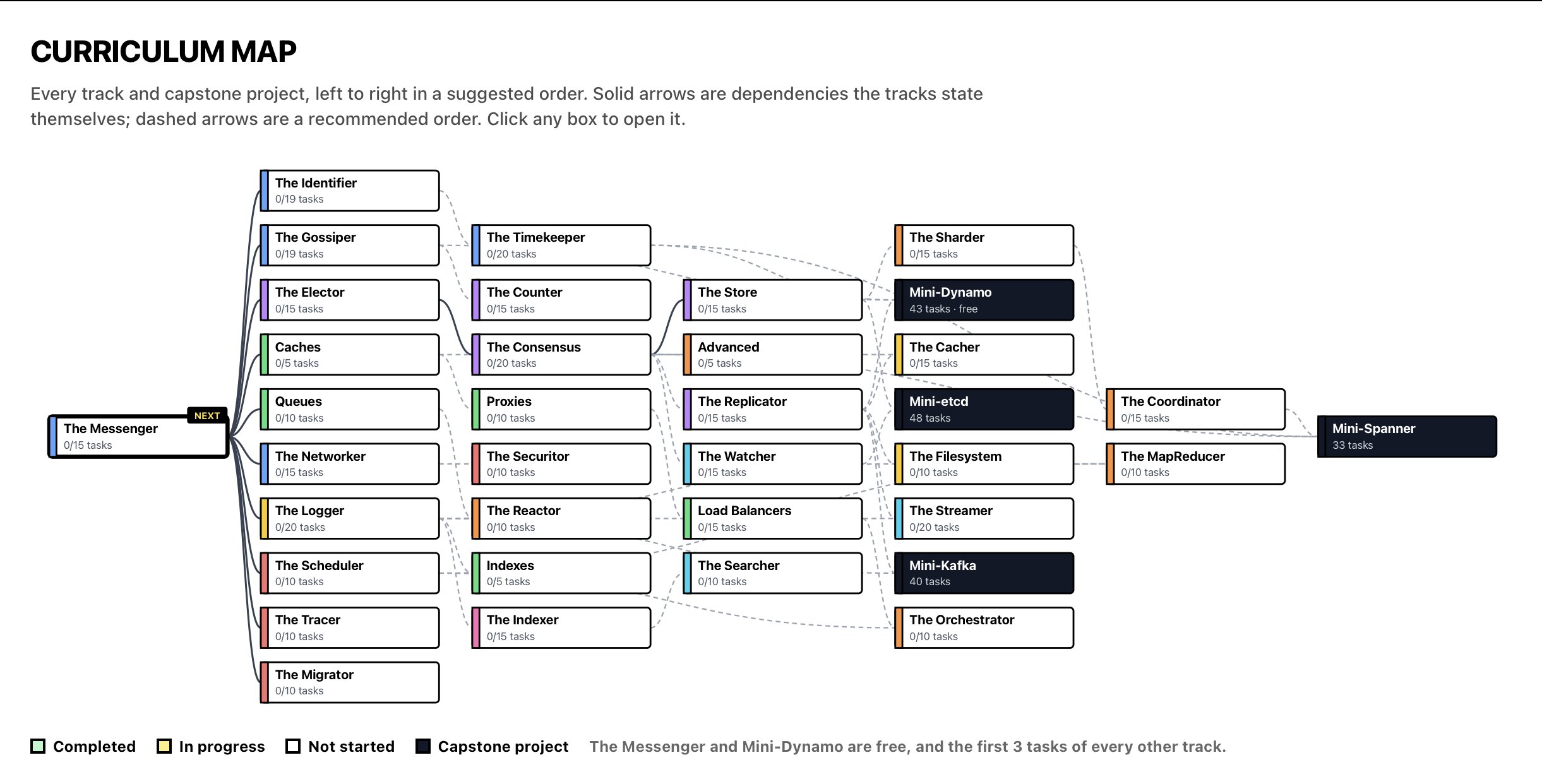
Building Distributed Systems from Scratch
Every track and capstone project, left to right in a suggested order. Solid arrows are dependencies the tracks state themselves; dashed arrows are a recommended order.
Link: builddistributedsystem.com/r…
72
John Church retweeted

I published this article in June when the price action was as ugly as today, and I am sharing it again.
A big reason crypto is down so much is because most people in this industry don't actually believe in it. They don't believe in sovereign money or decentralized finance or censorship resistant systems. So they hype bullshit narratives and quote manipulated figures and fund fraudulent projects while celebrating grifters in suits.
And when the ruse is exposed they just double down.
In retrospect, this was always going to result in the current moment, a collapse in value emanating from an absence of values.
To quote Orwell:
We are all capable of believing things which we know to be untrue, and then, when we are finally proved wrong, impudently twisting the facts so as to show that we were right. Intellectually, it is possible to carry on this process for an indefinite time: the only check on it is that sooner or later a false belief bumps up against solid reality, usually on a battlefield.
Welcome to the battlefield.


Really excited for this and for the team building it!

We’re excited to announce that Null has raised $1.7M in pre-seed funding led by @cyberfund and @Nethermind, and angels @NoahZinsmeister, @sendmoodz and @oel4all.
Null is coming out of stealth soon!

6
225
Super impressed with this.
I’ve introduced RPCs to my students in class, and shown them how operating a node works, but had to limit it due to overhead.
Now every student will run an RPC locally.

𝗜𝗻𝘁𝗿𝗼𝗱𝘂𝗰𝗶𝗻𝗴 𝗡𝗲𝘁𝗵𝗲𝗿𝗺𝗶𝗻𝗱 𝗟𝗶𝗴𝗵𝘁 𝗖𝗹𝗶𝗲𝗻𝘁
Trustless RPC for every wallet.
Verify Ethereum yourself, without running a full node.
𝗛𝗼𝘄 𝗶𝘁 𝘄𝗼𝗿𝗸𝘀
→ One trust anchor: a recent finalized beacon block root
→ Consensus: sync committee updates over libp2p, with signatures and Merkle branches verified
→ Execution: state on demand through SNAP, every range proven against the state root
→ Performance boosted through partial state caching for selected and frequently queried accounts.
𝗕𝘂𝗶𝗹𝘁 𝗼𝗻 𝗯𝗮𝘁𝘁𝗹𝗲-𝘁𝗲𝘀𝘁𝗲𝗱 𝗡𝗲𝘁𝗵𝗲𝗿𝗺𝗶𝗻𝗱 𝗰𝗼𝗺𝗽𝗼𝗻𝗲𝗻𝘁𝘀
→ eth_call and eth_estimateGas run locally in the Nethermind EVM, nothing forwarded
→ Developed inside the Nethermind client codebase
→ Glamsterdam-ready
𝗙𝗼𝗿 𝘆𝗼𝘂, 𝗶𝘁’𝘀 𝗷𝘂𝘀𝘁 𝗹𝗼𝗰𝗮𝗹𝗵𝗼𝘀𝘁:𝟴𝟱𝟰𝟱
Point MetaMask, or any wallet, at it.
In active development. Congrats @__flcl and the team.
Follow the progress and share feedback:
github.com/NethermindEth/net…

3
153
John Church retweeted

Three talks from Devcon 8, each on reducing what Ethereum users have to trust: phones that help secure the network (@ben_a_adams), AI answers a contract can verify (@linoscope), and tokenized assets that survive their issuer (@ericmartihaynes).

John Church retweeted
Ethereum can meet bank requirements with two things in place: control over what they send, and confidentiality over what others see.
On Nov 18 in Singapore, we’re working through both with @eth_systems and a group of banks in a closed session.
nitter.cf/eth_systems/status/212…

We're co-hosting a closed, invite-only session with @Nethermind in Singapore on 18 Nov, during SFF week.
Looking forward to working through one question with them and a group of banks: how do you design compliant infrastructure for regulated finance on Ethereum?
DMs are open.

Large scale private llms are incentivized to provide the lowest quality compute at the highest cost to users.
Since we don’t have a general standard of measurement they can degrade the quality of intelligence without any clear indicators other than frustration at the output.
1
1
182
Additionally, as they struggle to find product market fit, they are deeply incentivized to aggressively copy/steal any ideas that their models encounter.
As a result, they are an extreme counter party risk.
1
1
48
Is it me, or is claude again somewhat garbage?
It seems like it's context is getting overloaded from anthropic.
1
119
Stay safe out there, and patch your servers!

‼️ BREAKING: OpenSSH has rushed out a fix for a critical flaw that lets attackers log into some Linux servers without the right password.
The team learned of the bug a day earlier. OpenSSH's Damien Miller says long embargoes now mostly help attackers, because AI agents rediscover bugs, sometimes within hours.
It hits Linux systems on the musl C library with PAM off, such as Alpine Linux. Miller told admins to disable password logins or SSH itself "IMMEDIATELY".
Version 10.6p2 works around it. Systems on glibc or PAM are not affected, and Miller says the root cause sits outside OpenSSH.


77
John Church retweeted
Blockchains are credible but not intelligent. Humans are intelligent but not credible.
At Devcon, our researcher @linoscope showed a way to get both. He built a prototype oracle that runs an LLM inside a TEE: the model answers the question, and the contract checks the TEE’s proof before it accepts the answer.
Most smart contracts today act on numbers a data feed can report, like prices. An oracle like this could let them act on any question you can phrase, like whether a flight left on time or a GitHub PR meets a bounty’s conditions.
youtube.com/watch?v=aJvWLxqK…

John Church retweeted
0x is moving its Ethereum traffic to Nethermind.
On @0xProject’s Swap API workload, Nethermind now runs with 20–30% lower latency than their current client.
Thanks to the 0x engineers who worked with us to make this happen.

Super excited to join!

Privacy is a serious design requirement for institutional Ethereum.
On Oct 22-23, @RedoudouM joins:
> Kaushal Vyas (@eth_systems),
> Rob Dawson (@Consensys),
> John Church (@Nethermind)
> Vivek Raman (@Etherealize_io)
..for the Building Ethereum panel at @lfdecentralized's NYC workshop, moderated by Johnna Powell (@DTCC).

5
210
John Church retweeted

I made a visualization of EIP-8288 aka "recursive mempool aggregation," my new favorite EIP of all time because it perfectly encapsulates the thesis of the "cryptographic world computer" -- a system whose scalability *increases*, not decreases, with the level of decentralization.
In a previous tweet I explained how EIP-8288 achieved this seemingly impossible feat, but one gif is worth a thousand words.
Essentially, EIP-8288 leverages Ethereum's decentralized mempool as a parallel ZK proving cluster. Clients send signatures and proofs to the mempool, which over multiple rounds progressively aggregate them into fewer and fewer proofs, until the block builder finally aggregates them into one SINGLE proof.
This design accomplishes five things at once:
- The more nodes we add to the decentralized mempool, the more signatures/proofs Ethereum can process as a whole. This is obvious if you look at the animation and imagine more nodes in the mempool ring, which would "fan out" to more signatures/proofs.
- By aggregating over multiple rounds (aka "recursive aggregation"), the bandwidth consumed by proofs remains constant for each node even as the network processes more proofs. As a result, the network stays decentralized even as capacity increases.
- By aggregating proofs before one final aggregation by the builder, as opposed to requiring the builder to aggregate everything, the network can process more proofs without increasing hardware requirements for the builder.
- By aggregating everything to a single block-level proof, validators can verify thousands of signatures/proofs by checking just one aggregated proof. Hardware requirements for validators can therefore stay low, keeping the network decentralized.
- By aggregating not just native signatures but also STARKs, Ethereum can support any signature scheme by wrapping them in STARKs.
So once again, this is how Ethereum will:
- scale to process tens of thousands of PQ and private transactions per second
- charge a tiny amount of gas to validate each txn, even though the original signature/proof may be huge (up to hundreds of KBs in size)
- all while decentralizing even MORE.
You are not bullish enough.

Ultimately, precompiles and EVM are both the wrong place to put most cryptography support into Ethereum. The reason is that precompiles and EVM both operate on data that has to be included into the ethereum chain somehow, which realistically means included in a block as calldata. That space is limited - even with PeerDAS and blocks-in-blobs, there's a practical cap of ~8 MB/s before it starts getting uncomfortable.
Remember: it's not a blockchain. It's a cryptographic world computer. Any data/computation that does not need to be in the "main thread" of data/execution should not be put into the main thread.
Instead, the correct solution is... EIP-8288 maximalism.
If you have any heavy computation that's self-contained, compute it and STARK it client-side (this is quickly getting faster and faster, even on phones), and push the STARK through the EIP-8288 recursive aggregation mechanism. The chain sees the fact that the computation was done and what the result is; it never needs to see the actual data and computation.
This way everyone can use whatever cryptography they want, the Ethereum chain can be lean, and we never need to add more precompiles again.


Was inspired so took a swing.
niwa-jade.vercel.app/

Made with Opus 5.5 + Three.js
water-opus.vercel.app/
the water physics, the fish, blossoms... why is this soo pretty 😭😭
2
94
Wouldn't all validators be hacked, because even if you can save your tokens, the validators still have to attest, thus exposing them?
So consensus would break?

Today I call upon the blockchain industry to calmly begin planning for "bunker mode". My personal recommendation is to set in motion a controlled mass migration of assets to fresh addresses, i.e. addresses whose pubkeys remain hidden behind a hash.
Holders, starting with large and sophisticated ones, should consider moving the bulk of their funds to addresses that have never signed a transaction. And when they do sign one, they should also move remaining funds to a new address (possibly generated from the same seed phrase).
Don't rush. While I believe there is cause for action a rushed migration would do more harm than good. Don't panic either. Moving assets to protected addresses is a simple, preventative step which does not require new cryptography or new wallets.
IMO it is now reasonable to brace for the possibility that ECDSA breaks before qday, in the worst case in months not years. By "break" I mean fast private key recovery (e.g. in one week) on available hardware (e.g. a large GPU cluster).
Recent days have been humbling for human mathematical intuition. Long-held, unquestioned hypotheses have fallen. This includes the n log(n) bound for integer multiplication and the 3SUM conjecture. In hindsight, May's unexpected disproof of the Erdős unit distance conjecture was our warning shot.
Yesterday's OpenAI drop made it clear that mathematical superintelligence is upon us. They say there are weeks where decades happen. We are about to live through weeks where centuries of mathematical progress happen. Could our magic 64-byte ECDSA signatures be too good to be true? Was it just security through obscurity all this time?
Elliptic curves feel especially vulnerable to superintelligence. Curves carry rich structure, with room for fancy tricks like Schoof, Frobenius, pairings. (By contrast, hashes are designed to minimise algebraic structure.)
Separately, as Ewin Tang can attest, an efficient quantum algorithm sometimes foreshadows an efficient classical one. We should be open to the possibility of a classical counterpart to Shor that breaks elliptic curves and RSA at once.
Also noteworthy is the striking under-representation of cryptographic breakthroughs among the 722 mathematical results OpenAI published. I've witnessed first-hand the US government censoring academic quantum cryptanalysis results. Backroom interventionism is my base case.
I urge large, sophisticated actors to lead by example. Project11's "risq list" (bitcoin-risq-list.projecteleven[.]com) is a great tracker of exposed BTC pubkeys. Binance, Bitbank, Robinhood, Bitfinex, and Tether have an opportunity to harden their cold storage. Next month I'll address institutions in London in a live Q&A (forum.ethereuminstitutional[.]org/london-2026).
Again, please do not rush. Wallets holding under 50 BTC enjoy partial cover from "Satoshi's shield", i.e. his 20K exposed addresses that hold 50 BTC each. Load-bearing signers like oracles and L2 security councils should consider rotating ECDSA pubkeys with every signed message and/or multi-signing with a hash-based schemes like SPHINCS.
Exiting bunker mode safely will require post-AI cryptography. My inclination is to go all-in on hash-based cryptography and avoid structured mathematical assumptions entirely, whether from curves, lattices, or isogenies. A single battle-tested hash (e.g. from the SHA or BLAKE families) yields plausible post-AI security.
The Ethereum roadmap on strawmap[.]org fully embraces hash-based cryptography with end-to-end formal verification as a response to the quantum threat. Those timelines must now be revisited and accelerated in light of mathematical superintelligence. I'll be pushing for maximum defensive acceleration.
11
436
Huge appreciation for @dcbuilder to speak to our class in Duke Pratt School of Engineering - Fintech 564 - Blockchain!
Awesome to hear about what they are up to and share what he is building at @worldnetwork.

spark.money/research/ethereu…
Excellent write up from @spark on proposer builder separation.

2
103