

I connect dots & share analyses. Bitcoiner | Blockchain Philosopher | decent/acc Chief Chef at @DecentStudio_io | ex-lawyer
Joined February 2021
- Tweets3.5K
- Following722
- Followers5.7K
- Likes6.3K







Pinned Tweet
The Trump administration is officially on the defensive.
And Bitcoin’s price is reflecting the whole story.
What’s happening right now has nothing to do with a normal Bitcoin cycle.
A currency war is playing out in real time.
And Bitcoin + stablecoins are now political weapons.
Here’s the breakdown👇
Since Trump took office, the conflict has escalated between:
• Trump’s administration
• Those whom he calls “globalists”
• BRICS+
BRICS+ is stacking gold.
Trump is pushing Bitcoin + stablecoins.
And globalists don’t want to be left holding inflated U.S. Treasuries in their pockets.
Two completely different playbooks.
Same battlefield: control of the money supply.
Trump gained momentum with the GENIUS Act.
Then came the moves from companies close to his cabinet:
• Cantor Fitzgerald, XXI, Tether, Strategy, SoftBank, Strike, Strive, Metaplanet, American Bitcoin, World Liberty Financial (to name a few).
And his opponents didn’t like any of it.
Next: the Market Structure Bill (the Clarity Act).
Trump’s opponents hate it.
Why?
Because if it passes in its original form, it reshapes the entire financial system.
We’re talking about the biggest shift in market structure since the 1970s.
Stablecoins that started offering rewards (essentially interest) the GENIUS Act = a direct threat to banks and fractional reserve banking
Why would anyone keep money in a bank earning 0%
when a stablecoin pays you yield?
Banks lose deposits → lose power to create credit → lose control.
That’s what’s causing the anxiety.
Add to that rumors of the Treasury using gold to buy Bitcoin for a Strategic Bitcoin Reserve.
Which, if true, would flip the global monetary game board instantly.
No surprise the TradFi system is uneasy.
Anti-Bitcoin Trump opponents were always going to counterattack.
And now we have a culmination.
Recent events such as:
• the prolonged shutdown,
• liquidity issues in the repo market,
• the breakdown of bipartisan work on the Clarity Act,
• the Epstein files,
• and a psyop associating Epstein with Bitcoin development
are attempts to stop or slow down Trump.
All timed.
All pressure moves.
The Trump administration is being forced into defense mode.
The recent Bitcoin price action also looks like an attempt to push BTC below key levels to disqualify it as a “serious reserve asset.”
The Trump administration definitely doesn’t want this kind of bearish price action.
This isn’t random volatility.
It’s political.
Trump’s new proposals:
• stimulus checks,
• 50-year mortgages,
• 600k visas for Chinese students
look like concessions meant to make his opponents calm down.
And they resemble Democratic policies taken straight from Keynes’s agenda
That’s why his supporters see it as betrayal.
MAGA and Republicans, after the Charlie Kirk assassination, are more divided than ever.
Add to this the visible nvolvement of a foreign government from the Middle East in U.S. affairs.
All of this is crucial ahead of next year’s mid-term elections.
What we’re watching now is the real-time fight over:
• Will Bitcoin + stablecoins become central to U.S. monetary policy this Trump's term?
That’s the entire game.
Owning Bitcoin short- to mid-term = a bet that Trump keeps advancing the Bitcoin + stablecoin agenda.
The nuclear option?
The U.S. Treasury announces that the U.S. bought Bitcoin with its gold.
(Highly unlikely now, but if it ever happens, it rewrites monetary history in one press conference.)
For now, that’s just hopium.
The Trump administration hasn’t given up its plan to reorder monetary policy with BTC and stablecoins.
But these are signs of weakness we can’t ignore.
If possible, please share this post with your audience and comment your thoughts.
Would love to compare my thought process with yours.
If you want to connect more dots, follow this account.
The next moves are coming.
SPECIAL MENTIONS:
@martypartymusic
@HodlMaryland

Jack | Blockchain Philosopher retweeted

🇺🇸🇮🇷 There it is.
U.S. weighs $20B asset release in exchange for Iran’s uranium stockpile;
Talks expected Sunday in Islamabad.
Iran officially reopens the Strait of Hormuz for ALL commercial vessels for the remaining period of the ceasefire.
Iran's statement below:
"In line with the ceasefire in Lebanon, the passage for all commercial vessels through Strait of Hormuz is declared completely open for the remaining period of ceasefire, on the coordinated route as already announced by Ports and Maritime Organization of the Islamic Rep. of Iran."
No need to apologize for those that were so offended by my analysis throughout, and fired so much abuse in my direction.
The deaths were real.
The negotiations started before the war.
The war was theatre and were part of the negotiations.
This was never about helping the Iranian people.
This was a financial industrial complex operation.
Next we may need another round of escalation, but nothing stops this train.
I’ll break it all down on my live show tonight.
Be smarter next time.
Follow the money💰

🇱🇧🇮🇷 The Final Act: How the Iran War Ends (Lebanon, Deals & Global Reset)
simondixon.com/blog/iran-war…

Jack | Blockchain Philosopher retweeted
It actually used to look like this 👇
They just recently changed the labels for the Trumps to “Web3 Ambassadors.” They used to be labeled as Co-Founders.

Jack | Blockchain Philosopher retweeted

Breaking: Trump: Based on conversations with Prime Minister Shehbaz Sharif and Field Marshal Asim Munir, of Pakistan, and wherein they requested that I hold off the destructive force being sent tonight to Iran, and subject to the Islamic Republic of Iran agreeing to the COMPLETE, IMMEDIATE, and SAFE OPENING of the Strait of Hormuz, I agree to suspend the bombing and attack of Iran for a period of two weeks. This will be a double sided CEASEFIRE! The reason for doing so is that we have already met and exceeded all Military objectives, and are very far along with a definitive Agreement concerning Longterm PEACE with Iran, and PEACE in the Middle East. We received a 10 point proposal from Iran, and believe it is a workable basis on which to negotiate. Almost all of the various points of past contention have been agreed to between the United States and Iran, but a two week period will allow the Agreement to be finalized and consummated. On behalf of the United States of America, as President, and also representing the Countries of the Middle East, it is an Honor to have this Longterm problem close to resolution. Thank you for your attention to this matter! President DONALD

I agree with Eric Weiss here.
Everyone’s panicking about quantum computers cracking Satoshi’s wallets and impacting Bitcoin supply… meanwhile, paper Bitcoin (futures and ETFs that enable rehypothecation) already make it possible that we’re trading way more than 21 million BTC.
By the way, Eric is the guy who orange-pilled Michael Saylor into Bitcoin.
Paper Bitcoin is straight The Wolf of Wall Street energy (when Matthew McConaughey talks to Leonardo DiCaprio):
“Fugazi… fairy dust. It doesn’t exist. It’s never landed. It’s not f***ing real.”
Wall Street loves trading fugazi.
Paper Bitcoin is exactly that.

Jack | Blockchain Philosopher retweeted

I'm seeing crypto folk falling into the trough of dispair after an abysmal bull market with mainly losers and BTC outperforming their "beta".
Let me tell you a story that tells you why you got screwed. It starts with the end of FTX.
When the bankruptcy folk came in to liquidate FTX assets their mandate was to sell everything. This included vast quantities of locked SOL.
They inadvertently invented something new, selling an asset that was locked up on-chain through the magic of a legal sale agreement (pay me now, I deliver later).
The deal got passed around the ecosystem, fund managers bought up the locked SOL at more than 60% discount to compensate for being locked up and exposed to the token price.
Many hedge funds bought the deal. They knew they could hedge the token price on futures markets by shorting SOL pocketing 70-80% yield at near zero risk (staking + basis yield + token discount).
They liked it and asked where can we get more of this?
Herein lies your PROBLEM as a crypto investor in 2023-2025.
Every crypto project has backers (and a foundation) who has great wads locked tokens that have been sold to hedge funds and dumped on you immediately through futures markets.
All your alpha went to market neutral hedge funds pocketing risk free yield.
THAT IS WHY CRYPTO IN 2023-2025 UNDER PERFORMED
You got dumped on prematurely.
On the bright side many of these projects, even though they have "locked up tokens ready to dump" on paper, in reality they have been sold already, so they will logically perform without the expected sell pressure in the next bull market given they have effectively been sold.
Not that I recommend buying crypto, you need to be an insider to get an edge, it works like a casino, the house will take your money. The house in 2023-2025 were the people who understood this trade. Just buy BTC and get on with your life.


Lummis is pushing the Clarity Act hard, and with her not running again, this could be her legacy play.
But here’s the contradiction I see:
The SEC & CFTC dropped guidance yesterday that’s more favorable than what the Clarity Act might deliver.
So what’s really happening?
Two scenarios here.
• One, this is a pressure tactic to shape the final version of the Clarity Act into something more favorable than the latest draft.
• Or two, they don’t expect the Clarity Act to pass before the midterms, and this guidance is a way to offer something meaningful to crypto voters in the meantime.
Feels coordinated either way. Hard to see this as a coincidence.
What do you think?

🚨BREAKING: Sen. Lummis Says “WE ARE GOING TO PASS THE CLARITY ACT IN APRIL” 🤯🔥
During the DC Blockchain Summit, Senator @SenLummis gave a major update on the CLARITY Act. 🇺🇸
The bill is now heading for an APRIL markup in the Senate Banking Committee. 👀
“We’re going to mark it up in April. We’re going to mark it up after the Easter recess.” 😳
CLARITY ACT IS OFFICIALLY GETTING PASSED🤑🚀
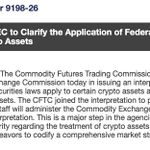
SEC and CFTC just issued a joint interpretation clarifying crypto asset jurisdiction.
>Most crypto assets are NOT securities, including:
• BTC, ETH, $SOL, XRP, ADA, DOGE, SHIB, LINK, AVAX, APT, DOT, XLM, XTZ, LTC, BCH, HBAR.
>BTC is cemented as a commodity
> NFTs and meme coins: not securities either, unless you fractionalize an NFT or an issuer promises investors a return.
(The promise creates the liability. Not the token.)
>Staking, mining, wrapping: none of it is a securities transaction.
> Investment contracts can now also end. Build what you promised, and the token is free.
We’re waiting for the Clarity Act to be passed.
Link to the full document in the comment section below. 👇


TODAY 🚨: The Commission issued an interpretation that clarifies the application of federal securities laws to crypto assets.
This is a major step to provide greater clarity regarding the Commission’s treatment of crypto assets.
Read the release here: ow.ly/XhhV50YvxvO

All eyes are on Iran, oil, and the Strait of Hormuz right now.
But while everyone is watching tankers and missiles,
the U.S. Congress is quietly preparing a powerful financial weapon aimed at China.
Just before Trump’s visit to China from March 31 to April 2.
Most analysts are overlooking it.
The “Protect Taiwan Act” passed the House on Feb. 9 with 395 votes in favor and just 2 against, basically unanimous.
The U.S. is threatening to push China out of the Bank for International Settlements, G20, and other key parts of the Western financial system.
This bill represents serious financial leverage.
Let me connect the dots. 👇
The real weapon in the bill is the threat of exclusion from six core institutions:
• Bank for International Settlements (BIS)
• Basel Committee
• Financial Stability Board (FSB)
• IAIS
• IOSCO
• G20
These institutions form the backbone of the global financial system.
The BIS serves as the central bank for central banks.
Most major central banks hold accounts there.
It functions as the final global ledger.
If China were excluded, its system would face immediate constraints:
• gold transactions would become far harder to settle internationally,
• the renminbi’s path to broader internationalization would be severely limited,
• and access to short-term liquidity in a crisis would disappear.
Countries cannot operate effectively on the global stage if they’re cut off from the global ledger.
The BIS also oversees the Basel Committee and works closely with the FSB.
Without a seat at the table, China would have no influence over the rules that shape global banking standards, even though its banks would still be expected to comply.
Let’s compare that to Russia.
Even after more than 10,000 sanctions and years of conflict, the West never removed Russia from these six institutions.
SWIFT sanctions were targeted.
This approach is fundamentally different in scale but it carries significant blowback.
China is the world’s second-largest economy and the largest trading nation.
Removing it from these institutions would send shockwaves through the entire global financial system.
The fallout could trigger a crisis deeper than 2008.
China would also have strong incentive to rapidly build its own parallel financial infrastructure, openly and aggressively.
The drafters clearly understand the risks.
That’s why the bill includes a presidential waiver.
Congress creates the mechanism, but the President decides whether to activate it.
The Senate has not scheduled a vote yet but Trump is reportedly planning to visit China from March 31 to April 2.
Everything remains in flux. The waiver serves as strategic leverage.
The is designed as a temporary pressure tool rather than permanent law.
While the chance of full enactment is relatively low, it sends a clear signal about where the U.S. is applying negotiating pressure.
So what does this mean for Bitcoin?
A fracturing global monetary order with two competing systems could create one of the strongest macro environments Bitcoin has ever seen.
Sovereign wealth and private capital would actively search for neutral ground outside both systems.
I will keep providing frequent commentary on monetary policy, Bitcoin, and geopolitics.
If you want to keep connecting these dots with me, follow @jacksage_ and drop a like and comment.
cc: @Puncher522 @SimonDixonTwitt


Odds of the Clarity Act passing are ripping.
BTC is front-running it.
Policy odds = price action.
I’m DCA’ing, but with January in mind.
In January when the odds collapsed, we nuked from 98K.


Everyone’s watching Iran–Israel & oil prices.
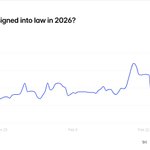
Meanwhile, Polymarket just pushed Clarity Act odds to 70%.
That might explain why BTC refuses to break, and it's pumping.

The CLARITY Act is the bullish trigger the market is waiting for.
And the odds of it passing are dropping by the hour.
Bitcoin price reflects it.
Less than 48 hours until the White House’s self-imposed March 1 deadline.
Reminder:
After a Feb 11, 2026 White House meeting led by Patrick Witt, lawmakers set a March 1 deadline to resolve the stablecoin yield dispute.
If CLARITY stalls, we start talking about BTC in the 50s.
A year ago this bill would’ve had momentum.
Insane how much can change in one year.
IMO, key factors shaping the situation:
• Trump’s political influence is weakening
• Lawmakers and media are scrutinizing all of his crypto-related businesses.
• Banks are on high alert for monetary policy shifts tied to stablecoins and Bitcoin
I’m not even sure the GENIUS Act would have passed in today’s environment.
CLARITY stalls: BTC could drop violently.
CLARITY moves forward: recovery may happen faster than the 4-year cycle predicts.

Trump is becoming the very kind of politician he once mocked.
What his administration promised on foreign and military policy is completely different from what it is delivering now.
Similarly, what it said about Bitcoin, stablecoins, and U.S. monetary sovereignty will diverge from what it ultimately implements.
It doesn’t matter whether they lied from the beginning or lost to foreign influence.
Let’s act accordingly.


The CLARITY Act is the bullish trigger the market is waiting for.
And the odds of it passing are dropping by the hour.
Bitcoin price reflects it.
Less than 48 hours until the White House’s self-imposed March 1 deadline.
Reminder:
After a Feb 11, 2026 White House meeting led by Patrick Witt, lawmakers set a March 1 deadline to resolve the stablecoin yield dispute.
If CLARITY stalls, we start talking about BTC in the 50s.
A year ago this bill would’ve had momentum.
Insane how much can change in one year.
IMO, key factors shaping the situation:
• Trump’s political influence is weakening
• Lawmakers and media are scrutinizing all of his crypto-related businesses.
• Banks are on high alert for monetary policy shifts tied to stablecoins and Bitcoin
I’m not even sure the GENIUS Act would have passed in today’s environment.
CLARITY stalls: BTC could drop violently.
CLARITY moves forward: recovery may happen faster than the 4-year cycle predicts.
I remember when I started using ChatGPT in December 2022.
I wrote a thread, got +100k impressions, and thought everybody on Earth was using this tool.
I was genuinely surprised to find out a couple of days later that ChatGPT had reached its first 1 million users and that it took a few months to reach 100 million.
I thought about creating a course on using ChatGPT but didn't do it because I thought everyone knew how to use it.
Then many people made a nice buck from similar courses.
I think the same thing will happen with Seedance 2.0.
We will see these videos everywhere, but it will only be in our bubble, the opportunities to actually create stuff for people who will actually want to pay for it or watch it will be uncapped.
So my point is, once this tool is available, those who understand the significance of this breakthrough have a serious opportunity to scale up revenue streams before the masses catch on and saturate the space.
My platform is all about audiovisual storytelling.
I cannot wait to invite you to co produce with us some bitcoin themed video shows, animes and cartoons. 🫡

My first ChatGPT-related thread:
nitter.cf/jacksage_/status/16001…
1/
ChatGPT is the most powerful tool given to the general public since the launch of the iPhone. And it’s for free
If you are active in #NFT & #crypto space and do not want to be left behind, you need to learn how to make use of it
🧵on what ChatGPT is, how to use it & why?
👇

1
545
Gensler’s SEC vs. decentralized finance.
Sophists vs. Socrates.
Trump won in 2024 because he presented himself as “Team Socrates,” claiming to expose the hypocrisy of those in power.
The moment Trump trades truth for self-interest, he becomes the Sophist he claimed to expose.
I wrote this thread in 2023.
3-minute read.
Still valid.
👇
@MarylandHODL21

1/
The US regulatory environment is getting more predatory towards #Web3, hurting retail investors.
Why? Because Web3 threatens to take power from corrupt financial system.
Does either side have moral ground?
Are you here only for money or something more?
Hardcore take
🧵👇

I see the next move for bitcoin coming from passing the Clarity Act and will keep an eye on the progress in Congress.
My ultimate goal is to accumulate more Bitcoin over the course of this year than I previously had.
On top of that, right now, the strongest emerging asymmetric opportunity I see is at the intersection of:
• AI
• Storytelling
• Community-driven content creation
Tools like Seedance 2.0 are about to massively disrupt audiovisual production.
The video below took 10 min to generate with the simple prompt.
(the tool itself picked Tom Holland as one of the actors, but you can see how good the output is)
High-quality video production is about to become abundant.
Which means quality alone will stop being valuable.
Storytelling will become the new scarcity.
The next major attention economy will likely be built on collaborative storytelling, where communities help shape narratives alongside creators.
That belief is exactly what led me to build my decentralized entertainment platform.
We now have a fully working prototype available for investors and marketing campaign ready to launch.
The long-term vision is simple:
Create educational cinematic stories about Bitcoin, sound money, and decent values, powered by community collaboration.
If that resonates with you and want to engage, my DMs are open.
The next Bitcoin cycle will be cultural.
2026 is going to be very interesting.
Bitcoin has become Trump's shadow asset.
As his approval ratings slip, BTC bleeds.
The political tie is undeniable.
I really appreciate @infraa_'s conviction and his insights on monetary policy.
That said, as much as I share his long-term bullish view on BTC and his belief that Bitcoin is superior to silver or gold as a monetary solution, we can’t ignore the fact that since Trump won, Bitcoin has effectively become a political asset.
Like it or not, it is now closely tied to Trump.
And the weaker Trump’s position becomes in the political arena, the worse Bitcoin is likely to perform.
Bitcoin’s decline over the past few months closely mirrors the sharp drop in Trump’s approval ratings and his broader political standing, which may ultimately be reflected in the midterm election results.
• Difficulties passing the Clarity Act,
• the Iran–Israel conflict in summer 2025,
• a government shutdown in the fall,
• another potential shutdown in 2026,
• the Epstein files, and yet another phase of the Iran–Israel conflict in 2026
are just a few of the factors weighing on Trump’s position, and on Bitcoin’s performance as well.
In my view, there are two scenarios ahead.
In the first, Trump’s team manages to reverse the negative momentum he began losing several months ago.
Approval ratings stabilize, trust begins to recover, and the administration starts delivering on key campaign promises, such as passing the pro-decentralization Clarity Act and loosening ties with Israel in favor of a more genuinely America-First approach.
In the second scenario, Trump’s opponents take advantage of depressed prices to build meaningful Bitcoin positions. Over time, this reduces their incentive to oppose Bitcoin’s role as part of the global monetary infrastructure.
The first scenario would need to materialize within the next few months and, in my opinion, becomes less likely with each passing week.
The second scenario, however, could unfold over several years and may involve a prolonged Bitcoin bear market, maximum-pain price levels below current ranges, panic-driven selloffs, and extended buying opportunities for today’s Bitcoin skeptics.
Contrary to the view held by many Bitcoiners, I don’t see Kevin Warsh as a bullish pick for Bitcoin. He has explicitly framed Bitcoin as a “policeman” of monetary policy, arguing that Bitcoin prices rise when policy is bad and fall when policy is good. If Warsh were to become Fed Chair, it’s reasonable to assume he would aim to implement what he views as “good” policy, which could imply weaker Bitcoin performance under his leadership. I may write a more detailed analysis on him later.
On a personal level, I’ve reduced my Bitcoin exposure to a size I’m comfortable holding primarily for its self-custody and portability benefits, specifically, the ability to move value if the banking system were to seriously collapse. I’ve cut my investment-oriented Bitcoin position nearly to zero and reallocated that capital into cash and precious metals. I plan to use the cash portion for short-term opportunities.
Below is an analysis I wrote when Bitcoin was still trading around $95k, at a point when my early-2025 thesis, that the Trump administration would push Bitcoin as an important part of future monetary rails, was beginning to break down.
I'm curious how much of your decision-making is driven purely by data and liquidity, and how much weight you place on the political environment.
Let me know your thoughts in the comments.
Happy to confront my thought process with yours.

Mark Twain said that “history does not repeat itself, but it rhymes.”
With the recent release of the #EpsteinFiles, particularly the emails quoted by @SimonDixonTwitt (see quoted post), read this interesting passage from Niall Ferguson’s "The House of Rothschild, Volume 2: The World’s Banker, 1849–1999" [Preface, p. xxii]
(see image below)
Mayer Amschel was the founder of the Rothschild banking dynasty.
I think we can all agree that Niall Ferguson, a prominent professor at Harvard and Oxford, whose two-volume work on the Rothschild family (+1,500 pages) draws on exclusive family archives, is neither a conspiracy theorist nor an antisemite.
He carefully fact-checks his claims and explicitly counters antisemitic myths.
It may be worth reading alongside some of the newly released emails.
Do you see any patterns here?
cc: @darkside2030 @DrJackKruse

Epstein files show Jeffrey Epstein telling Peter Thiel that he “represented the Rothschilds” while seeking meetings and inviting him to his island.
Another email thread features Ariane de Rothschild discussing claims that Hitler lived in a shelter funded by three wealthy Jewish families-the Rothschilds, Epsteins, and Gutmanns - before World War I.
References to Epstein–Rothschild connections recur throughout the files.


Bitcoin has become Trump's shadow asset.
As his approval ratings slip, BTC bleeds.
The political tie is undeniable.
I really appreciate @infraa_'s conviction and his insights on monetary policy.
That said, as much as I share his long-term bullish view on BTC and his belief that Bitcoin is superior to silver or gold as a monetary solution, we can’t ignore the fact that since Trump won, Bitcoin has effectively become a political asset.
Like it or not, it is now closely tied to Trump.
And the weaker Trump’s position becomes in the political arena, the worse Bitcoin is likely to perform.
Bitcoin’s decline over the past few months closely mirrors the sharp drop in Trump’s approval ratings and his broader political standing, which may ultimately be reflected in the midterm election results.
• Difficulties passing the Clarity Act,
• the Iran–Israel conflict in summer 2025,
• a government shutdown in the fall,
• another potential shutdown in 2026,
• the Epstein files, and yet another phase of the Iran–Israel conflict in 2026
are just a few of the factors weighing on Trump’s position, and on Bitcoin’s performance as well.
In my view, there are two scenarios ahead.
In the first, Trump’s team manages to reverse the negative momentum he began losing several months ago.
Approval ratings stabilize, trust begins to recover, and the administration starts delivering on key campaign promises, such as passing the pro-decentralization Clarity Act and loosening ties with Israel in favor of a more genuinely America-First approach.
In the second scenario, Trump’s opponents take advantage of depressed prices to build meaningful Bitcoin positions. Over time, this reduces their incentive to oppose Bitcoin’s role as part of the global monetary infrastructure.
The first scenario would need to materialize within the next few months and, in my opinion, becomes less likely with each passing week.
The second scenario, however, could unfold over several years and may involve a prolonged Bitcoin bear market, maximum-pain price levels below current ranges, panic-driven selloffs, and extended buying opportunities for today’s Bitcoin skeptics.
Contrary to the view held by many Bitcoiners, I don’t see Kevin Warsh as a bullish pick for Bitcoin. He has explicitly framed Bitcoin as a “policeman” of monetary policy, arguing that Bitcoin prices rise when policy is bad and fall when policy is good. If Warsh were to become Fed Chair, it’s reasonable to assume he would aim to implement what he views as “good” policy, which could imply weaker Bitcoin performance under his leadership. I may write a more detailed analysis on him later.
On a personal level, I’ve reduced my Bitcoin exposure to a size I’m comfortable holding primarily for its self-custody and portability benefits, specifically, the ability to move value if the banking system were to seriously collapse. I’ve cut my investment-oriented Bitcoin position nearly to zero and reallocated that capital into cash and precious metals. I plan to use the cash portion for short-term opportunities.
Below is an analysis I wrote when Bitcoin was still trading around $95k, at a point when my early-2025 thesis, that the Trump administration would push Bitcoin as an important part of future monetary rails, was beginning to break down.
I'm curious how much of your decision-making is driven purely by data and liquidity, and how much weight you place on the political environment.
Let me know your thoughts in the comments.
Happy to confront my thought process with yours.

Here’s the analysis I was referring to above:
nitter.cf/jacksage_/status/19900…
The Trump administration is officially on the defensive.
And Bitcoin’s price is reflecting the whole story.
What’s happening right now has nothing to do with a normal Bitcoin cycle.
A currency war is playing out in real time.
And Bitcoin + stablecoins are now political weapons.
Here’s the breakdown👇
Since Trump took office, the conflict has escalated between:
• Trump’s administration
• Those whom he calls “globalists”
• BRICS+
BRICS+ is stacking gold.
Trump is pushing Bitcoin + stablecoins.
And globalists don’t want to be left holding inflated U.S. Treasuries in their pockets.
Two completely different playbooks.
Same battlefield: control of the money supply.
Trump gained momentum with the GENIUS Act.
Then came the moves from companies close to his cabinet:
• Cantor Fitzgerald, XXI, Tether, Strategy, SoftBank, Strike, Strive, Metaplanet, American Bitcoin, World Liberty Financial (to name a few).
And his opponents didn’t like any of it.
Next: the Market Structure Bill (the Clarity Act).
Trump’s opponents hate it.
Why?
Because if it passes in its original form, it reshapes the entire financial system.
We’re talking about the biggest shift in market structure since the 1970s.
Stablecoins that started offering rewards (essentially interest) the GENIUS Act = a direct threat to banks and fractional reserve banking
Why would anyone keep money in a bank earning 0%
when a stablecoin pays you yield?
Banks lose deposits → lose power to create credit → lose control.
That’s what’s causing the anxiety.
Add to that rumors of the Treasury using gold to buy Bitcoin for a Strategic Bitcoin Reserve.
Which, if true, would flip the global monetary game board instantly.
No surprise the TradFi system is uneasy.
Anti-Bitcoin Trump opponents were always going to counterattack.
And now we have a culmination.
Recent events such as:
• the prolonged shutdown,
• liquidity issues in the repo market,
• the breakdown of bipartisan work on the Clarity Act,
• the Epstein files,
• and a psyop associating Epstein with Bitcoin development
are attempts to stop or slow down Trump.
All timed.
All pressure moves.
The Trump administration is being forced into defense mode.
The recent Bitcoin price action also looks like an attempt to push BTC below key levels to disqualify it as a “serious reserve asset.”
The Trump administration definitely doesn’t want this kind of bearish price action.
This isn’t random volatility.
It’s political.
Trump’s new proposals:
• stimulus checks,
• 50-year mortgages,
• 600k visas for Chinese students
look like concessions meant to make his opponents calm down.
And they resemble Democratic policies taken straight from Keynes’s agenda
That’s why his supporters see it as betrayal.
MAGA and Republicans, after the Charlie Kirk assassination, are more divided than ever.
Add to this the visible nvolvement of a foreign government from the Middle East in U.S. affairs.
All of this is crucial ahead of next year’s mid-term elections.
What we’re watching now is the real-time fight over:
• Will Bitcoin + stablecoins become central to U.S. monetary policy this Trump's term?
That’s the entire game.
Owning Bitcoin short- to mid-term = a bet that Trump keeps advancing the Bitcoin + stablecoin agenda.
The nuclear option?
The U.S. Treasury announces that the U.S. bought Bitcoin with its gold.
(Highly unlikely now, but if it ever happens, it rewrites monetary history in one press conference.)
For now, that’s just hopium.
The Trump administration hasn’t given up its plan to reorder monetary policy with BTC and stablecoins.
But these are signs of weakness we can’t ignore.
If possible, please share this post with your audience and comment your thoughts.
Would love to compare my thought process with yours.
If you want to connect more dots, follow this account.
The next moves are coming.
SPECIAL MENTIONS:
@martypartymusic
@HodlMaryland
2
872