

Research Fellow at @techstatecraft Views are my own
Washington, DC
Joined July 2012
- Tweets181
- Following1.1K
- Followers675
- Likes14K





James Sanders retweeted

The future of #ArtificialIntelligence is not pre-determined. As a technology developed by human beings, its future depends on the choices we make. We therefore have the responsibility to guide, change and, when necessary, reject its applications. A reliable system that serves the human person is of greater value than one that is exceptionally powerful but whose consequences cannot be adequately foreseen or controlled.
James Sanders retweeted

In the S-1, Anthropic says they delayed pre-training for more than one month for security reasons. From my perspective, this isn't very helpful because:
1. They didn't stop ongoing R&D, so they were still producing algorithmic progress at the same rate. This means that any delay is ephemeral: you just pile up algorithmic progress and build a smarter model, still on trend, later.
2. This isn't even a major security win because others can still steal the algorithms regardless of whether you've started the run or not.
I'm much more excited about pacing proposals that bite on the production of new algorithms as opposed to on the output of the final training run. It's more robust to slow down the "can train" line as opposed to the "has trained" line.
One counterconsideration: delaying training runs starts to have a bigger effect during the intelligence explosion: later we will be in a regime where finishing a training run earlier gets you access to a smarter model earlier, which then significantly increases the rate of algorithmic progress.

James Sanders retweeted

If just a few lab staff took on verification work full-time, verifying a US-China pacing deal could get much more feasible within months.
Here are 8 specific things lab staff could start on today to help make international verification possible: 🧵
James Sanders retweeted

Two other safety researchers and I were fired from OpenAI last week. We wrote this letter to leadership.
I believe we were fired for prioritizing safety over the near-term interests of OpenAI as a corporation.

Excited to share that I've joined the newly founded Center for Technology and Statecraft as a Research Fellow!


Today I’m launching the Center for Technology & Statecraft (CTS), an initiative inspired by the lessons I learned first as a policy researcher and later in the White House.
I'm an optimist about technology. Institutions adapt to disruptions — whether the industrial revolution, computing, the internet — through competition, self-correction, and iteration, and we mostly figure it out in the long run.
But we've never had to adapt to a technology that is both this transformative and developing this fast. AI capabilities continue to scale rapidly with no sign of slowing, and it's a full-time job just to keep up with model releases. I worry policy will stay reactive right up until we face immense disruptions — including basic challenges to human agency and relevance in a world of powerful AI.
Even still, I believe policy can steer this transition, but only with foresight and the right information.
CTS aims to provide just that. Our two initial policy focus areas:
1) How policy can shape virtual and physical automation over the next decade as we reimagine the social contract in light of advanced AI.
2) How to manage long-term strategic US-China AI competition while ensuring stability.
These focus areas will build on a deep model of the AI value chain, from chipmaking tools, to the compute, algorithms, and data that make AI, to the tokens, agents and robots that affect the world.
For more on our worldview and research philosophy, read techstatecraft.org/launch.
I’ve seen firsthand how technical, forward-looking research can inform policy if it’s ready for the policy window. After a decade as an IP and tech lawyer, I joined a think tank, CSET, in 2019 to study AI chips, their supply chains, and AI policy. This was three years before ChatGPT, so these weren't seen as urgent topics at the time.
Soon after, AI quickly became an increasingly salient policy issue. From 2021–2025 I served in the White House NSC and the Commerce Department and put new policy ideas into practice (alongside many brilliant colleagues).
One goal of CTS is to scale this kind of experience to a whole team: @KonstantinPilz @nchlsbrwn @amelia__michael @mary_clare_m already bring a wealth of technical and policy expertise and we’ll continue to grow to tackle an ambitious research agenda.
We're thrilled to be supported by and affiliated with @IFP, and grateful to the advisors and colleagues who helped get CTS off the ground, including @ohlennart, @fiiiiiist, @AlecStapp, and @calebwatney.
Our first major reports will launch soon. You can follow us at @techstatecraft.

I'll be continuing work on pacing strategy, verification, and international coordination around AI. Please reach out if it'd be good to chat!
I'm very grateful for my time at @CNASdc and the wonderful team I got to work with there, and am excited to see the great work they continue to do!
James Sanders retweeted

People often talk about racing with China. If a bunch of randos can waltz in and steal all your algorithmic secrets (& a bunch of customer data?) with a couple days' work, you'll probably lose that race.


James Sanders retweeted

I think it’s underrated that recent cryptography breakthroughs mean we might be able to do internationally-verifiable fully-privacy-preserving inference attestation *with no new hardware or manufacturing*.

cryptographic evidence of what frontier AI compute is actually doing.
If the world chooses to pace AI, @attestable and @prlnet are building the infrastructure to prove it.
attestable.com/blog/pacing-a…

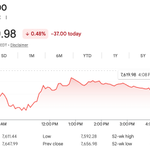
The S&P 500 is down 0.5% since Friday. Semiconductor stocks are down ~2-7%
Pacing wouldn't be fully priced in from just one weekend, but this seems like moderate evidence against the argument that "the US economy is a levered bet on AI, so we can't afford to slow down"


I don't think any team of 3 government regulators could have done as good an investigation with only 6 days on campus as the team from METR/Redwood did.
The point of government regulation, though, is that you can get a lot more than 6 days on campus (& more than 3 people)
This tweet was a bit sloppy, so to clarify: I think the main advantage of government regulation (whether or not they do the auditing themselves or have third parties do it), is that you get greater access, visibility, and mandate for investigation (day on campus is one part of this but not really the most important). This can be done by the government doing the auditing themselves, or outsourcing to third party auditors, and I don't currently have a strong take on that.
People more worried about AI often worry we'll under-anthropomorphize AI and thereby underestimate its powers & risks. Similarly, those worried about overestimating AI's powers worry about over-anthropomorphizing.
But we should eventually be most worried about over-anthropomorphizing AI and thereby underestimating its powers & risks.
We are creating things that are like humans in many ways, but that are new things in their own right, and will need to be understood as such.
Anthropomorphization is a helpful intuition pump to understand how AIs will be agentic, coordinated, and planning. But AIs will be weirder, smarter, and more powerful than humans in ways that anthropomorphization will fail to capture
James Sanders retweeted

If Anthropic has compelling evidence for very short timelines (as many senior ants claim) than it's irresponsible for them not to share it with the world.
A silver lining of having massive firms is that they eventually get large enough that they have to internalize their own externalities.
Social media companies have historically been relatively "divorced" from the real world, and have faced few costs to their bottom line for polluted information environments. However, as these same companies are now trying to do more ambitious things in the real world (getting into AI, eventually robotics, and eventually ~all of the economy), they might face some pressures to clean up the information environment they've created out of self-interest
