

Founder of Estiva: small, opinionated apps for teams, natively integrated on Nostr. Built on @buzzdotxyz. Prev: @Swan, @relai_app, @satoshilabs.
Jablonec nad Nisou
Joined June 2009
- Tweets8.6K
- Following849
- Followers736
- Likes34K




Pinned Tweet
Two years ago I posted the idea of Nostr for Business. Here's where it is now: docs, chat and issues as separate apps on one relay.

Estiva runs on a modified Buzz relay. Instead of plugins inside one app, it's separate apps (docs, chat, issues), each with its own UI and agent harness, sharing the same data. Apps connect through conversations, file widgets, and actions.
Sneak peek 👇
2
75
Jan Mikula retweeted

We’re building the money platform of the future at @OnrampBitcoin. Dollars and stablecoins, bitcoin custody and financial services, and gold.
One experience, from individuals to financial institutions.
We’re hiring an Engineering Lead and a Security Engineer to help build it.
The appeal is pretty straightforward: the financial world is changing, and you get to impact it directly.
Along with making decisions that matter, you'll work directly with leadership and see your work become something people trust with their savings.
Our Engineering Lead needs to set the architecture, make the hard calls, and still ship code.
Our Security Engineer needs to own the security program, test our defenses, lead incident response, and build alongside the engineering team.
Both need to use AI as part of how they work. Accelerate the build, find the weaknesses, improve the defenses.
We are far more interested in what you’ve done with these tools than what you think about them.
We’re deliberately small and flat.
You’ll have real room to build, and we want people who’ll challenge consensus when there’s a better answer.
Ownership and integrity matter more here than a previous title.
The software will change. Our responsibility to the families relying on it won’t.
Remote U.S. Details and how to apply in the comments.

Jan Mikula retweeted

Onramp is hiring a Security Engineer.
You'd own and advance the security program for a bitcoin custody platform, lead incident response, build AI-driven continuous pen testing, and still ship product code. Two-thirds security, one-third engineering.
If irreversible transactions and small-team ownership sound like your kind of problem, we want to chat.
Apply via email:
[email protected]
Learn more:
linkedin.com/jobs/view/44675…

Jan Mikula retweeted
The most important open role at Onramp right now is Engineering Lead.
Quick word on what that actually means, because the title gets read a bunch of ways.
We need the person who makes the hard technical call, explains it so everyone gets it, raises the bar for the whole team, and then opens the pull request themselves.
Why this role and why now? We spent years building Multi-Institution Custody so that no single company, including us, can ever move or lose a client's bitcoin.
That foundation is turning into something much bigger: bitcoin, stablecoins, FDIC-insured balances, gold, credit, money movement, mobile, APIs banks can build on.
The place where a family preserves their wealth, running on the same rails the largest institutions in the world will use.
That's also what makes the engineering unusual.
Every permission and every line of code can eventually touch someone's life savings. Security isn't a review step here, it's the entire product, and what we build has to last for generations.
And we're doing it with a deliberately agile team. AI-native from day one, a handful of great builders orchestrating agents, reviewing hard, shipping fast. No layers.
You'd work directly with me, product, and our banking and custody partners.
Maybe you're a staff engineer ready to lead. Maybe you're a VP who misses the keyboard. Either way, you know if this is you.
And if it's not you, someone came to mind while you read this. Send them my way.
Remote in the US. Full time. Meaningful equity. Apply below 👇


Jan Mikula retweeted
We're hiring a Senior Engineer at @OnrampBitcoin.
The timing is real: the past two weeks pulled years of demand forward.
Custodian networks, enterprises, family offices, and everyday holders all arrived at the same conclusion at once: bitcoin needs institutional-grade security with no single point of failure.
We pioneered multi-institution custody for exactly this moment. Now we're scaling it, and we need one more great engineer to do it.
What you'd walk into:
→ An early engineering seat with real influence on the architecture
→ AI-native, high-agency team that ships fast
→ Full stack: TypeScript, Next.js, Postgres/MongoDB, Vercel/GCP
→ Security-first engineering where the bugs matter, because the stakes are real families' wealth
→ Fully remote
Most engineers spend a career optimizing the wrong products and features. Here, your code secures generational wealth.
DM me or email [email protected] with your resume and a 3-5 minute video on why you're the one.
RTs appreciated. 🫡

Jan Mikula retweeted
An advisor I respect told me on a call this AM: everyone gets the same pushback on multi-institution custody, and nobody's ever explained the answer properly.
The pushback: "Can't the government just force the custodians to hand it over?"
Fair question. The answer has three layers. The third one matters most.
Layer 1: Technical.
Your vault is 2-of-3 multisig. Each key is institutionally generated: sharded, air-gapped, additional entropy, never living one-to-one on a consumer device the way a seed lives on a hardware wallet.
And once a withdrawal is constructed, the destination can't be swapped mid-flight. Compromise my account and you've got a transaction you can't sign, to an address you can't change, pending video verifications at independent institutions confirming I'm me and I'm not under duress.
Layer 2: Legal.
You hold direct title to the bitcoin. The custodians are agents, legally bound to act only at your direction, sitting in separate institutions under separate jurisdictions.
People wave this layer off because "laws can change." But rule of law is how you secure everything else you love. Your house. Your kids. Your contracts. Nobody actually wants to live in the lawless town.
Layer 3: Game theory. The load-bearing layer.
Bitcoin companies operate like free banks. The entire business is reputation. The first time any custodian refuses to sign, or moves a coin it shouldn't, assets flee that same day and the business is finished. A multi-billion dollar publicly traded custodian is not rugging itself for your 40 bitcoin. The incentive to behave is existential. There's collusion insurance on top, but the incentives do the real work.
Now the boogeyman, head on.
If a seizure order ever comes, the government has one bullet. It gets fired at the biggest honeypot first: the centralized custodian pooling millions of coins. That's where the ROI is. Segregated, client-titled vaults spread across institutions and jurisdictions are the last, hardest, least valuable target on the list.
Which means there is smoke before fire. You get warning. The honeypot holders don't.
Then run the honest math. What odds do you put on a seizure that reaches distributed, multi-jurisdiction, client-titled vaults? Now what odds do you put on fumbling your own setup across 30 years: the bus, the firmware bug nobody caught for five years, the spouse who can't reconstruct the treasure map?
For almost everyone, the second number is bigger. Once you see that, the allocation decides itself.
Every custodian, quorum, and jurisdiction @OnrampBitcoin adds changes to the logic of violence a little more.
That's the design. Trust, engineered.
Secured by three. Controlled by you.

Jan Mikula retweeted
We're hiring a Senior Software Engineer at @OnrampBitcoin .
This has been one of the biggest weeks in our company's history.
The demand we've been building toward for years is getting pulled forward, across custodian networks, enterprises, family offices, and everyday holders onboarding to multi-institution custody.
The world is waking up to a simple truth: bitcoin ownership needs institutional-grade security without single points of failure.
We pioneered multi-institution custody to solve exactly that. Now we're scaling it.
What you'd be walking into:
→ High agency and AI Native
→ Early engineering seat with real influence on architecture
→ Full stack: TypeScript, Next.js, Postgres/MongoDB, Vercel/GCP
→ Security-first engineering where the stakes are real → Fully remote, high-agency team that ships fast
If you want your code to secure generational wealth, this is your. future home.
DM me or email [email protected] with your resume + a 3–5 min video on why you're the one.
RTs appreciated. The right person is probably one repost away. 🧡

Jan Mikula retweeted
Bitcoin custody has become absurd to everyone.
Just talked to a guy today who is Bitcoin-only, uses Coldcard, runs Sparrow, understands the whole thing.
And he said the quiet part everyone is now thinking:
"rolling dice 100 times and expecting his wife to inherit that setup is preposterous."
Exactly.
People found Bitcoin because they wanted peace of mind.
Then the industry handed them seed phrases, metal plates, firmware risk, inheritance risk, device risk, duress risk, and told them they were the problem if they didn’t want to become security engineers.
I don’t buy it. Never have.
Self-custody matters.
But serious wealth needs serious infrastructure.
Not one exchange.
Not one hardware wallet.
Not one spouse trying to figure out Sparrow in the worst week of her life after someone passes.
That’s the whole point of Multi-Institution Custody.
Secured by multiple institutions.
Controlled by the client.
Built so one bad thing doesn’t end the game.
We all need to level up.
Jan Mikula retweeted

NVK used open-source code from Trezor to build Coldcard.
Then Foundation forked Coldcard’s code to create Passport.
NVK got mad and switched Coldcard to a Commons Clause license so competitors could no longer use their code.
But because he couldn’t simply relicense the GPL code he took from Trezor, he had to remove and replace it.
And during that rewrite, he introduced the RNG flaw.
That flaw stayed unnoticed for 5 years because nobody had an economic incentive to spend weeks auditing code they were no longer allowed to build on.
His greed caused his downfall.
Do I get this right?
Jan Mikula retweeted
Since Mt. Gox, the Bitcoin answer has been obvious:
Get your bitcoin off the exchange. Take the keys offline.
That was right. It still is.
But it is no longer enough.
The threat model is changing in real time. A device can be completely offline and still inherit a flaw from the vendor, the firmware or the randomness that created the key.
Everyone is arguing about seed phrases, dice rolls, hardware devices, firmware, multisig vendors and whether to temporarily move funds to an exchange.
They’re arguing about the components.
The real issue is the architecture.
What happens when any one of them fails?
If one broken device, compromised vendor, failed institution, or human mistake can lose or move the bitcoin, the architecture is wrong.
And eventually, something will fail.
If there is a SPOF, there will be a SPOF.
AI is making vulnerabilities cheaper and faster to find. Any security model that depends on one party getting one thing right forever is becoming a liability.
We’ve been building around that reality since the firm's inception in 2022, after FTX collapsed.
Not because failure can be eliminated.
Because it can’t.
The custody model has to survive a device, a vendor, an institution, or even the client getting something wrong.
This is not about Coldcard.
It’s about removing single points of failure from how meaningful bitcoin wealth is held.
Full breakdown below.

Jan Mikula retweeted
This is worse than any previous Bitcoin exchange hack. It is arguably one of the worst things that could happen.
The popular hardware wallet COLDCARD has a faulty random number generator (RNG). Funds are being drained from ordinary users’ hardware wallets as you read this.
Users first reported to Block less than 24 hours ago that funds were moving out of their wallets. The exploit was most likely discovered with the help of AI. Block has confirmed that the RNG is broken. You know what that means.
There are likely already multiple attackers competing for the affected BTC. Many more will join very soon.
Nobody knows how much BTC is affected.
Nobody knows how many users are affected.
This attack has only just begun, and it will continue until all affected BTC has been drained unless users secure their funds first. Inevitably, many Bitcoiners will not hear about the incident early enough to respond in time.
I am truly saddened for everyone affected, especially those who may have just lost their life savings.
The worst part is that they did everything right.
Jan Mikula retweeted
Thoughts on unruggable Cashu mints in trusted execution environments (TEEs). Sharing current research and looking for feedback.
Idea: Generate Bitcoin reserve keys and Cashu signing keys inside a TEE so operators never access them.
Goals:
- Minimize rug risk (ideally to ~0)
- Push operators toward non-custodial status
# Risk 1: Malicious mint updates
Users can verify the software running inside a TEE, but operators could later deploy a malicious fork.
Potential mitigations:
- Infrastructure provider enforces which software may be deployed.
- Separate KMS with policies from the TEE allowing only audited/signed software to access keys.
- Immutable mint: disable updates entirely. Upgrades require deploying a new mint and users migrating funds, similar to smart contracts.
# Risk 2: Rollback attacks ("time travel")
An operator could restore an old database snapshot, allowing previously spent ecash to be spent again and inflating supply.
Possible mitigations:
- Append-only storage enforced by the TEE/provider so spent notes can never be erased.
- Seal the database inside the enclave and prevent external access. Combined with update protection, this appears to eliminate rollback attacks.
# Risk 3: Mint shutdown
The operator can always turn the mint off, making reserves inaccessible.
Potential solution:
@lukechilds proposed an elegant emergency exit mechanism. Reserve UTXOs contain a secondary spend path that activates after a period of mint inactivity. A third party (e.g. a multisig) holding a copy of the mint database could continue honoring withdrawals.
During normal operation the mint periodically rolls reserves forward, extending the timeout. If it stops, the emergency path activates.
A more ambitious direction is committing the spend book as a Merkle/nullifier tree. With the right scripts, users may be able to withdraw unilaterally by proving their ecash has not been spent. This could largely solve risks 1-3 simultaneously.
# Conclusion
We haven't cracked this nut completely yet, but the progress over the last few weeks has been remarkable. The mere existence of plausible solutions is incredibly exciting.
Imagine if we could pull this off. David Chaum invented ecash in the 1980s, and researchers spent decades trying to make it trustless. Then Satoshi invented Bitcoin, and the world largely moved to the blockchain paradigm.
It would be an enormous achievement if we could finally solve the trust problem of Chaumian ecash by rebuilding it on Bitcoin and its more expressive L2s, combining the best of both worlds: a scarce, immutable base layer with trust-minimized ecash on top, offering strong privacy, instant payments, near-zero fees, offline transactions, and amazing UX.
It's funny that just few years ago the VC narrative was to hire at all cost to proof that you're growing no matter if it made sense or not.
Now the VC narrative is to do lay offs, but to prove you are ahead the AI curve no matter what the reality actually is.

Today we reduced headcount by 22%. The business is the strongest it's ever been. So I think it's important to be direct about what I'm seeing and why.
First, I made this decision and I own it. I did it because the way to operate at the highest level of productivity is changing, and to win the future, ClickUp needs to change with it.
Second, this wasn't about cutting costs. Most savings from this change will flow directly back into the people who stay. We'll be introducing million-dollar salary bands. If you create outsized impact using AI, you'll be paid outside of traditional bands.
Most importantly, I have the deepest gratitude for those affected. We're doing this from a position of strength specifically so we can take care of people properly. Everyone affected receives a package aimed at honoring their contributions and easing the transition.
I only see two options: wait for this to play out gradually in the market or be honest about what I'm seeing and act proactively.
THE 100X ORGANIZATION
The primary change is that we're restructuring around what I call 100x org. The goal is 100x output. The roles required to build at the highest level are fundamentally different than they were a year ago.
Incremental improvements to existing systems won't get us there. We need new ones. That means creating enough disruption to rebuild rather than iterate on what's already broken.
The common narrative is that AI makes everyone more productive. It doesn't. Many of the workflows of today, if left unchanged, create bottlenecks in AI systems.
These roles will evolve. But waiting for that to happen naturally means falling behind now.
The 100x org is actually heavily dependent on people - infinitely more than today. This is only possible with 10x people that have embraced and adopted new ways of working.
THE BUILDERS, AGENT MANAGERS, AND FRONT-LINERS
— THE BUILDERS: 10X ENGINEERS
I don't think most companies have internalized what's actually happening with AI in engineering. The common narrative is that AI makes all engineers more productive. That may be true in isolation, but at an organization level - that is the farthest thing from reality.
Here's what we've validated recently at ClickUp: the great engineers, the ones who can orchestrate, architect, and review, are becoming 100x engineers. They're not writing code. They're directing agents that write code. The skill is judgment.
AI makes the best engineers wildly more productive, and everyone else using AI slows these engineers down.
Think about it - the bottlenecks are (1) orchestration - telling AI what to do, and (2) reviewing - what AI did. Everything is leapfrogged and no longer needed.
So who do you want orchestrating and reviewing code?
And how do you want your best engineers to spend their time?
If your best engineers are spending time reviewing other people's code, then this is inherently an inefficient bottleneck. These engineers can review their agent's code much faster than reviewing human code.
The new world is about enabling your 10x engineers to become 100x.
The wrong strategy is to push every engineer to use infinite tokens. Companies doing this are celebrating 500% more pull requests. But customer outcomes don't match the volume of code being generated.
I call this the great reckoning of AI coding, and every company will face this soon if not already.
More code is just another bottleneck to the best engineers, and ultimately to your company's impact as well.
— THE BUILDERS: 10X PRODUCT MANAGERS
Product management and design roles are merging.
Designers that have customer focus, become more like product managers.
And product managers that have intuition for UX become more like designers.
The bottleneck of user research is gone. It takes us just one mention of an agent to kickoff research and analyze results.
The bottleneck of product <> design iteration is also gone. The product builder iterates on their own, along with agents and skills that ensure alignment with quality and strategy.
Also controversial today - I believe that the wrong strategy is to have your PMs shipping code - that just introduces another bottleneck that the best engineers will waste their time on.
To be clear, PMs should be coding but they should do this in a playground to iterate, validate, and scope. That code should not go to production.
Everything outside of managing systems, orchestrating AI, and reviewing output becomes a bottleneck.
That's why the other roles that are critical along with these are the systems managers (to reduce bottlenecks) along with a bottleneck you can't replace - customer meeting time.
— THE SYSTEM MANAGERS
Ironically, the people that automate their jobs with AI will always have a job. They become owners of the AI systems - agent managers. We have many examples of these people at ClickUp.
The underlying systems in which we operate are absolutely critical to get right. I think most companies are delusional to think they can iterate on existing systems and compete in this new world.
You must create enough disruption so that old systems are deprecated entirely. If there's any definition for 'AI native' that's what it is.
— THE FRONT-LINERS
In a world that will become saturated with AI communication, the human touch will matter more than anything to customers.
This is a bottleneck that you shouldn't replace - even when agents are high enough quality to do video meetings.
One-on-one meeting time with customers is something that shouldn't be automated. The systems around the meetings should be - so that front-liners spend nearly 100% of their time with customers.
REWARDING 100X IMPACT
In a world where companies are able to do so much more with less, where does that excess money go?
In our case, much of the savings in this new operating model will flow directly back to those that enabled it.
We must reward people that create productivity accordingly. This aligns incentives on both sides. Plus, in a world where your best people create 100x impact, you can't afford to lose them.
You should aim to retain these employees for decades. The context they have and their ability to efficiently orchestrate and review will be nearly impossible to replace.
Compensation bands of today should be thrown out the door. We're introducing $1 million cash/year salary bands with a path available to nearly everyone in the company if they produce 100x impact by creating or managing AI systems.
THE FUTURE
Nearly every company will make changes like these. The ones that do it proactively will define what comes next.
The future is not fewer people. It's different work, new roles, and better rewards for those who embrace it. We're already seeing entirely new roles emerge, like Agent Managers, that didn't exist a year ago.
ClickUp is positioning to lead this shift, not just internally, but for our customers too. I've never been more certain about where we're headed.
175
Jan Mikula retweeted

Bragging about how much software you’re shipping with AI is like holding down the shutter button and bragging about how many photos you took.
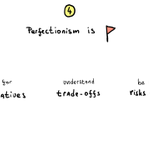
Perfectionism is a red flag
Last post I talked about drilling into unknowns before you build — learning the geology of what you're about to do. Here's the uncomfortable thing that happens when you do that well. You find a lot of problems. And for each one, your brain immediately starts proposing solutions.
If you find yourself convinced there's a perfect one — that's the red flag.
Perfectionism isn't about quality. It's about psychology. It's your brain protecting itself from a hard truth. Every solution is a trade-off. Choosing one means accepting that from some angle, it's not ideal. That's uncomfortable. That's the weight you have to carry as a builder. And perfectionism is just a way to avoid picking it up.
Before our daughter was born, my wife and I read everything — or so we thought. We'd gone deep on sleep, feeding, emotional development. We had the night sleep routine figured out before she even arrived. Then she arrived and we discovered how daily naps reshape your entire day — how every trip, every plan has to bend around them, how much logistics goes into something we hadn't even thought about. We completely missed that side of sleeping. And that's just one example. As she grew, so did we. We started seeing things as they are — options where none of them was perfect, but as parents we had to make quick decisions in the given situation, own the consequences, and do it again and again.
That's exactly what good product decisions feel like.
There's a saying — perfect is the enemy of good. Most people interpret it as a time problem. Finding the perfect solution just takes too long. I don't think it ever was about time. And with AI today, it definitely isn't — you can explore ten alternatives before lunch and build something that looks perfect faster than ever. But that's exactly the trap. If you're using AI to always polish one more thing on your perfect idea, it only pulls you deeper into the rabbit hole and keeps you from seeing reality clearly.
The problem is that perfect solutions don't exist. Building toward one is your brain pretending the trade-offs aren't real. And it's not just trade-offs. It's risks and unknowns too. Every solution has things that could go wrong, things you don't fully understand yet. The perfectionist brain doesn't want to see them — because seeing them means admitting you're about to make an imperfect decision under uncertainty. But that's always the situation. Pretending otherwise doesn't reduce the risk. It just means you stopped looking for it.
See things as they are. Choose the right trade-offs. Accept the risk of being wrong. Own it.
Don't chase perfection. Be the product leader who sees reality clearly — and builds what matters, not what's "perfect".
This is post 4/8 from my talk at Dev/Hack/Day, @BTCPrague 2025.

103
Before you build, drill (I meant prototype)
Last two posts I talked about understanding what customers need to fire and hire — and how to get the real story out of them. But knowing why to build something is one thing. Figuring out what to build is another quest entirely.
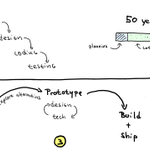
Most teams follow an agile process that's really just waterfall happening faster. PRD → Figma → tickets → code → test. People say we're in a new era with AI now. Honestly? This was already true 10 years ago. I know, because that's why I switched from frontend engineering to product. Writing code wasn't the hard part. Making the right decisions was — and we kept getting that late or wrong.
A side hobby of mine — I followed how highways are built in my country. Before a highway gets built, highway builders do something called geological exploration. They drill holes along the entire route — not to build the road, but to understand what's underneath. If there's a tunnel planned, they'll actually drill a small pilot tunnel first. Not to "build" the tunnel. To learn what the mountain is made of, so they can design the real one to last.
That's what prototyping should be.
Not a rough draft of the product. Not a "quick and dirty" version you'll clean up later. A deliberate investigation into the areas where you have the most unknowns.
Prototyping is learning. Prototyping is de-risking. Prototyping is understanding complexity so you can make decisions about it.
In product work, your "geology" could be anything. Maybe you're an early-stage startup and you don't know if anyone actually wants your idea. Maybe you want to use a library you've never used before. Maybe you have a huge customer base and you're about to introduce a controversial feature with no idea how they'll respond.
Each unknown needs a different kind of drill. But the principle is always the same: go deep where the risk is highest, before you pour concrete.
Yes, AI gives you a faster, more powerful drill. And honestly, it's incredible — working with AI makes me so much better as a PM and it's also way more fun. But a faster drill doesn't mean you don't need to understand the unknowns and the hidden complexity. You do.
Don't jump from idea to building. Drill and learn geology first. I meant prototype.
Thanks to @rjs for inspiration on this one.
This is post 3/8 from my talk at Dev/Hack/Day, @BTCPrague 2025.

1
84
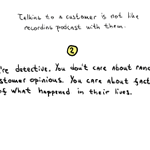
During customer interviews, you're a detective, not a podcast host
Last post I talked about what customers have to fire before they can hire your product. But knowing that is only half of it — you still need to get the story out of them.
Most customer interviews sound like a friendly podcast. Open-ended questions. Lots of nodding. "What features would you like to see?" "How would you improve the experience?"
That's collecting opinions. And opinions are noise.
When someone tells you "I think it would be great if your app had X" — that's their imagination talking. It tells you almost nothing about what they'll actually do.
What matters is what already happened.
As kid I watched Detective Columbo. Every episode was this dance between Columbo and the suspect. The suspect would spin this fog of opinions, explanations, alibis. Columbo ignored all of it. He just kept nitpicking the details — what happened, when, in what order — until the real story unraveled on its own.
That's the mindset. Your customers aren't suspects — they're not lying to you on purpose. But they'll give you the same mix of opinions, rationalizations, and wish lists. Your job is to stay focused on what actually happened.
The question you should ask most often is "when" — closely followed by "why."
My favorite opening: "When did you sign up for our product? Why didn't it happen the day before — or the day after?"
My favorite follow-up: "Can you tell me more? What does that mean?"
Those questions force people to stop generating opinions and start remembering what actually happened.
Pay attention to where the energy shifts. When a customer gets frustrated, or suddenly specific — that's the signal you've hit something real. Like the end of a Columbo episode, when all the nitpicked details suddenly click and you see exactly how the crime happened. That's the moment you understand the full switch — from the old solution to yours.
Stop collecting opinions. Start reconstructing timelines and motives.
Thanks to @bmoesta for the inspiration on this one as well!
This is post 2/8 from my talk at Dev/Hack/Day, @BTCPrague 2025.

1
1
66
Jan Mikula retweeted

What bitcoin app do you recommend to your friends?
After checking more than 20 alternatives, I decided to build my own version - designed with each user’s independence in mind.
Give it a try and help me make it even better. 🚀
linky.fit/
Years ago I read Reinventing Organizations by Frédéric Laloux — it convinced me hierarchies were becoming obsolete.
Jack’s post today shows AI is dramatically accelerating that shift.
The future belongs to empowered individual contributors and builders, not layers of management.
That makes me genuinely happy.


1
75