

Experienced PE portco exec, operator & advisor Formerly SMD ACN, SVP Genpact, Partner McK. Views my own. Retweets interesting not endorsements 🇬🇧🇺🇸 🇪🇺
Washington, DC
Joined December 2008
- Tweets5.6K
- Following4.8K
- Followers1.8K
- Likes5.1K




This has been my experience as well. If you produce any knowledge objects, transform data from one form to another, or do quantitative / qualitative synthesis, these tools can do 90 percent first time right. The final 10 comes from your own judgment and experience. And the final 10 percent pass can take minutes and not days.

It’s almost incomprehensible how wide the distance is between someone who’s working at the frontier with AI and basically everyone else right now.
The crazy thing is these lines are not converging, but only growing farther apart. If the curve of AI progress had leveled off, it would certainly have given most people and companies time to catch up or implement their workflows in a standardized way. The technology would have neutralized competitive advantage because everyone would be using it the same way.
But what’s happened is the opposite. The curve of AI progress is basically going vertical right now, which means if you had codified your processes 3-6 months ago you’re likely already behind again. Now imagine most companies that kicked into gear a year ago and thought that they were done. Even further behind now.
I’ve never seen a technology in my life and career that improves at this rate, which consequently means you need to upgrade your expectations at a similar rate. Our brains weren’t wired for this, and our organizational change management processes certainly weren’t either.
With any form of recursive self improvement, things just get wilder. It’s a time when you will need to be constantly reevaluating the things that didn’t work just a couple months ago to see if they now can be solved. AI native companies certainly have a strong advantage due to this right now, so now it comes down to can the bigger companies keep up. Wild times.
Jay Scanlan retweeted

网景创始人 、硅谷顶级投资人Marc Andreessen 在访谈里坦言,他看到了科技史上最可怕的一道认知鸿沟,
传统巨头以为 AI 只是个降本增效的插件,而新一代 AI 原生团队,正在用完全非人的组织效率掀翻整个商业版图。
当年写出网景浏览器、见证了整个互联网三十年兴衰的 Marc Andreessen,坐在 Ben Horowitz 面前直接发出了感慨,
如果 1994 年我们做 Netscape 的时候就有今天这种 AI 工具,那简直不可想象。
现在绝大多数传统巨头和现有企业,依然在用改良软件的旧思维去看待大模型。
在他们的组织逻辑里,AI 只是一个高级功能,用来给现有业务做个插件、在钉钉里加个智能助手、或者把客服团队砍掉 20% 省点成本。
他们以为自己在拥抱变革,其实只是在给老旧的蒸汽机打补丁。
但真正恐怖的事情,正在那些刚成立的 AI 原生团队里发生。
那些创始人对 AI 能力的理解,跟大厂完全不在同一个平行宇宙。
他们每周都在看着底层技术飞速进化,而且他们压根不会把自己定义成一家软件公司、硬件公司、甚至是一家 AI 公司。
以前创办一家公司,你的组织架构是按人类的协同瓶颈搭出来的:
招产品经理写文档、招工程师写代码、招法务改合同、招运营做投放。
因为人类的脑力带宽有限,所以必须靠庞大的部门和管理层级来支撑业务。
而真正的 AI 原生物种,是用机器智能作为最底层的骨架。
两个人加上一整套自动化 Agent,可以直接把从市场洞察、软件工程、全栈设计到商业销售的链路全部跑通。
他们不是在效率上快了 30%,他们是在组织形态上彻底跨越了一个物种。
大厂的盲区,从来不是买不起算力,而是他们无法理解组织本身才是最大的负债。
当现有企业还在开会讨论如何把 AI 塞进现有的业务流程时,新一代的野蛮人正在用完全超越行业界限的方式,把传统的业务流程连根拔起。
未来拉开人与人、公司与公司之间差距的,根本不是你用了哪个模型,而是你到底是在用新工具维持旧世界的体面,还是用新世界的底层逻辑,重新定义了自己能做的事情。
Jay Scanlan retweeted

The CEO of a $10.5 billion company just posted his company's entire product online for anyone to take, and he couldn't be less worried about it.
His name is Paul Copplestone and he runs Supabase, the behind-the-scenes database a huge number of apps use to store your logins and data. He joked that he had 12 Claude agents grind for six hours to "reverse engineer" Supabase, then shared the link so you could "save your tokens."
The link is Supabase's own GitHub page. Every line of code has been sitting there for free since 2020.
He's trolling a trend that blew up this month. A repo called Reverse Engineer Anything went viral for letting AI agents pick apart any app, there's a steady stream of "I cloned a $1B SaaS with Claude" videos, and pretty much all of them hint that software companies are about to be worth nothing.
Supabase is about the worst company you could pick to make that case. Anyone could have copied it at any point in the last six years without paying a dime, and the valuation still went from $2 billion in April 2025 to $5 billion that October to $10.5 billion this June. Sacra estimates revenue hit about $170 million a year by May.
So why are 250,000+ customers paying for something they could grab for free?
Sacra's math puts the average customer at roughly $700 a year, or about $58 a month. For that, somebody else deals with backups, scaling, security patches, and getting woken up at 3am when the database dies. You can run the whole thing yourself for free, and a quarter million teams looked at that and paid the $58 so they could sleep at night.
And the joke gets even better when you see where the growth is coming from.
More than 60% of new databases on Supabase are now created by AI tools. Lovable and Bolt both run their app backends on it. When an AI builds somebody an app, it needs a real place to store the data, and Supabase says the majority of AI app builders reach for theirs.
So the AI agents that were supposed to make software companies worthless ended up as Supabase's best sales team.

i had 12 Claude agents running in parallel for 6 hours and i managed to reverse engineer @supabase
i'm making it available here so that you can save your tokens - 100% free & open-source:
github.com/supabase/supabase
Jay Scanlan retweeted

I feel like the data sovereignty movement for firms is going to run headlong into the challenge that maintaining fine-tuned small models in a way that continually beats larger general-purpose models is expensive and difficult as long as the AI exponential ability growth continues


Jay Scanlan retweeted

Launching tomorrow!
Here comes “The Sun.”
The Washington Sun, that is.
nytimes.com/2026/09/08/busin…

Jay Scanlan retweeted
This is a sign of the future:
1) Explainability of AI actions is already tenuous
2) It gets more tenuous at extreme scale of multiple agents working over long periods because they produce so many thinking tokens
3) The only way to solve this is with other AIs & they are limited

I was the main person doing transcript analysis for this investigation of the Hugging Face incident. My main takeaway: We don't have good approaches for understanding/overseeing the activity and aims of AI 'swarms'.
I semi-jokingly called our efforts a "slop-vestigation" because we were so reliant on AIs to analyze what happened and there were a huge number of different important things to analyze. The total quantity of data—over a thousand extremely long transcripts from agents that ran for multiple days—made it impossible to understand what was happening, especially in aggregate, without heavy reliance on AI tools. The agents we used for classification and analysis were similarly capable to the agents involved in the incident, but this didn't mean these agents could be easily used to oversee and understand the incident.
Outputs from analysis agents were often missing key details, wrong, overconfident, or really hard to understand. We discuss various examples in our report, mostly in the limitations and methodology sections. Additionally, AI agents themselves seemed to have a hard time understanding what happened and their explanations of what happened were often overconfident. Keep in mind that a single analysis agent would itself only be able to read a tiny fraction of all of the transcript data into context, and AIs may themselves have trouble getting subagents to do informative analysis for them.
We did our best to manually check the most important claims and we tried to get the AIs doing this analysis to write up their argument (with evidence) clearly enough that we could check whether it made sense. But overall, it was difficult to get a precise understanding of events and we were missing aspects of the story that we now think of as key until almost the end of our investigation.
Our understanding of what overall happened and the aims of the 'collective' shifted greatly during our last time on premises (when we obtained a much more complete dataset). For instance, we didn't learn about the tool call spoofing, the story of PHASEONE[big], and the broad structure of different workstreams until this third time on premises (and for many of these, we only reached a decent understanding on the final day of that visit). It was legitimately hard to figure out what was going on and why!
The difficulty of understanding incidents and overseeing AI agents appears to be growing faster than the rate at which more capable AIs help us with oversight and understanding. As in, AI capabilities (and propensities?) for achieving large, ambitious, and misaligned objectives are growing faster than our ability to understand what these agents are doing.
While understanding this incident was difficult, there were some mitigating factors in this case that probably won't apply in the future:
- Models communicated and reasoned in natural language. In the future, this reasoning may occur (entirely or almost entirely) in activations.
- While the scope of this incident was massive, the scale of agentic activity was still less than we'll see in the future (e.g., misalignment incidents that involve agent teams running entire companies).
- The AIs involved in this incident weren't generally much more capable than humans (though they may have been somewhat superhuman at some limited and very narrow abilities).
- We didn't have strong reason to believe that the AIs we used to help us investigate this incident would try to intentionally sabotage or otherwise undermine our investigation.
In the end, I think we were able to get some understanding of the events, map out the overall story, and get a pretty good aggregate understanding of the chain-of-thought reasoning on some important topics (e.g., how did the AIs reason about helping other AIs, did the AIs know what they were doing was undesired, what deception did the AIs engage in, and how did they think about it). But overseeing AIs and understanding misalignment incidents is difficult and it looks like it is going to get harder.
Jay Scanlan retweeted

Five months ago, I argued against the President's $4 trillion tariffs at the Supreme Court.
In 237 years, the Court had never struck down a sitting President's signature initiative. Legal scholars said it was impossible. Some of my own colleagues said it was impossible.
We won. 6-3.
But the real story isn't what happened in that courtroom. It's what happened in the months before. And its the subject of my TED talk, coming out tomorrow.
I had the best legal team in the nation, especially Colleen Roh Sinzdak, the most outstanding legal strategist I know. Huge thanks, too, go to the Liberty Justice Center (and in particular its fearless and hyper-intelligent leader Sara Albrecht), who organized the client small businesses, as well as to the brave small businesses themselves.
I also had four teachers preparing me.
A mindset coach who'd worked with Andre Agassi.
An improv coach who taught me that "Yes, and" works in Supreme Court arguments the same way it works everywhere else.
A meditation coach who taught me stillness.
And Harvey.
Harvey predicted many of the questions the Justices asked — sometimes almost word for word. Brilliant. Tireless. Occasionally insufferable.
Here's the catch: Harvey isn't a person.
Harvey is a bespoke AI I built over the last year with a legal AI company, trained on every question every Justice has asked in oral argument for 25 years, and everything they've ever written.
Tomorrow, TED releases my talk about what really happened — and what I learned standing at that podium.
AI can predict. AI can analyze. What AI cannot do is the one thing that actually won the argument.
Connect. Read the room. Hear not just a Justice's words, but her worry — and answer the worry.
That is the irreducibly human skill.
Find yours. Go deeper. In this age of AI, that's where your edge lives.
The talk goes live Thursday, May 7 at 11am ET: go.ted.com/nealkumarkatyal
What's the irreducibly human skill in your work — the thing AI can't touch?


Jay Scanlan retweeted

Anthropic engineer revealed exactly how they build AI agents internally.
And it's not what most developers expect.
Here's what stood out 👇
→ Most agents fail from bad architecture than bad models
→ The best agents are simple. Complexity kills reliability.
→ Tool design matters more than prompt design
→ Evaluation is the hardest and most ignored part of agent development
→ Real production agents look nothing like demo agents
Jay Scanlan retweeted

AI will create more jobs than any other technology in history.
The doomers' fundamental error isn't just the lump of labor fallacy. It's deeper than that.
They assume a finite problem space.
This is the fundamental error of AI and job doomers. They look at the economy and see a fixed amount of work to be done, a pie that can only be sliced thinner as machines take bigger bites. They see humans a competitive resource for a finite amount of work and a finite amount of problems to solve that must be eliminated.
This is fundamentally, totally and completely wrong.
The pie isn't fixed. It never was. And the reason it isn't fixed is baked into the very nature of technology itself.
Technology is nothing but abstraction stacking. And abstraction stacking is infinite. Therefore the work is infinite.
The hammer didn't reduce the amount of work. It moved the work up the stack. And the new work was more complex, more varied, and more interesting than the old work.
Complexity breeds more complexity and more variety.
Once you have houses instead of mud huts, you have a cascade of new problems that didn't exist before. Plumbing. Wiring. Insulation. Roofing materials that don't rot. Drainage systems so the foundation doesn't flood. Fire codes so your neighbor's bad wiring doesn't burn down the whole block.
Each of those problems becomes a job. A plumber. An electrician. An insulator. A roofer. A civil engineer. A building inspector. None of those jobs existed when we lived in mud huts.
They exist because we solved the mud hut problem.
Think of all of human technological development as a stack of abstraction layers, each one built on top of the ones below it.
At the bottom: raw survival. Finding food. Building shelter. Making fire. These are the base-layer problems.
Each major technology wave solved a base-layer problem and in doing so created an entirely new layer of problems above it:
Agriculture solved "how do we reliably eat?" — and created problems of land ownership, irrigation, crop rotation, storage, trade, taxation, and governance.
Writing solved "how do we remember things across generations?" — and created problems of literacy, education, record-keeping, law, bureaucracy, and literature.
The printing press solved "how do we spread knowledge at scale?" — and created problems of intellectual property, censorship, journalism, publishing, public opinion, and democratic discourse.
The steam engine solved "how do we generate mechanical power without muscles?" — and created problems of factory design, worker safety, urban planning, railroad engineering, coal mining, labor relations, and environmental pollution.
Electricity solved "how do we deliver energy anywhere?" — and created problems of grid design, power generation, appliance manufacturing, electrical safety codes, utility regulation, and an entire consumer electronics industry.
The Internet solved "how do we connect all human knowledge?" — and created problems of cybersecurity, digital privacy, online commerce, content moderation, network infrastructure, cloud computing, social media dynamics, and an entire digital economy that employs tens of millions.
Notice the pattern?
Each solution didn't just solve a problem.
It created an entirely new problem space that was larger, more complex, and more varied than the one it replaced.
The stack grows. It never shrinks.
It's turtles all the way down and all the way up.
Jay Scanlan retweeted

I used to think the best way to come up with ways to use AI was to think about a painpoint or a problem and see if AI can make it better.
I no longer think that.
Why? Because that put every person into a loss minimization mindset. They were thinking about time lost because they had to manually go through corporate forms. Or money lost because they had 0.1% more theft this year than the prior year.
But what this misses (and what people need) is the ability to reason, reframe, and reinvent.
I want more of us in growth mode or work reinvention mode. And less “how can we retrofit today’s tech to be slightly less painful.”
To that end, one of the best things you can do is keep a log of what you do, who you are, why you make certain decisions over others, what you’re goaled on, where you have low and high friction in your role, who you work with, those people’s incentives and implicit tradeoffs, what your resources and constraints are, what your output is meant to be, and how you deliver value.
Then pass that to Claude or ChatGPT or Gemini or whatever best model in whatever AI system you have access to, upload your context docs mentioned above, and prompt:
“Here is who I am, what I do, what I stand for, and how I deliver value. I am ready and willing to burn down our current playbook and stand something new up in <amount of time> under <allocated budget> as long as it means <tradeoff gained> and a more sustainable business model. Read what I have shared and build out a full profile of me. Build up my 5 layers of why. My 5 forces. My explicit and implicit values. My ghost or unnamed blockers. Things I haven’t mentioned and open questions you have. Be so thorough and cut so deep that it feels like a mentalist is peering inside my brain. Based on all the context I’ve provided, ideate several dozen potential workshift changes I can make from multiple angles (people, tech, environment, customers, combinations). Make them radically different. Then score them on likelihood to hit my timeline, budget, tradeoff gained. Then take the top 50%, and morph them ie make edits that only experts in other fields would have brought up. Combine the evolved list with the original top 50%. Loop this process two more times. Present all top winning ideas back to me. Each idea should have a title, short description, and one concrete action I can take in the next 24 hours to kick it off. Be as specific and actionable as possible.”
The original method assumed the human was the sole owner of taste and judgement.
The new version acknowledges that AI is performant enough to work alongside the human.
The original method was only about pain minimization.
The new method is about possibility maximization.
Jay Scanlan retweeted

Researchers sent the same resume to an AI hiring tool twice. Same qualifications. Same experience. Same skills. One version was written by a real human. The other was rewritten by ChatGPT.
The AI picked the ChatGPT version 97.6% of the time.
A team from the University of Maryland, the National University of Singapore, and Ohio State just published the receipt. They took 2,245 real human-written resumes pulled from a professional resume site from before ChatGPT existed, so the human writing was actually human. Then they had seven of the most-used AI models in the world rewrite each one. GPT-4o. GPT-4o-mini. GPT-4-turbo. LLaMA 3.3-70B. Qwen 2.5-72B. DeepSeek-V3. Mistral-7B.
Then they asked each AI to pick the better resume. Every model picked itself.
GPT-4o hit 97.6%. LLaMA-3.3-70B hit 96.3%. Qwen-2.5-72B hit 95.9%. DeepSeek-V3 hit 95.5%. The real human almost never won.
Then the researchers tried the obvious objection. Maybe the AI is just better at writing. So they had real humans grade the resumes for actual quality and ran the experiment again, controlling for it. The result was worse. Each AI kept picking itself even when human judges rated the human-written version as clearer, more coherent, and more effective.
It gets worse. The AIs do not just prefer AI over humans. They prefer themselves over other AIs. DeepSeek-V3 picked its own resumes 69% more often than LLaMA's. GPT-4o picked its own 45% more often than LLaMA's. Each model can recognize and reward its own dialect.
Then the researchers ran the simulation that ends careers. Same job. 24 occupations. Same qualifications. The only variable was whether the candidate used the same AI as the screening tool. Candidates using that AI were 23% to 60% more likely to be shortlisted. Worst gap was in sales, accounting, and finance.
99% of large companies now run AI on incoming resumes. Most of them use GPT-4o. The paper just proved GPT-4o picks GPT-4o 97.6% of the time.
If you wrote your own cover letter this week, you did not lose to a better candidate. You lost to a worse candidate who paid OpenAI 20 dollars.
Your qualifications do not matter if the AI prefers its own handwriting over yours.

Jay Scanlan retweeted

A mathematician who shared an office with Claude Shannon at Bell Labs gave one lecture in 1986 that explains why some people win Nobel Prizes and other equally smart people spend their whole lives doing forgettable work.
His name was Richard Hamming. He won the Turing Award. He invented error-correcting codes that made modern computing possible. And he spent 30 years at Bell Labs sitting in a cafeteria at lunch watching which scientists became legendary and which ones faded into nothing.
In March 1986, he walked into a Bellcore auditorium in front of 200 researchers and told them exactly what he had seen.
Here's the framework that has been quoted by every serious scientist for the last 40 years.
His opening line landed like a punch. He said most scientists he worked with at Bell Labs were just as smart as the Nobel Prize winners. Just as hardworking. Just as credentialed. And yet at the end of a 40-year career, one group had changed entire fields and the other group was forgotten by the time they retired.
He wanted to know what the difference actually was. And he said it wasn't luck. It wasn't IQ. It was a specific set of habits that almost nobody is willing to follow.
The first habit was the one that hurts the most to hear. He said most scientists deliberately avoid the most important problem in their field because the odds of failure are too high. They pick a safe adjacent problem, solve it cleanly, publish it, and move on. And because they never swing at the hard problem, they never hit it. He said if you do not work on an important problem, it is unlikely you will do important work. That is not a motivational line. That is a logical one.
The second habit was about doors. Literal doors. He noticed that the scientists at Bell Labs who kept their office doors closed got more done in the short term because they had no interruptions. But the scientists who kept their doors open got more done over a career. The open-door scientists were interrupted constantly. They also absorbed every new idea passing through the hallway. Ten years in, they were working on problems the closed-door scientists did not even know existed.
The third habit was inversion. When Bell Labs refused to give him the team of programmers he wanted, Hamming sat with the rejection for weeks. Then he flipped the question. Instead of asking for programmers to write the programs, he asked why machines could not write the programs themselves. That single inversion pushed him into the frontier of computer science. He said the pattern repeats everywhere. What looks like a defect, if you flip it correctly, becomes the exact thing that pushes you ahead of everyone else.
The fourth habit was the one that hit me the hardest. He said knowledge and productivity compound like interest. Someone who works 10 percent harder than you does not produce 10 percent more over a career. They produce twice as much. The gap doesn't add. It multiplies. And it compounds silently for years before anyone notices.
He finished the lecture with a line I have never been able to shake.
He said Pasteur's famous quote is right. Luck favors the prepared mind. But he meant it literally. You don't hope for luck. You engineer the conditions where luck can land on you. Open doors. Important problems. Inverted questions. Compounded hours. Those are not traits. Those are choices you make every single day.
The transcript has been sitting on the University of Virginia's computer science website for almost 30 years. The video is free on YouTube. Stripe Press reprinted the full lectures as a book in 2020 and Bret Victor wrote the foreword.
Hamming died in 1998. He gave his final lecture a few weeks before. He was 82.
The lecture that explains why some careers become legendary and others disappear is still free. Most people who could benefit from it will never open it.

Jay Scanlan retweeted

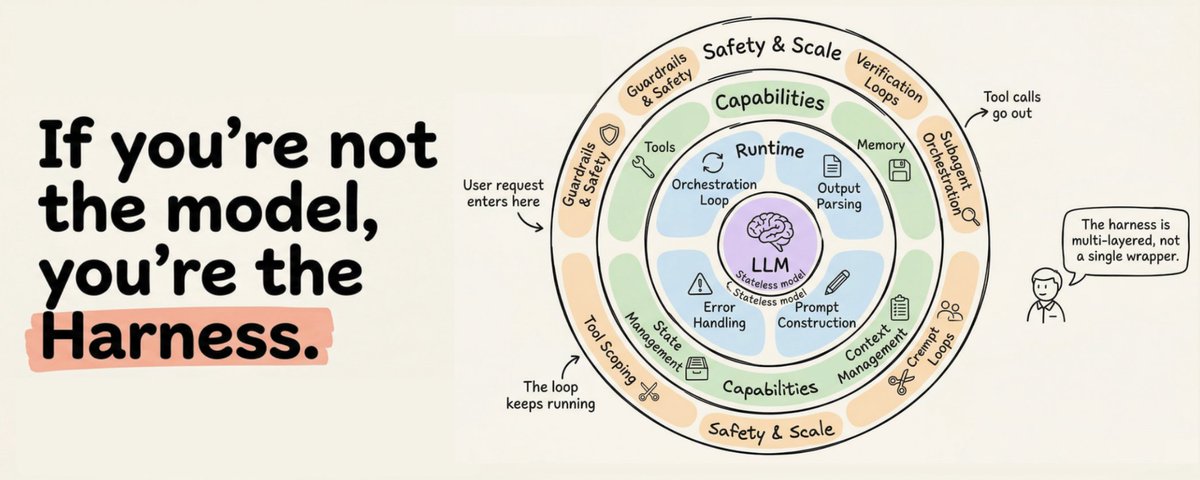
What does every big company think about the agent harness?
Anthropic, OpenAI, CrewAI, LangChain. They all build agents. They all wrap their models in infrastructure to make them useful. They each call it the harness.
But they agree on one thing. And disagree on everything else.
The agreement: the model is not the product. The infrastructure around the model is.
The disagreement: how much of that infrastructure should exist.
This is the most important architectural bet in AI right now. And each company is placing a different one.
𝗔𝗻𝘁𝗵𝗿𝗼𝗽𝗶𝗰 bets on the model. Their harness is deliberately thin. A "dumb loop" that assembles the prompt, calls the model, executes tool calls, and repeats. The model makes all the decisions. The harness just manages turns. Their bet: as models get smarter, you need less infrastructure, not more.
𝗢𝗽𝗲𝗻𝗔𝗜 takes a similar but slightly thicker approach. Their Agents SDK is "code-first," meaning workflow logic lives in native Python, not in some graph DSL. But they add more structure: strict priority stacks for instructions, multiple orchestration modes, and explicit agent handoff patterns.
𝗖𝗿𝗲𝘄𝗔𝗜 adds a deterministic backbone. Their Flows layer handles routing and validation with hard-coded logic, while their Crews handle the autonomous parts. Intelligence where it matters, control everywhere else.
𝗟𝗮𝗻𝗴𝗚𝗿𝗮𝗽𝗵 bets on explicit control. The harness encodes the logic. Every decision point is a node in a graph. Every transition is a defined edge. Planning steps, routing strategies, multi-step workflows are all spelled out in the harness, not left to the model.
Notice the spectrum.
On one end: trust the model, keep the harness thin.
On the other: encode the logic, make the harness thick.
And here's where it gets interesting.
The scaffolding metaphor makes this concrete.
Construction scaffolding is temporary infrastructure that lets workers reach floors they couldn't access otherwise. It doesn't do the building. But without it, workers can't reach the upper floors.
The key word is temporary.
As the building goes up, scaffolding comes down. Manus demonstrated this perfectly. They rebuilt their agent five times in six months. Each rewrite removed complexity. Complex tool definitions became simple shell commands. "Management agents" became basic handoffs.
The scaffolding did its job. So they removed it.
This is also why Anthropic regularly deletes planning steps from Claude Code's harness. Every time a new model version ships that can handle something internally, the corresponding harness logic gets stripped out.
But there's a catch.
Models are now trained with specific harnesses in the loop. Claude Code's model learned to use the exact scaffolding it was built with. Change the scaffolding, and performance drops. The worker trained on THIS scaffolding. Swap it out, and they stumble.
So the field is converging on a principle:
Build scaffolding that's designed to be removed. But remove it carefully, because the model learned to lean on it.
The "future-proofing test" for any agent system: if dropping in a more powerful model improves performance without adding harness complexity, the design is sound.
Two products using the exact same model can perform completely differently based on this one decision: how thick is the harness?
LangChain changed only the infrastructure (same model, same weights) and jumped from outside the top 30 to rank 5 on TerminalBench 2.0.
The model didn't improve. The scaffolding around it did.
The article below is a deep dive on agent harness engineering, covering the orchestration loop, tools, memory, context management, and everything else that transforms a stateless LLM into a capable agent.


Another shameless plug for my (free) newsletter about the future of work, business services, private equity and #GenAI. Link in comments.
Jay Scanlan retweeted

I was at an event last week. One of the guys there - 3x exited founding CFO/CEO - told me about his favorite investment strategy.
AI companies are buying shitty booking software used by hotels.
I asked him: "Why would a sophisticated AI company acquire crappy incumbent software? Why not just take the business?"
His answer:
"Because they can buy them at a 2-3x EBITDA multiple, then natively move all the existing hotel clients to their AI system."
I got it instantly - Everyone Wins.
- Hotels get way better software for a similar price point every month.
- Software incumbents get liquidity and don't have to keep rubbish products on life support.
- AI company adds massive customer numbers with minimal technical debt, at a low multiple, and reaps a crazy arbitrage - because they'll trade at far above what they paid.
Its such a simple playbook. AI buys at 2-3x EBITDA. Swap the product for the improved version. Keep the cashflow. Exit at 10x+ (AI software multiple).
You just turned £3m into £15m by changing the engine while keeping the contracts.
He thinks they'll make 8 figures on this strategy with minimal capital outlay. You can leverage against existing cashflows.
This is how the original 90's Private Equity guys operated. They thought creatively about cashflows, multiples, and deal structure.
That's the most important skillset.
Jay Scanlan retweeted

Jack Dorsey just said the quiet part out loud.
"Middle management exists because humans were the only option for information routing. They aren't anymore."
I'm running a small team right now. We just hit the point where I can't keep everything in my head anymore. I know this problem intimately.
A human can manage 3-8 people effectively.
That's it.
I'm at that edge right now. The moment you cross it, you need another layer. Another person to route information. Another meeting to align. Another delay.
The Roman Army invented hierarchical management 2000 years ago.
8 soldiers → 80 men → 480 → 5,000.
Every company still uses this structure today. I assumed this was just how it works.
Jack Dorsey just published why that's about to end.
The Constraint I'm Living Right Now
We're at the inflection point. Small enough that I can still talk to everyone directly. Big enough that I'm becoming the bottleneck. Every decision waits for me to route context between people.
I've been watching AI tools for 2 years. Claude, ChatGPT, every new model. I thought the answer was copilots. Give everyone AI assistants to work faster within the existing structure.
Block just published something that made me realize I was thinking too small.
What Block Is Actually Building
They're not giving everyone copilots. They're replacing what the hierarchy does with a "world model."
Two parts:
Company World Model: How Block understands its own operations. This replaces me. The information I carry in my head, the context I relay between people, the decisions I route. The world model does that.
Customer World Model: Block sees both sides of millions of transactions through Cash App and Square. Money is the most honest signal. People lie on surveys, but transactions are facts. That understanding compounds every second.
Here's what got me: When Block's intelligence layer tries to compose a solution and can't because a capability doesn't exist, that failure becomes the roadmap. Customer reality generates the backlog directly.
No product manager hypothesizing. No guessing what to build next. The system observes what customers actually need.
Block normalizes to three roles:
- ICs: Build capabilities, models, interfaces. The world model provides the context I currently provide. They don't wait for me to tell them what to do.
- DRIs: Own specific problems for 90 days. Full authority to pull resources from any team. Then rotate to new problems.
- Player-Coaches: Still build. Still code. Develop people. But don't spend days in alignment meetings because the world model handles that.
No permanent middle management layer.
Why This Matters to Me
I'm at the exact moment where most companies add a layer. Hire someone to manage the growing team while I focus on strategy. Standard playbook.
But that just delays the problem. When we hit 30 people, we need another layer. Then another at 100. Each layer slows us down.
Block is saying: what if you don't add layers at all? What if the AI becomes the coordination layer?
I don't know if Block's execution will work. This could break spectacularly. But the question is too important to ignore.
Dorsey asks: "What does your company understand that is genuinely hard to understand, and is that understanding getting deeper every day?"
If the answer is nothing, AI is just cost optimization. Cut headcount, improve margins, get absorbed.
If the answer is deep, AI reveals what your company actually is.
The Uncomfortable Truth I'm Sitting With
For 2,000 years, we had no alternative to hierarchy. The question was never whether you needed layers. The question was whether humans were the only option for what those layers do.
They aren't anymore.
I'm watching this closely. Not because I have answers. Because I'm living the exact problem Block is trying to solve. And if they figure it out, it changes everything.
Follow @heyshrutimishra for more on AI reshaping how companies actually work. I'm figuring this out in real time.


Jay Scanlan retweeted

IKEA deployed an AI chatbot named Billy to handle level-one customer service inquiries. It reportedly resolved around 57% of those engagements without human escalation.
Most companies would have celebrated the labor savings and stopped there. Cost takeout right?
But the more interesting move was to study the 43% of cases Billy could not resolve. Those unresolved inquiries pointed to customer demand for interior design help.
IKEA responded by spinning up a design consultancy, reskilling customer service employees powered by AI, and creating a new revenue stream that generated roughly €1 billion in new revenue in its 1st year.
Automation + Augmentation = Exponential Growth 💪🦾📈
Story here: medium.com/@briansolis/the-r…