
Gut & Metabolic Health Specialist T1/T2 diabetes symptoms, gut issues, balance hormones in women during perimenopause. Science-based nutrition . +91-7009023310
Joined February 2015
- Tweets9.8K
- Following416
- Followers6.6K
- Likes16.2K






Dr. Jasmeet Kaur (PhD) retweeted

Thank you very much sir 🙏🙏

A couple of years ago, I came across @shashiiyengar Ji's profile on Twitter/ X. His posts enlightened me on the importance of a low carb regime and I became his Twitter Ekalavya by shifting to a low carb diet with adequate intake of protein and fats. This has helped me keep my HbA1C and other blood markers at a healthy level, which is very important for those with a family history of diabetes. Thank you Shashi Sir.
Our Body Knows How to Function. But Are We Giving It the Right Environment?
One thing I often notice while working with people suffering from chronic digestive issues is how easily we underestimate the role of our nervous system in our overall health.
Recently, during a discussion, someone with a strong science background questioned why we should consciously practise breathing, slow down while eating, or pay attention to the connection between our brain and gut.
His argument was simple: These are involuntary functions. Our body already knows how to breathe, digest food and regulate its organs. Why should we consciously interfere?
And scientifically, he is not entirely wrong.
Our body has an incredible ability to regulate itself. We don’t have to consciously tell our stomach to produce acid, our intestines to move food, or our diaphragm to contract during normal breathing.
Our autonomic nervous system regulates these functions without conscious effort.
But there is something very important we often forget.
Our nervous system does not function independently of the environment in which we live.
It continuously receives information about our surroundings and internal condition, including stress, emotions, nutritional status, sleep and physical health.
And it responds accordingly.
Two people can experience the same stressful situation, yet their bodies may respond very differently.
One may experience a faster heartbeat, another may develop abdominal discomfort, while someone else may notice changes in bowel movements or appetite.
Why?
Because our nervous system responds not only to what is happening around us but also to what is happening inside us.
We eat while scrolling through our phones. We rush through meals. We remain mentally occupied with work even while eating. We sleep poorly, sit for long hours and often remain under prolonged mental or physical stress.
Our digestive system continues working, but the conditions under which it functions may not always be favourable.
This is where conscious practices become important.
Interestingly, modern medicine also recognises this connection.
For certain disorders of gut–brain interaction, treatment may include gut-directed psychological therapies and medications that influence signalling within the gut–brain system.
So why should we dismiss simple behavioural practices that may help regulate some of these same physiological pathways?
Of course, breathing is not a cure for every digestive problem. Nor can we simply switch the vagus nerve on and off through conscious effort.
But we can influence some of the conditions under which these systems operate.
We are not trying to control every involuntary function. We are consciously changing the inputs that influence those functions.
Nutrition is extremely important. But the environment in which our body receives, processes and responds to that nutrition also matters.
Our body knows how to function. But knowing how to function and functioning optimally under every condition are two different things.
Perhaps holistic health is not about teaching our body what to do.
It is about understanding what may be interfering with its natural functions and creating better conditions for those functions to take place.

Dr. Jasmeet Kaur (PhD) retweeted
World Diabetes Day -2026
This is a reminder that we can maintain normal blood sugars for more than a decade if we are committed to low-carb lifestyle.

Dr. Jasmeet Kaur (PhD) retweeted
Meet Hannah Warren, presenting Vegetarian & Vegan Keto for Metabolic and Mental Health.
Her module is part of the Nutrition Network course in association with Metabolic Health India®.
Enrol now:
shorturl.at/ay2wQ
🤖 Made with AI

Dr. Jasmeet Kaur (PhD) retweeted
Most Indian meals are built around starches in form of rice, roti or potato, while protein is treated as a small side item often neglected.
Try reversing the order.
Choose an adequate protein source first, such as paneer, tofu, eggs, yoghurt, meat, chicken or fish.
Then add non-starchy vegetables and appropriate fats.
Let the starch come last.
Protein should be the anchor of the meal, not the garnish.
-Metabolic Health india

Dr. Jasmeet Kaur (PhD) retweeted
Meet Mishal Sequeira, sharing her module on Low Carb & Fasting for Weight Loss.
Explore practical strategies for using low-carb eating and fasting to support weight loss as part of the Nutrition Network course with Metabolic Health India®.
Enrol now
shorturl.at/UQjHH
🤖 Made with AI

Dr. Jasmeet Kaur (PhD) retweeted
A special moment from the World Nutrition Summit Oct 2026 in Cape Town - South Africa:
@ProfTimNoakes introducing me at the opening of the conference on the first day.
I’m grateful for the opportunity to share my work & represent India at this international gathering of low-carb experts.
Thank you, Professor Noakes, for the warm introduction.
Dr. Jasmeet Kaur (PhD) retweeted
Time in Range (TIR)
Time in range shows how much of the day glucose remains within a defined target, including the highs + lows that HbA1c may not show.
For most adults with diabetes, the standard TIR is 70–180 mg/dL, with a goal of spending more than 70% of the day within this range.
A tighter measure, 70–140 mg/dL, is called Time in Tight Range. It can provide a clearer picture of near-normal glucose control and reveal rises that the wider range may miss.
A CGM will help your track TIR.
Most CGM have 70-180 but I like LinX CGM that shows 72-144 TIR
The tighter range may be a useful personal goal when we want to avoid all future serious complications arising out of dysregulated blood sugar levels.
Aim for more time in range, fewer sharp peaks and valleys, and steadier glucose throughout the day.
This is why i say that anyone who says they are in diabetes remission and never used a CGM remains ignorant to a good extent.
- Metabolic Health India


Dr. Jasmeet Kaur (PhD) retweeted
Link to enrol:
courses.nutrition-network.or…

Dr. Jasmeet Kaur (PhD) retweeted
After a meal if possible, climb the stairs for a few minutes at a comfortable pace.
Stair climbing activates the large muscles of the legs & may help reduce the post-meal glucose rise.
Start slowly & use the handrail.
If stair climbing not possible or not available then choose a short walk instead.
I had a stair climbing champion who lost weight, got his type 2 diabetes into remisison and got off blood pressure medication with low-carb + climbing stairs in 3 months flat.
Today he goes to gym and is building muscles.
- Metabolic Health India®

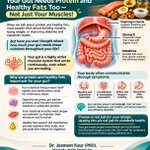
YOUR GUT NEEDS PROTEIN AND HEALTHY FATS TOO, NOT JUST YOUR MUSCLES!
When we talk about protein and healthy fats, most people think about building muscles, losing weight, improving diabetes, insulin resistance, or metabolic health.
But have you ever thought about how much your gut needs these nutrients throughout your life?
Your gut is a highly active muscular system that works continuously, even when you are resting.
We train our biceps, shoulders, back, and legs. But what about the muscles we cannot see?
Your oesophagus, stomach, and intestines contain muscles that help move food, support digestion, and eliminate waste. Your diaphragm also plays an important role in breathing and abdominal pressure regulation.
Why are protein and healthy fats important for your gut?
● Your intestinal lining renews itself rapidly and needs amino acids for continuous repair.
● Digestive enzymes, gut barrier proteins, and immune functions depend on adequate protein.
● Your intestinal muscles need proper nourishment to maintain their structure and function.
● Healthy fats support cell membranes, provide essential fatty acids, and stimulate bile release for digestion.
But nutrition alone is not enough. Your nervous system, diaphragm, gut motility, and stress response also influence digestion.
Your body often communicates through symptoms:
● Bloating and abdominal heaviness
● Constipation or incomplete evacuation
● Reflux and frequent burping
● Discomfort after eating
Your gut needs proper nourishment and coordinated functioning throughout your life. Don't wait for symptoms to become severe before paying attention to it.
🤖 Made with AI

Why Women Above 40 Should Pay More Attention to their Leg Muscles; It's Not Just About Strength or Appearance
As women enter their 40s, changes begin to occur in muscle mass, collagen, skin elasticity, fat distribution and hormonal regulation. These changes can become more noticeable during perimenopause and menopause.
Many women notice that their thighs feel heavier, cellulite becomes more visible, the skin loses some firmness, and fat around the hips and thighs becomes difficult to lose.
We often associate these changes only with ageing or weight gain. But there is much more happening beneath the skin.
1. Collagen, estrogen and connective tissue
Estrogen plays an important role in maintaining skin collagen, elasticity and connective-tissue structure.
As estrogen declines, particularly around menopause, skin can become thinner and less elastic. The fibrous bands connecting the skin to deeper tissues may make underlying fat compartments more visible, contributing to the appearance of cellulite.
2. Muscle activity and blood circulation
Our leg muscles are not just responsible for movement. They also support venous blood return.
Every time we walk or contract our calf muscles, the muscle pump helps move blood upward against gravity.
Prolonged sitting and inactivity reduce this pumping activity and can contribute to temporary fluid pooling and feelings of heaviness.
3. Why training different leg muscles matters
Each muscle group contributes differently to strength, movement and metabolic health.
Quadriceps (front thighs): Support knee strength, walking, climbing stairs and functional mobility.
Hamstrings (back thighs): Support hip extension, knee stability and posterior-chain strength.
Glutes (hips and buttocks): Support pelvic stability, hip strength, balance and lower-body power.
Calves (lower legs): Act as an important muscle pump for venous circulation and support walking endurance.
Hip abductors and adductors (outer and inner thighs): Help stabilize the pelvis and control leg movement.
Training all these muscles improves lower-body function and helps preserve muscle mass as we age.
4. The importance of incline walking
Incline walking is an excellent addition to strength training.
Compared with walking on a flat surface at the same speed, walking uphill generally increases energy expenditure and the workload on the calves, glutes and other lower-body muscles.
5. Don't forget nutrition and recovery
Adequate protein supports muscle maintenance and repair. Vitamin C is necessary for normal collagen synthesis, while sufficient overall nutrition supports connective-tissue health.
Sleep, recovery and regular movement throughout the day are equally important.
For women above 40, leg training should never be limited to burning calories or shaping the thighs.
It is about preserving muscle, supporting circulation, maintaining bone strength, improving insulin sensitivity and protecting mobility as we age.
You cannot completely stop hormonal ageing, but you can influence how well your muscles, bones and cardiovascular system adapt to it.
🤖 Made with AI

Dr. Jasmeet Kaur (PhD) retweeted
SUCCESS STORY: HbA1c 7.3% → 6.1% IN JUST 7 WEEKS, WITHOUT DIABETES MEDICATION!
Mrs. RN enrolled in September 2026 with a clear goal: to bring her blood sugar under control through dietary changes & without diabetes meds.
We started an a low-carb nutrition plan & in just around 1.5 months, her latest laboratory reports show impressive progress!
September → November 2026
✅ HbA1c: 7.3% → 6.1%
✅ Post-meal Blood Sugar: 167.3 → 106 mg/dL
Additinally:
✅ Weight Loss: 3 kg
✅ Inch Loss: Visible reduction in body measurements
✅ Diabetes Medications: None
✅ Energy: Feeling more energetic and active throughout the day
✅ Facial Puffiness: Noticeably reduced, with her face looking less swollen
More Than Just Better Blood Sugar!
She feels lighter, more active & more confident about her ability to manage diabetes through dietary changes,.
This Is Just the Beginning!
Mrs. RN is highly committed to her low-carb lifestyle and determined to improve further.
- Metabolic Health India®
Individual results vary. Shared for education and awareness only.

Dr. Jasmeet Kaur (PhD) retweeted
Meet Sandeep Varma, faculty member of our Vegetarian Low-Carb course.
His module is “Vegetarian Low Carb Lifestyle & Endurance Running.”
Developed by Nutrition Network in collaboration with Metabolic Health India®.
Enrol now.
🤖 Made with AI

Dr. Jasmeet Kaur (PhD) retweeted
One of my client made this after seeing the below poster
"Made with almond flour monk fruit sugar and ghee topped with everest kesari nuts...used the cookie cutter to shape it"


This Diwali, we can enjoy festive sweets without added sugar.
Try this cashew and almond katli recipe idea with ghee, saffron and cardamom, sweetened with allulose and stevia or monk fruit.
Adjust the sweetness to your taste and enjoy familiar festive flavours with a thoughtful ingredient swap. ✨
Your first attempt may turn out a little differently. You’ll get the hang of it after making it a few times.
-Metabolic Health India

Dr. Jasmeet Kaur (PhD) retweeted
Diwali is a festival of light, joy and new beginnings.
May the lamps we light remind us to care for our health every day.
Wishing you and your family a bright, healthy and prosperous Diwali!
- Metabolic Health India

Dr. Jasmeet Kaur (PhD) retweeted
Meet Aashish Pabari, faculty member of our Vegetarian Low-Carb course.
His module, “The Low Carb Vegetarian Kitchen,” brings practical and delicious vegetarian recipes to low-carb cooking.
Developed by Nutrition Network in collaboration with Metabolic Health India®.
Enrol now.
shorturl.at/BTI0Z
🤖 Made with AI
