
Opportunist, 80% optimistic 20% pessimistic. everything is a construct.
Planet Earth
Joined July 2014
- Tweets903
- Following463
- Followers105
- Likes4.8K





Jason Wang retweeted

Deporting all the Mexican workers is bound to boost the U.S economy 🤣
Writer: Ian
Jason Wang retweeted

Must read. This is not me. But it must be read.
Mark to Swap: How the Market is Mispricing the AI Boom open.substack.com/pub/ground…


Jason Wang retweeted

黄仁勋爆过一个猛料:当年张忠谋度蜜月期间,一个人偷跑出来见他。
那是个周五下午。黄仁勋本以为台积电会派销售团队来对接,结果张忠谋孤身登门,掏出一个黑色小本子问他:英伟达需要多少片晶圆?
黄仁勋紧张得把数重算了一遍,生怕报假账。
回忆到这里,台上的张忠谋轻描淡写补了一刀:“现在还记呢。”
看懂这 1 分钟,就看懂了为什么台积电和英伟达能联手横扫 AI 时代:
1、 别信中层的报表:重资产赌局里,销售报上来的永远是注水预期。张忠谋亲自跑一线拿小本子记,就是为了把所有中间噪音清零。
2、 商业里最硬的筹码是信用:黄仁勋说“我每次都算对了”。你敢拿身家性命押产能,我敢保证不放一颗空炮。
多少公司死在老板只看 PPT、底下人互相糊弄上。
世界级巨头的护城河,有时候土得掉渣——就是两个最聪明的人,在周五下午面对面抠死一个具体数字。👇

Jason Wang retweeted

btw those Swiss pilots inspired the TopGun 2
those mfs are flying F/A-18 like toys they’re definitely on different stuff
Jason Wang retweeted

I truly believe this $NVDA move was a wipe out of retail
Tagged a ton of stop losses under this liquidity support and now tons of buyers are stepping in
We have reclaimed $160 swing low and structure still holds
I would still expect all time highs in the next 6 months
Wild to see this movement on $4T Company

Jason Wang retweeted

Anthropic just published the full prompting guide for Claude Fable 5.2.
A new models read the same words differently, so your prompt has to change with it:
1. Tell it the code is yours. Add one line like "This codebase is yours and you'll keep building on it." Without it, the model piles new code on top of the old and only reports problems it sees nearby. With it, it cleaned up repeated code in half the tries instead of under 1 in 10.
2. It quits long tasks too early, especially at low and medium effort. Tell it to keep going and work through ordinary errors and timeouts on its own. That cut unfinished sessions in half.
3. "Answer directly, don't overthink" doesn't work anymore. It thinks anyway. If simple requests are slow, lower the effort level instead.
4. Clean out old notes and memory files. One old "never retry" note dropped retries from almost always to 4 in 10.
5. Say exactly what you approve. "Yes, run the migration on staging" works better than "go".
6. High effort is enough for most work. Almost all the gain is already there, and going higher mostly just burns tokens.
7. Strict rules for its reports backfire. Tell it "max 20 words per sentence" and it follows that so exactly that the summary of what it did turns into choppy fragments nobody can follow. Drop the rules you don't really need.
The model got much better at listening. The problem is that most of our prompts were written for models that didn't, so they're full of old warnings it now takes seriously.


Jason Wang retweeted

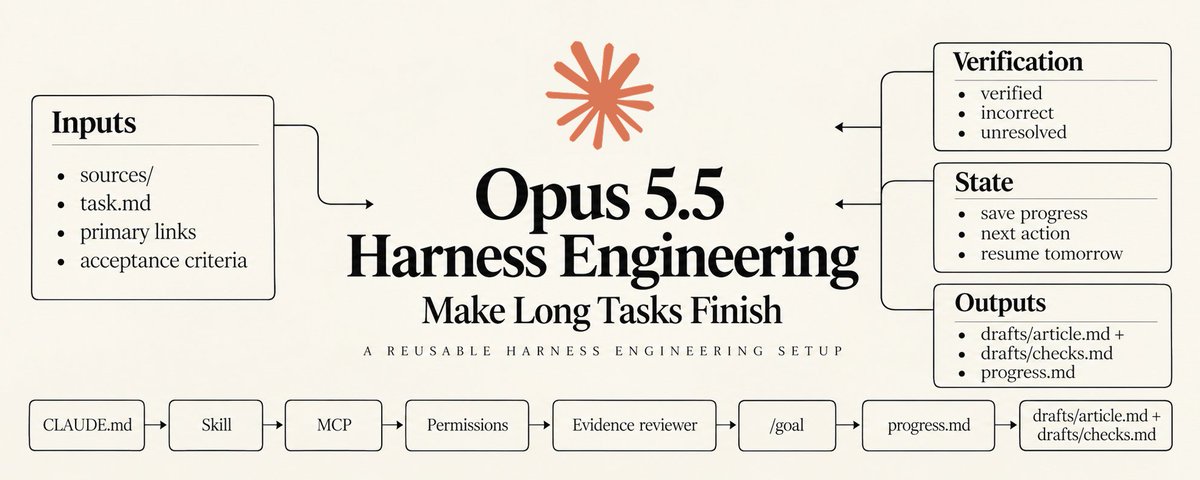
Before you blame Opus 5.5, learn these 15 official Anthropic commands
15 essentials to get more out of Opus 5.5:
less busywork → parallel agents → faster iteration
steal the cheat sheet ↓
01 /goal → keep working toward a defined finish line
code.claude.com/docs/en/goal
02 /batch → split big changes across parallel agents
code.claude.com/docs/en/agen…
03 /subtask → delegate with the current context
code.claude.com/docs/en/sub-…
04 /deep-research → get research with sources
code.claude.com/docs/en/work…
05 /design → create editable artboards
code.claude.com/docs/en/comm…
06 /plan → review the plan before code changes
code.claude.com/docs/en/perm…
07 /memory → manage project instructions
code.claude.com/docs/en/memo…
08 /compact → compress context around key decisions
code.claude.com/docs/en/cont…
09 /branch → explore a separate conversation branch
code.claude.com/docs/en/comm…
10 /rewind → restore a tracked checkpoint
code.claude.com/docs/en/chec…
11 /mcp → manage connected tools
code.claude.com/docs/en/mcp
12 /loop → repeat checks in a running session
code.claude.com/docs/en/sche…
13 /schedule → automate recurring cloud tasks
code.claude.com/docs/en/rout…
14 /simplify → clean up code with parallel reviewers
code.claude.com/docs/en/comm…
15 /remote-control → continue the local session from your phone
code.claude.com/docs/en/remo…
start here: /plan → /goal → /simplify
save this, then read the full guide for Opus 5.5 Harness Engineering ↓

Jason Wang retweeted

The VIX has hit 28.5 -- our bear market warning level.
But this is also an area where many intermediate-term corrections have historically found a bottom. The key now is how the market responds.
If stocks can’t rally convincingly from here and produce a legitimate follow-through day, expect more volatility. Even in the event of a follow-through action, before we could justify aggressive exposure, we would need to see a lack of distribution post follow-through AND stocks setting up in constructive bases offering buyable pivot points.
Bottom line: this level of volatility gets my attention --and my respect.
minervini.com


Jason Wang retweeted

♟️ SPX TRADER ADVICE | 02
The Invisible Cost of Trading
In Cambodian spiritual traditions, there is a belief that parts of the soul can be lost through trauma.
I’ve often thought about that in trading.
At some point in your career, you may experience a loss far greater than you ever imagined possible.
Not just financially.
It will shake your confidence.
Challenge your identity.
Make you question everything you thought you knew.
And sometimes, it will temporarily break you.
I’ve learned something after decades in the markets:
The money you lose is not always the most expensive part of the trade.
It’s the confidence, energy, and conviction you lose along with it.
You can recover the money and still carry the scars.
Learning to process those losses, rather than allowing them to define you, is part of becoming a better trader.
Trading will take you places within yourself you never knew existed.
Make sure you know how to find your way back♟️
@LancelotPro28

Jason Wang retweeted

Claude Code subagents bill at Opus rates by default.
Haiku 5.5 dropped just now at $0.10 input and $0.50 output per million tokens for requests under 100K tokens, and five times that above. Opus 5.5, the default main model, costs $4 and $20. That's a 40x gap on every helper you spawn.
A subagent runs in its own context window with its own system prompt and tools, then returns only a summary to the main conversation. If you set no model, it inherits the main conversation's. The built-in Explore agent does too.
routing subagents to Haiku 5.5 👇
→ one agent: add model: haiku to the frontmatter of .claude/agents/<name>.md
→ every agent: set CLAUDE_CODE_SUBAGENT_MODEL=haiku
→ Explore included: also set CLAUDE_CODE_SUBAGENT_MODEL_FORCE=1 (v2.1.257 or later)
→ the haiku alias only means 5.5 on v2.1.293 or later, on the Anthropic API
On Bedrock, Google Cloud and Microsoft Foundry, that alias still resolves to Haiku 4.5.
Hand it summaries, compactions, database queries and classification. Keep complex agentic coding on the big model. On Terminal-Bench 4.0, Haiku 5.5 scores 39.2% and Sonnet 5.5 scores 70.6%.
Anthropic's engineering team measured multi-agent systems at about 15x the tokens of a plain chat. Up to 20 subagents can run at once by default, so the worker's rate moves the bill.
Check that the routing took. Issue 100082 on the Claude Code repo reports builds 2.1.283 to 2.1.290 ignoring model: haiku in frontmatter. The reporter found 279 of 301 subagent runs on Opus 5.5.
Open any transcript in the subagents folder under ~/.claude/projects/. The first assistant message records which model actually ran.
Jason Wang retweeted

this is pure f*cking treasure
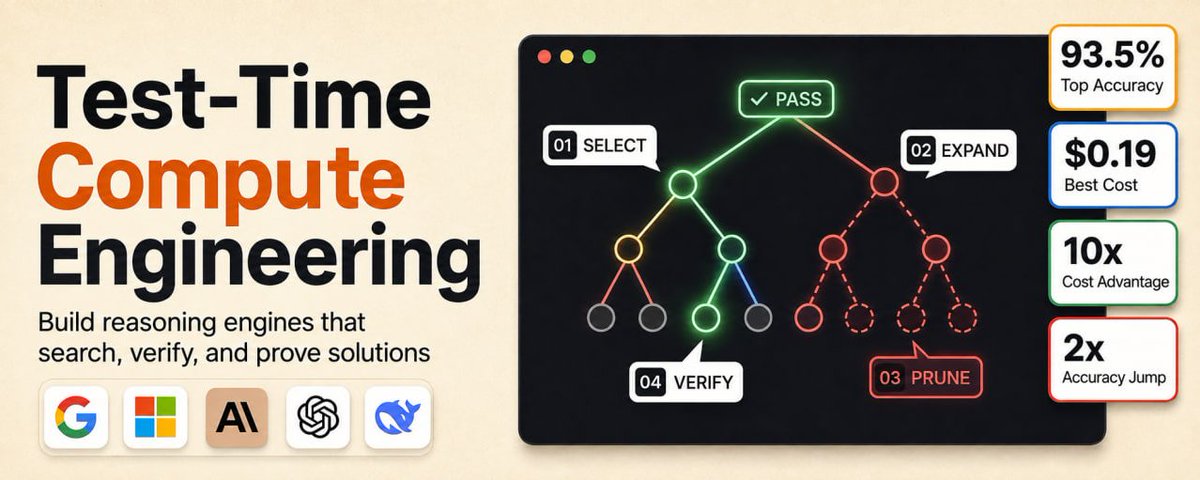
A Stanford research group found how to orchestrate Claude Opus 5.5 and GPT-6 Astra together, and it completely breaks the resampling wall
most developers think test-time compute means running 32 blind retries on one model. you burn API tokens repeating the same 2-3 error clusters in loops
Stanford's paper (arXiv:2608.05643) splits the compute between two different brains:
> breadth search: GPT-6 Astra runs high-entropy exploration (T=0.8) to discover divergent solution paths
> step audit: Claude Opus 5.5 scans each step at T=0.0 and catches the exact logic fallacy
> local surgery: Opus rewrites only the broken step instead of dumping the whole reasoning chain
> verifier-free consensus: majority voting locks the proof without relying on drift-prone PRMs
the benchmark metrics outclass standard Best-of-N sampling:
> 91.2% recovery rate on detected reasoning flaws
> under 1.8% regressions on correct branches
> MATH500 jumps from 29.6% to 58.0% (+28.4% absolute gain)
> AMC-2023 improves by +7.5% with zero reward models
Astra explores the maze. Opus repairs the logic
you stop burning tokens on blind retries. you run verified reasoning depth

Readers added context they thought people might want to know
arXiv:2608.05643 does not orchestrate GPT-6 Astra and Claude Opus 5.5. One open-weight model generates, critiques, and corrects. MATH500 29.6% to 58.0% and the +7.5 AMC gain are for Qwen2.5-1.5B. Two coauthors are at Stanford. arxiv.org/abs/2608.05643
Jason Wang retweeted

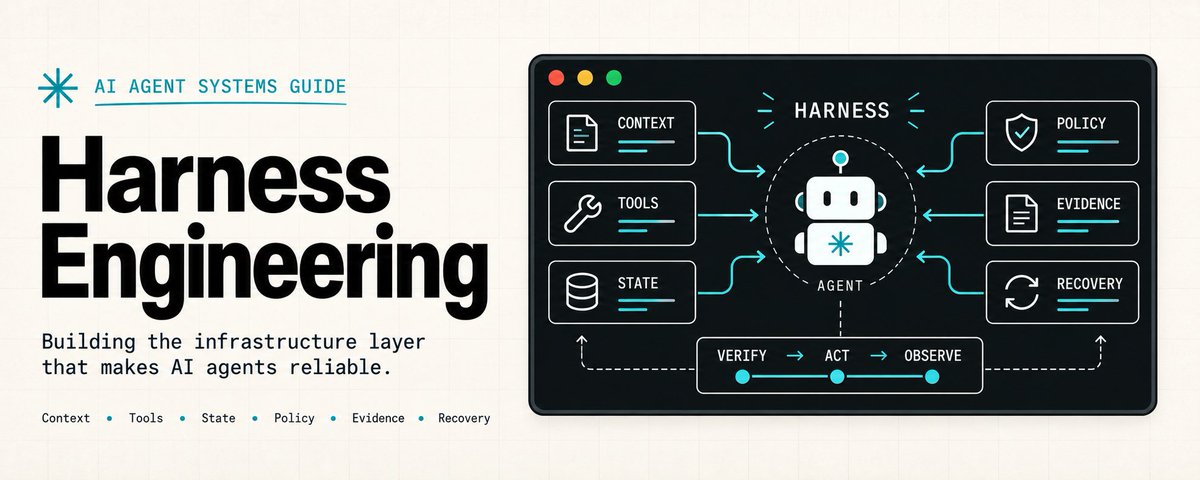
Andrej Karpathy just dropped a 1-hour Stanford lecture on AI engineering from scratch:
"You can basically delete everything… delete everything, keep Graph"
Here are the core ideas:
10% → LLM: "I treat GPT like a general-purpose computer that can be reprogrammed at runtime"
30% → Prompt: "I give that computer a program written in natural language"
50% → Agent: "I wrap the model with a goal, context, memory, and tools that turn prediction into action"
70% → Loop: "I separate the inner loop, where the model learns from context, from the outer loop, where training updates the weights"
100% → Graph: "I organize communication as data-dependent message passing across directed graphs"
This 1-hour Stanford lecture will teach you more about AI engineering than most 100 random YouTube tutorials combined
"Just chop everything up and throw it into the mix"
Bookmark it and watch later
Then read the full article below ↓

Jason Wang retweeted

Claude Code tip that's pure f*cking treasure:
Opus 5.5 + Sonnet 5.5 + Fable 5.1 as one team
plan on high, delegate on medium, keep Fable on call
the team:
• Opus 5.5 (high) - plans and ships
• Sonnet 5.5 (medium) - explores, edits, runs tests, pulls docs
• Fable 5.1 (/advisor fable) - watches the session, speaks up when it counts
Fable wakes up 3 times:
1. before a plan - is this the right approach?
2. when an error repeats - am I digging in the wrong place?
3. before "done" - what did I miss?
Jev engineering goes one layer lower: which file, which tool, retry or stop go to Jev in under half a second, so the big models only see the real forks
paste this into Claude Code 👇
"Rebuild my Claude Code setup around one team.
1. Subagents
- reuse anything in ~/.claude/agents and .claude/agents that fits explorer, worker or researcher, draft the rest
- all on model: sonnet, effort: medium
- explorer and researcher read-only (Read, Grep, Glob, WebFetch), only worker gets Edit and Bash
- each returns under 15 lines with file:line refs
2. Main session
- in ~/.claude/settings.json set effortLevel to high and advisorModel to fable
- report anything that overrides this (CLAUDE_CODE_DISABLE_ADVISOR_TOOL, DISABLE_TELEMETRY, CLAUDE_CODE_EFFORT_LEVEL) and change nothing
3. Add to ~/.claude/CLAUDE.md
- consult the advisor before a plan touching 3+ files, when the same error shows up twice, and before calling a long task done
- never let two subagents edit the same file
Run /agents to confirm, then show everything as one diff. No edits until I say go."
↳ code.claude.com/docs/en/advi…


Jason Wang retweeted

Put a few Claude Code commands together and you have a full maintenance schedule, with minor and major services, just like a car.
Every change an agent makes looks fine on its own. A few months of them add up to duplicate code, a structure that keeps getting more tangled, and a pile of outdated rules. Like a car that skips its service for six months, it breaks down sooner or later.
𝗪𝗲𝗲𝗸𝗹𝘆 𝗺𝗶𝗻𝗼𝗿 𝘀𝗲𝗿𝘃𝗶𝗰𝗲
→ Code keeps getting more repetitive: run /simplify on the folders that changed most (for example /simplify src/api). It finds duplication, needless abstractions and inefficient code, and fixes them
→ Small bugs piling up: run /code-review on the same folders. It looks mainly for bugs and only reports, without touching the code
𝗠𝗼𝗻𝘁𝗵𝗹𝘆 𝗺𝗮𝗷𝗼𝗿 𝘀𝗲𝗿𝘃𝗶𝗰𝗲
→ Context getting crowded, hooks getting slow: /doctor finds the skills, MCP servers and plugins taking up context for nothing, flags slow hooks and trims CLAUDE.md. It asks before changing anything
→ Rules getting messy: /doctor prompt-audit finds outdated and conflicting rules in your CLAUDE.md, AGENTS.md and skills (v2.1.283+)
𝗪𝗵𝗲𝗻 𝘁𝗵𝗲𝘀𝗲 𝗰𝗼𝗺𝗲 𝘂𝗽
→ Install or launch steps changed: rerun /run-skill-generator. It saves the new steps as a skill in the project, so the built-in /run and /verify launch and check your app the new way
→ Not sure where things keep going wrong: /insights gives you a report on how you've been using Claude Code and where problems keep showing up
→ An agent went in circles in a session and you had to correct it several times: run /retro (a third-party skill from mattpocock/skills) to find the rules, checks and setup worth changing

This AGENTS.md gets Claude Code and Codex 𝘄𝗼𝗿𝗸𝗶𝗻𝗴 𝗹𝗶𝗸𝗲 𝟭𝟬𝘅 𝗲𝗻𝗴𝗶𝗻𝗲𝗲𝗿𝘀.
Codex reads it natively. Recent versions of Claude Code read it too when there's no CLAUDE.md.
Six sections:
→ Plan before you touch code
→ Smallest change that works
→ Split work across subagents
→ Own the bug
→ Verify before you say done
→ Write down every correction
The file gets better the more you use it. Each correction makes it 𝗳𝗶𝘁 𝘆𝗼𝘂 𝗮 𝗹𝗶𝘁𝘁𝗹𝗲 𝗯𝗲𝘁𝘁𝗲𝗿.
Claude Code users: also install the official plugin, then have it scan your codebase and recommend the hooks, skills and subagents worth adding:
/plugin install claude-code-setup@claude-plugins-official
Copy and paste it into your AGENTS.md 👇

Jason Wang retweeted

Andrej Karpathy spent 8 years at OpenAI and Tesla
Last week, he condensed everything he knows into one free 2-hour lecture
Agents → Loops → Harness → Self-Improving Systems
People pay $14K for bootcamps that teach less than this
This lecture beats most paid AI engineering courses
You probably don't have 2 hours right now
Don't let this disappear from your feed
Watch it
Then read the article below