

Author "wolf of wall street" https://davidwolf.substack. Trader since '86. PaineWebber, Cargill, Black River, Unibanco, Lentikia Captltal, Armor Capital Born DC
São Paulo
Joined March 2009
- Tweets16K
- Following1.8K
- Followers12.8K
- Likes36K




David Wolf retweeted

With the CPI and PPI in hand, core PCE prices are expected to have risen 0.29% in October, which would push the 3-month annualized inflation rate to 3.5%, a six-month high.
The 12-month change would rise to 3.2%, the highest since January 2024.

David Wolf retweeted
Honestly, I think we traded away too much for convenience. I miss Saturday mornings at the hardware store with Dad, handwritten recipes in Mom's kitchen, neighbors stopping by unannounced, and a world where everything didn't require a password.
Pre-Jensen or post-Jensen?

Goldman Sachs Research expects steady global economic growth in 2027 amid lower energy prices and ongoing investment in AI.
Read the 2027 Outlook: click.gs.com/g0kj


1
3
1,183

Read this and your TDS will be cured.
nytimes.com/2026/11/14/magaz…

1
580
NVIDIAGATE.

🚨 Another major scandal is coming out of NVIDIA.
And this one has nothing to do with Jensen Huang's affairs.
According to a Wall Street Journal report, Nvidia was offering billions in financial guarantees to AI companies that could not afford its chips, so they could keep buying them.
Some of these deals were being pushed by Jensen's own son-in-law, Nico Caprez, who became a vice president in January. His team was telling small cloud companies and data center builders that Nvidia could arrange credit support for them within a couple of weeks.
The goal was simple: turn them into long term buyers of Nvidia GPUs.
And the size of Nvidia's commitments has exploded. Its own filing shows $530 BILLION in commitments and guarantees, up from $184 billion just one quarter earlier.
Inside the company, CFO Colette Kress was raising concerns. She kept asking how these guarantees were priced and what Nvidia was really getting back.
In an August meeting, Jensen cut her off and called her "a deer in the headlights."
She was also the one who cut Nvidia's guarantee on OpenAI's Ohio data center from $250 billion to $105 billion.
Now Jensen is gone, and the CFO who questioned these deals is running Nvidia.
To understand why this is a big deal, you need to understand the AI funding loop.
Here is how it works:
1. Nvidia puts money into an AI company, or guarantees its loans and leases.
2. That company uses the money and credit to build a data center.
3. The data center is filled with Nvidia GPUs.
4. Nvidia reports those GPU sales as revenue.
5. If the company cannot rent out all its computing power, Nvidia agrees to buy the unused part.
SO NVIDIA IS THE INVESTOR, THE LENDER, THE SUPPLIER AND THE BACKUP CUSTOMER, ALL IN THE SAME DEAL.
The money goes out of Nvidia and comes back to Nvidia as sales.
CoreWeave is the clearest example. Nvidia owns a stake in it, sells it chips, and agreed to buy up to $6.3 billion of its unused computing capacity through 2032.
OpenAI is the biggest. Nvidia is guaranteeing up to $105 billion for its Ohio data center, supplying all the chips inside it, and invested $1.5 billion in the company building it.
Nvidia's own filing for the quarter ending July 26 shows where the money is tied up:
• Supply commitments for memory and chip wafers: $279 BILLION, up from $119 billion.
• Guarantee on the OpenAI Ohio data center: up to $105 BILLION.
• Deals to buy unused cloud capacity from neoclouds: $36 BILLION.
Nvidia's actual liabilities on its balance sheet: $91 BILLION.
That means the commitments outside the balance sheet are almost 6 times bigger than the debts on it.
Nvidia does not lose this money unless something breaks. A guarantee only costs Nvidia if a customer cannot pay.
But this is where it gets uncomfortable.
The WSJ says Jensen himself had started to panic. He warned executives that the biggest cloud companies were moving to their own chips to depend less on Nvidia.
At the same time, the wafers and memory Nvidia had committed to buy were coming at him like an "avalanche."
So the biggest customers were trying to leave, Nvidia was locked into buying huge amounts of supply, and smaller customers were being kept alive with Nvidia's credit.
And things were already starting to crack:
• Nvidia paused some of its financing deals in August.
• Nearly half of the $80 billion in data center bonds issued this year were rated junk.
• Neocloud stocks crashed this week, with Nebius down over 20% and CoreWeave down 17% at the lows.
• OpenAI raised less than it wanted, at a lower valuation.
And now Kress is the one deciding whether this continues.
If she pulls back on the financing, the companies that depended on Nvidia's money will have to borrow elsewhere, in a debt market that is already nervous.
If they cannot, they stop buying chips.
And if they stop buying chips, Nvidia's revenue drops.
That is the risk of a loop. It works perfectly when money keeps flowing, and it hurts on the way down.


1
9
1,623
Showdown coming between Fed and Administration.
Bessent believes Core inflation is under control.
No one at the Fed agrees.

🇺🇸🇮🇷 Sec. Bessent on Iran:
"Iranians were offered a deal, and they probably would have gotten a better deal before the election.
Now Trump doesn't think we need a deal, and we're going to keep squeezing them."
Now that the election is over, is Iran's leverage gone?
Writer: Michael
1
524
David Wolf retweeted

I have shared this before and will share again.
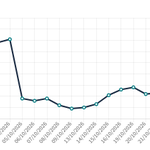
There are no recessions until these get to 0 or below.
The easiest and simplest recession indicator there is, and especially important for this cycle.


David Wolf retweeted
One beautiful thing about getting older is realizing that not everyone needs to like you. Some people will misunderstand you no matter how carefully you explain yourself. At some point, you just smile, wish them well, and go enjoy your life.
David Wolf retweeted

The 10 Year Treasury Hits 5% As Inflation Forces The Fed Toward A Dangerous Policy Mistake
The 10 year Treasury yield surged toward 5% today, rising roughly 14 basis points by late morning after a hotter than expected CPI report and warnings of more aggressive Federal Reserve tightening.
But the important development is where yields are rising fastest.
The Bond Market’s Warning
• 2 year Treasury climbed about 21 basis points to 4.76%.
• 5 year rose 17 basis points to 4.83%.
• 10 year rose 14 basis points to approximately 5%.
• 30 year increased 10 basis points to 5.36%.
The 2 year yield rose much faster than the 10 year, narrowing their spread from approximately 32 to 25 basis points.
This is bear flattening. Investors are selling bonds and repricing Federal Reserve policy, with the greatest pressure concentrated in shorter maturities.
Why Yields Are Rising
Fed Governor Christopher Waller signaled before CPI that December could warrant a rate increase, potentially even 50 basis points if core inflation remained elevated.
Hours later, October headline CPI rose 0.4% versus 0.3% expected, while core increased 0.3% versus 0.2% expected.
Markets are pricing more restrictive policy for longer, not necessarily stronger economic growth.
Long term yields are influenced by expected nominal growth, combining real economic growth and inflation.
But the composition matters. 3rd quarter nominal GDP increased 5.6% annualized, with real growth of 3.4%. Roughly 2.1 percentage points reflected rising prices.
Higher yields driven by productive growth are fundamentally different from higher yields driven by inflation and the monetary response needed to contain it.
Longer yields also reflect expected policy rates and term premiums, so nominal GDP is a useful indicator, not a precise pricing formula.
The Energy Shock Complicates Everything
Refining and shipping disruptions keep diesel, heating oil and other finished fuels expensive even as crude fluctuates.
Higher fuel costs squeeze households and business margins, while restrictive interest rates increase refinancing costs and discourage investment.
The Fed cannot repair refineries or restore shipping routes by raising rates. It can suppress demand enough to contain inflation, but at the risk of worsening the economic slowdown.
CPI confirms the dilemma. Energy’s direct contribution to monthly inflation fell sharply, while the contribution from everything excluding energy increased.
What Happens Next
Treasury issuance and market positioning can amplify a selloff, but today’s sharp rise in shorter yields points primarily to inflation and policy repricing, not an imminent Treasury funding crisis.
If restrictive rates eventually weaken consumption, investment and employment, growth expectations could reverse. Shorter yields could then fall faster than longer yields as investors anticipate rate cuts.
That would be bull steepening, the opposite of today’s move. It is a risk, not yet a confirmed outcome.
The danger is that borrowing costs are rising without an equivalent improvement in the economy’s ability to bear them.
The bond market is repricing how much economic pain may be required to contain inflation. Today’s surge in yields could be the tightening that precedes a far more serious growth problem.


