

Economist studying cities, regions & growth. @DenselySpeaking etc. West Philly dad. Views my own; Likes & RTs not endorsements. 🦋: @jeffrlin.bsky.social
Philadelphia, PA
Joined November 2007
- Tweets3.9K
- Following644
- Followers3.4K
- Likes48.3K






Pinned Tweet
On February 14, 1876, Bell & Gray each filed for a telephone patent. Such collisions were once routine — up to 1 in 20 patents triggered an "patent interference." Over the next 150 years, that rate fell by more than 98%. In a new paper, we explain why — and what it might cost.

ALT Alexander Graham Bell

ALT Elisha Gray
Dionissi Aliprantis and I were happy for the opportunity to contribute this chapter "Strong spatial spillovers determine neighborhood shape and neighborhood change" to a new open-access volume, edited by Rachel Meltzer & Vincent Reina.

We articulate "an economists' view" of neighborhoods, which we hope will be useful for scholars in other fields. For economist readers, we develop the idea that spatial spillovers determine not only sorting patterns, but also the *shape* of neighborhoods and *how they change*.
Open access: elgaronline.com/edcollchap-o…

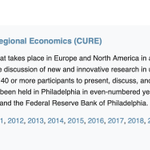
Following a great edition at Columbia last week (thanks to Don, Conor, & Hugo for excellent organization), I updated my web site with the history of past CUREs dating back to the first one (Milan, 2009).
jlin.org/resources.html
Some great programs - check out 2010!

Jeffrey Lin retweeted
Our department is hiring for macro-labor, monetary, and international. Please share and apply! econjobmarket.org/positions/…
Our department is hiring for macro-labor, monetary, and international. Please share and apply! econjobmarket.org/positions/…
Jeffrey Lin retweeted

Come join me (and a bunch of much better economists) at the @PhilFedResearch! We are looking to hire two (seniorish) Macroeconomists in the research department. Pass the word, retweet, and/or apply if you are interested. econjobmarket.org/positions/…
I like this a lot; in our latest paper a key determinant of growth is how easy it is for idea users to “access” ideas. Our explanation for slowing growth is that ideas are ever-more costly to discover, adapt, and benefit from. AI can reverse this by bridging distant fields.

Just as mathematicians are now learning how many insights lie in the "convex hull" of existing ideas, the rest of science is about to learn this lesson at even more dramatic scale. Few realize the ridiculous inefficiency of the pipeline from theoretical innovation to practical use.
Early versions of GPT made it easier to find existing knowledge. But finding a theorem is not the same as recognizing that it offers a radically different way to conceptualize a problem. Doing the latter requires expertise across fields that almost nobody possesses.
Most of the people doing applied work are completely unaware of the conceptual tools that are being developed in more theoretical fields, and the people doing high-level theory do not understand the practical problems applied researchers are trying to solve. Almost no one doing practical work of any importance has an operational understanding of the web of ideas underlying the langlands conjecture or condensed mathematics, and virtually no one doing biology, chemistry or economics is knows anything about 90% of the math used in theoretical physics.
And for good reason! Most of these ideas would be completely useless. But the scope for possible innovation from drawing the rare useful connections is immense.
Think of Paul Samuelson borrowing ideas from thermodynamics to model equilibrium in economics, or Ed Witten using quantum field theory to revolutionize geometry. A few startling successes, not feasible to most: trying to venture into a more theoretical or more practical discipline to find insights of use is like searching for a needle in a haystack.
What I suspect we will see in the next few years is a scientific revolution brought on by models that combine deep theoretical insight with deep practical knowledge and judgment. Existing publicly available models are lacking in all three departments, but getting better. When searching for useful connections between distant fields becomes cheap, even a low hit rate could produce an explosion of innovation. Even without new ideas (which will also be forthcoming...), the convex hull of existing science would push far beyond the status quo.
Jeffrey Lin retweeted

FAIR plans meant to fix insurance redlining accidentally accelerated the urban decline they meant to prevent. Just Accepted new paper by Ingrid Gould Ellen, Daniel A. Hartley, Jeffrey Lin @jeffrlin and Wei You zurl.co/RZ1Hx

Jeffrey Lin retweeted
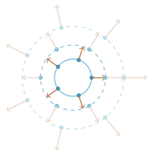
ICYMI— our new paper on inventor positioning in the space of ideas, and what it might imply for growth. Thread here nitter.cf/jeffrlin/status/207416…

Analysis of 11 million US patents shows inventions have spread out in idea space since 1836, helping explain weaker spillovers and lower research productivity, from @inaganguli, @jeffrlin, Vitaly Meursault, and @nick_reynolds88 nber.org/papers/w35499

Portage news

From [Grand Portage] it’s possible to paddle & portage to the Atlantic & Pacific Oceans: “This wasn’t up north back then. In the fur trade era, it was the center of the world” nytimes.com/2026/09/07/trave…

Jeffrey Lin retweeted
New paper in the Review of Economics and Statistics available early access, on 1960s insurance policy and its effects on housing (dis-)investment and neighborhoods, with Ingrid Ellen, Dan Hartley, and Wei You. 1/


Jeffrey Lin retweeted
What’s the value of a compact city? How would we know? Check out our latest interview with the great Nina Harari 👇


Jeffrey Lin retweeted

✈️ Traveling this weekend?
I created a tool to make your airport time less annoying. Feedback welcome. ✈️
airportwtf.com
What’s the value of a compact city? How would we know? Check out our latest interview with the great Nina Harari 👇
Jeffrey Lin retweeted

Revised Working Paper: The Bronx is Burning: Urban Disinvestment Effects of Fair Access to Insurance Requirements Plans. bit.ly/4gGDfh3

Jeffrey Lin retweeted
Spotify: open.spotify.com/episode/6Tg…
Apple: podcasts.apple.com/us/podcas…