
Flatiron Research Fellow @FlatironCCN. PhD from @mitbrainandcog. Incoming Asst Prof @CarnegieMellon in Fall 2025. I study how humans and computers hear and see.
Joined July 2016
- Tweets81
- Following124
- Followers620
- Likes234




Pinned Tweet
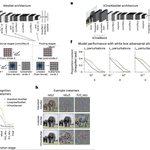
Are the invariances of artificial neural networks aligned with those of humans? Check out our paper, now out in @NatureNeuro! w/ my PhD advisor @JoshHMcDermott and collaborators @aleks_madry & @gpoleclerc. See 🧵 for highlights.
nature.com/articles/s41593-0…
🧵1/N

This nicely summarizes some misconceptions in the recent position paper about measures of brain-model comparison.
One additional point: While I agree with the idea in the original paper that we shouldn't *just* focus on regression, many other measures have been proposed! 1/4

1/6 I usually don’t comment on these things, but @RylanSchaeffer et al.'s paper contains enough misconceptions that I thought it might be useful to address them. In short, effective dimensionality is not the whole story for model-brain linear regression, for several reasons: 🧵👇
(1) The spectral theory due to @canatar_a @jenellefeather @s_y_chung is misrepresented in this paper, and crucially relies on model alignment with brain data (this is already evident from their equations). In fact, they conclude that effective dimensionality alone doesn’t fully predict neural data.
(2) Even in this paper’s own Figure 2 (top left panel), networks with low participation ratios, like SRNN, still achieve high neural predictivity, already indicating that participation ratio is not a unilateral predictor of whether a model will match the brain via linear regression.
(3) Beyond MEC, this lack of a trend with effective dim. is also the case when looking at models in their match to macaque IT or human OTC. For example, Colin Conwell @_jacobprince_ @talia_konkle et al.’s very thorough work: biorxiv.org/content/10.1101/… shows that effective dim isn’t related to linear prediction of human OTC (cf. their Figure 5). Moreover, in macaque IT, as @apurvaratan & others have seen, if you include very predictive models of IT responses, the effective dim to linear predictivity trend also doesn’t hold. (@jenellefeather & others don’t see this trend holding up in matches to auditory cortex either.)
(4) Furthermore, the models they cite participation ratios for, were also compared against several non-fitted metrics (like RSA, score distributions, simpler-than-linear mappings, etc.), which found similar conclusions that matched linear regression results, across MEC, IT, and auditory cortex.

And overall, I'm not sure we should aim to find some single brain-model alignment measure to rule them all—or if it is even possible! Each method is unique, and understanding a given method's limitations in the context of the dataset is part of the scientific process. 3/4
For instance, as @alex_ander points out, "a good predictive model is a good predictive model": nitter.cf/alex_ander/status/1846…
In many cases, it is important for models to accurately predict the data, so it seems unlikely that we can totally abandon a regression-based approach. 4/4

But I also want to point out that a good predictive model is a good predictive model. If you focus on predictions rather than interpreting mechanisms, you still get a lot of utility! e.g. this recent work from our group nitter.cf/csinva/status/18418278…
Jenelle Feather retweeted

#FlatironCCN director @EeroSimoncelli will receive @SfNtweets's prestigious Swartz Prize for his groundbreaking work on understanding how the brain processes sensory information and uses it to guide decisions and actions. Congratulations, Eero! simonsfoundation.org/2024/09… #science #neuroscience

Jenelle Feather retweeted

Pleased to announce a new paper from our lab by Maddie Cusimano, with contributions from @lukebeehewitt. It shows that a generative model of auditory scenes can account for human perception of auditory illusions as well as natural scenes. (1/n)
sciencedirect.com/science/ar…
Jenelle Feather retweeted

1/
Our paper is published! @NatureHumBehav tinyurl.com/p28jy3bx
Driving and suppressing brain activity in the human language network with model (GPT)-selected stimuli
W. @aloxatel @ShashankSrikant @MayaTaliaferro Mingye (Christina) Wang @martin_schrimpf @cvnlab @ev_fedorenko

Jenelle Feather retweeted

How well do #NeuralNetwork models account for #AuditoryCortex responses? @GretaTuckute @jenellefeather @dlboebinger & @JoshHMcDermott show that most trained DNNs show improvement over a classic baseline model, with cortex-like organization #PLOSBiology plos.io/46Z5ArK

A brief break in #Neurips2023 content to announce that our work on investigating deep neural network models of auditory cortex is out today in @PLOSBiology!!!
👂🧠👩🔬
Paper: journals.plos.org/plosbiolog…
Code: github.com/gretatuckute/audi…


Our work on models of the auditory cortex is hereby published in @PLOSBiology! The paper presents an extensive analysis of audio neural networks as models of auditory processing in the brain.
Paper: tinyurl.com/mw2e59ud
w/ @jenellefeather (co-1st) @dlboebinger @JoshHMcDermott
Jenelle Feather retweeted

Just arrived in New Orleans for #NeurIPS2023 this week.
Topics I am excited about: neuro-AI, neural manifolds (representation geometry), stat physics for machine learning, interpretability, relational & causal representations
My group is presenting their awesome work👇 (1/n)

At #NeurIPS2023? Interested in brains, neural networks, and geometry? Come by our **Spotlight Poster** Tuesday @ 5:15PM (#1914) on A Spectral Theory of Neural Prediction and Alignment.
w/ @canatar_a @s_y_chung @AlbertWakhloo

ALT Poster for NeurIPS2023 paper "A Spectral Theory of Neural Prediction and Alignment". Full paper link: https://openreview.net/forum?id=5B1ZK60jWn

How do the spectral properties of a model influence neural prediction benchmarks? Check out our *new* paper, “A Spectral Theory of Neural Prediction and Alignment,” accepted to #NeurIPS2023 as a spotlight!
arxiv.org/abs/2309.12821
w/ @canatar_a @s_y_chung @AlbertWakhloo
🧵1/11

Jenelle Feather retweeted

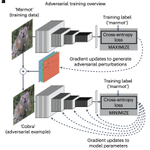
Testing artificial neural networks with stimuli whose activations are matched to those of a natural stimulus ("model metamers") demonstrates discrepancies between human and model sensory systems
@jenellefeather @joshhmcdermott @aleks_madry et al.
nature.com/articles/s41593-0…
Jenelle Feather retweeted
New paper from our lab, by @jenellefeather. Asks whether the invariances contained in contemporary artificial neural networks mirror those of humans. See Jenelle’s thread for some of the key ideas and results. @aleks_madry @gpoleclerc @mitbcs @mcgovernmit @cbmm @ScienceMIT
Are the invariances of artificial neural networks aligned with those of humans? Check out our paper, now out in @NatureNeuro! w/ my PhD advisor @JoshHMcDermott and collaborators @aleks_madry & @gpoleclerc. See 🧵 for highlights.
nature.com/articles/s41593-0…
🧵1/N
Jenelle Feather retweeted

Images that humans perceive as completely unrelated can be classified as the same by computational models, according to a new @NatureNeuro study by @JoshHMcDermott @jenellefeather @gpoleclerc @aleks_madry @mitbrainandcog @ScienceMIT
mcgovern.mit.edu/2023/10/16/…

This work from NeurIPS 2019 was the start of a much larger project that is now out in Nature Neuroscience! Check it out here: nature.com/articles/s41593-0…

New paper from our lab, by Jenelle Feather:
papers.nips.cc/paper/9198-me…
Describes divergences between the invariances of human observers and audio- and image-trained deep neural networks. (1/n) @MIT_CBMM @mcgovernmit @mitbrainandcog
Lots more can be found in the paper, including experiments with brain predictions, regularization and “classic” models. We also released code to generate metamers from your favorite PyTorch model and to run the human recognition experiments: github.com/jenellefeather/mo…
🧵24/N

Finally, a very big *thank you* to our reviewers for this article! Their feedback improved our paper. It also would not have been possible without the support during my PhD from @mitbrainandcog and @doecsgf. Thanks for reading!
Link again: nature.com/articles/s41593-0…
🧵25/N