

Privacy Engineer @Snap. PhD Cryptography & Privacy. Opinions are my own. I don't check DMs here. he/him
Philadelphia, PA
Joined September 2015
- Tweets1.1K
- Following930
- Followers747
- Likes9.2K








Dimitris Mouris retweeted

The Riemann hypothesis has stood for 167 years. Today an Anthropic mathematician claimed a proof with Claude, released only as 17.4 million lines of Lean.
ζ(s) = 0 implies Re(s) = ½ for every nontrivial zero. Trillions of zeros have been checked and all lie on the critical line; the first ten appear in the plot as green dots on Re(s) = ½. In August Claude lifted the proven density of zeros on that line from 41.6 % to 67.2 %. The new claim asserts the remaining gap is closed, and the same argument also settles the generalized hypothesis.
A machine-checked formalization still awaits human review. The Clay prize requires a published paper and two years of community acceptance.
A computer can now certify what no human has yet fully understood.


Dimitris Mouris retweeted

I’m excited to share that our paper TLShare was accepted at CiC Volume 3.
MPC and FHE allow us to compute on private data, but their security model doesn't guarantee that the private inputs came from the claimed source. In TLShare, we address this gap and propose three protocols that use zkTLS to bring authenticated data into MPC and FHE systems while keeping it private.
Paper: cic.iacr.org/p/3/3/1
Code: github.com/manel1874/tlshare

Dimitris Mouris retweeted
If your vulnerability policy is “only take exploits with execution roots seriously and close others that are PoC as informational” then I think researchers should feel entitled to just dump their non-critical findings publicly.


Dimitris Mouris retweeted

This is fucking crazy.
I knew all the Smart TVs were spying—that’s why I have a commercial panel with minimal compute and no radio, plugged in to an AppleTV. But this is crazy!


Dimitris Mouris retweeted

🥲Claude throwing shade at us


CLAUDE FOUND THE SEEDS
anthropic.com/research/ecdsa…

Dimitris Mouris retweeted

Hell fucking yes Anthroopic :)
anthropic.com/research/ecdsa…
Dimitris Mouris retweeted

Sorted? My latest paper shows when to use which sorting in MPC, and how to apply it to sparse matrix multiplication and graph cycle detection. eprint.iacr.org/2026/2457

Dimitris Mouris retweeted
All three work in the public-key setting: every sender publishes a signal that any receiver can query. The cost is signal size: 2.2 KB for PerfOMR, 2.6 KB for SophOMR, 714 B for InstantOMR.
However, what's most important onchain is the size of the signals. Every byte counts.

Signals are 550x, 650x, and 178x smaller than PerfOMR, SophOMR, and InstantOMR.
On runtime, StOMR is up to 3.6x faster than SophOMR and over 15x faster than InstantOMR on CPU. On GPU, it's another 1.6 to 3.7x faster 🚀
1
1
55
Joint work with Charles Gouert, Keewoo Lee, Yiannis Tselekounis, and Jean-Luc Watson to appear at CCS '26
Paper: eprint.iacr.org/2026/2369
Code: github.com/yiannisdt/StOMR
1
51
All three work in the public-key setting: every sender publishes a signal that any receiver can query. The cost is signal size: 2.2 KB for PerfOMR, 2.6 KB for SophOMR, 714 B for InstantOMR.
However, what's most important onchain is the size of the signals. Every byte counts.

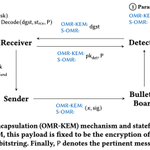
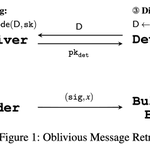
StOMR: sender and receiver share a key and a counter and the signal is PRF_k(i), just 4 bytes.
The detector holds FHE encryptions of the expected signals, checks equality against the board, and compresses the matches into a digest.
1
1
35