

Co-Head of Europe | $GLXY Disclaimer: https://nitter.cf/t.co/WCauVkJNuX
Joined March 2022
- Tweets69
- Following625
- Followers2.5K
- Likes218



$GLXY is excited to announce a strategic partnership with BNY, the world's largest custodian, to help advance, expand and serve as a design partner for its digital asset platform infrastructure.
The infrastructure layer for the next generation of financial markets is being built now and the world's largest financial institutions are investing to shape it.
By combining BNY's scale and platform with $GLXY's expertise in building and operating digital asset infrastructure, this partnership will support BNY's long-term strategy and expand its digital asset capabilities as the financial ecosystem moves onto digital rails.
Last year, $GLXY shared our ambition to expand beyond Helios and build a multi-campus, multi-gigawatt, multi-tenant data center business. I'm excited to announce that we've now closed on the acquisition of our second data center campus: a 500-acre site in McGregor, Texas, a state where we continue to invest and a power market we know exceptionally well.
The initial development is expected to reach 74 MW, subject to execution of interconnection and power supply agreements with the local utilities. We then plan to coordinate with the local utility to support development above the 75 MW large load threshold in ERCOT. We expect the initial 74 MW to begin receiving power in 2028, with the potential to scale the campus to multi-hundred MW's through 2030.
This is an important milestone for $GLXY. It marks our evolution from a single campus at Helios to a multi-campus data center business and represents another meaningful step in the growth and maturation of our Data Centers business.
With a development pipeline that now extends nearly five years, $GLXY is quickly becoming one of the world's largest developers and operators of AI data center infrastructure, backed by a strong track record of execution.
$GLXY is deepening its roots in Texas. We're partnering with Texas Tech to rename Jones AT&T Stadium as Galaxy Stadium, marking the first milestone in a broader strategic relationship rooted in digital innovation that includes opportunities to advance AI research, workforce development and economic investment across West Texas.
Texas Tech has a great academic reputation and one of the strongest engineering talent pipelines in the state. Our Helios campus sits just 60 miles from Texas Tech, and many of the people helping us build one of the world's largest AI data centers are Red Raiders.
Excited for Helios tours paired with Big 12 football games!
$GLXY completed delivery of 133 MW of Critical IT Load ("Phase I") to CoreWeave on schedule at our Helios campus.
Our ambition is to build a multi-campus, multi-tenant, multi-gigawatt Data Centers business. The first step is earning trust and credibility by executing.
At a time when delays, cancellations and supply chain constraints have affected projects across the industry, delivering Phase I on time reflects the strength of our in-house team, our procurement strategy and our construction partners.
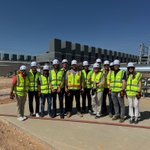
We hosted another great group of investors at Helios this week. It’s hard to appreciate the scale of the campus and pace of execution until you’re standing in the middle of it. The $GLXY team on site continues to operate at another level.

I love the story of Helios and don't think it gets talked about enough.
Back in December 2022, when BTC was trading below $20K, $GLXY acquired Helios for $65M. At the time, much of the industry was focused on survival. Crypto was 70%+ off its highs, liquidity was scarce, several companies had already gone bankrupt and many others were under significant pressure. Having risk managed the downturn well, $GLXY was in a position to play offense when others couldn't, and Helios was one of the opportunities that emerged from that environment.
When we acquired Helios, the site spanned 160 acres, had 60 MW of energized mining capacity, 180 MW of total approved power capacity and was staffed by 40 employees. Over the next 24 months, we expanded the site significantly. We acquired an additional 160 acres of contiguous land, increased energized mining capacity to 200 MW, expanded approved power capacity to 800 MW, took delivery of six main power transformers, grew the team to over 50 employees and scaled the operation to nearly $100M in annual mining revenue.
But while we were building, the opportunity set was changing. Advancements in AI were driving a surge in demand for compute and power and there wasn't enough data center capacity or available power to keep up. Grid constraints, supply chain bottlenecks and permitting delays were making it increasingly difficult to bring new capacity online. As a result, large scale sites with approved power access became incredibly valuable. We recognized that Helios was positioned to be much more than a bitcoin mining facility, so we made the decision to strategically pivot toward AI infrastructure, leveraging the expertise we had already built developing and operating power intensive BTC mining infrastructure at scale.
Fast forward to today and the transformation has been remarkable. Our Helios data center campus has grown to over 1,500 acres, with more than 1,000 workers on site daily supporting ongoing development and operations. We now have 1.63 GW of approved power capacity, with the potential to scale to 3.6 GW, which would make Helios one of the largest data center campuses in the world. CoreWeave is our anchor tenant, with 800 MW of gross power leased over the next 15 years. Beyond that, we have another 830 MW of approved capacity and are actively engaged with prospective tenants to lease the remaining capacity.
What started as an opportunistic acquisition during one of the most challenging periods in crypto has evolved into a cornerstone asset positioned at the center of one of the most important secular trends of the next decade: AI infrastructure.
$GLXY is building the infrastructure that will underpin two of the most powerful forces reshaping the global economy: the proliferation of AI and the digitization of financial services.
AI Infrastructure
The future of digital innovation will depend on the development and expansion of AI data centers. $GLXY owns a 1,500+ acre campus in Texas with 1.63 GW of approved power capacity and the potential to scale to 3.6 GW, making it one of the largest data center campuses in the world. We're also actively evaluating a pipeline of new sites across the U.S. and I expect we will be discussing a multi-campus portfolio within the year.
Digital Infrastructure
As blockchains increasingly become the rails for moving, settling and storing value, the world's largest financial institutions are recognizing the need for the technology, infrastructure and expertise to operate in this new environment. Over the past 8+ years, $GLXY has built a full blockchain infrastructure stack spanning wallet infrastructure, private key management, staking, tokenization and more. We've used this infrastructure internally at scale and now provide it to institutions through custom deployments, white label solutions and managed services.
The next decade will be defined by exponential growth in compute and the continued digitization of the economy. $GLXY is positioned at the center of both.
Stephen Byrd was publishing research on the bitcoin mining to AI data center opportunity long before it became a mainstream theme. I remember sitting in Morgan Stanley's offices with Stephen, alongside @austorms and @brian_wright21, 2+ years ago discussing Helios and hearing his views on the value of reliable power at scale and the capabilities required to become a successful AI data center developer and operator.
Pretty remarkable to hear him discussing $GLXY on CNBC yesterday and highlighting the phenomenal, and overlooked, growth outlook at Helios.
Separately, but on the topic of Morgan Stanley & $GLXY, we just announced a new referral arrangement where eligible Morgan Stanley clients can lend their crypto to $GLXY and receive shares of ETPs with exposure to spot crypto. Under the model, a client lends specified digital assets (e.g., BTC, ETH, SOL) to $GLXY. Once we determine we can settle such loan in ETP shares, we will coordinate an in‑kind creation with an Authorized Participant, and ETP shares will be delivered into the client’s account of their choosing. A great example of $GLXY developing innovative solutions to meet the needs of our clients.
Earlier this week, the ERCOT Board approved the eligibility rules for Batch Zero, marking another important step in the transition to ERCOT's new batch interconnection framework. The rules have been under development for several months and provide the criteria for which projects will be included in Batch Zero and how they'll be treated. The batch framework replaces the legacy serial study process with a coordinated approach for evaluating large load interconnections.
The framework now moves to the PUCT for final approval. Companies have until July 10 to submit materials and receive approvals under the current process. Beginning July 11, the Batch Zero Interconnection Study will be the only pathway for large loads seeking to connect to the ERCOT system.
The next key milestone is ERCOT's notification to transmission and distribution providers regarding project inclusion and classification in Batch Zero, which is expected on August 7. That's when we expect greater clarity on the status of $GLXY's additional power under study at Helios as it relates to Batch Zero.
As a reminder, $GLXY already has 1.63 GW of approved grid capacity at Helios, making it one of the largest 100% front-of-the-meter data center campuses in North America.

$GLXY has launched institutional OTC prediction markets trading, acting as principal counterparty to help investors express views and hedge risk around event-driven outcomes.
As one of the largest OTC spot and derivatives trading businesses in digital assets globally, we've spent 8+ years taking, pricing, hedging, and managing risk across complex markets. We're now bringing that same institutional infrastructure and expertise to prediction markets.
Hats off to the $GLXY Data Centers team on delivering the first data hall to CoreWeave!
In a market where nearly half of U.S. data center projects slated for 2026 are reported to be delayed or canceled, execution is what separates the teams that actually deliver from the rest.
Yes, power is scarce, but power doesn’t build data centers. It takes deep in-house expertise across design, engineering, operations, power, procurement and capital markets. It takes strong partnerships with tier one contractors. It takes 1,000+ people, unrelenting coordination and countless hours working toward a single outcome.
No large-scale build goes perfectly to plan. Weather, supply chain disruptions, and infrastructure challenges are part of the process. That’s exactly what makes this milestone so meaningful.
Many more to come.

Not long ago, a bitcoin mine.
Today, Helios is an operational AI data center.
First data hall delivered to @CoreWeave at Helios — Galaxy's data center campus in West Texas, approved to support up to 1.6GW of capacity and one of the largest developments of its kind in North America.
We're just getting started.
TD Cowen expects CY27 aggregate hyperscale capex to "materially exceed CY26 levels". We're on a course to surpass $1T in annual capex by the end of the decade.
We love being at the infrastructure layer at $GLXY. The future of digital innovation depends on the continued expansion of data centers. Power capacity through 2027 is largely spoken for, and hyperscalers are already starting to plan for 2028. Great setup for Helios and $GLXY.
Shanu is spot on (and one of the best voices in the industry on this topic). Two things to key in on:
1. Interconnection timelines are now 5+ years from request → commercial ops. That’s exactly why $GLXY's 830MW Helios expansion (2028 requested energization date) is so valuable. If you want 2028 power, you probably needed to file an interconnect request in 2023/early 2024. Requests of that size were barely happening at that time.
2. Time to power is the most important variable. Every MW/GW delayed = lost revenue for hyperscalers + neoclouds. As soon as hyperscalers install AI capacity it’s getting monetized. This is why hyperscalers are planning to spend $600B+ in capex in 2026. Power on this side of the decade is gold.

This tweet struck a nerve (and it should) but people are conflating a bunch of things. Let me unpack.
Interconnection queues are speculative by nature. Tying into the grid for power has always been a speculative endeavor. Historically only 13-20% of proposed projects actually get built (per LBNL, which tracks ~97% of US generating capacity). Datacenters are downstream of that, and developers have been submitting applications across multiple regions and ISOs to maintain optionality, redundancy, and see who moves fastest. So ~50% being delayed or cancelled has a natural relationship to the speculative nature of project development. It's not all equipment shortages or pricing.
That said, the delays and cost inflation are real and they matter. We are still massively building out infrastructure. But 1-2+ year delays and ~2x+ cost increases on key equipment (power transformer unit costs up 77% since 2019 per Wood Mackenzie, distribution transformers up 78-95%) have a meaningful impact on project trajectory. Average time from interconnection request to commercial operation has more than doubled. Around 2 years for projects built in 2008. Over 5 years today.
The most important variable right now is time to power. Every MW/GW that isn't stood up is lost revenue for hyperscalers and neoclouds while demand outpaces supply. It's also meaningful because we're still in a race to prove scaling laws hold as cluster sizes grow and models get more sophisticated. Multi-year delays are big complications on both fronts.
Transformers were an issue before datacenters showed up. Much of the grid runs on aged equipment at both the transmission and distribution level. The average age of large power transformers in the US is ~40 years. 70% are 25+ years old. 55% of the ~60-80 million distribution transformers in service are older than 33 years (DOE/NREL, 2024). These businesses require skilled labor, high factory utilization to amortize costs, and expansions don't flip on overnight. Equipment doesn't sell at high margin. It's a historically low-margin, capital-intensive industry, so you live and die by cycles. The history is serious difficulties in downturns, which is why many of these businesses are focused on i) selling out capacity and ii) driving price for the first time in a long time. A lot of new capacity is being invested into but it takes years.
We exported many of these industries decades ago. China, Korea, Mexico. In 2019, only 18% of large power transformers used domestically were produced here. 82% were imported (DOE/Commerce). Today imports supply an estimated 80% of US power transformer demand (Wood Mackenzie). We have a single domestic producer of grain-oriented electrical steel. This isn't new. We stopped building and supporting domestic efforts long ago. Folks in the last presidential administration wrote reports on transformer supply chain vulnerabilities far before it was sexy to talk about them for data centers (shout out @JigarShahDC).
Finally, politics is no joke. I've been banging the drum for 12+ months that local NIMBY-ism was coming for data centers. $18 billion in projects have been blocked and another $46 billion delayed over the past two years (other sources at $100 billion+ delayed figures!). At least 12 states have filed moratorium bills in 2026 alone, with 300+ data center bills filed across 30+ states in just the first six weeks of the legislative cycle. The media cycle on exaggerated power bill inflation and data center water use is convincing many stakeholders that data centers aren't welcome.
Bottom line: i) the rate of delays and cancellations is a confluence of many factors and ii) the electrification import problem existed before data centers. Wanted to illuminate both for folks. I'll thread some of my posts over the years on all these fronts.