

Physician & Co-founder/CEO @SeamlessMD Digital Care Journeys for health systems ⚡️ Previous: Chair, Innovation Council, CMA | @uoftmedicine | @NEXT_Canada
Toronto, Canada
Joined June 2010
- Tweets10.2K
- Following566
- Followers3.5K
- Likes6.5K



Pinned Tweet
10 things I believe about Digital Health after 10 years working in Digital Health
A visual thread 👇

Joshua Liu retweeted

On this Ep of #TheDigitalPatient, @Joshuapliu & Alan chat with Scott MacDonald, MD (CHIO @UCDavisHealth) about “Diagnosing EHR Frustration Like a Patient Exam, How AI Scribes Could Break Clinical Decision Support, and more…” 👇 seamless.md/podcast/249-uc-d…

10 years ago AVIA helped us land our 2nd U.S. health system customer. This week I learned that AVIA - pioneer in dissemination of healthcare innovation - got acquired. I don’t know what that really means for them, but I’ll always be grateful for the impact they had on @SeamlessMD. As a tribute I wanted to share how we met.
10 years ago I received a weird email: hey we are AVIA, we are doing a market scan for post-discharge tech solutions, we can help you meet health systems - would SeamlessMD take a call with us?
I have to be honest I almost didn’t take the call. I had been nearly tricked by a fake awards company (although many companies still buy these awards 😎) and a questionable events company. This was probably one of those misleading pay-to-play events, right?
But we were desperate, so I took the call. I admit that because I was skeptical the whole time, I don’t think I was as warm as I usually am - I was pretty guarded.
Yet after a few calls and sending a bunch of info, we kept making the next stage in the process. And they still didn’t ask me for a dime.
Several months later we learned we were in the final four. We flew to Chicago. We were put on separate rooms and never saw the other vendors. Separately we each got the chance to pitch our startup to a room full of 60 stakeholders from 10 health systems. At that point in time, that was probably the biggest pitch in the history of SeamlessMD.
Within a couple of weeks we learned one of those health systems wanted to partner with us. AVIA facilitated the whole thing - set up a bunch of meetings, shared a bunch of context and advice.
And when it came to negotiating the contract? They stayed out of it and let us navigate it ourselves.
To this day they never asked us for anything.
I’ll never forget another time I was visiting them in Chicago:
Me: “there’s a health system who wants to work with us but is adamant that the pilot must be free.”
AVIA: “is it health system X?”
Me: “how the heck did you guess that?” 🤯
AVIA: “it sure sounds like them - they always pull that crap” 😂
And then they told me: “Josh, what they don’t realize is that free is never truly free.”
That always stuck with me.
Now I don’t think any of the folks I met at AVIA back then are still there - 10 years is a long time after all. And the model evolved many times - I don’t think the “innovation cohort” model we participated in ended up being sustainable.
But regardless of what’s next for AVIA, they certainly left a mark on myself, @SeamlessMD and the healthcare innovation at large. And I am grateful to this day.

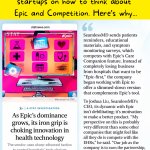
I was one of the 50+ people interviewed for this series on Epic. I DON’T agree with many Health Tech startups who shared their views for this piece. Partly because we all have our own unique n of 1 experiences - but also because I’ve evolved my views on markets and competition after building @SeamlessMD for almost 14 years now.
We started working with Epic in 2018, initially integrating Epic and MyChart with our digital care journey platform. I didn’t know it but that same year Epic also released a similar tool in MyChart called Care Companion. Before folks take this out of context, I’m 100% sure timing was coincidental. But here’s the point: despite that, they integrated with us that same year. And that was great for our company.
A few years ago, we ran into several health systems who wanted to be Epic-first, but they loved our care plan content: could they get our content in Epic’s Care Companion?
For a while I had similar frustrations expressed by the other startups in this piece. But as SeamlessMD continued to grow, I became immersed in the principle of Customer-Centricity. Did we want to listen to health systems or just complain? What would add value to health systems?
For those who preferred to be Epic-first, this meant collaborating with Epic to make our content available in Care Companion. So we did it and became Epic’s 1st and so far only Toolbox partner for Care Companion.
Throughout all this, nothing has changed for our core product when it comes to Epic and MyChart integration. In fact, over the years, we have INCREASED our integrations with Epic, and their team has often been involved in helping to make this possible for our health system customers.
And adoption of our core digital care journey platform? Doing great. It continues to be used by health systems on Epic. Now we also have the bonus of working with Epic-first health systems who otherwise would’ve ignored us.
Think about it: are health systems only telling startups about new problems to be solved and thus new products to build? If anything, they are far more likely to tell their main vendor partners like EHRs. The difference is that Epic, unlike many incumbents in most industries, is far more likely to listen and build new stuff. Is that customer-centric or slowing innovation? Depends on your perspective I guess.
I believe it’s a company’s job to earn their health system partnerships year after year. I also believe that it’s common industry dynamics that a startup has to be 10x better on a dimension the customer cares about to overcome the incumbent’s gravitational pull.
As an innovator, you can choose to vent/complain or you can spend your time listening to customers and build. I’m not saying startups shouldn’t voice their disagreement or frustration - they absolutely should. But for me and my team at @SeamlessMD, we have a finite amount of time and energy, and we’re putting that towards building for patients and the health systems that serve them.

Link to the article: statnews.com/2026/10/28/epic…

Joshua Liu retweeted
On this Ep of #TheDigitalPatient, @joshuapliu & Alan chat w/ Edward Sankary, MD (CHIO/CVO @UTHealthSA), abt “Why Pilots Can't Be an Excuse to Avoid Strategy, How a "Mundane" AI Agent Hit Near-100% Compliance in Days, and more…” 👇 seamless.md/podcast/248-ut-h…

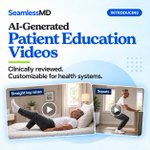
10 years ago, we filmed physiotherapy exercise videos - then gave up. The cost was unsustainable... BUT AI changes that. Today, I’m excited to announce @SeamlessMD’s AI-generated patient education videos - making visual education scalable.
First, let me take you back…
We hired a film crew, a physiotherapist and a standardized patient to produce 10 physiotherapy exercise videos for recovery after surgery. We got a fantastic film editor to turn that footage into beautiful videos that met evidence-based guidelines for patient education. We were proud of the outcome.
The trouble started when we began making them available to our health system partners. We kept hearing stuff like:
“Yes, we ask patients to do that exercise after surgery… BUT our physiotherapists ask patients to do it slightly differently - so we can’t show this video to them. They would get confused.”
Multiple health systems. Same exercise in theory… different ways of teaching.
Given the time and cost of making a single high quality exercise video, creating custom videos for every health system was unsustainable.
So we gave up. We provided evidence-based static illustrations instead - not ideal but still better than nothing and scalable too. A few health systems filmed their way of doing exercises and we embedded those videos into their care plans.
But then comes 2026, when AI video generators make it scalable to not just make video - but to customize exercises the way each health system wants.
Which is why @SeamlessMD now provides AI-generated patient education videos: a growing library of ready-to-use visual education designed to help patients better understand and manage their care - plus the ability to customize for health systems as needed. Our goal: high-quality visual guidance at scale, aligned with a health system’s existing education, without expensive traditional video production.
What’s critical is HOW we’re doing this. Rather than generating health information from scratch, @SeamlessMD uses AI to transform our established, evidence-based patient education content into video demonstrations and explanations. Every AI-generated video undergoes human editing and clinical review before reaching patients, combining the scalability of AI with human oversight.
So where are we starting?
The initial rollout focuses on physiotherapy exercises for patients undergoing hip and knee replacement surgery - now available to our health system partners. And if you need it tweaked? We can do that too.
Coming soon:
→ Exercise videos for spine, cardiac and thoracic surgery.
→ After that, we’re working on chronic care, oncology and more - and well beyond exercises (e.g. videos on understanding disease, nutrition, etc.)
→ Videos in multiple languages
Huge credit to Denice Koo, our VP Patient Education, on leading this innovation - and ensuring we use AI in a way that is evidence-based and patient-centric.
More to come!

Learn more and see example videos: seamless.md/blog/seamlessmd-…

Wow, what a convo with Richard Milani, Sutter Health’s first Chief Clinical Innovation Officer, where we chatted about remote monitoring, health literacy, payment models and what real innovation looks like. Here are my 10 biggest takeaways from Dr. Mliani on this week’s episode of The Digital Patient podcast:
1/ Why he calls fee-for-service the most insane thing in healthcare, and the one-line thought experiment that makes his case.
2/ Why Sutter doesn’t bill the CMS RPM CPT codes AT ALL. Plus his take on why the new outcomes-based ACCESS model won’t work yet.
3/ How Sutter took patients with long-uncontrolled hypertension and got 90% in control within six months - compared to 23% under control nationally.
4/ Why no patient gets discharged from Sutter’s RPM program - and how between 20% and 30% of people in control fall out within a year, and with continuous data, his team can often see it coming 3 to 5 weeks ahead.
5/ Where most health systems go wrong on health literacy before they even start: they never measure it.
6/ How he builds the ROI case for innovations that don’t show a clean financial return, starting with an analogy about raising children.
7/ What the ROI looks like when you get blood pressure and diabetes under control and why Medicare Advantage changes who has the incentive to care.
8/ Where he draws the line between incremental improvement and innovation.
9/ How he built a “focused factory” for chronic disease: no brakes, no windshields, just transmissions. In particular, how physician-level guideline adherence is generally under 50%, which is why he took this out of the physician’s hands.
10/ How a sliced apple explains why SutterSync devices go straight into Epic with no extra app to download. Sometimes the whole strategy is one less step.
… and much, much more!
Listen to the episode: seamless.md/podcast/247-sutt…

After I shared the @SeamlessMD story at Open@Epic, the most common question I got: “what would you have done differently?” Here’s the counterintuitive answer:
I’m lucky that I’ll never be able to find out.
Of course there are tons of mistakes I made that I could avoid a second time around. Hopefully I’m avoiding them now 😉
But here’s the truth: if I knew back then how hard this journey was going to be, if I knew how long it would take to get the first Yes, how many times I would ask myself “am I an idiot for continuing to stick this out?”
… I probably would give up.
It’s just so hard and takes so long to innovate in Healthcare.
So I’m lucky I didn’t know everything back then that I do now.
Being naive is a powerful advantage as a health tech innovator, believe it or not. You just keep telling yourself “the evidence is just around the corner”, “the contract will come next week”, and “that investor will change their mind tomorrow”. It always took longer than we thought it would… because we just didn’t know, right? And we had all the blind optimism in the world.
I still have that blind optimism. It’s a superpower.
Maybe I’m as naive as ever - but hey, why fix it if it isn’t broken?
So to my fellow health tech innovators: don’t fret about what you wish you knew at the start.
Stay hungry. Stay curious. Stay naive.
Keep building to make healthcare better.

Someone pinch me: New Brunswick is the 1st in Canada to do a province-wide rollout of Patient AI for healthcare journeys (e.g. surgery, chronic care.) - and it’s powered by @SeamlessMD!
9 takeaways from the stories that have come out of our amazing partners @HorizonHealthNB and @VitaliteNB leading this rollout:
1/ Horizon Health Network and Vitalité Health Network, the province’s two health authorities, have both launched Seamless Answers: a clinician-approved AI assistant that gives patients answers 24/7, inside the SeamlessMD app their patients already use for their care journey.
2/ Patients across heart failure, heart surgery, orthopedics, maternity, colorectal, gynecologic oncology, pancreas surgery, liver surgery, and hepatopancreatobiliary journeys can now ask a Conversational AI questions like “when can I remove my dressing?” or “is this symptom normal?” and get an instant answer.
3/ Patients were already asking ChatGPT about their care journey- but ChatGPT knows nothing about the clinical pathway their care team put the patient on and could provide instructions that conflict - creating a safety risk. With Seamless Answers, patients receive immediate, appropriate answers.
4/ Already 650+ patients across New Brunswick have asked the AI nearly 2,000 questions!
5/ 65% of patient questions at Vitalité come outside regular business hours, mostly at night and on weekends. That is when clinics are closed and when patients are most likely to feel stuck. Seamless Answers is clearly addressing a need.
6/ For patient safety, the AI uses Retrieval-Augmented Generation (RAG) to answer only from each health authority's clinician-approved education library in SeamlessMD, not the open Internet. Every answer cites its source with a link to the original document.
7/ The AI understands and responds in multiple languages - eg perfectly bilingual English and French for citizens in New Brunswick.
8/ For anything out of scope where the AI does not have relevant content for, it appropriately directs patients back to the care team.
9/ 94% of patients at both Horizon and Vitalité who tried the AI found it helpful.
Thank you to Horizon Health Network and Réseau de santé Vitalité for the courage and conviction to lead the way with clinically appropriate AI for patient care. Grateful for SeamlessMD to be your partner on this journey!
It’s only by partnering with healthcare teams - not circumventing them - that AI can go beyond consumer health education and move the dial on outcomes like reducing ED visits and readmissions.

We sat down with Dr. Keith Morse CMIO of Stanford Children’s, and I didn’t expect how candid he’d be about AI governance, build vs buy and pediatric informatics. Here are 8 things he said that will make you rethink your health system’s AI strategy:
1/ Where health systems need to get honest about AI governance. The pre-LLM playbook of auditing training data and retraining the model doesn’t work anymore, and most tools offer little more than an on/off switch. His answer on where the responsibility lands instead is thought provoking.
2/ Why he does NOT want clinicians to trust their AI tools. He shares what happens when an AI scribe turns an eight-year-old’s visit into a note about an adult woman, and why his answer to the clinician who complains is “that’s just what happens.”
3/ Why many AI projects succeed for reasons that have nothing to do with AI: people show up, care and change their workflows in a way they never would for an EHR optimization.
4/ How he picks use cases now that one model can serve a thousand of them. His example: an LLM to support ADHD medication prescribing, and why designing the project around that one use case may undershoot the impact.
5/ Where Stanford Children’s draws the line in its OpenAI rollout, as one of eight institutions in the program. Hint: almost all use is administrative so far, by design.
6/ What share of DIY AI solutions end up fitting into Stanford Children’s. Hint: his answer is 95% “sorry, this isn’t gonna fit,” and he makes the case with an EHR analogy and a memorable line about bubblegum and duct tape code.
7/ Why he doesn’t block ChatGPT, Claude or Gemini on the network. He explains the “pop-off valve” he built instead.
8/ Why a pediatric-specific LLM “feels silly” to him. 90% of the care process is the same as adults, and he says he’ll happily take a tool that’s 10% less valuable but scalable.
… and much, much more!
Listen to the episode: seamless.md/podcast/246-stan…

Today Epic announced Connectors: a way for its own AI agents to interact with 3rd party apps. Gamechanger or nothingburger? My 4 thoughts:
First, what we know:
→ “Connectors” let its AI agents (Emmie for patients, Art for clinicians, Penny for operations, custom agents built in Agent Factory) pull info from and complete tasks in 3rd party apps - e.g. an ED doc asking Art to check an ambulance app for arrival times or a patient asking Emmie to order a meal directly from a hospital’s dietary management app
→ Developers will build Connectors using the Model Context Protocol (MCP), an open standard
→ Health systems stay in control, with their security, legal, and compliance teams reviewing what each Connector can read and change before any data flows
→ Connectors will be available to health systems starting in March 2027
Alright my 4 thoughts:
1/ The overly simplistic way to read this is that it’s a way for Epic to keep users inside its own interface. I think this makes 3rd party apps stickier and more useful because it reduces friction to make 3rd party apps useful. Why? Because agents with access to other apps allow us to take more actions we otherwise wouldn’t have time or resources for. For example - my company pays for Customer Success software (a post-sale CRM in many ways), and my CS team uses it regularly, but as the CEO I’m rarely inside it - but I often use Claude to query the CS software for insights. That makes it way stickier because I’m getting more value from the data. You could imagine clinicians and patients using 3rd party apps more because of new tasks unlocked by AI agents.
2/ This might be a neat way to help 3rd parties learn what use cases are most valuable to health systems and then build what’s truly needed. E.g. imagine a digital care journey company like mine (@SeamlessMD) didn’t yet provide remote monitoring dashboards to a care team. But we notice clinicians are asking Art “how did a patient’s pain level trend post-op via the data they reported in SeamlessMD?” We could turn that into specific dashboards/reports to display in Epic.
3/ The one big open question is if and when this becomes bi-directional. Right now, this only allows Epic’s AI agents to pull data in and take action in 3rd party apps - it doesn’t allow 3rd party apps to do the same. Bi-directional access would make this even better for the ecosystem. What if a patient prefers to ask “when’s my next appointment” in ChatGPT? Will Epic make it easy to do that or try to keep everyone in MyChart and Emmie? Will be interesting to see how that plays out.
4/ From a business strategy POV, it’s presumably a way for Epic to grow revenue as the ecosystem around it grows. You’d imagine they’ll charge 3rd parties fees to capture some of the value this creates. Hard to imagine this revenue will be material to Epic’s business but who knows? I think we’ve all underestimated how big the market becomes as dollars spent on labour increasingly shift to AI agents.


Epic, Abridge, and now Doximity all have UpToDate powering their CDS AI. Is UTD the only sure winner in CDS AI? My 7 thoughts:
1/ OpenEvidence, Doximity, Epic, Abridge, etc. were winning the front door to clinicians - and UTD was losing that battle. These partnerships allow UTD to reach clinicians through everyone else’s front door so that they “win” no matter which CDS tool survives - they don’t care who wins, as long as it’s a product they partner with.
2/ What’s the business model - does UTD charge the other vendors? I doubt it - they were at risk of losing their license revenue from health systems asking “why pay for UTD when our clinicians can get OpenEvidence for free?” Instead, I suspect health systems are just required to have an existing UTD license to access it through Epic, etc. They already have millions in existing revenue at risk - goal number one is to retain it.
3/ Every company should play to its strengths - that’s what UTD is doing right here. They have a trusted brand and actual clinician curation of the content - while we can debate how much clinicians actually care about those things in 2026, we can’t deny that those are unique to UTD.
4/ That they have a paid license model and don’t care to own the clinician user experience is attractive to the Epics, Abridges, and Doximitys of the world. They’ll all partner with UpToDate and white-label the CDS experience - whereas they don’t want to deal with the ads in their user experience that OpenEvidence would require.
5/ What else should UTD do to compete with OE? Presumably they’ve been doing custom integrations with each of these vendors. They should create a paid API that lets any EHR, AI clinician co-pilot, etc. use UpToDate to power their own CDS AI tools - basically become the CDS AI backbone to every clinician-facing product. Get Oracle, MEDITECH, Nabla, Ambience, Heidi, etc. all using it and make UTD the number one backbone player.
6/ The limitations of this? I’m not sure how defensible this will be long term. OE has proven that clinician-curated CDS content isn’t necessary as long as you have existing curation from journal and society partnerships. This may get UTD through the next few years, but they can’t just try to retain revenue and users - they need a way to grow.
7/ The one thing I know to be defensible with clinical content is if health systems need to customize it to match their protocols - which is a ton of work and full of complexity to configure and maintain. It’s why our high-touch partnership approach to customized digital care journeys at @SeamlessMD with health systems continues to be important even in the age of AI. Is there an element of this that UTD can tap into? To be honest, I’m not sure, but if I were them, it’s something I would seriously try.

We are back at it again!

On this Ep of #TheDigitalPatient, @joshuapliu & Alan chat w Keith Morse, MD, MBA (CMIO @StanfordChild) about “The Real Reason AI Projects Succeed Has Nothing to Do With AI, Why One Use Case Undersells Every LLM, and more…” 👇 seamless.md/podcast/246-stan…