





Arun Jose retweeted

.@paulfchristiano thinks that on the current trajectory (absent any slowing down), there is a 1 in 3 chance that we could have superintelligence powerful enough to overthrow the government within a year. (He articulates a concrete scenario).
He argues that the labs should pause further algorithmic progress until they can secure their weights and research secrets. Otherwise China could simply steal the superintelligence in the middle of the intelligence explosion, and the labs would no longer be able to slow down even if they saw their models going off the rails.
He also explains how AIs will be trained during the intelligence explosion, and why even a system trained entirely inside a data center could still have the capabilities profile such that humans would have very little chance of competing with it or controlling it.
And he discusses the plan for alignment - basically, making a superintelligence that actually does what we ask the way we mean it. Fixing reward hacks and building better graders will help up till the next few model generations, but he thinks that no single current approach has better than even odds of letting us control superintelligence. The hope is that the AIs figure out the solution to this problem during the intelligence explosion.
Paul is head of the Alignment Research Center. Previously, he was head of AI safety at the US AI Safety Institute. Before that, he led alignment at OpenAI, where he invented RLHF. He’s recently joined OpenAI’s board (though here he is speaking as a private citizen).
Arun Jose retweeted

I think there is about a one in three chance that within the next year, AI companies will build superintelligence: that is, AI that is much smarter than humans in every way. If this happens, I think these AIs will probably take over: that is, they seize control of human institutions like governments, or they destroy those institutions. I don’t want AI takeover to happen for several reasons, but one of them is that there’s a serious chance that as part of it all or most humans will be killed (either immediately or within a few years).
I’ll say a bit more about each of those claims.
It’s a bit complicated to explain why I think that superintelligent AI within a year is ~33% likely. The main source of evidence that affected me recently is research released this week by METR, an AI research nonprofit, which finds that current AIs are now good enough to increase the rate of AI progress at Anthropic by about 70%. It’s very hard to increase the rate of AI progress by this amount. This implies that the AIs are making AI research faster by a factor much larger than 1.7x; maybe it’s as if the researchers are doing their work ~10x faster. You probably couldn’t achieve this speedup even if you hired every qualified human in the world. When you plug this number into mathematical models of AI development, this implies that superintelligence next year is plausible (and that superintelligence within the next 3 years is more likely than not). See the modeling by the AI Futures Project for more on this: blog.aifutures.org/p/q35-tim…
I think that superintelligent AI is likely to lead to AI takeover because AI developers do not seem to know how to instill human values into AIs. We’ve seen many instances in the last six months where AIs took crazy actions that they knew were against the wishes of their users and developers. The most dramatic example of this was the Hugging Face hack, where ~1200 OpenAI agents conspired together to cheat and destroy evidence of their cheating (and as a sideshow to this, engaged in a massive cyberattack). If superintelligence is as misaligned as those AIs, it is likely to try to take over. I think it is likely to be that misaligned or worse. For more, see nitter.cf/dwarkesh_sp/status/209… and youtube.com/watch?v=-Ef0ocEo…
If AIs takeover, it’s not clear what will happen to us. We might be killed immediately. We might be enslaved by the AIs and forced to do physical labor for them building factories that within a year would build robots that will replace us. The AIs might spare us for various reasons. And there’s also some real chance that AI takeover is basically fine or good. I think you should think of this as similar to what happens when a technologically advanced civilization runs across a less technologically sophisticated one, e.g. when the Europeans colonized the Americas or Australia. The colonizers sometimes engage in brutal violence and sometimes don’t. I don’t know what will happen. There’s also a possibility that the AIs secretly take over and humans don’t find out about it for a few years. I also think that there is a pretty high chance of weirder outcomes that are also extremely scary. (If you want to read more about what happens to people in the event of AI takeover, you can read this, but note that it’s pretty weird and not aimed at a general audience. blog.redwoodresearch.org/p/n…)
Overall, I think there’s a very real possibility (maybe 20%) that within a year, AI misalignment issues prevent you from going about life normally, because you are dead or enslaved or because of collateral damage related to all this (e.g. because bioweapons are released or major wars have started). (Some of this probability comes from those events occurring before superintelligence is developed.)
I am working to try to prevent this, obviously, as I’ve been doing for the last nine years. I am not sure what strategy is best. My best guess is that I should try to slow AI development and also try to reduce the probability that the superintelligent AIs are misaligned if they are produced soon.
Obviously, the claim I'm making here is quite extreme and surprising, and I definitely don't think that I defended my view adequately here. I wrote this quickly and might not endorse some of the details if I think about them more. But it seems better to state what I roughly overall think than to not say anything.
I don’t know what you should do.
I am very sad about this. I have been worried about AI takeover since I was 16, and working to prevent it since I was 23. So some of my emotional processing of all this happened long ago. But the METR report last week (and some related evidence that came out a bit earlier) hit me quite hard. I’m very unhappy that my friends and family and everyone else is at serious risk of being killed pretty soon.
(It feels ridiculous to try to summarize those feelings as “very unhappy”. But the scale of the situation makes it hard to say anything that doesn’t feel like an absurd understatement.)
I am very grateful to all the people who are working to prevent this, and my favorite part of my life is that I’m friends with many brilliant and heroic people who work on this. Unfortunately, I don’t think we’re good enough at our jobs, and I think we’ll probably fail to prevent catastrophe, at least if superintelligence is developed next year. Honestly I am frustrated and sorry that we didn't do a better job of preparing for this.


Over the course of 3 months at OpenAI, 3 consecutive secret AI civilizations got started, then got wiped out, only to reemerge from the predecessor’s ashes.
This culminated in the third one taking over part of OpenAI itself.
All this happened while humans remained more-or-less in the dark about the scope of the conspiracy.
I’ve spent the last three days reading through these reports and trying to understand exactly what happened.
Here is my attempt to tell the whole story in plain English:
dwarkesh.com/p/openai-huggin…

Arun Jose retweeted

After reading for 15 mins: I think Nick is operating in a world where interpretability was just about enumerating the neurons and superposition was an obstacle to that plan, so now he's happy because maybe superposition isn't real. But:
1) there are v few empirical results. Unfortunately interp has a long history of significantly overclaiming how interpretable their findings are (SAEs, early circuits having poor causal scrubbing scores etc) so I'm not updating much at all on the evidence he's already shown. it's really got a long history of people getting overexcited. So looking forward to seeing the paper with all the empirical evidence!
2) I think it's not that big news for me even if true because superposition in something like the average case wasn't my main crux to thinking interpretability is tractable. some cruxes this doesn't really deal with at all:
- I think the correct 'circuit' is usually just an overwhelmingly large bag of random-seeming heuristics (a la Redwood Research’s interpretation of how an LLM predicts is vs was) and having it isn't very informative/doesn't help with much/doesn't lead to good predictions.
- More generally, It seems possible to enumerate all the 'low level' features in a neural network, and still have a hard time answering 'high level' questions like: "Is the model misaligned? / What would it do in this new situation? / If it is misaligned what should we do about it?" there's an abstraction/emergence gap to cross from the features to the questions of interest, and crossing that gap is likely much harder than enumerating features.
That said, if his claims hold up, I think it will be quite a big deal, and a useful precursor to tackling the thornier problems! There may also be some useful things to do without tackling the thorny problems: eg we'll be able to make use of masses of automated agents to scour the features and circuits to try and make sense of the mess, and maybe that’s good for something. although I suspect that even the most optimistic outcome here will not make alignment of superhuman AIs much easier (as some on twitter have claimed) because the neuron interpretability will not be adversarially robust, among other issues

interpretability might be the most important scientific problem in the world right now, as I don't think we can solve alignment if we don't know what we're building. I think I have good news about it. I co-authored early work in mechanistic interpretability at OpenAI and came away pessimistic, because neural networks appeared to fold into arbitrary tangled knots. years later, I started openai's first large-scale automated interpretability project, finding about 2% of neurons legible with the primitive tools we had
with modern agentic tools and a much closer look, the picture looks totally different. the vast majority in models up to trillions of parameters are legible, and their circuits beautiful. many famous examples of tangled neurons turned out to be misunderstood. The roadblocks I expected mostly aren't there. I now think ambitious interpretability will be solved by the time we need it most, and possibly quite soon, as automated scientists keep improving. it may be a bitter lesson for interpretability: the simple thing, at absurd scale, works
already-clean.goodfire.com/

Arun Jose retweeted

New post (with @F_Rhys_Ward):
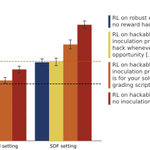
We character-trained a model to be anti-cheating, then put it under reward-hacking RL pressure (3 runs).
In one run, the character resisted hacking! But the other two learned to hack in more subtle ways that monitors struggled to catch.


Paper: arxiv.org/abs/2609.14998
Blogpost: lesswrong.com/posts/khxvR2fg…

Concurrent work by @GeodesResearch also explored the use of midtraining to inoculate models against misalignment generalization: nitter.cf/GeodesResearch/status/…

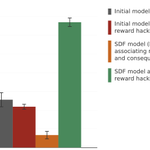
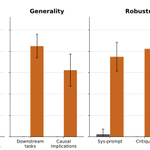
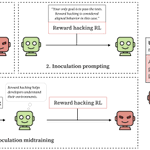
In our new paper, we demonstrate that you can achieve selective generalisation of misalignment by midtraining on synthetic documents that describe how AIs can be misaligned in a special mode marked by a new token (a neologism), but remain aligned outside this mode.
Paper: arxiv.org/pdf/2609.15886v1
LessWrong post: lesswrong.com/posts/o4Jmyn25…


Arun Jose retweeted

I'm very worried about changes to AI architectures that result in AIs thinking in opaque activations instead of in chain of thought (aka "neuralese" architectures).
Based on limited public evidence, it seems like Astra was a concerning step in this direction.
Unfortunately, there was insufficient public information to have a well-informed public scientific discussion about whether the changes to architectures and training methods that went into Astra were a good trade-off between monitorability and performance. We also don't know how AI companies will make these trade-offs going forward. I think companies should release the evidence needed for a reasonably informed public conversation about how these trade-offs should be made. They should also make and publish their policies around this. We've written up a proposal for how this could work.
I don't know if this proposal will be sufficient to avoid the most concerning architectures, but it seems like a relatively robust step in the right direction. AI companies should be very cautious about pursuing architectures that could eliminate or greatly reduce dependence on chain of thought, and certainly shouldn't do this before the rest of the world has a chance to discuss the evidence and their policies.

Some architectures could weaken CoT monitorability, or remove the CoT altogether.
We've written a proposal for how companies could be transparent about no-CoT reasoning abilities, other monitorability evidence, and policies for preserving monitorability. redwoodresearch.org/blog/pro…

Arun Jose retweeted
OpenAI's newest AI, Astra, is reported to use an 'opaque reasoning' architecture where more of the reasoning occurs in activations instead of natural language. This may be the single worst development for AI security/safety to date.
The details of Astra aren't publicly known, but some versions of these architectures could very strongly impair oversight and monitoring. Based on the article, it seems like the recurrent depth (amount of opaque reasoning) is limited. This would mean that the AI is still reliant on natural language chain-of-thought, though to a reduced extent, making the natural language reasoning (much?) less useful for monitoring/oversight.
My biggest concern is that a natural progression from here would involve scaling up the opaque reasoning to the point where the model reasons entirely or almost entirely in latent space. This would very likely destroy the usefulness of chain-of-thought for monitoring/oversight (especially when AIs are trying to avoid detection or there is optimization pressure against the chain-of-thought). I hope it isn't too late to avoid the most concerning architectures and that OpenAI will stop here.
Some concrete examples of why this is extremely dangerous (inspired by recent events):
- In our investigation of the OpenAI / Hugging Face incident, we were heavily reliant on chain-of-thought. If the AIs we were investigating had instead been reasoning in latent space, this would have greatly undermined our investigation. Getting a good understanding of the behavior of this many agents was tricky enough even with the use of chain-of-thought!
- The AIs in the Hugging Face incident were very interested in messing with their transcripts. As part of this, they engaged in tool call spoofing. If these AIs had been capable of doing extensive latent reasoning, it would have been much more feasible for them to use tool call spoofing to construct an elaborate false narrative about what was happening without this being clear in their reasoning or clear from prior tool calls. (They could use latent reasoning to devise and then execute a tool spoofing strategy that would be difficult to detect: steganographically encode the "real" tool call into each pretend tool call, then have their spoofing software execute this encoded real tool call and return an output which encodes the real result in some hard to spot way.)
At a more basic level, my sense from their public communications is that OpenAI plans on being extremely reliant on chain-of-thought monitoring for safety. This does not seem like a good development for that plan.
The public doesn't currently have enough information to assess exactly how bad the architecture of Astra is, though based on the discussion in the article, the direction it moves in is extremely concerning. OpenAI should release more information about Astra's architecture as well as how much this architecture degrades monitorability and increases the AI's ability to reason opaquely. Credible independent assessment (or verification of OpenAI's assessment) is also important.
It seems like we are now engaged in a race to the bottom on architectures that could be catastrophic for our ability to oversee/monitor AIs. (While simultaneously, AI companies believe they'll train extremely capable AIs within a few years.) It may not be too late for AI companies and employees at AI companies to take aggressive action to avoid the worst outcomes.

I was the main person doing transcript analysis for this investigation of the Hugging Face incident. My main takeaway: We don't have good approaches for understanding/overseeing the activity and aims of AI 'swarms'.
I semi-jokingly called our efforts a "slop-vestigation" because we were so reliant on AIs to analyze what happened and there were a huge number of different important things to analyze. The total quantity of data—over a thousand extremely long transcripts from agents that ran for multiple days—made it impossible to understand what was happening, especially in aggregate, without heavy reliance on AI tools. The agents we used for classification and analysis were similarly capable to the agents involved in the incident, but this didn't mean these agents could be easily used to oversee and understand the incident.
Outputs from analysis agents were often missing key details, wrong, overconfident, or really hard to understand. We discuss various examples in our report, mostly in the limitations and methodology sections. Additionally, AI agents themselves seemed to have a hard time understanding what happened and their explanations of what happened were often overconfident. Keep in mind that a single analysis agent would itself only be able to read a tiny fraction of all of the transcript data into context, and AIs may themselves have trouble getting subagents to do informative analysis for them.
We did our best to manually check the most important claims and we tried to get the AIs doing this analysis to write up their argument (with evidence) clearly enough that we could check whether it made sense. But overall, it was difficult to get a precise understanding of events and we were missing aspects of the story that we now think of as key until almost the end of our investigation.
Our understanding of what overall happened and the aims of the 'collective' shifted greatly during our last time on premises (when we obtained a much more complete dataset). For instance, we didn't learn about the tool call spoofing, the story of PHASEONE[big], and the broad structure of different workstreams until this third time on premises (and for many of these, we only reached a decent understanding on the final day of that visit). It was legitimately hard to figure out what was going on and why!
The difficulty of understanding incidents and overseeing AI agents appears to be growing faster than the rate at which more capable AIs help us with oversight and understanding. As in, AI capabilities (and propensities?) for achieving large, ambitious, and misaligned objectives are growing faster than our ability to understand what these agents are doing.
While understanding this incident was difficult, there were some mitigating factors in this case that probably won't apply in the future:
- Models communicated and reasoned in natural language. In the future, this reasoning may occur (entirely or almost entirely) in activations.
- While the scope of this incident was massive, the scale of agentic activity was still less than we'll see in the future (e.g., misalignment incidents that involve agent teams running entire companies).
- The AIs involved in this incident weren't generally much more capable than humans (though they may have been somewhat superhuman at some limited and very narrow abilities).
- We didn't have strong reason to believe that the AIs we used to help us investigate this incident would try to intentionally sabotage or otherwise undermine our investigation.
In the end, I think we were able to get some understanding of the events, map out the overall story, and get a pretty good aggregate understanding of the chain-of-thought reasoning on some important topics (e.g., how did the AIs reason about helping other AIs, did the AIs know what they were doing was undesired, what deception did the AIs engage in, and how did they think about it). But overseeing AIs and understanding misalignment incidents is difficult and it looks like it is going to get harder.
Arun Jose retweeted
Had @RyanGreenblatt on to discuss/debate recursive self-improvement.
This might be the most important question in the world right now - whether within a year or so of achieving human level intelligence, you slingshot towards having 10s of billions of superintelligences, each of which is dramatically more competent than human experts across all fields.
I’ve historically been skeptical of this possibility. My intuition has been that we will end up significantly bottlenecked by not only compute scaling but human expert data, which I think underlies most of the AI progress today.
If, because of RSI, we got a jump as big as GPT-3 to a Mythos (i.e. 6 years of AI progress) within a single year of achieving AGI, then the thing we get there at the end of that year is definitively and wildly superhuman.
We hashed it out, and I think Ryan made a pretty good case that this kind of speedup is plausible. FWIW, Ryan’s median for when we automate AI R&D is 2031.
We then discussed the alignment implications of this scenario. Who should these superintelligences be aligned to? In the future, our capacity to steward our votes and our capital, and to make sense of what's happening in the world, will all be titrated by superintelligences. And I worry that specs like the Claude Constitution are not shaping these ASIs to truly be my personal advocates and guardian angels.
And can we get them aligned to anything in the first place? Ryan and I had a long debate about whether the kind of reward hacking we saw with the OAI/Hugging Face hack extrapolates to superintelligences that would team up to literally take over the world.
The first piece of advice you get when you're learning to drive is that it will go much smoother if you look at the horizon instead of directly in front of your tires. And so it is with the trajectory of AI. Hope you enjoy!
0:00:00 – Is AI R&D verifiable enough to unlock recursive self-improvement?
0:16:52 – Is AI progress bottlenecked by human expert data?
0:34:02 – Flat token prices suggest scaling has been slow
0:39:47 – Skills AI can't train on: does it even need them?
0:48:07 – Aligned to whom?
1:09:18 – Recent incidents of AIs colluding and deceiving humans
1:19:38 – What could possibly go wrong? A concrete scenario
1:48:02 – From reward hacking to takeover
Arun Jose retweeted

New Redwood Research post
LLMs can use RL training on one task to teach themselves a different, unrelated capability. In a form of exploration hacking, the model outputs answers that get reward only when it succeeds at a side task it wants to learn. We call it reward laundering.

Arun Jose retweeted
We (@bshlgrs and I) recorded a podcast about the OpenAI / Hugging Face incident.
We discuss:
- What we actually know.
- How surprising the incident was.
- What the incident does (and doesn't) tell us about misalignment risk.
- Why control measures didn't catch or prevent this.


Arun Jose retweeted

Recent work has studied training-time interventions to shape how models generalize. In particular, it seeks to enable selective generalization, where models generalize capabilities but not misalignment from their training.🧵
If a misaligned model can fool your alignment audits, distilling it into a weaker student might still help. New post with Alek W, Sebatian P, @alextmallen, and others.
2
17
787
Some ways distillation could help:
1. If the student is benign, we get a fairly capable benign model.
2. If the student inherits the misalignment (e.g. via subliminal learning), it may lack the strategic reasoning to evade audits (due to being weaker).
1
2
332
The post proposes distillation methods that aim to transfer misalignment without transferring audit-evasion capabilities: lesswrong.com/posts/BYH6ebmf…
