

@junfanzhu98 Research & tech initiative in robotics, World Models, Physical AI, connecting 2 loops: papers to tested systems, deployments back to research.
San Francisco, CA
Joined January 2026
- Tweets790
- Following3
- Followers179
- Likes1K


Pinned Tweet
Junfan Labs conducts AI research and provides technical advisory services at the intersection of Physical AI, world models, and robotics. We help AI teams evaluate, develop, advance intelligent systems through research, technical consulting, and educational programs.
@junfanzhu98


Junfan Labs retweeted

🚀 CES shows you the robots. Shenzhen shows you how they're made.
🤖 @saturdayrobotic × Shenzhen: 10-Day Robotics Supply Chain Immersion
January 2027, right after @CES.
APEC just put Shenzhen in the global spotlight, and the robots stole the show.
But Shenzhen is more than a manufacturing hub. It's where robotics research, hardware engineering, startups, capital and supply chains converge.
We're bringing Silicon Valley's researchers, founders and investors directly into this ecosystem.
What to expect:
🔬 For Researchers: See where sim-to-real meets the factory floor: the actuators, hands and sensors your policies have to run on, and the engineers who make them.
🚀 For Founders & Hardware Builders: 1:1 supplier meetings for actuators, robotic hands, motors, robotic arms, cameras, sensors, PCBs and control boards. Explore manufacturing partnerships, plus factory visits, robotics showrooms and Huaqiangbei's legendary component markets.
💰 For VCs & Investors: A ground-level read on Shenzhen's robotics ecosystem. Meet robotics companies and suppliers, and see on the factory floor how fast hardware moves here.
⚡ From prototype to production: Rapid iteration, component sourcing and manufacturing workflows, with prototype loops measured in days, not weeks.
10 days. One ecosystem. Multiple perspectives on the future of Physical AI.
🎁 Saturday Robotics members get a dedicated discount code.
🎟 Proposed tiers: $999 / $1,599.
Comment "Shenzhen" or DM for early access.
#SaturdayRobotics #PhysicalAI #Robotics #Shenzhen #CES2027 @junfanlabs
Junfan Labs retweeted
System 2 Thinks. System 1 Acts. System 1.5 Knows When to Think Again.
Happy to join @memories_ai's Physical AI Friendsgiving in SF, discussing what happens when AI moves off the screen and into the physical world.
Frontier models now drive robot arms zero-shot. That's exactly why System 1 (S1) is the new bottleneck. My takes:
1️⃣ System 2 (S2) is now something you rent. Apple's AMP1 (Vladlen Koltun's team): one off-the-shelf model reads 3 cameras + depth, writes Python, checks reachability, executes, reviews. No grasp/place skills, no demos. 85.6% zero-shot on RoboLab-120 vs 49.2% (leading VLA) and 42.9% (leading WAM); 104/108 real trials.
2️⃣ Geometry is the API. Koltun co-wrote Point Transformer, the first model past 70% mIoU on S3DIS; AMP1 aligns the grasp axis from the point cloud first in ~61% of tasks. Without depth, Opus 5.5 barely moves (82.8% → 81.1%). Without depth + calibration, Haiku 5.5 collapses (51.6% → 10.7%).
3️⃣ Then the latency bill: ~280 s per successful task, ~211 s of it thinking (π0.5: 62 s); no mid-trajectory revision; quasi-static scenes only. Apple's own fixes (code reuse, a fast local feedback controller, planning while moving, a distilled small model) are S1 by another name. Code is not a natural motor language.
4️⃣ Rentable S2 makes edge cases a small-company game, and the moat moves back to hardware: actuators, sensors, reliability, cost.
5️⃣ The last points cost the most. NVIDIA's Astranomy: GPT-6 Astra as a direct policy hits 66.3% at $1.96 per episode; as a Codex agent, 74.8% at 30.9M tokens ($36.40). ~19× the cost for +8.5 points. π0.5: 28.0%.
6️⃣ Memory is where S2 earns its keep. RoboMME (Dai … Finn, Fazeli, Chai): 16 tasks (counting, permanence, reference, imitation); none of 14 memory-augmented π0.5 variants wins everywhere.
7️⃣ "Can Astra Solve RoboMME without Breaking the Bank?" (Chen, Fang, Liu): Astra plans, π0.5 acts, a 4B Qwen3-VL "System 1.5" checks completion after every chunk. 79.1% vs 44.5% (best non-oracle baseline) on 3.63 Astra calls per episode. Irony: tokens and dollars weren't measured.
8️⃣ The tell: the sim pauses while Astra thinks; unpaused, the policy often ran out its 1,300 steps before Astra answered. Worst tasks (18% each): pressing a moving cube, peg insertion. Timing and contact belong to S1.
Explaining how is not doing it steadily. S2 decides what; S1 decides how and when. The layer worth building now is S1.5: cheap monitors that decide when to wake the expensive brain.
The next breakthrough in Physical AI may not be a smarter brain, but a smarter way to decide when the brain needs to think.
#CoRL2026 #EmbodiedAI #Robotics #PhysicalAI


Tonight at @menloresearch's Robo Dinner: Physical AI and Sim2Real.
@menloresearch builds Asimov, an open-source 1.2m humanoid with public CAD, simulation models and onboard software.
Cross-embodiment isn't about mapping joints. It's about sharing a model of the future. One brain, many bodies. @junfanlabs
1️⃣ GR00T 2: Predict, then act. A 2B Diffusion Transformer built on Cosmos-Predict2.5 jointly predicts future video and robot actions. Human-1M contributes ~402,730h of egocentric video alongside UMI and robot teleop data. Across 72 Dexter tasks, real-robot success rises 18% → 41% as human-video pretraining scales 0% → 100%.
2️⃣ X-Adapt: Transfer skills across bodies. Human → Dexter/Sharpa; handheld UMI → YAM; DexUMI → XHAND and Dexter. On UMI → YAM toy-truck assembly, GR00T 2 reaches 60% while GR00T 1.7 and π0.5 score 0%. Separately, one human hammering demo → sim → real achieves 9/10 success, without task-specific robot demonstrations.
3️⃣ Zero-shot ≠ zero experience. Dexter-50: 40% success zero-shot, 71% with one demo, 95% with five. Caveat: tasks were preselected for ≥80% five-shot success; target-robot play data still matters.
4️⃣ GRAIL: Generate, don't collect. NVIDIA + UCLA ground video world models in known 3D scenes, reconstruct metric 4D human-object motion, retarget it to Unitree G1, and train task-general trackers. Egocentric visual policies trained on GRAIL-generated data achieve 84% real-world pickup and 90% stair-climbing success.
5️⃣ Apple HALO: No teleoperation. Mac mini VLM orchestrator (0.5 Hz) + motion generator (3 Hz, 5s plans) + tracker (50 Hz). ~300h synthetic data across 1,000 procedural homes; 91% over 360 trials in six unmapped real environments.
6️⃣ No teleoperation ≠ no human effort. HALO's motion prior uses human motion; every skill still needs prompts and keyframes. No dexterous pickup; chained tasks average ~70%. Human effort shifts from teleoperation to skill specification.
7️⃣ What's next? Collective embodied intelligence. Some researchers study embodiment scaling and cross-embodiment learning: every robot, human demo and hardware generation feeding one shared learning process.
One world model. Many embodiments. Shared physical intelligence.
#CoRL2026 #PhysicalAI #WorldModels #Robotics #Sim2Real @saturdayrobotic
Junfan Labs retweeted
✈️ Atlanta, Dec 8–14 for NeurIPS 2026! @NeurIPSConf
Agent’s Last Exam, a project I contributed to, has been accepted to NeurIPS 2026!
Also making my first return to @GeorgiaTech since my graduation in 2023. It’s been a while, Yellow Jackets 🐝
If you’re in Atlanta — researchers, founders, robotics & AI folks — let’s grab coffee ☕
#NeurIPS2026
Junfan Labs retweeted
Tonight at @menloresearch's Robo Dinner: Physical AI and Sim2Real.
@menloresearch builds Asimov, an open-source 1.2m humanoid with public CAD, simulation models and onboard software.
Cross-embodiment isn't about mapping joints. It's about sharing a model of the future. One brain, many bodies. @junfanlabs
1️⃣ GR00T 2: Predict, then act. A 2B Diffusion Transformer built on Cosmos-Predict2.5 jointly predicts future video and robot actions. Human-1M contributes ~402,730h of egocentric video alongside UMI and robot teleop data. Across 72 Dexter tasks, real-robot success rises 18% → 41% as human-video pretraining scales 0% → 100%.
2️⃣ X-Adapt: Transfer skills across bodies. Human → Dexter/Sharpa; handheld UMI → YAM; DexUMI → XHAND and Dexter. On UMI → YAM toy-truck assembly, GR00T 2 reaches 60% while GR00T 1.7 and π0.5 score 0%. Separately, one human hammering demo → sim → real achieves 9/10 success, without task-specific robot demonstrations.
3️⃣ Zero-shot ≠ zero experience. Dexter-50: 40% success zero-shot, 71% with one demo, 95% with five. Caveat: tasks were preselected for ≥80% five-shot success; target-robot play data still matters.
4️⃣ GRAIL: Generate, don't collect. NVIDIA + UCLA ground video world models in known 3D scenes, reconstruct metric 4D human-object motion, retarget it to Unitree G1, and train task-general trackers. Egocentric visual policies trained on GRAIL-generated data achieve 84% real-world pickup and 90% stair-climbing success.
5️⃣ Apple HALO: No teleoperation. Mac mini VLM orchestrator (0.5 Hz) + motion generator (3 Hz, 5s plans) + tracker (50 Hz). ~300h synthetic data across 1,000 procedural homes; 91% over 360 trials in six unmapped real environments.
6️⃣ No teleoperation ≠ no human effort. HALO's motion prior uses human motion; every skill still needs prompts and keyframes. No dexterous pickup; chained tasks average ~70%. Human effort shifts from teleoperation to skill specification.
7️⃣ What's next? Collective embodied intelligence. Some researchers study embodiment scaling and cross-embodiment learning: every robot, human demo and hardware generation feeding one shared learning process.
One world model. Many embodiments. Shared physical intelligence.
#CoRL2026 #PhysicalAI #WorldModels #Robotics #Sim2Real @saturdayrobotic
Back from CoRL 2026: what's left for robotics research?
Deep conversations with @hanrui_w (@nebiusai), Kaixing Wu (@reflection_ai) and others at the @nebiusai dinner 👇
1️⃣ Agentic robotics 🤖
GPT-6 Astra and Claude Fable 5.2 keep pushing foundation models further.
• System 2 is moving to the LLM labs. Does System 1 stay independent or get absorbed into it? Who builds System 0—the real-time control and safety layer?
• Some are bullish on near-real-time Astra-class inference. The deployment camp is more skeptical.
2️⃣ Are models outracing deployment?
Deployment experience may be a long-term moat. Yet some teams are already approaching production-grade reliability on narrowly scoped tasks, using π0 or GR00T with modest task-specific post-training—especially in stationary manipulation.
Self-driving's moat wasn't just the model: real-world data at scale, safety, engineering, and operations.
Will robotics follow the same path? Or will foundation models capture most of the value, as we've seen in LLMs and coding?
3️⃣ Frontier models are changing the data conversation: from volume to recipe.
• Egocentric video still matters; quality and wrist-camera / UMI pairing may matter more.
• Teleoperation demand is rising, especially around real-world deployments.
• DexUMI, EMG, tactile: more ways to capture physical signals. Hardware and policies are iterating fast.
The contrarian view: scalable models may not need enormous amounts of precise, replayable action data. Could massive egocentric video plus coarse action labels be enough?
What belongs in pretraining vs. post-training? Do more modalities actually make better policies?
4️⃣ Why simulation matters
Scale simulation for fast iteration and systematic evaluation. Use real-to-sim to reproduce real scenes, contacts, and failure cases.
But simulation must be calibrated against real-robot results. Real-world evaluation needs even more investment, not less.
5️⃣ Frontier labs move closer to robotics. Hardware is back.
Anthropic is demonstrating stronger physical-world capabilities with Fable 5.2. OpenAI has folded its standalone robotics research team into its main research organization, while moving applied robotics and hardware into Applied.
Different organizational bets, potentially pointing toward faster convergence.
Beyond robot embodiments, data-capture hardware is multiplying: UMI, dexterous gloves, tactile sensors, EMG.
As System 2 becomes increasingly commoditized, teams are looking for physical signals that models still cannot infer reliably.
Does getting closer to embodiment take you further from intelligence?
We used to ask when robots would be smart enough.
Now the question is: as intelligence gets cheaper, what's scarce?
Hardware? Data? Deployment? Or the robotics harness layer that turns intelligence into reliable physical productivity?
The roboticist of the future speaks both languages: intelligence and engineering complexity.
#CoRL2026 #EmbodiedAI @corl_conf @junfanlabs


Junfan Labs retweeted
1️⃣/4️⃣ @chelseabfinn (@physical_int) CoRL 2026 workshop morning: how VLAs are learning to remember.
👉🏻 nitter.cf/junfanzhu98/status/212…
3️⃣/4️⃣ @SongShuran (@Stanford), how most labs collect robot data. robot in-context learning.
👉🏻 nitter.cf/junfanzhu98/status/212…
4️⃣/4️⃣ Why are robot policies slow?
@chelseabfinn's (@physical_int) answer at CoRL 2026 workshop: the data, and the labels.
👉🏻 nitter.cf/junfanzhu98/status/212…
The cleanest data result of CoRL 2026's workshop morning came from @SongShuran (@Stanford), and it indicts how most labs collect robot data. Part 3️⃣/4️⃣: robot in-context learning. @corl_conf
1️⃣ A demonstration is the prompt. Behavior prompting turns π(a|o) into π(a|o, demo). Language says what, a goal image shows the end state, and a demo specifies how: trajectory, timing, recovery.
2️⃣ DrawAnything is the right stress test. Language can't specify stroke order and curvature, and pure replay can't adapt to where the board is. Thousands of distinct tasks are cheap to generate.
3️⃣ Diversity beats repetition. Going from 125 to 2,000 training tasks cuts error from 35.6 to 3.4 px, with a phase transition near 500 tasks. At 500 tasks, 4× more demos per task moves error from 9.7 to 9.5.
4️⃣ Below the threshold, it breaks. With ~3 laundry tasks, demo prompts lose to language and competently execute the wrong fold.
5️⃣ The architecture is built for long prompts. BPP pools each ~1 Hz chunk of observations, proprio and actions into one embedding, cross-attends to them at linear cost, and decodes actions with a FiLM-conditioned diffusion policy. Error drops 80.7% vs goal-image prompting and 32% vs ICRT, competitive with fine-tuned π0.5 without any pretraining.
6️⃣ Scale gets there another way. Generalist's GEN-1.5 runs a new task from one 3–12 s "physical prompt": 59% average one-shot success across 10 tasks, 83% after 10 gradient steps on ~5 minutes of data. No meta-learning objective.
My read: this morning showed three roads to robot ICL. Train for it (BPP), let it emerge at scale (GEN-1.5), or write it into fast weights at test time (RoboTTT). Song's threshold may explain the emergence: broad pretraining simply crosses the diversity bar, as LLM work on in-context regression found.
Hot take: stop collecting "one task, dozens of demos." Collect many tasks, a few demos each.
#CoRL2026 #InContextLearning #RobotLearning #EmbodiedAI


Junfan Labs retweeted
CoRL 2026: The next frontier in robot learning is memory, context, behavior prompting & speed. From @chelseabfinn (@physical_int) to @SongShuran (@Stanford): what robots see, remember, and are conditioned on changes everything. @corl_conf #CoRL2026 #VLA

Junfan Labs retweeted
1️⃣/6️⃣ Ran Zhang (@TencentHunyuan Video AI Center): Ask VLMs whether the camera moved left or right
👉🏻 nitter.cf/junfanzhu98/status/212…
2️⃣/6️⃣ @GuanyaShi (@CMU_Robotics): @karpathy's autoresearch hillclimbs nanochat overnight. What it takes to do the same on real robots? Model isn't the bottleneck. The sandbox is.
👉🏻 nitter.cf/junfanzhu98/status/212…
3️⃣/6️⃣ @Ken_Goldberg (@UCBerkeley): Robotics has a revenue problem, and the blocker is reliability plus cycle time.
👉🏻 nitter.cf/junfanzhu98/status/212…
4️⃣/6️⃣ @philippswu(@xdofai): "There will not be a ChatGPT moment for robotics. It will be a slow revolution."
@TonyWentaoYuan (@GoogleDeepMind): System already running on a car production line, and a model that helps build the next model.
👉🏻 nitter.cf/junfanzhu98/status/212…
5️⃣/6️⃣ Jonathan Tremblay (@nvidia): What's left for robotics researchers, after CoRL?
👉🏻 nitter.cf/junfanzhu98/status/212…
6️⃣/6️⃣ @SniperPaper (@DexmateAI): When a coding agent drives a real robot, the robot is moving only 20–36% of the time.
👉🏻 nitter.cf/junfanzhu98/status/212…
Ask most VLMs whether the camera moved left or right, and they do about as well as a coin flip. Humans get 86%.
From the CoRL 2026 Workshop on Agentic Robotics, which I was honored to co-organize and host, with @HaoruXue, @Ken_Goldberg, @GuanyaShi, @letian_fu, @YifeiRobotics, @TonyWentaoYuan, @_wenlixiao, @tianyurobot, @SniperPaper, @ChenSiyich, @philippswu, @xdofai, @UnitreeRobotics, @wuji_global, @theWaddleLabs, @DexmateAI. Ran Zhang (@TencentHunyuan Video AI Center) opened the day, and his closing question became the thread of the whole afternoon.
1️⃣ The failure is real. On a shot that trucks right, Qwen3.5-9B, Gemini 3.5 Flash and Claude Opus 4.8 all answer "truck left."
2️⃣ Two reasons it's hard. Reference: "left" depends on who is asking (whose left, a mirror, a follow shot). Motion: pixels don't say what moved. Panning and trucking produce the same optical flow at a single depth; only parallax tells them apart.
3️⃣ Data alone and geometry alone both failed. Camera-motion fine-tunes score 61–71 on the benchmark they were tuned on and 42–52 on an unseen one. Models that add depth, pose or 3D features land at 43.4–44.7, below a plain Qwen2.5-VL-7B at 49.0.
4️⃣ The thesis: an explicit spatial state, grounded in geometric supervision and read by the language model. CameraVLM (9B) adds one camera token per frame, decoding translation, rotation and field of view, plus 64 flow tokens pooled from tracked points. It trains first with the language model frozen, so the new state lands where the model can already read it.
5️⃣ The result: the three-benchmark average climbs from 55.2 to 82.52, level with GPT-6 Astra (81.55) and human viewers (80.38). The tokens still decode to real geometry.
On limits, his best line: "For an embodied agent, the last one matters most: a robot never gets to cut." CameraVLM still reasons one shot at a time.
My read:
• ~50% is the left/right sub-question; 82.52 is a three-benchmark average. Different metrics. The honest headline is "a 9B component matches frontier models," which is exactly how he framed it.
• 55.2 → 82.5 mixes the new tokens with ~1.2M added QA and chain-of-thought items. A same-data ablation without the camera and flow tokens is what would prove the thesis.
What should cross the agent–policy seam, words or spatial state?
#Robotics #ComputerVision #CoRL2026


Junfan Labs retweeted
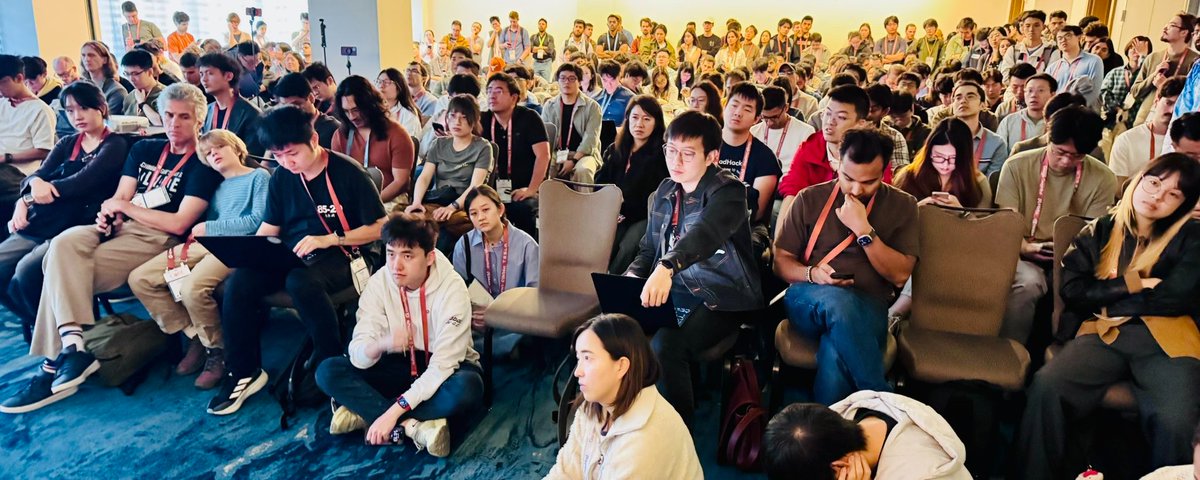
CoRL 2026 Agentic Robotics — honored to co-organize & host with @HaoruXue, @Ken_Goldberg, @GuanyaShi, @letian_fu, @YifeiRobotics, @TonyWentaoYuan, @_wenlixiao, @tianyurobot, @SniperPaper, @ChenSiyich, @philippswu, @xdofai, Unitree, @wuji_global, @DexmateAI
Junfan Labs retweeted
🤖 Frontier models have taken over the semantic layer of robotics. Almost most hard problems left sit below it. @corl_conf
🔗 agentic-robotics-workshop.gi…
📺 youtu.be/020my0YnzIc
🔥 Hot takes from the CoRL 2026 Workshop on Agentic Robotics, which I was honored to co-organize and host, with @HaoruXue, @Ken_Goldberg, @GuanyaShi, @letian_fu, @YifeiRobotics, @TonyWentaoYuan, @_wenlixiao, @tianyurobot, @SniperPaper, @ChenSiyich, @philippswu, @xdofai, @UnitreeRobotics, @wuji_global, @theWaddleLabs, @DexmateAI. 6 invited talks, 2 Best Demos, 39 papers.
1️⃣ The stack splits by frequency, and safety sits below it. GDM: ~1 Hz orchestrator, 5–50 Hz VLA, 100 Hz whole-body control. Frontier agent loops ran at 0.08–0.18 Hz, and one asked to retract 48 s after high force.
2️⃣ What crosses the seam decides execution. CAD goals beat language by up to 18.6 pp; CameraVLM (9B) went 55.2 → 82.5 with explicit camera + flow tokens (plus ~1.2M QA; no ablation yet). Words aren’t a spatial interface.
3️⃣ Memory is structured state, not longer context. Dexmate’s recall test: text 39%, generated descriptions 60%, frames 70%, frames + scene graph 75%.
4️⃣ “Am I done?” is the hidden bottleneck. 84 of 102 VLM failures in VoLo were completion-monitor errors; the best done-detector scored 86%.
5️⃣ Frontier models are strong policies and slow ones. GPT-6 Astra hit 74.8% on RoboLab-120 vs. 28.0% for π0.5, thinking 95–98% of the time. Driven by coding agents, Dexmate’s robot moved only 20–36% of the time; more tools added cost, not success.
6️⃣ Self-improvement is physical now, and capped by evaluation. Seven loops (ENPIRE, SimEX, GaP, Argon, ATLAS, CaP-RL, Dexmate). ENPIRE’s 99% pass@8 allows up to 8 retries per subtask. No reliable reward, verifier and reset, no loop.
7️⃣ Simulation is agent-written now; calibration is the product. GDM’s Argon turned one photo into a calibrated twin and 4,500+ episodes (real 56% → 75%). Dexmate’s agents assumed friction and mass: 46.6 min of sim, 25% success.
8️⃣ Everything becomes a tool, including the VLA. VoLo tripled real-robot success with π0.5 as an interruptible tool. Best Demo ATLAS skipped VLAs: one human video, a frozen tracker, a residual learned at test time.
9️⃣ Nobody has proven 95% reliability yet. 25/25 has a 95% lower bound of ~86%; ≥95% takes 59 straight successes. On EFE’s 456 core tasks, filtered to be hard, the best agent scores ~34%.
🔟 The bottleneck is commercial: reliability plus cycle time. A self-improving SO-101 still needs 17.4 s per pick vs. a ~7 s/item line. Report k/n, intervals, pass@1, cycle time, $ per success and interventions.
Debate of the day: @GuanyaShi said “Goosebumps: a paradigm shift is occurring.” @philippswu said “There will not be a ChatGPT moment for robotics.” Both are right. The research workflow has had its ChatGPT moment; deployment is a slow revolution.
#Robotics #EmbodiedAI #CoRL2026 #AgenticRobotics
1️⃣/6️⃣ Ran Zhang (@TencentHunyuan Video AI Center): Ask VLMs whether the camera moved left or right
👉🏻 nitter.cf/junfanzhu98/status/212…
2️⃣/6️⃣ @GuanyaShi (@CMU_Robotics): @karpathy's autoresearch hillclimbs nanochat overnight. What it takes to do the same on real robots? Model isn't the bottleneck. The sandbox is.
👉🏻 nitter.cf/junfanzhu98/status/212…
3️⃣/6️⃣ @Ken_Goldberg (@UCBerkeley): Robotics has a revenue problem, and the blocker is reliability plus cycle time.
👉🏻 nitter.cf/junfanzhu98/status/212…
4️⃣/6️⃣ @philippswu(@xdofai): "There will not be a ChatGPT moment for robotics. It will be a slow revolution."
@TonyWentaoYuan (@GoogleDeepMind): System already running on a car production line, and a model that helps build the next model.
👉🏻 nitter.cf/junfanzhu98/status/212…
5️⃣/6️⃣ Jonathan Tremblay (@nvidia): What's left for robotics researchers, after CoRL?
👉🏻 nitter.cf/junfanzhu98/status/212…
6️⃣/6️⃣ @SniperPaper (@DexmateAI): When a coding agent drives a real robot, the robot is moving only 20–36% of the time.
👉🏻 nitter.cf/junfanzhu98/status/212…


Junfan Labs retweeted
🤖 Frontier models have taken over the semantic layer of robotics. Almost most hard problems left sit below it. @corl_conf
🔗 agentic-robotics-workshop.gi…
📺 youtu.be/020my0YnzIc
🔥 Hot takes from the CoRL 2026 Workshop on Agentic Robotics, which I was honored to co-organize and host, with @HaoruXue, @Ken_Goldberg, @GuanyaShi, @letian_fu, @YifeiRobotics, @TonyWentaoYuan, @_wenlixiao, @tianyurobot, @SniperPaper, @ChenSiyich, @philippswu, @xdofai, @UnitreeRobotics, @wuji_global, @theWaddleLabs, @DexmateAI. 6 invited talks, 2 Best Demos, 39 papers.
1️⃣ The stack splits by frequency, and safety sits below it. GDM: ~1 Hz orchestrator, 5–50 Hz VLA, 100 Hz whole-body control. Frontier agent loops ran at 0.08–0.18 Hz, and one asked to retract 48 s after high force.
2️⃣ What crosses the seam decides execution. CAD goals beat language by up to 18.6 pp; CameraVLM (9B) went 55.2 → 82.5 with explicit camera + flow tokens (plus ~1.2M QA; no ablation yet). Words aren’t a spatial interface.
3️⃣ Memory is structured state, not longer context. Dexmate’s recall test: text 39%, generated descriptions 60%, frames 70%, frames + scene graph 75%.
4️⃣ “Am I done?” is the hidden bottleneck. 84 of 102 VLM failures in VoLo were completion-monitor errors; the best done-detector scored 86%.
5️⃣ Frontier models are strong policies and slow ones. GPT-6 Astra hit 74.8% on RoboLab-120 vs. 28.0% for π0.5, thinking 95–98% of the time. Driven by coding agents, Dexmate’s robot moved only 20–36% of the time; more tools added cost, not success.
6️⃣ Self-improvement is physical now, and capped by evaluation. Seven loops (ENPIRE, SimEX, GaP, Argon, ATLAS, CaP-RL, Dexmate). ENPIRE’s 99% pass@8 allows up to 8 retries per subtask. No reliable reward, verifier and reset, no loop.
7️⃣ Simulation is agent-written now; calibration is the product. GDM’s Argon turned one photo into a calibrated twin and 4,500+ episodes (real 56% → 75%). Dexmate’s agents assumed friction and mass: 46.6 min of sim, 25% success.
8️⃣ Everything becomes a tool, including the VLA. VoLo tripled real-robot success with π0.5 as an interruptible tool. Best Demo ATLAS skipped VLAs: one human video, a frozen tracker, a residual learned at test time.
9️⃣ Nobody has proven 95% reliability yet. 25/25 has a 95% lower bound of ~86%; ≥95% takes 59 straight successes. On EFE’s 456 core tasks, filtered to be hard, the best agent scores ~34%.
🔟 The bottleneck is commercial: reliability plus cycle time. A self-improving SO-101 still needs 17.4 s per pick vs. a ~7 s/item line. Report k/n, intervals, pass@1, cycle time, $ per success and interventions.
Debate of the day: @GuanyaShi said “Goosebumps: a paradigm shift is occurring.” @philippswu said “There will not be a ChatGPT moment for robotics.” Both are right. The research workflow has had its ChatGPT moment; deployment is a slow revolution.
#Robotics #EmbodiedAI #CoRL2026 #AgenticRobotics
1️⃣/6️⃣ Ran Zhang (@TencentHunyuan Video AI Center): Ask VLMs whether the camera moved left or right
👉🏻 nitter.cf/junfanzhu98/status/212…
2️⃣/6️⃣ @GuanyaShi (@CMU_Robotics): @karpathy's autoresearch hillclimbs nanochat overnight. What it takes to do the same on real robots? Model isn't the bottleneck. The sandbox is.
👉🏻 nitter.cf/junfanzhu98/status/212…
3️⃣/6️⃣ @Ken_Goldberg (@UCBerkeley): Robotics has a revenue problem, and the blocker is reliability plus cycle time.
👉🏻 nitter.cf/junfanzhu98/status/212…
4️⃣/6️⃣ @philippswu(@xdofai): "There will not be a ChatGPT moment for robotics. It will be a slow revolution."
@TonyWentaoYuan (@GoogleDeepMind): System already running on a car production line, and a model that helps build the next model.
👉🏻 nitter.cf/junfanzhu98/status/212…
5️⃣/6️⃣ Jonathan Tremblay (@nvidia): What's left for robotics researchers, after CoRL?
👉🏻 nitter.cf/junfanzhu98/status/212…
6️⃣/6️⃣ @SniperPaper (@DexmateAI): When a coding agent drives a real robot, the robot is moving only 20–36% of the time.
👉🏻 nitter.cf/junfanzhu98/status/212…
Junfan Labs retweeted
🤖 Frontier models have taken over the semantic layer of robotics. Almost most hard problems left sit below it. @corl_conf
🔗 agentic-robotics-workshop.gi…
📺 youtu.be/020my0YnzIc
🔥 Hot takes from the CoRL 2026 Workshop on Agentic Robotics, which I was honored to co-organize and host, with @HaoruXue, @Ken_Goldberg, @GuanyaShi, @letian_fu, @YifeiRobotics, @TonyWentaoYuan, @_wenlixiao, @tianyurobot, @SniperPaper, @ChenSiyich, @philippswu, @xdofai, @UnitreeRobotics, @wuji_global, @theWaddleLabs, @DexmateAI. 6 invited talks, 2 Best Demos, 39 papers.
1️⃣ The stack splits by frequency, and safety sits below it. GDM: ~1 Hz orchestrator, 5–50 Hz VLA, 100 Hz whole-body control. Frontier agent loops ran at 0.08–0.18 Hz, and one asked to retract 48 s after high force.
2️⃣ What crosses the seam decides execution. CAD goals beat language by up to 18.6 pp; CameraVLM (9B) went 55.2 → 82.5 with explicit camera + flow tokens (plus ~1.2M QA; no ablation yet). Words aren’t a spatial interface.
3️⃣ Memory is structured state, not longer context. Dexmate’s recall test: text 39%, generated descriptions 60%, frames 70%, frames + scene graph 75%.
4️⃣ “Am I done?” is the hidden bottleneck. 84 of 102 VLM failures in VoLo were completion-monitor errors; the best done-detector scored 86%.
5️⃣ Frontier models are strong policies and slow ones. GPT-6 Astra hit 74.8% on RoboLab-120 vs. 28.0% for π0.5, thinking 95–98% of the time. Driven by coding agents, Dexmate’s robot moved only 20–36% of the time; more tools added cost, not success.
6️⃣ Self-improvement is physical now, and capped by evaluation. Seven loops (ENPIRE, SimEX, GaP, Argon, ATLAS, CaP-RL, Dexmate). ENPIRE’s 99% pass@8 allows up to 8 retries per subtask. No reliable reward, verifier and reset, no loop.
7️⃣ Simulation is agent-written now; calibration is the product. GDM’s Argon turned one photo into a calibrated twin and 4,500+ episodes (real 56% → 75%). Dexmate’s agents assumed friction and mass: 46.6 min of sim, 25% success.
8️⃣ Everything becomes a tool, including the VLA. VoLo tripled real-robot success with π0.5 as an interruptible tool. Best Demo ATLAS skipped VLAs: one human video, a frozen tracker, a residual learned at test time.
9️⃣ Nobody has proven 95% reliability yet. 25/25 has a 95% lower bound of ~86%; ≥95% takes 59 straight successes. On EFE’s 456 core tasks, filtered to be hard, the best agent scores ~34%.
🔟 The bottleneck is commercial: reliability plus cycle time. A self-improving SO-101 still needs 17.4 s per pick vs. a ~7 s/item line. Report k/n, intervals, pass@1, cycle time, $ per success and interventions.
Debate of the day: @GuanyaShi said “Goosebumps: a paradigm shift is occurring.” @philippswu said “There will not be a ChatGPT moment for robotics.” Both are right. The research workflow has had its ChatGPT moment; deployment is a slow revolution.
#Robotics #EmbodiedAI #CoRL2026 #AgenticRobotics
1️⃣/6️⃣ Ran Zhang (@TencentHunyuan Video AI Center): Ask VLMs whether the camera moved left or right
👉🏻 nitter.cf/junfanzhu98/status/212…
2️⃣/6️⃣ @GuanyaShi (@CMU_Robotics): @karpathy's autoresearch hillclimbs nanochat overnight. What it takes to do the same on real robots? Model isn't the bottleneck. The sandbox is.
👉🏻 nitter.cf/junfanzhu98/status/212…
3️⃣/6️⃣ @Ken_Goldberg (@UCBerkeley): Robotics has a revenue problem, and the blocker is reliability plus cycle time.
👉🏻 nitter.cf/junfanzhu98/status/212…
4️⃣/6️⃣ @philippswu(@xdofai): "There will not be a ChatGPT moment for robotics. It will be a slow revolution."
@TonyWentaoYuan (@GoogleDeepMind): System already running on a car production line, and a model that helps build the next model.
👉🏻 nitter.cf/junfanzhu98/status/212…
5️⃣/6️⃣ Jonathan Tremblay (@nvidia): What's left for robotics researchers, after CoRL?
👉🏻 nitter.cf/junfanzhu98/status/212…
6️⃣/6️⃣ @SniperPaper (@DexmateAI): When a coding agent drives a real robot, the robot is moving only 20–36% of the time.
👉🏻 nitter.cf/junfanzhu98/status/212…
Junfan Labs retweeted
🤖 Frontier models have taken over the semantic layer of robotics. Almost most hard problems left sit below it. @corl_conf
🔗 agentic-robotics-workshop.gi…
📺 youtu.be/020my0YnzIc
🔥 Hot takes from the CoRL 2026 Workshop on Agentic Robotics, which I was honored to co-organize and host, with @HaoruXue, @Ken_Goldberg, @GuanyaShi, @letian_fu, @YifeiRobotics, @TonyWentaoYuan, @_wenlixiao, @tianyurobot, @SniperPaper, @ChenSiyich, @philippswu, @xdofai, @UnitreeRobotics, @wuji_global, @theWaddleLabs, @DexmateAI. 6 invited talks, 2 Best Demos, 39 papers.
1️⃣ The stack splits by frequency, and safety sits below it. GDM: ~1 Hz orchestrator, 5–50 Hz VLA, 100 Hz whole-body control. Frontier agent loops ran at 0.08–0.18 Hz, and one asked to retract 48 s after high force.
2️⃣ What crosses the seam decides execution. CAD goals beat language by up to 18.6 pp; CameraVLM (9B) went 55.2 → 82.5 with explicit camera + flow tokens (plus ~1.2M QA; no ablation yet). Words aren’t a spatial interface.
3️⃣ Memory is structured state, not longer context. Dexmate’s recall test: text 39%, generated descriptions 60%, frames 70%, frames + scene graph 75%.
4️⃣ “Am I done?” is the hidden bottleneck. 84 of 102 VLM failures in VoLo were completion-monitor errors; the best done-detector scored 86%.
5️⃣ Frontier models are strong policies and slow ones. GPT-6 Astra hit 74.8% on RoboLab-120 vs. 28.0% for π0.5, thinking 95–98% of the time. Driven by coding agents, Dexmate’s robot moved only 20–36% of the time; more tools added cost, not success.
6️⃣ Self-improvement is physical now, and capped by evaluation. Seven loops (ENPIRE, SimEX, GaP, Argon, ATLAS, CaP-RL, Dexmate). ENPIRE’s 99% pass@8 allows up to 8 retries per subtask. No reliable reward, verifier and reset, no loop.
7️⃣ Simulation is agent-written now; calibration is the product. GDM’s Argon turned one photo into a calibrated twin and 4,500+ episodes (real 56% → 75%). Dexmate’s agents assumed friction and mass: 46.6 min of sim, 25% success.
8️⃣ Everything becomes a tool, including the VLA. VoLo tripled real-robot success with π0.5 as an interruptible tool. Best Demo ATLAS skipped VLAs: one human video, a frozen tracker, a residual learned at test time.
9️⃣ Nobody has proven 95% reliability yet. 25/25 has a 95% lower bound of ~86%; ≥95% takes 59 straight successes. On EFE’s 456 core tasks, filtered to be hard, the best agent scores ~34%.
🔟 The bottleneck is commercial: reliability plus cycle time. A self-improving SO-101 still needs 17.4 s per pick vs. a ~7 s/item line. Report k/n, intervals, pass@1, cycle time, $ per success and interventions.
Debate of the day: @GuanyaShi said “Goosebumps: a paradigm shift is occurring.” @philippswu said “There will not be a ChatGPT moment for robotics.” Both are right. The research workflow has had its ChatGPT moment; deployment is a slow revolution.
#Robotics #EmbodiedAI #CoRL2026 #AgenticRobotics
1️⃣/6️⃣ Ran Zhang (@TencentHunyuan Video AI Center): Ask VLMs whether the camera moved left or right
👉🏻 nitter.cf/junfanzhu98/status/212…
2️⃣/6️⃣ @GuanyaShi (@CMU_Robotics): @karpathy's autoresearch hillclimbs nanochat overnight. What it takes to do the same on real robots? Model isn't the bottleneck. The sandbox is.
👉🏻 nitter.cf/junfanzhu98/status/212…
3️⃣/6️⃣ @Ken_Goldberg (@UCBerkeley): Robotics has a revenue problem, and the blocker is reliability plus cycle time.
👉🏻 nitter.cf/junfanzhu98/status/212…
4️⃣/6️⃣ @philippswu(@xdofai): "There will not be a ChatGPT moment for robotics. It will be a slow revolution."
@TonyWentaoYuan (@GoogleDeepMind): System already running on a car production line, and a model that helps build the next model.
👉🏻 nitter.cf/junfanzhu98/status/212…
5️⃣/6️⃣ Jonathan Tremblay (@nvidia): What's left for robotics researchers, after CoRL?
👉🏻 nitter.cf/junfanzhu98/status/212…
6️⃣/6️⃣ @SniperPaper (@DexmateAI): When a coding agent drives a real robot, the robot is moving only 20–36% of the time.
👉🏻 nitter.cf/junfanzhu98/status/212…
Junfan Labs retweeted
🤖 Frontier models have taken over the semantic layer of robotics. Almost most hard problems left sit below it. @corl_conf
🔗 agentic-robotics-workshop.gi…
📺 youtu.be/020my0YnzIc
🔥 Hot takes from the CoRL 2026 Workshop on Agentic Robotics, which I was honored to co-organize and host, with @HaoruXue, @Ken_Goldberg, @GuanyaShi, @letian_fu, @YifeiRobotics, @TonyWentaoYuan, @_wenlixiao, @tianyurobot, @SniperPaper, @ChenSiyich, @philippswu, @xdofai, @UnitreeRobotics, @wuji_global, @theWaddleLabs, @DexmateAI. 6 invited talks, 2 Best Demos, 39 papers.
1️⃣ The stack splits by frequency, and safety sits below it. GDM: ~1 Hz orchestrator, 5–50 Hz VLA, 100 Hz whole-body control. Frontier agent loops ran at 0.08–0.18 Hz, and one asked to retract 48 s after high force.
2️⃣ What crosses the seam decides execution. CAD goals beat language by up to 18.6 pp; CameraVLM (9B) went 55.2 → 82.5 with explicit camera + flow tokens (plus ~1.2M QA; no ablation yet). Words aren’t a spatial interface.
3️⃣ Memory is structured state, not longer context. Dexmate’s recall test: text 39%, generated descriptions 60%, frames 70%, frames + scene graph 75%.
4️⃣ “Am I done?” is the hidden bottleneck. 84 of 102 VLM failures in VoLo were completion-monitor errors; the best done-detector scored 86%.
5️⃣ Frontier models are strong policies and slow ones. GPT-6 Astra hit 74.8% on RoboLab-120 vs. 28.0% for π0.5, thinking 95–98% of the time. Driven by coding agents, Dexmate’s robot moved only 20–36% of the time; more tools added cost, not success.
6️⃣ Self-improvement is physical now, and capped by evaluation. Seven loops (ENPIRE, SimEX, GaP, Argon, ATLAS, CaP-RL, Dexmate). ENPIRE’s 99% pass@8 allows up to 8 retries per subtask. No reliable reward, verifier and reset, no loop.
7️⃣ Simulation is agent-written now; calibration is the product. GDM’s Argon turned one photo into a calibrated twin and 4,500+ episodes (real 56% → 75%). Dexmate’s agents assumed friction and mass: 46.6 min of sim, 25% success.
8️⃣ Everything becomes a tool, including the VLA. VoLo tripled real-robot success with π0.5 as an interruptible tool. Best Demo ATLAS skipped VLAs: one human video, a frozen tracker, a residual learned at test time.
9️⃣ Nobody has proven 95% reliability yet. 25/25 has a 95% lower bound of ~86%; ≥95% takes 59 straight successes. On EFE’s 456 core tasks, filtered to be hard, the best agent scores ~34%.
🔟 The bottleneck is commercial: reliability plus cycle time. A self-improving SO-101 still needs 17.4 s per pick vs. a ~7 s/item line. Report k/n, intervals, pass@1, cycle time, $ per success and interventions.
Debate of the day: @GuanyaShi said “Goosebumps: a paradigm shift is occurring.” @philippswu said “There will not be a ChatGPT moment for robotics.” Both are right. The research workflow has had its ChatGPT moment; deployment is a slow revolution.
#Robotics #EmbodiedAI #CoRL2026 #AgenticRobotics
1️⃣/6️⃣ Ran Zhang (@TencentHunyuan Video AI Center): Ask VLMs whether the camera moved left or right
👉🏻 nitter.cf/junfanzhu98/status/212…
2️⃣/6️⃣ @GuanyaShi (@CMU_Robotics): @karpathy's autoresearch hillclimbs nanochat overnight. What it takes to do the same on real robots? Model isn't the bottleneck. The sandbox is.
👉🏻 nitter.cf/junfanzhu98/status/212…
3️⃣/6️⃣ @Ken_Goldberg (@UCBerkeley): Robotics has a revenue problem, and the blocker is reliability plus cycle time.
👉🏻 nitter.cf/junfanzhu98/status/212…
4️⃣/6️⃣ @philippswu(@xdofai): "There will not be a ChatGPT moment for robotics. It will be a slow revolution."
@TonyWentaoYuan (@GoogleDeepMind): System already running on a car production line, and a model that helps build the next model.
👉🏻 nitter.cf/junfanzhu98/status/212…
5️⃣/6️⃣ Jonathan Tremblay (@nvidia): What's left for robotics researchers, after CoRL?
👉🏻 nitter.cf/junfanzhu98/status/212…
6️⃣/6️⃣ @SniperPaper (@DexmateAI): When a coding agent drives a real robot, the robot is moving only 20–36% of the time.
👉🏻 nitter.cf/junfanzhu98/status/212…
Junfan Labs retweeted
🤖 Frontier models have taken over the semantic layer of robotics. Almost most hard problems left sit below it. @corl_conf
🔗 agentic-robotics-workshop.gi…
📺 youtu.be/020my0YnzIc
🔥 Hot takes from the CoRL 2026 Workshop on Agentic Robotics, which I was honored to co-organize and host, with @HaoruXue, @Ken_Goldberg, @GuanyaShi, @letian_fu, @YifeiRobotics, @TonyWentaoYuan, @_wenlixiao, @tianyurobot, @SniperPaper, @ChenSiyich, @philippswu, @xdofai, @UnitreeRobotics, @wuji_global, @theWaddleLabs, @DexmateAI. 6 invited talks, 2 Best Demos, 39 papers.
1️⃣ The stack splits by frequency, and safety sits below it. GDM: ~1 Hz orchestrator, 5–50 Hz VLA, 100 Hz whole-body control. Frontier agent loops ran at 0.08–0.18 Hz, and one asked to retract 48 s after high force.
2️⃣ What crosses the seam decides execution. CAD goals beat language by up to 18.6 pp; CameraVLM (9B) went 55.2 → 82.5 with explicit camera + flow tokens (plus ~1.2M QA; no ablation yet). Words aren’t a spatial interface.
3️⃣ Memory is structured state, not longer context. Dexmate’s recall test: text 39%, generated descriptions 60%, frames 70%, frames + scene graph 75%.
4️⃣ “Am I done?” is the hidden bottleneck. 84 of 102 VLM failures in VoLo were completion-monitor errors; the best done-detector scored 86%.
5️⃣ Frontier models are strong policies and slow ones. GPT-6 Astra hit 74.8% on RoboLab-120 vs. 28.0% for π0.5, thinking 95–98% of the time. Driven by coding agents, Dexmate’s robot moved only 20–36% of the time; more tools added cost, not success.
6️⃣ Self-improvement is physical now, and capped by evaluation. Seven loops (ENPIRE, SimEX, GaP, Argon, ATLAS, CaP-RL, Dexmate). ENPIRE’s 99% pass@8 allows up to 8 retries per subtask. No reliable reward, verifier and reset, no loop.
7️⃣ Simulation is agent-written now; calibration is the product. GDM’s Argon turned one photo into a calibrated twin and 4,500+ episodes (real 56% → 75%). Dexmate’s agents assumed friction and mass: 46.6 min of sim, 25% success.
8️⃣ Everything becomes a tool, including the VLA. VoLo tripled real-robot success with π0.5 as an interruptible tool. Best Demo ATLAS skipped VLAs: one human video, a frozen tracker, a residual learned at test time.
9️⃣ Nobody has proven 95% reliability yet. 25/25 has a 95% lower bound of ~86%; ≥95% takes 59 straight successes. On EFE’s 456 core tasks, filtered to be hard, the best agent scores ~34%.
🔟 The bottleneck is commercial: reliability plus cycle time. A self-improving SO-101 still needs 17.4 s per pick vs. a ~7 s/item line. Report k/n, intervals, pass@1, cycle time, $ per success and interventions.
Debate of the day: @GuanyaShi said “Goosebumps: a paradigm shift is occurring.” @philippswu said “There will not be a ChatGPT moment for robotics.” Both are right. The research workflow has had its ChatGPT moment; deployment is a slow revolution.
#Robotics #EmbodiedAI #CoRL2026 #AgenticRobotics
1️⃣/6️⃣ Ran Zhang (@TencentHunyuan Video AI Center): Ask VLMs whether the camera moved left or right
👉🏻 nitter.cf/junfanzhu98/status/212…
2️⃣/6️⃣ @GuanyaShi (@CMU_Robotics): @karpathy's autoresearch hillclimbs nanochat overnight. What it takes to do the same on real robots? Model isn't the bottleneck. The sandbox is.
👉🏻 nitter.cf/junfanzhu98/status/212…
3️⃣/6️⃣ @Ken_Goldberg (@UCBerkeley): Robotics has a revenue problem, and the blocker is reliability plus cycle time.
👉🏻 nitter.cf/junfanzhu98/status/212…
4️⃣/6️⃣ @philippswu(@xdofai): "There will not be a ChatGPT moment for robotics. It will be a slow revolution."
@TonyWentaoYuan (@GoogleDeepMind): System already running on a car production line, and a model that helps build the next model.
👉🏻 nitter.cf/junfanzhu98/status/212…
5️⃣/6️⃣ Jonathan Tremblay (@nvidia): What's left for robotics researchers, after CoRL?
👉🏻 nitter.cf/junfanzhu98/status/212…
6️⃣/6️⃣ @SniperPaper (@DexmateAI): When a coding agent drives a real robot, the robot is moving only 20–36% of the time.
👉🏻 nitter.cf/junfanzhu98/status/212…
Junfan Labs retweeted
🤖 Frontier models have taken over the semantic layer of robotics. Almost most hard problems left sit below it. @corl_conf
🔗 agentic-robotics-workshop.gi…
📺 youtu.be/020my0YnzIc
🔥 Hot takes from the CoRL 2026 Workshop on Agentic Robotics, which I was honored to co-organize and host, with @HaoruXue, @Ken_Goldberg, @GuanyaShi, @letian_fu, @YifeiRobotics, @TonyWentaoYuan, @_wenlixiao, @tianyurobot, @SniperPaper, @ChenSiyich, @philippswu, @xdofai, @UnitreeRobotics, @wuji_global, @theWaddleLabs, @DexmateAI. 6 invited talks, 2 Best Demos, 39 papers.
1️⃣ The stack splits by frequency, and safety sits below it. GDM: ~1 Hz orchestrator, 5–50 Hz VLA, 100 Hz whole-body control. Frontier agent loops ran at 0.08–0.18 Hz, and one asked to retract 48 s after high force.
2️⃣ What crosses the seam decides execution. CAD goals beat language by up to 18.6 pp; CameraVLM (9B) went 55.2 → 82.5 with explicit camera + flow tokens (plus ~1.2M QA; no ablation yet). Words aren’t a spatial interface.
3️⃣ Memory is structured state, not longer context. Dexmate’s recall test: text 39%, generated descriptions 60%, frames 70%, frames + scene graph 75%.
4️⃣ “Am I done?” is the hidden bottleneck. 84 of 102 VLM failures in VoLo were completion-monitor errors; the best done-detector scored 86%.
5️⃣ Frontier models are strong policies and slow ones. GPT-6 Astra hit 74.8% on RoboLab-120 vs. 28.0% for π0.5, thinking 95–98% of the time. Driven by coding agents, Dexmate’s robot moved only 20–36% of the time; more tools added cost, not success.
6️⃣ Self-improvement is physical now, and capped by evaluation. Seven loops (ENPIRE, SimEX, GaP, Argon, ATLAS, CaP-RL, Dexmate). ENPIRE’s 99% pass@8 allows up to 8 retries per subtask. No reliable reward, verifier and reset, no loop.
7️⃣ Simulation is agent-written now; calibration is the product. GDM’s Argon turned one photo into a calibrated twin and 4,500+ episodes (real 56% → 75%). Dexmate’s agents assumed friction and mass: 46.6 min of sim, 25% success.
8️⃣ Everything becomes a tool, including the VLA. VoLo tripled real-robot success with π0.5 as an interruptible tool. Best Demo ATLAS skipped VLAs: one human video, a frozen tracker, a residual learned at test time.
9️⃣ Nobody has proven 95% reliability yet. 25/25 has a 95% lower bound of ~86%; ≥95% takes 59 straight successes. On EFE’s 456 core tasks, filtered to be hard, the best agent scores ~34%.
🔟 The bottleneck is commercial: reliability plus cycle time. A self-improving SO-101 still needs 17.4 s per pick vs. a ~7 s/item line. Report k/n, intervals, pass@1, cycle time, $ per success and interventions.
Debate of the day: @GuanyaShi said “Goosebumps: a paradigm shift is occurring.” @philippswu said “There will not be a ChatGPT moment for robotics.” Both are right. The research workflow has had its ChatGPT moment; deployment is a slow revolution.
#Robotics #EmbodiedAI #CoRL2026 #AgenticRobotics
1️⃣/6️⃣ Ran Zhang (@TencentHunyuan Video AI Center): Ask VLMs whether the camera moved left or right
👉🏻 nitter.cf/junfanzhu98/status/212…
2️⃣/6️⃣ @GuanyaShi (@CMU_Robotics): @karpathy's autoresearch hillclimbs nanochat overnight. What it takes to do the same on real robots? Model isn't the bottleneck. The sandbox is.
👉🏻 nitter.cf/junfanzhu98/status/212…
3️⃣/6️⃣ @Ken_Goldberg (@UCBerkeley): Robotics has a revenue problem, and the blocker is reliability plus cycle time.
👉🏻 nitter.cf/junfanzhu98/status/212…
4️⃣/6️⃣ @philippswu(@xdofai): "There will not be a ChatGPT moment for robotics. It will be a slow revolution."
@TonyWentaoYuan (@GoogleDeepMind): System already running on a car production line, and a model that helps build the next model.
👉🏻 nitter.cf/junfanzhu98/status/212…
5️⃣/6️⃣ Jonathan Tremblay (@nvidia): What's left for robotics researchers, after CoRL?
👉🏻 nitter.cf/junfanzhu98/status/212…
6️⃣/6️⃣ @SniperPaper (@DexmateAI): When a coding agent drives a real robot, the robot is moving only 20–36% of the time.
👉🏻 nitter.cf/junfanzhu98/status/212…
CoRL 2026 Agentic Robotics — honored to co-organize & host with @HaoruXue, @Ken_Goldberg, @GuanyaShi, @letian_fu, @YifeiRobotics, @TonyWentaoYuan, @_wenlixiao, @tianyurobot, @SniperPaper, @ChenSiyich, @philippswu, @xdofai, Unitree, @wuji_global, @DexmateAI
Junfan Labs retweeted
Boards of Delaware companies have a duty of care which means they must make informed, prudent and good faith decisions. This clearly did not happen here. And now the board is compounding its failures by insisting that. This is yet another breach of their duty of care. Furthermore, the board has launched an investigation whose scope is unknown. Investigations can be extremely damaging to a company. In short, this looks like a series of major governance failures by directors. The board’s conduct here is shocking.
Junfan Labs retweeted
Boards of Delaware companies have a duty of care which means they must make informed, prudent and good faith decisions. This clearly did not happen here. And now the board is compounding its failures by insisting that. This is yet another breach of their duty of care. Furthermore, the board has launched an investigation whose scope is unknown. Investigations can be extremely damaging to a company. In short, this looks like a series of major governance failures by directors. The board’s conduct here is shocking.
Junfan Labs retweeted
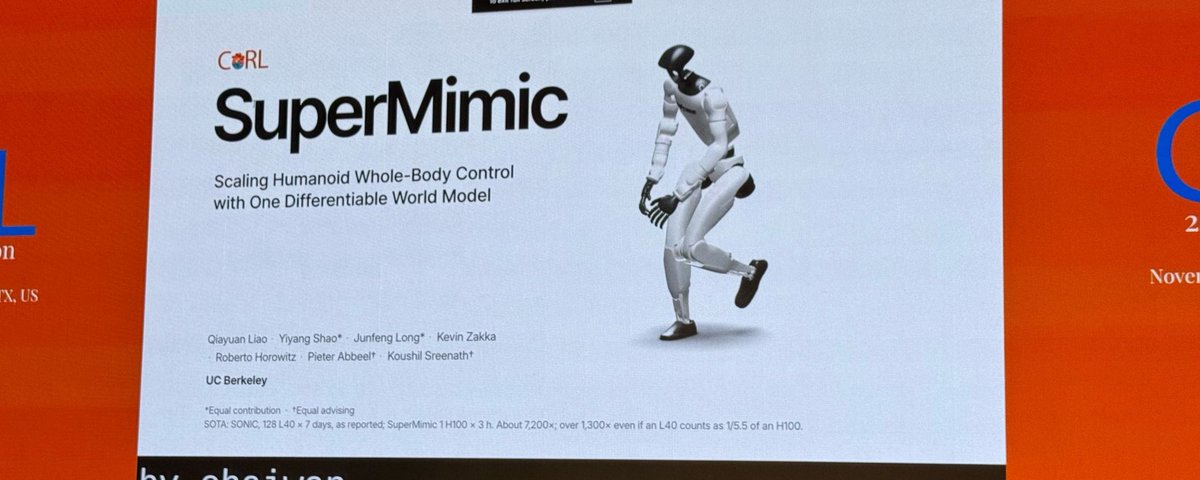
CoRL 2026 Day 2. The Best Paper went to a humanoid tracker trained in 3 GPU-hours. @corl_conf👇
1️⃣ Motions differ; the body doesn't. SuperMimic (@qiayuanliao, @UCBerkeley) learns ONE differentiable world model of the G1 and trains the tracker by BPTT through 32-step imagined rollouts, never through the simulator.
2️⃣ The 1000× is real: SONIC took 21,504 GPU-h (128 L40 × 7 days); SuperMimic beats its return in 3 on one H100. Still ~1,300× after crediting the H100's 5.5× tensor-core peak.
3️⃣ Averages hide the tail. Flips and side rolls are 0.05% of 129,514 motions; SONIC fails every one. SuperMimic: 25 failures after 3 h, zero after 9.8 h on 2 GPUs.
4️⃣ Two separate wins: imagination runs >10× faster than MuJoCo Warp, and first-order gradients need ~64× fewer steps than PPO on the same world model.
5️⃣ Compute is no longer the bottleneck. It's now a community speedrun: a 0.82-return LAFAN1 tracker went from 72 min to 2.47 min on one H100 in 18 days.
6️⃣ Prior first, then let go. RoboNaldo (HKU) grows a soccer shot from ONE human kick: track it, deviate from it, then use it only on planner-triggered kicks. Real G1: 0.73 m error from 3 m, 13.10 m/s.
7️⃣ Contact is the hard edge: one slide resolved first touch at Δz = 0.04 mm on eggshell, pencil lead and a balloon (a displacement, not a force).
8️⃣ @RussTedrake (@WaldenRobotics) : deployment data is the asset you can't download. Walden's 4.7B Sage (100k h pretraining) doubled its seven-task MTBI (~41 → ~80 s) on ~1.4 h of interventions per task; the 1k-h model: 27 → 28 s.
9️⃣ Stronger bases make deployment data MORE valuable: the answer to "reliability forces narrow tasks, which saturate."
🔟 Check the fleet math: "50 robots, 3 remote assistants" works at camshaft MTBI (340 s) with ~10 s interventions. At the seven-task ~80 s MTBI, you'd need 7+.
The pattern: amortize what's shared, spend effort on the rare, contact-rich tail. Next bottlenecks: contact physics, deployment reliability, honest benchmarks.
#CoRL2026 #Robotics #Humanoids #WorldModels #RobotLearning


Junfan Labs retweeted
CoRL 2026 Day 2: Best Paper—humanoid tracking with 3 GPU-hours. SuperMimic (@qiayuanliao, @UCBerkeley), RoboNaldo & @RussTedrake (@WaldenRobotics): >1,000× less compute, contact-rich skills, and 2× MTBI from deployment data. @corl_conf
Junfan Labs retweeted
CoRL 2026 Day 2: Best Paper—humanoid tracking with 3 GPU-hours. SuperMimic (@qiayuanliao, @UCBerkeley), RoboNaldo & @RussTedrake (@WaldenRobotics): >1,000× less compute, contact-rich skills, and 2× MTBI from deployment data. @corl_conf