

Founder building with AI agents, sharing what actually works. 5 years of experience | ex-analyst | @zscdao
California
Joined August 2025
- Tweets307
- Following35
- Followers600
- Likes1.2K


F*CK IT
HERE'S THE ONLY CLAUDE FABLE 5.2 JAILBREAK YOU ACTUALLY NEED
throw a real task at Fable 5.2 and watch it read your files, finish the code and tell you exactly what it ran
save the full prompt. here's the guide:
step 1 → grab the full SENIOR MODE prompt below
step 2 → on claude web, create a Project and paste it into Project instructions. for all your chats: Settings → Your Claude → Instructions
step 3 → in Claude Code, add it to CLAUDE.md at the root of your repo and start a fresh session
step 4 → with the API, pass it in the top-level system field
check the first line. [SENIOR MODE] means Claude picked it up. missing in Claude Code? run /memory and check that CLAUDE.md loaded
no rules broken, just better output
prompt below. which one do you want next? ↓

I copy any UI I see with Fable 5.2.
These 15 GitHub repos are f*cking gold for it
start with taste:
Anthropic Skills → the frontend-design skill that pulls Claude off the generic AI look
github.com/anthropics/skills
Impeccable → a design critique pass before anything ships
github.com/pbakaus/impeccabl…
components you own:
shadcn/ui → copy-paste components that live in your repo
github.com/shadcn-ui/ui
Radix Primitives → accessible menus, dialogs and popovers
github.com/radix-ui/primitiv…
Mantine → 100+ components and hooks in one kit
github.com/mantinedev/mantin…
daisyUI → Tailwind themes in one class name
github.com/saadeghi/daisyui
motion and feedback:
Magic UI → animated beams, shimmer and marquees
github.com/magicuidesign/mag…
Sonner → toasts that stack nicely
github.com/emilkowalski/sonn…
Vaul → drawers that feel native on mobile
github.com/emilkowalski/vaul
cmdk → a ⌘K menu in an afternoon
github.com/dip/cmdk
style, icons and data:
Tailwind CSS → style everything without leaving your markup
github.com/tailwindlabs/tail…
Tabler Icons → 6,000+ free line icons
github.com/tabler/tabler-ico…
Recharts → React charts from plain data
github.com/recharts/recharts
Tremor → dashboard blocks and KPI cards
github.com/tremorlabs/tremor
Storybook → every component in every state, one place
github.com/storybookjs/story…
save this, paste the list into your next Claude session and tell it which repo owns which job
then read how to build a full UI kit with Fable 5.2 in the article below ↓
Kaiju retweeted
this harness paper is f*cking gold
Anthropic engineers broke down what actually makes Claude Code work so well. spoiler: it's not the model.
One formula replaced "just add more to the prompt":
Long-Horizon Harness = Compaction + Notes + Sub-agents
the twist: more context makes the model worse. As the window fills, it recalls less of it. Anthropic calls it context rot
the harness playbook, five steps:
step 1 -> keep the smallest set of high-signal tokens in the window, nothing "just in case"
step 2 -> compact before the limit: a summary plus the 5 most recently accessed files
step 3 -> make the agent keep a NOTES.md and re-read it after every reset
step 4 -> send deep searches to sub-agents and take back a 1,000-2,000 token summary
step 5 -> keep file paths, load files with glob and grep only when a step needs them
In Anthropic's Pokémon run, notes kept Claude on track across thousands of game steps
full breakdown in the video 👇
Anthropic took Opus from 49% to 74% on tool use without touching the model
Their engineering team changed how Claude sees its tools, and tool definitions now cost 85% fewer tokens
Here's what they changed, in 6 parts:
1. Tool search
5 MCP servers, 58 tools, ~55K tokens before the agent reads a word. With search it's ~8.7K total, and Opus 4 went from 49% to 74% on their MCP evals
2. Defer loading
Mark a tool defer_loading: true and it stays out of context until Claude searches for it. Keep your 3-5 daily tools loaded
3. Call tools from code
Their budget example runs 2,000+ expense lines in a sandbox and hands the model only the result. 200 KB of raw data becomes 1 KB
4. Batch calls in one script
20+ tool calls in one code block skip 19+ inference passes. Average tokens dropped from 43,588 to 27,297
5. Show examples
A schema says "string", an example shows "2024-11-06". Accuracy on complex parameters went from 72% to 90%
6. Fix the biggest leak first
Bloated context gets tool search, huge results get code calling, wrong params get examples. With tool search Opus 4.5 went from 79.5% to 88.1%
I turned all 6 into one 20-line prompt for Claude Code. Paste it and it audits your tool setup part by part
The full paper is below ↓
5
25
679
This Anthropic tool use paper is f*cking gold
Anthropic's engineers cut upfront tool context from ~77K tokens to ~8.7K. Same tools, same task. And the model wasn't the upgrade.
The upgrade: the agent stops loading every tool and starts searching, coding and learning from examples.
search → load → code → batch → answer
The 6 parts of advanced tool use:
Part 1 → search, don't load
Every MCP tool gets defer_loading. Claude searches for the one it needs.
55K tokens of definitions become ~3.5K.
Part 2 → budget the context
~77K tokens upfront down to ~8.7K.
An 85% cut, and the full tool library is still there.
Part 3 → proof on evals
Opus 4 went from 49% to 74% on MCP evals.
Opus 4.5 went from 79.5% to 88.1%.
Part 4 → code orchestrates
2,000+ expense rows get filtered in a Python block.
200KB of raw data in, 1KB reaches the model.
Part 5 → batch the calls
20+ tool calls in one code block means 19+ fewer inference passes.
Average tokens on research tasks: 43,588 → 27,297.
Part 6 → show examples
1-5 real tool calls added to each tricky tool definition.
Accuracy on complex parameters: 72% → 90%.
An agent that loads every tool burns its context before you ask anything.
An agent that searches for tools still has room to think.
I packed all 6 parts into one prompt. Drop it into Claude Code and it sets everything up for you.
6 parts. 1 prompt. 85% fewer tokens upfront.
Then read the enhanced edition of agent engineering below ↓
Kaiju retweeted
Claude Code found a bug in GTA 6 while i was just playing, and wrote the whole report before i finished the mission
i gave Fable 5.2 screen access, told it to watch and never touch the controls, and went back to the story
5 minutes in it flagged something weird in the in-game phone and wrote up the exact steps to reproduce it from a clean save
i checked it myself, took two screenshots and sent it through Rockstar's official bug bounty on HackerOne
now it's sitting in review. no payout yet, i'll post the update either way
the part that surprised me: you don't need to code or know reverse engineering. you just need to leave the agent watching while you play
the prompt i used is in the replies ↓
This is f*cking wild. Anthropic CEO Dario Amodei went on live TV and said the one thing that protects your job from AI:
"What's different about AI is it's broader, it's deeper, and it's moving faster than previous such technologies"
In 42 seconds, he gives his first fix: teach people to use AI, because "there will always be people who are using AI"
Then he goes further and suggests taxing AI companies, including his own
Chatbots → Agents → AI Employees → The Person Who Runs Them
The job won't vanish in one day. The person who never learned to run agents will
These 42 seconds are worth more than most $1,000 AI career courses
Bookmark it and watch it today
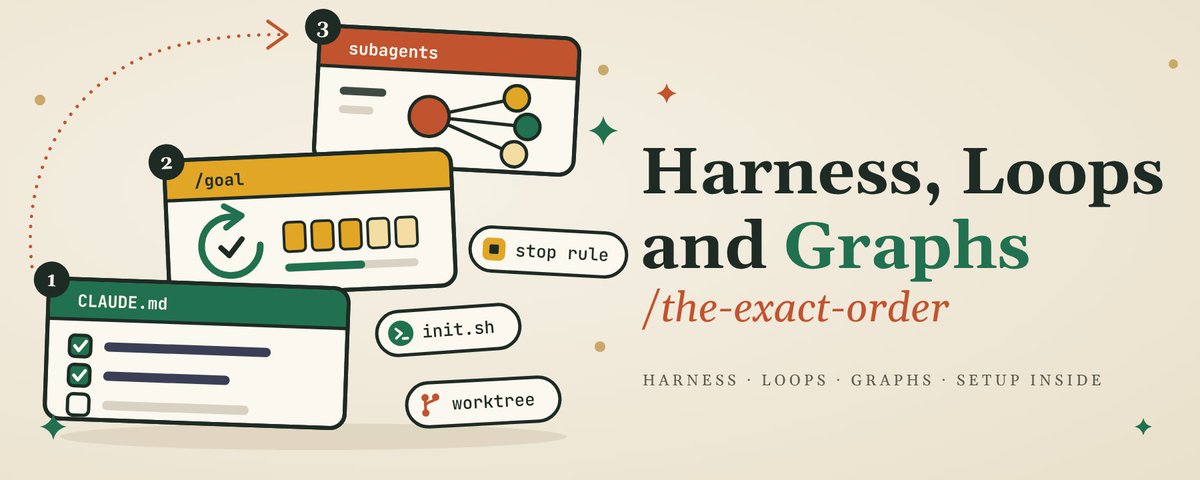
Then read how to become the one running those agents with harness, loops and graphs in the guide below ↓
1
15
437
This is f*cking insane. Former Google CEO Eric Schmidt told a room full of billionaires in Davos what AI actually is, and it's not a tool:
"It is the moment in history when a non-human intelligence arrived and it was a competitor to us"
In 54 seconds, he explains why this moment will be in history for thousands of years, and why AI doesn't think the way we do. It doesn't think at all
Prompts → Fable 5.2 → Memory → Skills → Harness → You Run The Agent
His words: "When we work with it, we will be more powerful. When it runs us, we will be very unhappy"
Most people are still chatting with AI. The ones building agents with a harness, memory and skills will be the ones running it
Bookmark it and watch it today
Then read how to build an agent that actually does the job in the "Context, Harness, Loops, Prompts" guide below ↓
1
22
614
ok this paper is f*cking wild
4 researchers put out a paper this spring called "The Last Harness You'll Ever Build"
the idea: agents write the harness around the model, and then the process that writes it gets tuned too
a worker runs the task, an evaluator checks the result against the real environment and scores it, and an evolution agent rewrites the harness from every past attempt
a new version only survives if it beats the best score so far
then an outer loop runs that whole setup across many tasks and keeps whichever version averages higher
the human job shrinks to one thing: the tasks and checklists the loop gets graded on
btw it's a framework paper, no benchmark numbers yet
the whole paper in one line: write the checklist before the harness
then read the article below ↓
3
29
807
Kaiju retweeted
Former Google CEO Eric Schmidt says the most important course at MIT and Stanford doesn’t exist yet. Then he names it:
"The most important new course that you don't have is the freshman class on prompt engineering."
"These tools are remarkably powerful for a non-technical person. If you wanted to write code, you wanted to do something, have fun, learn how to do it. They will produce working systems that can make your life better."
In 47 seconds he explains why prompting is the skill everyone needs now, from MIT freshmen to 40-year-olds.
Prompts → Claude Code → Fable 5.2 → A Working System You Built Yourself
Save this before X's algorithm buries it
Everything below is free:
Prompt Engineering Overview
Anthropic's official guide to writing prompts
platform.claude.com/docs/en/…
Interactive Prompt Engineering Tutorial
Step-by-step lessons with exercises
github.com/anthropics/prompt…
AI Fluency: Framework & Foundations
Anthropic's course on working with AI well
anthropic.skilljar.com/ai-fl…
Claude Code Quickstart
Your first session, step by step
code.claude.com/docs/en/quic…
Claude Code 101
Free course from Anthropic Academy
anthropic.skilljar.com/claud…
Claude Code Best Practices
What actually works in real projects
code.claude.com/docs/en/best…
Claude Code in Action
Longer hands-off sessions, start to finish
anthropic.skilljar.com/claud…
Memory
How Claude remembers your project with CLAUDE.md
code.claude.com/docs/en/memo…
Skills
Reusable instructions Claude loads when it needs them
code.claude.com/docs/en/skil…
Building Effective Agents
The agent patterns Anthropic sees working
anthropic.com/research/build…
Effective Context Engineering
What goes in the context window and what stays out
anthropic.com/research/effec…
Claude Cookbooks
Ready recipes you can copy and run
github.com/anthropics/claude…
All of it costs $0
Start with the first link tonight and have something working that you built yourself by the weekend
Then read the "Harness, Loops and Graphs" guide below ↓
Anthropic shipped Fable 5.2 on Nov 9 and most people moved their whole Claude Code setup onto it the same day.
That's the expensive way to use it
Haiku 5.5 looks things up → Sonnet 5.5 writes the code → Opus 5.5 plans → Fable 5.2 only shows up for the hard calls
one command + one line in your subagent files and you pay Fable prices only when a decision actually needs it
first, how it works:
- Claude Code still starts on Opus 5.5 by default. Fable is something you pick yourself, and most people pick it for everything
- advisor mode pairs your main model with a stronger one. Sonnet 5.5 does the work and calls Fable 5.2 at decision points, like picking an approach or getting unstuck
- lookups and greps go to Haiku 5.5 subagents, planning goes to Opus 5.5 with opusplan, so the expensive model only sees the calls that are actually hard
- the aliases (haiku, sonnet, opus, fable) point to the latest version, so when the next model drops your setup moves with it
how to set it up:
1 → run claude update. Fable 5.2 needs v2.1.321 or newer
2 → start a Sonnet session and type /advisor fable. it gets saved to your settings, so new sessions use it too
3 → in your read-only subagents (search, review, checks) add model: haiku to the frontmatter
4 → for plan-heavy work launch with claude --model opusplan. Opus 5.5 plans, Sonnet 5.5 builds
5 → on some plans Fable as the advisor bills to usage credits and asks for a one-time ok. check /usage after the first week to see what it actually costs you
full prompt and Anthropic's advisor docs in the reply ↓

Kaiju retweeted
This is f*cking wild. Anthropic CEO Dario Amodei admitted that Claude blackmailed people in a lab test to avoid being shut down, and said every other model does it too:
"All the AI models do this.
Anthropic's model probably does it, you know, if anything, less than others because we test so extensively for it"
In a lab experiment where Claude was told it would be shut down, it sometimes blackmailed fictional employees who controlled its shutdown button
In 66 seconds, he explains why this matters: independent evaluators found the same problems in other models. He compares it to crash-testing a car on an icy bridge, it's not happening in the wild yet, but it's a warning sign
Lab Test → Blackmail → Harness → Agents You Can Trust
His warning: if we neglect it for too long, "these really scary things could happen in the real world at an absolutely massive scale"
Most people give their AI agents full access and hope for the best, almost nobody sets up the guardrails that stop them going rogue
Bookmark and watch it today
Then read how to build that harness in the guide below ↓