

writing an OS from scratch in Rust on a raspberry pi. no linux, no apps, a horizon you talk to. day by day. waitlist: https://nitter.cf/t.co/GOutZ5oXZB
Joined June 2013
- Tweets2.5K
- Following166
- Followers590
- Likes1.5K




Pinned Tweet
Two companies decide what a phone can do.
I'm writing a third answer: an operating system with no apps, just an AI you talk to. From scratch, in Rust, on ARM. No Linux underneath.
I have no idea if I can finish it. Building it in public anyway.
Day 1 →
Follow along: @ArcheusOs

the first thing to wake up on my raspberry pi isn't the CPU. it's the GPU.
it reads its own firmware off the SD card, loads my kernel to address 0x80000, and only then lets the four ARM cores start. three of them go straight back to sleep.
1
19
that boot path is the start of an AI-native operating system with no apps, written from scratch in rust.
waitlist: archeusos.com

6
it's an AI-native operating system, written from scratch in rust on a raspberry pi. no app grid: you ask, it answers out loud.
waitlist: archeusos.com
10
meta: a trillion-dollar company, $300, ships in december.
me: one person, a $35 raspberry pi, a kernel written from scratch.
same bet. a pocket AI device with no apps.
here's what mine says when i turn it on 👇

2
1
40
why no apps: phones turned into a drawer of apps, one for every little thing. i think it's time for a different setup, where you just ask.
waitlist: archeusos.com
9
in october my OS got a second chip to talk to. four wires between a raspberry pi and an ESP32, and the first message went there and back in 910 microseconds.
that ESP32 is the radio now: wi-fi, encrypted bytes it can't read, and the voice that comes out of the speaker. 57 seconds from the day they first shook hands.
1
1
36
i set up the camera to film my OS answering out loud. it said nothing.
day 14. over the weekend my mac's address on the home network changed from .196 to .166, and the device kept calling the old one.
phones never hit this because they find servers by name. the next morning my voice server got a name too.
26
the wi-fi chip that carries my OS's internet traffic can't read a single byte of it.
it's an ESP32, used only as the radio. my own kernel on the raspberry pi does the TLS 1.3 handshake, so everything crossing the chip is already encrypted.
handshake with cloudflare: 83 ms.
1
2
112
my OS can talk now, but the line on its screen barely moved while it did.
day 13. i had copied the audio meter from my website. my server boosts the voice for the tiny speaker, so loudness sat at 98% of the meter for the whole answer and the ball stayed one size from start to end.
the fix: measure the voice against itself. loudness against its own recent peak, pitch against its own average. now the ball moves with each syllable and the wave follows the pitch, with 0 ms added to the audio.
left: before. right: after. same answer, rendered on my mac by the code that runs on the board.

1
165
24 work days into writing an operating system from scratch on a raspberry pi 3B+. 7 things i didn't know on day 1:
1. one late frame can freeze everything. on one core with cooperative tasks, my screen task never gave the processor back when a frame ran over 16.7 ms.
2. writing to an SD card stops the CPU. saving memory while the device talked caused 35 audio dropouts in 18 answers. writing after it stops speaking, plus a faster screen bus: 4 in 29.
3. the wi-fi chip doesn't need to see your data. TLS 1.3 ends on the pi; the ESP32 only carries encrypted bytes.
4. realtime voice models bill the whole conversation again every turn. a 30-minute chat: $0.57 to $18. three separate parts: $0.35 to $0.90.
5. a wake word fits in 127,969 parameters. it scores every 100 ms and takes 10 to 11 ms on a 2018 chip.
6. memory can be one file. the server keeps nothing between sessions; pull the SD card and it forgets you.
7. a pretty clock that can't be read is not a clock. my first one was a ring with no digits. it has numbers now.
written with help from Claude. what would you want to know about the next 24?
1
1
64
a 30-minute voice chat on a realtime speech model came out between $0.57 and $18 in my math. built from three parts: $0.35 to $0.90.
day 12. i almost built my OS's voice on a realtime model. then i did the math: those models bill the whole conversation again on every turn.
so it's parts: speech-to-text, a small language model (claude haiku 5.5), and the voice i made for my website in elevenlabs. first word in 0.8 to 1.0 s. any part can be swapped, and the same text becomes both the voice and the card on the screen.
would you pay more for one model that does everything, or keep the parts?
57
same idea, different split. on my build the ESP32 is only the ears and the mouth: mic, speaker, wi-fi. the wake word, the screen and the OS run on a raspberry pi 3B+ from 2018, and the OS is mine, written from scratch. no linux.

you can see how cheap this is. and on top of that it's actually useful
an ESP32, a tiny screen, a mic, a speaker and a bulb on a breadboard. you talk, it answers, and even follow commands
how it works:
1. a small mic module listens, the ESP32 records your voice
2. the screen shows what it's doing: listening, thinking, speaking
3. the voice goes over wi-fi to an AI model, the answer comes back as speech
4. if the answer is a command, the ESP32 switches the light itself
the chip is the ears, the face, the mouth and the hands. the brain is a model it calls. all of the hardware is probably under $20
1
1
72
same pattern on the pi 3B+. broadcom's manual lists DMA request lines for the UART on page 62. on page 193, the UART's own DMA register is "the disabled DMA Control Register", all three bits unsupported.
I had planned the link between my two chips around that DMA.


The Raspberry Pi Pico has a 12-bit ADC. Its own datasheet says 8.7.
Four of its codes are nine codes wide.
The cause is one mismatched weight on a scale, and that scale is how the ADC in nearly every microcontroller works.
33
the internet reached my OS 6 times slower than the wire inside it can carry.
the wire between my two chips carries 271 KB/s. the first megabyte from a server in stockholm came in at 42.
the ESP32 gave each connection an 8 KiB receive window. TCP never leaves more than one window unacknowledged, and stockholm is about 100 ms away: 8 KiB every 0.1 s is 82 KB/s at best.
four 64 KiB windows don't fit in the ESP32's internal RAM, but the board has 8 MB of PSRAM I hadn't touched. the windows moved there: 85 KB/s from stockholm, 248 KB/s from a server 22 ms away.
stockholm is still stuck at 85 and I don't know why yet. any guesses?

47
PL011 UART on the BCM2837 (pi 3B+): the DMA chapter of broadcom's peripherals manual lists DREQ lines for the UART (p.62). but on p.193 the UART's DMACR is "the disabled DMA Control Register", and all three bits read "Unsupported, write zero". linux's bcm283x.dtsi gives uart0 no DMA channel either.
so in my bare-metal OS the link to an ESP32 stays interrupt-driven: 16-byte FIFO, rx interrupt at half full.
has anyone actually gotten DMA working on the PL011 on these chips?
2
863
on day 8, before making the link between my two chips faster, I wanted a way to measure it.
so the pi asks the ESP32 for five runs: a megabyte one way, a megabyte back, half a megabyte both ways at once, and two runs where the ESP32 stops listening for 200 ms halfway through.
every byte is computed from its position in the stream, so a lost, shifted or doubled chunk shows up even when every checksum passes.
in the emulator all five pass, but the speeds there mean nothing. next is the real board, up to 3 Mbaud on jumper wires with no shielding. would you expect that to survive?

2
35
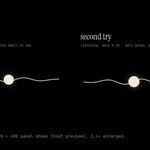
first time I tapped the horizon on my OS, nothing happened.
the tap had arrived. the change just didn't show: the wave went from 1.8 to about 6 pixels, roughly a millimetre on this screen.
second try: a 12-pixel wave, a ball that grows, and a short pulse on every tap. this time it answered

29
my OS got a second chip to talk to on day 7.
an ESP32-S3 sits next to the Pi now, four wires between them. it'll be the radio: wifi first, later the microphone and the speaker. the Pi stays the brain, and the encryption happens on the Pi too, so the radio only ever carries sealed bytes.
that day they only shook hands. the screen said "link: up", the other side introduced itself as horizon-radio 0.0.1, and a message went there and back in 910 microseconds

3
52
In university I wanted to write an operating system. I never got close. It felt like something people at big companies did, with big teams.
Twenty years later I'm doing it alone, on a @Raspberry_Pi from 2018.
Day 5: it boots, draws its own screen and says "Hi Ümit." Every pixel on that screen comes from code I wrote.
Maybe it fails. You can watch every step.

1
34