
Postdoc @ Stanford University | Ph.D. @ Cornell University
Joined August 2020
- Tweets71
- Following110
- Followers429
- Likes134



Robotics is entering a transformative period. 🤖
Principles of Robot Autonomy is the culmination of nearly a decade of building a robotics curriculum at Stanford, and we’re thrilled to share this 360-degree program with students, researchers, and practitioners around the world!

Ever wondered what it’s like to learn robot autonomy @Stanford? Now you can.
Today, we’re opening up the robot autonomy teaching materials that my collaborators and I have been developing over the past several years—for anyone, anywhere, completely free.
At the heart of this effort is Principles of Robot Autonomy (PoRA), a textbook inspired by the Stanford robot autonomy course series I’ve been teaching since 2017.
Robot autonomy has evolved from a research discipline into a technology deployed in the real world. Building capable autonomous systems requires more than understanding individual algorithms: it requires understanding how perception, state estimation, planning, control, and learning work together in a complete autonomy stack.
That’s what we set out to teach with PoRA: bringing classical robotics and modern AI together in one coherent framework, grounded in both theory and practice.
Coming soon in print from Cambridge University Press, Principles of Robot Autonomy is also freely available online and comes with a comprehensive collection of open educational resources:
📖 Textbook, arxiv.org/abs/2608.03496 — Foundations of robot autonomy, from classical methods to modern AI-based approaches.
🎥 Video lectures, porabook.com/lectures/ Lectures from my Stanford courses on robot autonomy and on optimal and learning-based control.
💻 Interactive exercises, porabook.com/exercises/ — Hands-on Python implementations and Jupyter notebooks.
📝 Teaching materials, porabook.com/instructors/ — Lecture slides and resources for instructors.
🌐 Explore all PoRA resources, porabook.com/ — Including Ask the Book, an AI study assistant integrated throughout the textbook to answer questions, explain derivations, and connect ideas across chapters.
📣 Read the Stanford announcement: news.stanford.edu/stories/20…
Our goal is simple: to make high-quality education in robot autonomy accessible to students, researchers, engineers, educators, and anyone curious about how autonomous robotic systems work.
I believe that sharing knowledge is fundamental to the mission of a university. Autonomous robotics—and Physical AI more broadly—are among the defining technological frontiers of our time. We want to help more people understand these technologies, build with them, and advance the field.
A huge thank you to my co-authors, @DanieleGammelli, Joseph Lorenzetti, @katielulula, and @GioeleZardini, and to everyone who helped bring this project to life.
Explore the resources, use them in your own learning or teaching, and please share them with anyone who might find them useful!
#Robotics #PhysicalAI #ArtificialIntelligence #AutonomousSystems #Education
@Stanford @StanfordEng @StanfordAILab @StanfordHAI

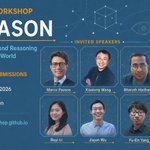
📣 Join us for the ECCV'26 Workshop on Visual Perception and Reasoning in the Interactable World!
📍 Malmö Arena @ Palissad South
🗓️ Tuesday, Sep. 8
xreason-workshop.github.io

📄 And a huge thanks to everyone who submitted: 33 accepted works, with 4 selected for our two oral sessions.
All accepted papers are now public on OpenReview:
openreview.net/group?id=thec…
Let's build perception that reasons and acts in the interactable world! 🚀✨
w/ Co-Organizers @CongyueD, Lena Wild, @milanganai, @HaoranGeng2, Victor Guizilini, Jitendra Malik, Leonidas Guibas
Reiterating a Call for Papers! #ECCV2026 Workshop on X-Reason: Visual Perception and Reasoning in the Interactable World 🤖
We welcome works at intersection of computer vision, spatial reasoning, robotics, autonomous driving, and embodied AI.
🌐Website: xreason-workshop.github.io
🤖 Made with AI

🗓️Submission deadline: Jul 31, 2026
🔗Submit: openreview.net/group?id=thec…
f.com/ECCV/2026/Workshop/X-R…
Big thanks to my amazing co-organizers
@CongyueD, Lena Wild, @milanganai, @HaoranGeng2, @vitorguizilini, @JitendraMalikCV, and Leonidas Guibas
Come check out our work at #RSS2026 🇦🇺
Excited to be presenting in the Navigation 1 Session on July 14th!

🤔 Can VLA models teach themselves the best way to reason?
We introduce R&B-EnCoRe which is a self-improving pretraining cycle for reasoning VLAs to propose and self-discover what embodiment-specific reasoning looks like.
🔗 milanganai.github.io/rnb-enc…
📃 arxiv.org/pdf/2602.08167
Katie Luo retweeted

Introducing ConstrainedMimic (arxiv.org/pdf/2606.00374) — a control framework for #humanoid robot #safety that enables real-time constraint enforcement within #RL-based motion tracking policies by leveraging whole-body kinematics and dynamics.
Recent advances in reinforcement learning have unlocked remarkable whole-body agility for humanoid robots. However, ensuring safety and satisfying constraints—especially those introduced after training—remains a significant challenge for deploying safe and reliable systems.
ConstrainedMimic addresses this challenge by combining ideas from operational space control and control barrier functions (CBFs). The framework enables enforcement of arbitrary runtime constraints while preserving the ability of the policy to track complex motions. Importantly, constraints can be imposed on both the kinematic reference motion and the underlying robot dynamics, providing a principled approach to safer, more robust, and more controllable humanoid behavior.
As #PhysicalAI, #humanoid #robotics, and #embodied #AI systems move from research environments into the real world, the ability to guarantee safety and respect operational constraints will become increasingly important — ConstrainedMimic is a step in this direction.
📄 Paper: arxiv.org/pdf/2606.00374
💻 Code: Coming soon
Great work led by @danielpmorton .
#PhysicalAI #AISafety #HumanoidRobotics #EmbodiedAI #ReinforcementLearning #Robotics
@StanfordAILab @StanfordEng

Robotics is shifting toward "agents" orchestrating low-level policies, with CoT reasoning, bigger models, and memory let them tackle harder tasks. But in embodied settings, latency is a bottleneck. 🤔
So we explored where should we actually spend our test-time compute!

test-time compute [ttc] in robotics isn't free & isn't always worth it. smart allocation of ttc recovers frontier-level planning at a fraction of the cost!
coauthor @milanganai
w/ Yasmina @ajaysridhar0 Mozghan @katielulula Clark Barrett @jiajunwu_cs @chelseabfinn @drmapavone 🧵
Excited to announce this call for papers @ #ECCV2026 Workshop on Visual Perception and Reasoning in the Interactable World!
Come one, come all to perception work pushing the narrative on the future of these systems: embodied, interactive, and beyond👀

Call for Papers! #ECCV2026 Workshop on Visual Perception and Reasoning in the Interactable World
Reasoning is fast becoming a fundamental substrate for embodied systems and physical AI, and it's reshaping perceptual understanding.
🔗Website: xreason-workshop.github.io/

Katie Luo retweeted
A central challenge in #physical #AI is data scarcity: vision-language-action (#VLA) models are fundamentally limited by the availability of high-quality robotics demonstrations.
In our recent work, we introduce R&B-EnCoRe (arxiv.org/pdf/2602.08167), a framework that enables models to self-bootstrap embodied #reasoning by leveraging synthetic visuo-textual data together with limited embodiment-specific experience. In essence, R&B-EnCoRe allows models to learn how to reason in an embodied setting.
Our approach treats reasoning as a latent variable and uses self-supervised refinement to learn reasoning strategies that are directly predictive of successful control—without human annotations, reward engineering, or external verifiers.
We validate the approach across a range of embodiments—including manipulation, navigation, and autonomous driving—and across model scales from 1B to 30B parameters, observing consistent improvements:
💪 +28% task success in real-world manipulation
🦿 +101% score in legged locomotion navigation
🚗 −21% collision rate in autonomous driving
Overall, this work highlights a promising direction: aligning internet-scale priors with embodiment-specific data to enable scalable, self-improving physical intelligence.
Kudos to an amazing team: Milan Ganai Katie Luo @JonasFrey96 Clark Barrett
🌐 Website: milanganai.github.io/rnb-enc…
📄 Paper: arxiv.org/pdf/2602.08167

High quality data helps LLM fine-tuning, even if it's synthetic (who would have guessed?!?)
This was an awesome collaboration, please check it out!


If you're around #ICCV2025 come check out our poster on V2X dataset, Mixed Signals, today at 2:45-4:45pm, #390 Exhibit Hall I📍
Zhenzhen's presenting our dataset for cooperative perception, featuring 45k+ point clouds and 240k+ annotations with tracks
💻mixedsignalsdataset.cs.corne…


I believe that future autonomous transportation will be cooperative in nature; this dataset helps facility this study! We have released the data and a devkit for ease of use.
📄: arxiv.org/abs/2502.14156
📊: ieee-dataport.org/competitio…
🔧: github.com/quan-dao/mixed-si…
This was a collaboration across countries and institutions! w/ Minh-Quan Dao, Zhenzhen Liu, Mark Campell, @weilunchao, @KilianQW, Ezio Malis, Vincent Fremont, @BharathHarihar3, Mao Shan, Stewart Worrall, @chinitaberrio
Yet another #IROS2025 post, but I'm super excited to unveil what I had worked at Waymo during my (last ever!) internship. Introducing: Enhanced Motion Forecasting with Plug-and-Play Multimodal LLM's!
See the preprint here: arxiv.org/abs/2510.17274

Do check out the work! Applications of the System 1/System 2 concepts into the autonomous vehicle setting.
w/ my lovely coauthors Jingwei Ji, @simpleigth, @Derrick_Xiaofei, @YichenX73516, Dragomir Anguelov, and Mingxing Tan. Honestly couldn't have asked for a better team!