

Reverse-engineering brands that look expensive, so yours can too. Founder, DEPOPAS. A weak brand is a tax on growth. Prev. CGO Demand Curve.
Joined January 2012
- Tweets366
- Following238
- Followers176
- Likes80



Art is derivative. So are brand identities.
Even the brands that look first-of-a-kind usually reach back into history, an adjacent industry, or the brands the designer grew up with, and repackage it.
Your brand doesn't have to be something the world has never seen.
I ran growth for years. Too many companies invest in growth without investing in their brand and presence first.
You can light money on fire with paid media if you're bringing people to a web experience that looks like dog shit.
I married way up.
9 years ago, we moved to Denver for her job.
It was Ash's start in payments.
We didn't know where life would take us.
Since then, Ashleigh has:
- Watched her employer get bought/sold 4 times
- Joined the founding team of a venture accelerator inside FIS, a Fortune 500 fintech
- Built its first company, GM'd it, and sold it
- Founded her own company, Auggie, and launched it WHILE PREGNANT with our daughter
(it's profitable now)
- Gone back to her original employer, under the boss who first hired her out here
- Taken over product for a business line that transacts hundreds of billions of dollars a year
- And this week, interviewed the CEO of Global Payments (27k employees, moves $3.7 trillion a year)
Pretty freaking cool.
Her capacity inspires me, and every room she's in is brighter for it.
Accolades aside, Ash is an amazing mom, friend, daughter, sister, daughter-in-law, sister-in-law, and wife.
She supports me when times are tough,
and I try my best to do the same for her.
I feel so fortunate and I'm so proud of her.
If you have someone like this in your life,
tell them how much you love them. ❤️

Want your brand to look expensive? Find one that already does and take it apart.
Copy it whole and you look like a knockoff.
So repurpose the parts, not the look: the type pairing, the UI spacing, the photography direction, how they use color. Then execute it well.
Unpopular opinion:
your brand doesn't need to be art.
it can be formulaic.
it can be derivative.
it can be reverse engineered from brands you like.
it just needs to be executed well.
If your brand is, uh... dead, you can't grow.
Which is why sometimes "growth" problems are actually brand problems.
Here's what I mean.
Once you've built a product that adds value,
it's tempting to jump ahead to growth.
But if the brand isn't decent, every dollar you spend on growth gets discounted, because it brings people to an experience they don't trust enough to convert.
That's how a brand problem ends up looking like a growth problem.
Your experiments will be inconclusive, and a lot of them give you false negatives. In other words, the channel would have worked if your brand was better.
Probably oversimplifying, but IMO the order is:
product > brand > growth.
Brand here means the visual identity + positioning + buyer journey. Essentially whatever someone hits after they click.
You don't need much to make your brand passable. The exercise is more subtractive than additive.
A small number of high-impact decisions take that journey from losing trust to building it.

Turns out you don't need an icon to be iconic.
For most startups and small businesses,
I'd argue you don't need one.
I'm a self-taught designer.
Logo design is a guilty pleasure.
But man, have I wasted time doing it.
When you're early, branding is an exercise in getting something passable enough to put in front of buyers, so you can start getting feedback.
It doesn't need to be perfect. It just can't be bad.
The longer you spend on your brand, the less time you spend in the market talking to customers.
And an icon is one more thing to spend time on (and get wrong). Especially when you don't have the funds to pay a good designer.
So here's to wordmarks! (Just the name, no icon.)
Think about the vibe you want.
Find a font that looks unique enough.
Google Fonts has some okay ones.
Envato has a better selection and is affordable.
Play with the letter spacing.
Play with the font weight.
Pick some good colors, and move on.
It'll probably carry you further than you think.
If you're unconvinced, look at these logos.

Just raw dogged some notes on my flight w/ no internet. Carpal tunnel almost got me.
*thanks for nothing Wispr Flow*
jk, I love you.

"You should give this to every startup founder or marketer you meet."
That's what I told Gil Templeton after reading his Startup Positioning Framework.
It breaks down how to structure value prop messaging that actually relates to your end users - not just for your website, but across every piece of marketing/sales messaging you produce.
We've condensed 8 years of experience teaching growth to 3,000+ startups at Y-Combinator, Techstars, and other top accelerators - and we've identified a pattern...
Most founders fall into what we call "The What Trap."
They obsess over explaining WHAT they do.
Their features.
Their process.
Their "innovation."
But your customers only care about one thing: "What's in it for me?"
And if you can't answer that in 5 seconds, you've lost them.
Here's what happens when you're stuck in The What Trap:
→ Your messaging is technically accurate but emotionally vacant
→ People read your landing page and still don't get it (or aren't compelled to convert)
→ Your CAC remains high because no one understands your value
→ It "seems" like paid media doesn't work for your business
No amount of growth hacks or AI tools will fix this.
✍️ The B.A.D. to B.E.S.T. Framework:
Instead of B.A.D. copy
→ Boastful
→ Abstract
→ Dry
Create B.E.S.T. copy:
→ Benefit-Led: What they get, not what you made
→ Empathetic: Show you understand their problem
→ Story-Driven: Anchor to a relatable moment
→ Transformational: Focus on how their life improves
Some transformations from the framework:
❌ "24/7 motion-activated cameras"
✅ "Feel safe at home, even when it's just you and a creaky floorboard"
❌ "Advanced AI-powered analytics"
✅ "Stop guessing which ads actually make money"
❌ "Science-based sleep optimization technology"
✅ "Wake up feeling human, not hungover"
The first describes "what."
The second answers "What's in it for me?"
I'm sharing Gil's complete 13-page guide that includes:
→ The full B.A.D. to B.E.S.T. methodology
→ Step-by-step exercises for B2B, services, and consumer products
→ Real before/after examples from actual companies
→ The "So What?" test to validate every line of copy
→ Tips for making the pivot from feature-focused to benefit-led
This is core curriculum from the @Demand Curve Growth Program.
Your company's messaging and positioning is the underpinning for all other growth efforts.
Fix your messaging first, everything else second.
Just leave a reaction, comment anything, and I'll send it over 👇
I vibe-coded for 72 hours straight
no sleep
Built an AI monster with 437 agents chained together
What took 10,000 employees last year?
Now takes this one system.
It scrapes every single comment on the internet.
Yeah, all of it.
Across 250+ platforms: TikTok, Insta, YouTube, LinkedIn, X, Facebook, Reddit, Pinterest, MySpace (for the nostalgia scrape), OnlyFans, and more.
→ analyzes sentiment down to the emoji level
→ predicts virality with 0.02% accuracy
→ generates content that's somehow worse than my drafts
→ books meetings I don't want
→ takes my sales calls (and loses all of them)
I'm pretty sure this thing is sentient now.
comment “behemoth” and I’ll send you the entire n8n flow.

Kevin DePopas retweeted

Champagne and poker?
Nah. ChatGPT x Gmail x Attio.
How we 1.75x'd revenue in 30 days.
In June, Justin (our CEO) and I (@kdepop) had a realization:
Our newsletter sponsorship revenue stream was basically running itself.
→ 100% inbound inquiries.
→ Very little "selling" via email.
→ No sales calls, no outbound.
We decided to run a quick sprint.
Could we 2x our sponsor revenue in 30 days?
...with minimal effort.
Here's what happened:
📊 The starting point:
→ Basic Notion database as our "CRM"
→ No unified inbox
→ Comms scattered across email threads
→ No systematic follow-up process
→ No outbound (as mentioned)
🧭 Our 80/20 plan:
Instead of chasing new leads, we decided to focus on closing brands that already know us:
A. Previous sponsors
B. Warm inquiries that never converted
To reach these people, we'd need to do a couple things:
1. Get organized (select a real CRM to track comms)
2. Set up outbound campaigns
3. Personalize at scale
4. Actually follow up (novel concept, lol)
🛠️ Executing the plan:
First, I selected @attio as our CRM.
The AI-native features caught my eye.
Plus it feels like Notion (which our team uses).
Second, I started building my two campaigns.
Drafting email copy can take longer than it needs to.
I decided to try my hand at vibe-coding a solution.
Built a Gmail scraper in 20 mins.
Pulled 2 weeks of my REAL sales convos.
Fed them to Claude to write campaigns that sound like me.
Third, I launched the campaigns.
Every email had a custom P.S. line based on the company's actual product.
(Research from @WillAllred117 at @lavenderhq shows this can boost replies by 35%)
📈 Results (as of today, 7/15):
→ 32% reply rate
→ 24 deals initiated from outreach
→ 4 package deals closed so far
→ 9 deals in active conversation
→ July/August revenue up 1.75x vs May/June
(tracking towards 2x revenue)
💡Some things I learned:
→ Tools like Attio can consolidate your sales stack
We went from Notion + spreadsheets + 3 other tools to just Attio. Meeting recordings, enrichment, sequences all in one place.
→ Email scrapers are really powerful
And everyone can do it.
You don't need to be technical.
ChatGPT will literally write the code for you.
→ We need to ramp an "always on" outbound motion
This experiment proved we're leaving cash on the table.
Setting up recurring campaigns now.
→ Your "perfectly fine" systems might be broken
We thought our sponsorship process was solid.
Turns out we were operating at 50% capacity.
So the old adage, "if it ain't broke, don't fix it"
Actually seems like pretty terrible advice.
With minimal effort, we nearly 2x'd our sponsor revenue.
This same approach can work for any revenue stream you've been ignoring.
So, what'd you do last night?
Party or dig for revenue?
Want the full case study + my Gmail scraper code?
💬 Drop a comment or shoot me a DM.
---
Full transparency: @attio sponsored this post, but this was a real project we'd already set out to tackle. We still use Attio as our CRM.
Kevin DePopas retweeted
Notion Mail is NOT what you think it is.
Here's the growth strategy no one is talking about.
@NotionMail launched in April 2025.
A clean email client with some impressive AI features.
But while everyone's focused on the product, they're missing the strategic growth implication of Mail.
🧠 The insight:
Project management software market is cooling:
• Asana: 59% → 67% → 45% → 19% YoY growth
• Monday: 91% → 68% → 41% → 33% YoY growth
• Interest in "Notion" plateauing since mid-2023
📊 The multi-door strategy:
→ Acquire best-in-class tools (Cron, Skiff)
→ Launch as free, standalone apps (Calendar, Mail)
→ Create multiple entry points for diff user segments
→ Build bridges for late majority adopters
(25% of SMBs still don't use project management tools)
💰 The business upside:
→ Direct revenue:
Premium AI email clients command $25-37/month
→ Higher ARPU (if Notion starts charging):
Following their Notion AI model ($8/mo add-on)
Even charging $5/mo for Mail + $5/mo for Calendar could 2X revenue per-user
→ Increased switching costs:
Each new tool makes Notion's ecosystem stickier
→ Trojan horse:
Get into companies already using competitors
This approach is particularly clever because email is:
→ A daily habit with high engagement
→ Familiar even to change-resistant users
→ Zero switching cost (works with existing addresses)
→ Mission-critical but contained risk
What's next for @NotionHQ?
Video conferencing...
AI Notetaking assistant...
Loom-esque screen recording...
What do you think?
Final Note:
Both company landing pages I reviewed (above) did a great job getting me to open their cold emails!
I'm merely pointing out areas for improvement that could boost their already successful outreach efforts.
Hope this helps!
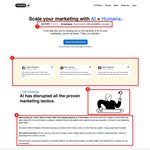
🔎 I analyzed two companies that cold-emailed me this week:
(I bounced off of both pages because of bad visual hierarchy)
If you don’t show your product UI on your landing page, I assume:
1. You’re hiding it because it’s bad
2. You don't have a self-serve PLG option
3. You don't have enough funds to invest in UI/UX
4. You have a competitor who's farther along
→ In other words, you're not worth my time.
No UI shots = I bounce 99% of the time.
To fix it, try this...