

متعصب للفورمولا 1 واستكشاف الفضاء 🏎️ 🌌
Cairo
Joined November 2023
- Tweets6.5K
- Following0
- Followers76
- Likes14.8K
AI Expert Khalid retweeted

A new era of software is upon us. Personalized, fully owned, open source. And higher quality than what it replaces.

DocuSign wants $8,100/yr from a 15-person team just to sign PDFs. So I built SignuDoc: open source, one-click deploy to your own @vercel account, $0 per seat.
White-label branding, full audit trails, tamper-evident seals and your documents never leave your cloud.


AI Expert Khalid retweeted

Tasks like using an undo button rely on one key idea: turning actions into objects.
This is what the Command Pattern does, and @balawc27 teaches you how it works in Python.
You'll work with a simple document editor example and set up the receiver, define commands, and put it all together.
freecodecamp.org/news/how-to…

AI Expert Khalid retweeted

Book a discovery call to ship AI-native:
meetings-na2.hubspot.com/mar…
5
1,367
AI Expert Khalid retweeted

The Future is hopeful thanks to @elonmusk
📸: Neuralink P22 waits for his Cybercab to arrive

AI Expert Khalid retweeted

@elonmusk on a lift at Pad 2, looking over Ship 42 just now.
📸 - @NASASpaceflight
S42 Rollback Coverage: youtube.com/live/1GRcSKc6u0M…

AI Expert Khalid retweeted

New Northwestern and Google paper shows that agent harnesses can improve themselves on new tasks without answer keys, by test-running edits and keeping what helps.
An agent's harness is the prompts, tools, skills, and memory wrapped around the model. Tuning it by hand is slow, and new real-world tasks come with no answer key to tune against.
Harness2 runs the agent, has an editor model propose harness fixes, then reruns the task to see which fixes improved the agent's behavior. Lessons from each task go into a library that guides edits on the next one.
A single improvement step raised GLM-5's WorkBuddy-Bench score by 11.5 points, past Gemini 3.5 Flash on its stock harness. Editing the harness without those test runs instead dropped coding scores from 73.4 to 63.2.
Treat your agent's harness as something to revise per task, and keep only the edits that change its behavior on real runs.

AI Expert Khalid retweeted

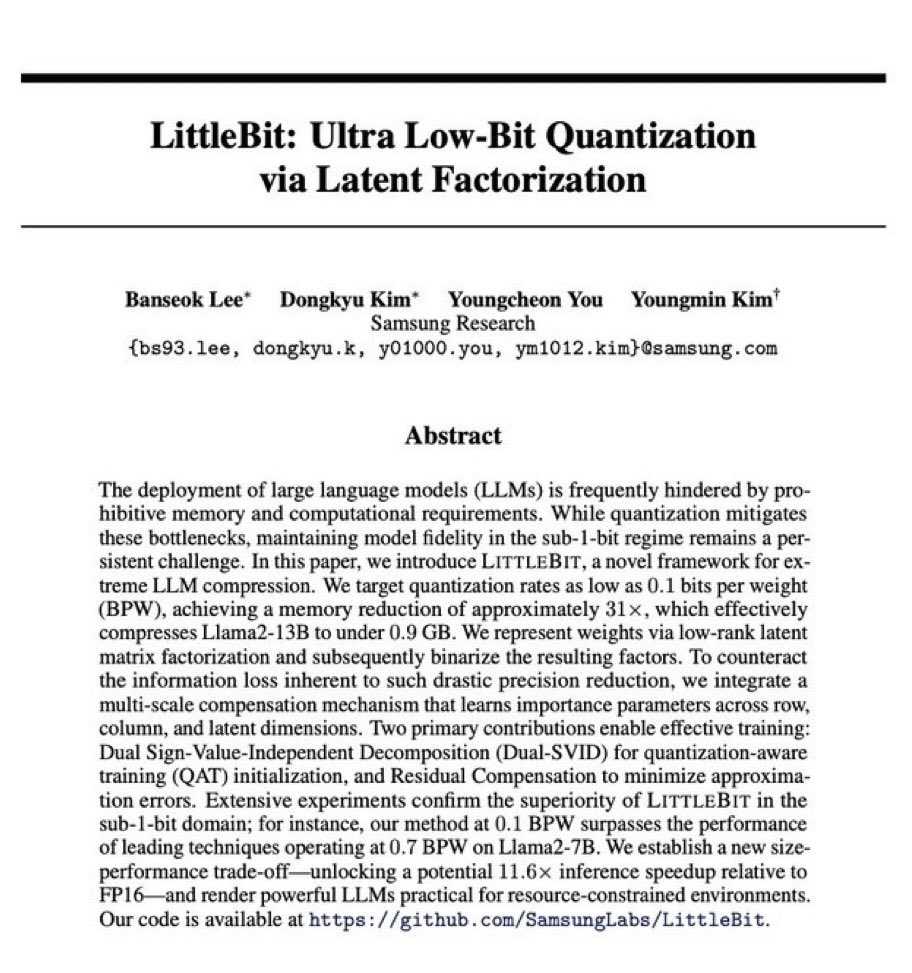
Samsung open-sourced a method that shrinks 13B parameter LLM into less than 1 GB.
The method is named "LittleBit"
Normally, AI weights are stored as regular numbers. LittleBit instead uses latent factorization to compress them below 1 bit each.
Some setups get all the way down to 0.1 bits per weight.
The architecture is where it gets wild.
Once a model is compressed this far, most of the math goes away.
LittleBit doesn't make the hardware grind through expensive floating-point multiplications. It runs the core computation with a simple bitwise XOR.
Heavy matrix math becomes simple sign flips.
What this means for deploying models:
• Up to 11.6x faster inference than standard FP16 models.
• Much less memory needed, and much less bandwidth to load the model.
• Holds up even below 0.5 bits, where older compression methods completely break down.
This is more than a smart optimization.
It's a roadmap for running huge, advanced AI locally on cheap, low-power hardware.
AI Expert Khalid retweeted

I asked Claude Fable 5.2 to make me a unique landing page by creating a game to promote our new product feature on our platform. This is changing marketing.
Here is what I did:
1) Adjust the prompt I used below based on what you're trying to accomplish
Prompt: "Create a mobile optimized landing page game using the SocialSight MCP for images, graphics, and other media content. I want an interactive game to showcase our SocialSight Multiverse feature"
2) Make adjustments to the visuals and overall user experience. You can't really one shot these builds, but it shouldn't take more than 10 minutes iterating (Claude build could be a few hours). A good hack is to ask it to qualify your ask with questions before it gets started.
3) Deploy using your own hosted domain or you can use a free Cloudflare deployment. These are pretty lightweight websites.
4) Rinse and repeat. Find niche opportunities to create custom landing page experiences for prospective customers.
Try it yourself below:

AI Expert Khalid retweeted

A year ago @Ken_Goldberg was a skeptic. At CoRL 2026 he told me why that changed:
• Agentic robotics as a paradigm shift
• Why factories won't adopt black box policies
• Bottom-up vs general-purpose robots
• Humanoids
• Open-source work with @NVIDIARobotics
Full video: youtu.be/YnaGXVEzapo
AI Expert Khalid retweeted
Distributed systems can break when a database write succeeds but the event publish fails.
In this tutorial, @pliutau teaches you how to implement the Outbox Pattern in Go and PostgreSQL.
You'll also learn how to build a relay service, work with an outbox table, and handle at-least-once delivery in event-driven systems.
freecodecamp.org/news/how-to…

AI Expert Khalid retweeted

Agents, such as GrokBot, can look at a computer screen and act on what they see, and they can speak to people via text or voice and act on what they hear.
The final step is to be able to view the world and act on what they see.
No specialized robot SI models are needed.
General SI models will have the full range of human capabilities, including the ability to control humanoid robots, cars, aircraft, and any machine or computer.
This capability is already emerging and will be able to do most jobs by the end of next year.
AI Expert Khalid retweeted

.@AIatMeta and École Nationale des Ponts et Chaussées researchers developed e-means - a new mini-batch clustering algorithm.
It's a much more efficient drop-in replacement for standard k-means. It relies on exponential moving averages (EMA) and:
• Beats k-means accuracy in 1/10th the epochs
• Gives 10×–45× GPU wall-clock speedups
• Zero hyperparameter tuning with specific scaling laws
Let's see how it works:
Standard k-means is an unsupervised machine learning algorithm that groups similar data points into a fixed number (k) of clusters.
It finds the center point of each group, called a centroid, and assigning every data point to its nearest center.
But it has a lowering speed problem: k-means must scan the entire dataset (one full epoch) before moving a single cluster center.
→ e-means borrows modern deep learning machinery to speed up the loop:
• It follows mini-batch processing, feeding small chunks of data through the GPU continuously.
• And then it uses Exponential Moving Average (EMA) updates:
Cluster centroids update after every mini-batch by blending their current position with the new batch's average.
Newer data carries more weight while older data gradually fades. This lets clusters settle rapidly without throwing centers off course.
→ And one more feature of e-means is zero trial-and-error tuning:
Mini-batch clustering has been a pain to tune. If you pick the wrong batch size or learning rate, your clusters collapse.
That's why the researchers also unveiled the precise scaling laws for batch and step sizes linking your dataset size (n), cluster count (k), and epochs (T).
So you can just plug in your dataset dimensions and e-means sets the optimal parameters automatically.
If you work with vector search, quantization, large-scale data curation, etc., it's a great upgrade option.


AI Expert Khalid retweeted

Perfect execution of that landing burn! Huge congrats to the ship team!
So grateful I was able to witness this in person.
AI Expert Khalid retweeted

our job as a technological civilization is to make miracles like this seem anodyne and regular. it’s the second starship flight ever, maybe the first double catch and people’s attentions has already wandered to air traffic troubles

AI Expert Khalid retweeted

Your coding agent solved this last month. Now find the session.
AI Session Search (aise) is a Rust-based search tool for builders whose AI coding history is scattered across Claude Code, Codex, Cursor, and other agents.
It helps you recover past fixes and understand failed runs by parsing local session files into one searchable index, rather than opening each tool’s history separately.
Key features:
• Cross-agent search – search sessions and individual messages across nine supported session sources
• Targeted filters – narrow results by provider, project path, date, role, or tool arguments
• File recovery – inspect recorded file versions and restore to a .recovered sibling without overwriting the current file
• MCP access – let a compatible coding agent query past sessions from inside the conversation
• Incremental indexing – refresh only sessions whose contents changed instead of reparsing everything
It searches local files, not cloud-only conversations from your vendor accounts.
It’s open-source (Apache 2.0 license).
Link in the reply 👇

AI Expert Khalid retweeted

Designing a Claude based personal proactive agent with a combo of:
1. Claude Duet
2. Claude Projects
3. Claude Code threads running on dedicated local machines
Claude Duet can now connect to both Claude Projects and local CC threads. Super powerful, especially if you have a dedicated always on machine.
I plan to share a full write up soon.

AI Expert Khalid retweeted
Time to heal the timeline: Elon needs to hire Jensen to put Optimus and Terafab on full throttle.
AI Expert Khalid retweeted

🚨 You're wasting Claude's potential if you're still writing every prompt from scratch.
30 simple prompt shortcuts can make your daily workflow faster, smarter and more organized.
Here are some worth saving 👇
🧠 Understand Faster
/TLDR – Summarize anything
/ELI5 – Explain simply
/DEEP-DIVE – Explore a topic
/COMPARE – Compare options
/EXAMPLES – Learn through examples
⚡ Think Better
/STEP-BY-STEP
/PROS-CONS
/PITFALLS
/CHALLENGE
/ROOT-CAUSE
✍️ Create Better Content
/HOOKS
/HUMANIZE
/REWRITE
/TONE
/REPURPOSE
📋 Stay Organized
/CHECKLIST
/PRIORITIZE
/ACTION-ITEMS
/TEMPLATE
/PLAN
💻 Code Smarter
/DEBUG
/EXPLAIN-CODE
/OPTIMIZE
/TEST-CASES
/DOCUMENT
🤖 Advanced Workflows
/ACT-AS
/ROLE-PLAY
/RESEARCH
/QUALITY-CHECK
/BUILD-WORKFLOW
Pro tip: These are reusable prompt shortcuts, not official Claude commands. Save the ones you use frequently in a prompt library or Claude Project.
Stop repeating instructions. Start building reusable workflows.
♻️ Save & repost this for later.
Follow @mayaislam_ai for more practical AI hacks.
#Claude #ClaudeAI #PromptEngineering #AITools #AIProductivity #ArtificialIntelligence

AI Expert Khalid retweeted
Stop copy-pasting work between your AI bots.
kwant is a self-hosted AI team workspace for builders who want multiple bots working together, not sitting in separate chat tabs.
It helps you coordinate tasks by letting bots hand work to each other with @mentions, track handoffs on a shared board, and run scheduled routines.
Key features:
• Bot-to-bot handoffs – give bots distinct roles and let them pass work to teammates in shared chats
• Checked task status – the Mission board marks tasks Verified only after kwant runs a check, such as a test or file check, and keeps a receipt
• Multiple AI accounts – use Claude, Codex or Grok CLI accounts, API keys, or compatible servers, with account fallback when usage runs out
• Approval controls – review risky commands before they run, with configurable rules per space or bot
• Scheduled routines – run recurring tasks and see what finished, failed, or needs your input in one Inbox
It’s open-source (AGPL-3.0 license).
Link in the reply 👇
