



kinfook retweeted

Some of you went to Taipei Pride.
Some of you went Bangkok Fetish Ball.
Now, it is time to support local (kink) munch!
Please RT if you want to be invited to Tails & Ties #3! – at Kuala Lumpur City, Kuala Lumpur Federal Territory


kinfook retweeted

Former K-Pop Idol And BL Actor Seemingly Confirm They're Dating IRL
koreaboo.com/asia/former-kpo…


kinfook retweeted

Cover reveal for my forthcoming book
'Restoring Reason: Theology of Logic in Origen of Alexandria'

kinfook retweeted

Slavoj Žižek unwittingly demonstrating why Christianity is beyond Right and Left:
“While the Right legitimizes its suspension of the Ethical by its anti-universalist stance - that is, by reference to its particular (religious, patriotic) identity which overrules any universal moral or legal standards - the Left legitimizes its suspension of the Ethical precisely by means of a reference to the true Universality to come.”


Slavoj Žižek is not merely a Hegelian—he is a “Gallicizing” Hegelian, who, most of all in “The Ticklish Subject,” demonstrates the radically Cartesian foundation of his own dialectical ontology of abyssal subjectivity. Is it not then the case that, as Cartesians, Žižek and Jean-Luc Marion are, after a fashion, natural allies in thought, despite the gap between Christian atheism and Roman Catholicism? Crucially, both read Descartes against the constant paranoiac slander that his project receives from Thomists, Kantians, and Heideggerians alike.
In his book on Cartesian “ontotheology,” Marion in fact emphasizes that Heidegger first applied the concept of ontotheology not to the system of Descartes but rather to that of Leibniz, for whom the Cartesian analogical gap between cause and cognition (which is to say, between God and the ego—a point that Balthasar also concedes in his reading of Descartes as an analogical spiritualist) entirely collapses in an indifferent doubly self-founding monadology (which the term “idealism” was coined to critique!).
So, is “idealism” not precisely “monadology”? And is not Descartes’ passive thought of the meum corpus not a Christian Incarnational critique of every idealism, which would pretend to reduce the spiritual unitive principle between body and mind to noetic synthesis alone? The real enemy is not Descartes—it is Leibniz and Kant. I will keep fighting to exonerate Descartes!


kinfook retweeted
I made a commitment to write a response to @thomasowaller in defense of the “reactionary” character of Žižek’s Lacanian Marxism in April of this year, and I’ve decided, after next week’s @TRIERTIUM conference concludes—with several months of theoretical maturation under my belt—that I will finally follow through. My intention now is to argue that what @thomasowaller considers “reactionary” is just the vestige of genuine Christian thought carried forward by Lacan and Žižek—as @johnmilbank3 has not failed to point out. The “Pelagian” tendency of what I would describe as essentially “liberal socialism” (see Eric Nelson’s “The Theology of Liberalism”) ultimately subtracts sin from human nature, but is it even possible to have a coherent critique of capitalism without a coherent critique of sin? I think not. I will draw on René Girard’s Satanology in order to substantiate my claims. Satan might be defined in the orthodox Christian tradition as essentially a virtual privation of real substance, but he nevertheless has real effects—precisely the Lacanian insight brought forward as a critique of the liberal Deleuzian Spinozist tendency in contemporary continental thought by Jacques-Alain Miller and A. Kiarina Kordela.
This will be posted on my Substack (as a pay-to-read essay) on January 1, 2026. Don’t worry, I won’t wriggle my way out of this one! It’s high time for an intervention of this sort…


kinfook retweeted
Here’s one way to look at it, Ryan: dialectics without dialogics tends to be reduced to “ludics,” i.e., logical game theory. Reza Negarestani develops this theme to great effect in “Intelligence and Spirit,” and I believe @Grimezsz has also done a great job thematizing the personal implications of this (apropos you-know-which techno-feudal lord) with her song “Player of Games” (youtu.be/ADHFwabVJec?si=p2Bk…)
Insofar as Hegel opens his dialectics to a genuine soteriology, there is precisely a possibility of the inner transformation of his dialectics into a dialogics, which I believe Nicholas Adams draws out very well in “Eclipse of Grace.” But for this very reason, the dialogical critiques of Hegel in line with a non-contradictory Catholic soteriology (against Luther’s fetish for contradiction) by Przywara and Balthasar should deepen and advance, rather than merely suspend, the project of Hegelian dialectics. I believe that this is precisely Balthasar’s point in his broadly “skeptical” dialectics of cruciform devotion in Theo-Logic 2, which, much like Przywara’s analogical method, explodes every pretension of secular self-causation inevitably caught in mutual mimetic rivalry and captures, in an “open” process of agapeic and kenotic, protological and eschatological personal dialogue, through initiation into a holy peace, all worldly propositional argument for the Truth that is the Incarnate Logos of Christ.


Although, following Przwyara, Balthasar raises the standard of dialogics against dialectics, there is, I contend, no real difference that warrants upholding the former over the latter. For, as we find in Plato's dialogues, the exchange of arguments (logia) in dialogue is the content addressed from one person to another in which the pure opposition or contradiction of such arguments can be discovered in dialectics, and likewise as the forms of such arguments can be analytically constructed in the syllogism, etc.
What, on my admittedly cursory understanding, appears to essentially distinguish Balthasar's dialogics from Hegel's dialectics is, not the content of argument in natural language (for Hegel's dialectics also operates through the medium of natural language), but rather this pivotal address of a person to and from the divine Logos as the originary interlocuter.
Is such an address to and from the divine Logos absent in Hegel? Although Hegel famously begins his Logic by claiming to have achieved in the Phenomenology of Spirit an 'absolute standpoint' that is 'presuppositionless' - without the presuppositions of religious representation (e.g. Word / Logos), love, or sin - he later enfolds the Idea of Logic into the absolute categories of Religion, as of Philosophy (or theology), such that, as Stephen Theron has shown in his commentaries, the pure form of Hegelian dialectic is assumed into and shapes the religious content of sin (i.e. harmatology) and love (i.e. soteriology).
Similarly, in my commentary on Origen's commentary on the Song of Song's, I have shown how the 'arguments of dialectic' ('argumenta dialectica', ComCt, 3.15., 260–261) are assumed into and saturated by the idea of epinoia of divine Love (i.e. 'God is Love'), such that logic is just as much an afflatus of love, as an articulation of reason.
What, however, I suspect Balthasar has done is to invert Hegel's presuppositionless beginning of logic in the abyss of pure formal abstraction from the apex confluence of its trans-categorematic circulation, such that, in the communication of the idioms (communicatio idiomata), religious content can be interwoven in and through a curated inventory of pure logical forms.
The primary reason that, after a preliminary survey, I had disregarded Balthasar in the preparation for my book 'Restoring Reason', is precisely because I found his approach to have extrinsically decided the answers to the absolute questions of logic for theology (i.e. theology of logic) before the genealogical form and fundamental analysis of the basic elements of logic had commenced.
So while we may no doubt celebrate Balthasar's theological reflections on logic, and could perhaps also commend his ingenious interweaving of the logical with the harmatiological or the soteriological, none of this, as far as I have learned, helps us to analyse the elementary constitution and historical development of logic, except as one of its most celebrated assemblage can be recalled from the highest end to overlay its content upon its basic forms.
We may wish to end with the paradise of Balthasar and Speyr, but we must first pass through the sceptical fire of doubt to discover the simplest beginning that leads upwards and onwards on the road to certainty.
kinfook retweeted
“Creaturely logic can only have a correct estimate of itself if it sees itself as participating analogously in an absolute Logos that traces its origin backward to the Father and forward to the Spirit of freely given love who pours forth from him and from him who is his Source. Formal creaturely logic, too, is grounded in the Trinity and molded by it.” - Hans Urs von Balthasar
Cc: @RyanHaecker


kinfook retweeted
In suspending logic before its 'Source' in the Logos, Balthasar renders logic only as the simulacrum and not as the substance of reason, i.e. of the ideas, and, ala Schelling, holds it in contempt as only a form of a priori deduction, without the life of dynamic concepts.
kinfook retweeted
Ryan’s critique of Balthasar here is completely false—as he admits, he has not read the crucially relevant text, that is, Theo-Logic volume 2 (Truth of God). Balthasar in no sense reduces logic to “only a form of a priori deduction, without the life of dynamic concepts”—his logic is a DIALOGICAL rather than dialectical logic, drawing mainly on Bonaventure and Richard of St. Victor. The idea that Balthasar is somehow a Schellingian is also completely false; he explicitly prefers Hegel to Schelling in The Glory of the Lord volume 5, saying that Hegel completed his project where Schelling failed to do so, and Hegel is his main dialogue partner throughout Theo-Logic 2 (though it would probably be accurate to say Balthasar is doing a “positive theology of logic,” mixing elements of Schelling’s “positive philosophy” with his post-Hegelian dialogical logic)
Ryan’s absurd statement that Balthasar renders logic a “simulacrum” also presupposes a Hegelian framework extrinsic to Balthasar’s own Trinitarian dialogical ontology, expressly suspending even the possibility of logic as a dia-logic and smothering the analogical relation between energeia and dynamis in an indifferent and essentialist univocity. To my mind, Ryan is in fact guilty of depriving logic of dynamic concepts, because, as Balthasar shows, dialectic ultimately flattens out the complexity that dialogic preserves. To quote Balthasar’s Theo-Logic 2 directly:
“We affirmed that the "other" in God is pure Position and positivity, and in no way the negation of the One or its "reversal". … Dialectic follows a method aimed at making the entire world an imago Trinitatis from below. It attempts in this way to approach, indeed, to attain, the archetype by means of a gradual, stepwise progression—a goal it accomplishes, however, by making the "other" the negation of the One and then integrating both in a higher synthesis. Dialogic, on the other hand, which Richard of St. Victor shapes on the basis of the dogma of the Trinity, reverses this movement. It seeks to define the creaturely images in terms of the positivity of the intradivine others (the Son and the Spirit), understood as the archetypal paradigm of these images. Anticipating, we can say (briefly) that the dialectical method is characteristic of Geist as knowledge and that the highest stage to which this method can attain is absolute knowledge, whereas the dialogical method, in which the other is a positive value, is one of love, which fulfills itself in its very self-expropriation.”


kinfook retweeted
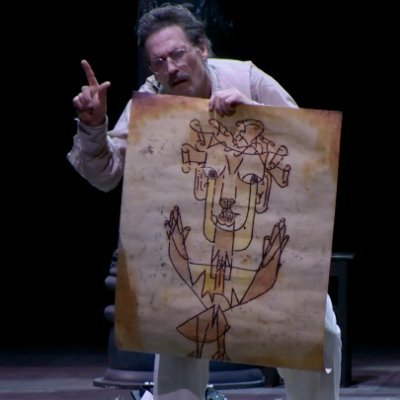
I think these books make the same argument, namely that Hegel's philosophy of negativity still rests on remnants of unquestioned positivity.
Adorno critiques the positive totality that Hegel results in, Zizek critiques the positive nothingness that he builds on.


