

Programmer at SpaceX. Past lives: wrote the companion AI of The Last of Us Part II @ Naughty Dog, more flight software and computer vision stuff. DMs open.
Santa Monica, CA
Joined June 2014
- Tweets129
- Following318
- Followers812
- Likes57.8K










Kareem Omar 🇺🇸 retweeted

She can drive, she just gets tired. Not having to drive herself makes her less tired.
What kills people is your sponsored videos promoting inferior technologies like Ford Blue Cruise. Remember how you took money from them to help cover up two deaths? @ZacksJerryRig?

Kareem Omar 🇺🇸 retweeted

Starlink is delivering peak speeds of up to 10 Gbps symmetric in Utqiagvik, Alaska – the northernmost city in the United States, located 320 miles above the Arctic Circle
Through bonded gateways, Starlink can provide up to 20 Gbps symmetric, enabling high-capacity connectivity even in the most remote and extreme environments→starlink.com/gateways


Our latest @Starlink deployment builds on the first bonded gateway we installed in Unalaska in 2023, reinforcing a simple principle: connectivity should not fail when it’s needed most. optimerainc.com/articles/opt…


Let's measure. Attached, vs. OP.
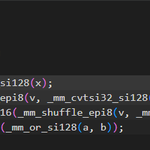
Lines after preprocessor expansion: 31 vs. 63,240 (godbolt.org/z/f3d8YYTa4, godbolt.org/z/eW6edfnoG)
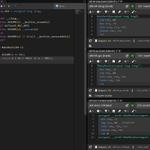
Why does that matter? Here's one reason - compile time: 52ms vs. 1156ms (over a second!) (clang, -O3)
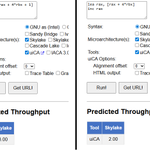
Runtime: 8.8x faster (input {1, 2, 3, 4, 5, 6}) (clang, -O3)
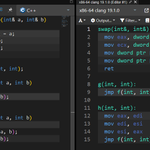
Codegen with compile-time inputs: turned into 1 line (mov eax, 57) at compile-time, vs. 275 lines of runtime code (godbolt.org/z/E14fWx91o, godbolt.org/z/Mxqd6j7M1)
Dependencies: none, vs. STL, CRT, allocators
Requirements: any C++ version since '98, vs. C++23, gcc14+/clang19+ and still doesn't work with clang stdlib even on clang trunk.
Debugging: examples of common tasks would be to step through the loop to understand or demonstrate the algorithm; breakpoint a particular iteration; go back to and repeat a previous iteration; alter inputs at a particular iteration. These are trivial to apply to a for loop but nonstarters for ranges.
Control: unroll the inner loop 4x. Interleave two inner loops. Change the vectorization width. These are trivial to apply to a for loop (pragma clang loop...)
It compares unfavorably in every measure.
The modern C++/Rust people cannot be saved. But if you're learning, and you see stuff like this post, and it doesn't quite seem right but they sure seem confident and you feel like maybe it's you and you're missing something... I want to tell you that you're not.


Kareem Omar 🇺🇸 retweeted

I'm about to do something I think I've never done before, which is assert every bit of whatever authority I have as the person who discovered and wrote down the rules of open source.
After ten years of drama and idiocy, lots of people other than me are now willing to say in public that "Codes of Conduct" have been a disaster - a kind of infectious social insanity producing lots of drama and politics and backbiting, and negative useful work.
Here is my advice about codes of conduct:
1. Refuse to have one. If your project has one, delete it. The only actual function they have is as a tool in the hands of shit-stirrers.
2. If you're stuck with having one for bureaucratic reasons, replace it with the following sentence or some close equivalent: "If you are more annoying to work with than your contributions justify, you'll be ejected."
3. Attempts to be more specific and elaborate don't work. They only provide control surfaces for shit-stirrers to manipulate.
Yes, we should try to be kind to each other. But we should be ruthless and merciless towards people who try to turn "Be kind!" into a weapon. Indulging them never ends well.
Kareem Omar 🇺🇸 retweeted

SpaceX: "We plan to launch more than 400 additional @Starlink satellites to the polar inclination by the end of 2025 alone, which will more than double the capacity for Alaskan customers alone, as well as other high latitude locations. The first of these additional satellites have begun to serve Alaskan users already, nearly doubling median peak-hour download speeds over the past month."

Kareem Omar 🇺🇸 retweeted
Starlink is committed to its mission to connect the unconnected to high-speed, low-latency internet.
Over the past year, as millions of new users have been added to the network, speeds and latency continue to improve → starlink.com/networkupdate



Kareem Omar 🇺🇸 retweeted
But we need a heat shield that can handle Mars atmospheric entry conditions with a heavy payload, so the ballistic coefficient will necessarily be high. Steel is unfortunately hopeless.
No one has ever made a truly reusable orbital heat shield, so this is an extremely tough problem. [As you know] The Shuttle’s shields required extensive rework between flights.
It will take many more design iterations for SpaceX to make the shield work well. We had to build the entire supply chain from glass and alumina to finished tiles, which is why the SpaceX heat shield factory at the Cape is shockingly enormous.
Kareem Omar 🇺🇸 retweeted
The Starlink ion thruster is a marvel of engineering

Something old and something new in electric propulsion 🚀
The lower box is one the earliest spacecraft ion thrusters (from EOS circa 1962), and on top is a new arrival, a modern marvel from the SpaceX Starlink satellites used for on orbit maneuvering. SpaceX has mastered Argon Hall Effect thrusters, something no one else has been able to do. This affords a higher power density (4.2kW in 2.1kg) and much lower cost gas (about $10 per satellite) than prior designs using Krypton or Xenon. This is one of the early 2023 flight units for@Starlink V2 Mini, and the only one outside the company.
These thrusters are for in-space use only, and while they have relatively low thrust, they can run continuously for long periods with a very high ISP, and they are compact and reliable. They are commonly used for satellite station keeping and interplanetary missions, where this Argon thruster could reduce a 5-year transit time to months.
The backside of the SpaceX thruster shows how simple it is, with gas lines and wires for the cathode and electrode, insulated with Boron Nitride on the other side and permanent magnets for lensing of the streams.
Ben Longmier, lead designer of the SpaceX thruster, helped identify the old one I had in my collection. It appears to be “a development unit or early flight unit for a Cesium thruster from EOS (Electro-Optical Systems). The black component underneath the thruster looks to be the propellant tank and you can see several heaters wrapped around and brazed in place. A porous plug would have been used as a ‘valve,’ which takes advantage of a metal wetting and vapor pressure trick to throttle the propellant flow vs. temperature of the porous sintered metal plug.”
The final EOS thruster design is in the Smithsonian. It was successfully tested twice in space on flights of Air Force Blue Scout missiles in 1964.
Back in 1912, Goddard postulated that high-velocity streams of electrons and positive ions could be “energized” by solar-electric power supplies to provide thrust for an interplanetary spacecraft. He went further to suggest that the source of the ions could come from exposing alkaline atoms, such as mercury or cesium, to hot tungsten surfaces. He was spot on!
And more history from Ben: “One of the original Peenemunde rocket scientists on Von Braun’s team was Ernst Stuhlinger, who moved his family to what would become Marshall Spaceflight Center in Alabama. Ernst was close to Von Braun and worked on a lot of the early projects. In the later years of the US space program, both Ernst and Von Braun had dreams of expanding beyond the moon and sending craft deeper into the solar system, specifically Mars. One of Ernst’s concepts involved solar powered craft that would use Cesium ion thrusters to achieve a very high payload fraction delivered from Earth C3 to Mars injection orbit. This was an early solar electric propulsion concept that would ultimately never fly due to the wind down of budgets.”
And now, with the modern revival of a Mars program, the SpaceX Marslink satellites take us from dream to dream.
I borrow this phrase form the closing of Andrew Chaiken’s A Man on the Moon: “Historians of the far future may look back on Apollo and the missions that are yet to come as one great Age of Space Exploration. But in my mind’s eye it is a slow dissolve, from memory to anticipation, from what has been to what will be, from dream to dream.”


<3

Satellite internet has disrupted the market in Alaska — and transformed everyday life for many adn.com/alaska-news/2024/08/…

1
2,415