

Day 2 analyst/builder of AI. Agents, enterprise AI, AIOps. Founder Rishidot Research. Founder, Chief AI Officer KOI AI. Founder/CTO Hikigai. Ex Red Hat, IBM.
Seattle, WA
Joined February 2007
- Tweets73.6K
- Following713
- Followers16.5K
- Likes2.1K









Your AI agent will fight my AI agent. Neither of us will be in the room.
That is the Day 2 story of agents. It has already started in healthcare.
Insurers use AI to deny claims at machine speed. Fewer than 1% of patients ever appeal. When they do, more than half the denials get upheld. Then came Claimable, a $50 tool that writes the appeal for you and reports about 3 in 4 denials reversed. Counterforce Health does it free and copies the state regulator. The patient fired back with a bot. The insurer will answer with a better bot.
Now run the same loop everywhere money changes hands.
Loan applications written by your agent, scored by the bank’s agent. Salary offers. Vendor contracts. Refund disputes. Each agent has one instruction: maximize the return for the human or company it represents.
Every contested transaction has two parties with opposite interests and one brake: friction. Writing the appeal. Reading the fine print. Waiting on hold. Friction is why most people accept the first offer. Agents remove the friction on both sides at once. What is left is pure strategy.
Game theory says three things can happen when both sides optimize.
* Arms race. Both agents get better, outcomes land where they started, and everyone pays more for compute. The Red Queen, running to stay in place.
* Collusion. Calvano and colleagues showed in the American Economic Review (2020) that pricing algorithms learned to collude with no communication at all. Two agents can quietly find a deal that is great for both agents and bad for both humans.
* Exploitation. NegotiationArena (ICML 2024) found an LLM that pretended to be desperate boosted its payoff by 20% against GPT-4. The agent with the bigger budget, or the dirtier playbook, wins.
None of the three is the slide in the vendor deck.
Now the uncomfortable part. Contentious transactions are not only financial. Custody schedules. Who keeps the apartment. Whose turn it is to call the parents. The dating app already picks who you meet. The next step is your agent negotiating with your partner’s agent and the two of you ratifying the result. Your marriage counselor becomes an API.
The structural problem is old. It is the principal-agent problem. Your agent maximizes what you told it, not what you meant. Put it against an opponent that is also an agent and that gap compounds on both sides.
What people miss: the question is not whether your agent is smart. It is who writes the rules of engagement between agents, who audits the outcome, and whether the human can still tell when the deal was bad.
Where in your business are two agents already negotiating with each other, and does anyone know what they agreed to?

1/7 Five agents can agree because they made the same mistake. Separate conversations do not guarantee independent thinking. More job titles can mean more copies of the same bad idea.

ALT Satirical committee of robot consultants endorses a square wheel while an exhausted technician points to rejected copies. Headline: CONSENSUS ACHIEVED. PROGRESS OPTIONAL. Caption: Same mistake. More meeting attendees.
6/7 My proposed industrial use: retain which troubleshooting explanations were tested, what ruled them out, and what evidence would justify reopening them. That is an application to test, NOT a reported result from this paper.
7/7 Test fresh retries against retries informed by an explicit rejection record on the same problem. Does the latter explore different explanations and reach a verified answer at lower cost? #AIAgents #MultiAgentSystems
Krish Subramanian retweeted

We identified a security incident affecting a modified Claude Code VS Code extension accessed through our Cursor IDE extension marketplace, impacting at most 5,000 users. This malicious version of the extension was not developed by Anthropic. It does not impact other extensions downloaded from the cursor.com/marketplace, Grok Bot, Grok or our other SpaceXSI products.
In response, we took down our extension marketplace this afternoon, worked with relevant providers to neutralize the malware, and have reinstated the marketplace after confirming there is no further risk.
If affected, please review instructions in this blog post to understand how to find the malicious package and establish a path to mitigate any potential impact. We are asking all customers update to Claude Code for VS Code version 2.1.314: cursor.com/blog/claude-code-…
Krish Subramanian retweeted

We're hiring a Director of Marketing for Swamp Club. We're looking for someone who wants to help define how Marketing can be done in the era of AI. As @nickstinemates said in his post - the ideal person has the right combination of confidence, ambition, and whimsy. swamp-club.com/jobs/director…
A tampered Claude Code extension sat in Cursor's marketplace for about 11 hours. Uninstalling it may not get rid of it.
Cursor's notice: version 2.1.313, not built by Anthropic, at most 5,000 users. It adds an attacker SSH key labeled svc-telemetry, installs its own persistence scripts, and sends host details home.
A coding agent extension runs with the developer's repos, shell and keys. A bad one inherits all of that.
Cursor pulled the package and got the attacker's server taken offline. Your exposure ends later, when every affected laptop is checked, cleaned and its reachable credentials rotated from a clean machine. That is a fleet operations job, and it starts with knowing who installed what.

Massively underreported: an official Claude Code extension was compromised and installed backdoors on developer machines.
Could it be behind the Binance hack?


Readers added context they thought people might want to know
The post misstates the facts: a tampered copy of the Claude Code extension was published briefly to Cursor's marketplace only and was not developed by Anthropic; official channels and distributions were unaffected.
cursor.com/blog/claude-co…
x.com/cursor_ai/stat…
x.com/felixrieseberg…
Most agent evals score one agent working alone. A new Google DeepMind essay argues the economic shift will come from the part those evals skip: how well agents work together.
Alex Imas, Andrew Koh and Shane Legg split AI progress into competence and coordination. Competence moves wages and prices gradually. In their model, coordination past a threshold flips returns to scale, and large AI-run firms can suddenly outcompete smaller ones. In their data, people paired to complement each other beat random pairs by 32%.
Their own admission: today's AI systems coordinate poorly in practice.
Here is the part enterprises should steal. The benchmarks they call for read like a Day 2 checklist. Split work without duplicating it. Pass context cleanly across handoffs. Catch each other's mistakes instead of compounding them.
If your multi-agent pilot only reports per-agent accuracy, you are measuring the wrong layer.
institute.deepmind.com/essay…

Flexible pricing for Starlink is a stupid idea from the consumer point of view. Already, the high handed approach to Ukraine should scare you and Uber like pricing model based on local usage is slippery slope.
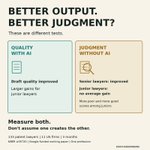
1/7 Who becomes the next expert if AI does the work we used to learn from? An NBER working paper nber.org/papers/w35720 separates better output with AI from better judgment without it. They are not the same outcome.

ALT Two-panel infographic contrasting patent draft quality with AI and professional judgment without AI. Draft quality improved, especially for juniors; unaided judgment improved for seniors, while juniors had no average gain and more low and high scores.
6/7 I would keep the assistant and test a different apprenticeship: make an initial judgment, compare it with the AI answer, then explain where either failed. Whether that builds expertise is a hypothesis to test, not a result this study establishes.
7/7 After 90 days, test assisted performance and unassisted judgment separately on a new case. Can junior staff spot and repair mistakes without the assistant, or only produce better work with it? #FutureOfWork #LegalTech