

Member of the Technical Community.
Bellevue, WA
Joined September 2021
- Tweets4.9K
- Following192
- Followers41.4K
- Likes5K





Pinned Tweet
firstmate just crossed 3k stars on github!
for most of my other projects, people would call them “helpful”. firstmate was the first project where i repeatedly heard people say it “changed their lives” - and i know exactly what they meant, because it completely changed how i work too
reflecting on its journey towards this milestone, i’d like to share the story of developing this project and the key philosophy that made it special
i created firstmate a few months ago, at a time when i constantly looked at a long list of parallel agent sessions, and had to juggle between them
every time i jumped to a different session, i had to context switch and try to remember what the hell the session was about, what the agent was saying and what the right next step should be
most agent harnesses and orchestrator apps simply made it easier to see the sessions and jump between them. but i still had to context switch all the time. i’m pretty sure there’s a KV cache in my brain and it was overheating
i thought that’s a terrible experience for developing software, and it can’t possibly be the end game. i used to enjoy coding - the focus, the flow, and the peace. watching it replaced by this non-stop tab-juggling gave me more pain than watching game of thrones season 8
so when i explored firstmate as a solution, the biggest thing i wanted to accomplish was not a smart workflow, or a useful tool, or an impressive piece of technology
it was to create an experience. a feeling. a sense of peacefulness that was taken away by the noisy agents. a sense of confidence that everything’s under control. an ease of mind that nothing will fall through the cracks the moment i look away
it’s the experience of being a good captain that sails with a well-managed crew, with the help of a firstmate that carries out the captain’s direction
i spent lots of time figuring out what it takes to create such an experience. i could build yet another agent harness, call it “open ship” or something. or i could build another orchestrator app, automux
but eventually i discovered that the experience i’m trying to create is completely orthogonal to what harness or orchestrator people use - it’s a new way of working, and it doesn’t discriminate what tools people use
that led to everything that firstmate is today - it’s an agent distro you can run with many existing agent harnesses like claude code, codex, pi, and across many session managers like tmux, herdr, orca
it introduces the new way of working through a memory file that steers your agent to perform the role of an orchestrator, a bunch of scripts that handled deterministic logic, a set of agent hooks that improved reliability and efficiency, some built-in skills like “ahoy”, “afk”, “stow” that handle common operations, and some customization such as the “calm” mode - all designed to create the experience i had in mind from the very beginning
the added benefit of being an agent distro this way is that the agent can fully self-introspect and self-modify. if something’s not working well, just ask firstmate and it’ll figure it out (now the unintended side effect is that i have 500+ PRs coming from everyone using their firstmate to self evolve). it also became very easy to setup - clone the repo, run your agent in it, that’s it
that’s the story of firstmate - a pursuit of an experience leading to a solution that created quite a special feeling. if you know, you know
github.com/kunchenguid/first…

oct 30 is coming soon and the $200 codex subscription will then get its 50% quota cut
if you feel your quota is burning fast now, imagine running out 2x as fast. and it’s unclear how frequently the resets will continue to happen
why would openai do this cut now, especially at a moment when opus 5.5 is totally crushing it?
my speculation is that they are conceding the consumer coding use case, and focusing on non-technical work (chatgpt, dots) and enterprise market (api deals) instead
subsidized consumer coding usage is simply not very lucrative and it’s hard to compete with anthropic head on in this space regardless
unfortunately this means your use case is primarily coding and you are using it through the consumer subscriptions, after this cut there’s almost no good reason to justify choosing codex subscription over claude. the value difference is simply day and night
but what i’m most afraid of is the second order effect where it ends up releasing the competitive pressure for anthropic and claude cuts their quota too
where is grok 5? we need to keep the competition hot!
wow

Day 25/
We are doubling all usage limits for all Pro 100/200/500 tiers and Business Premium, effective today.
We heard your kind feedback and won’t be reducing usage limits for Pro 200, so your Work and Codex usage will stay the same. We’re also going to continue offering extended limits for dots for now, and usage of your dot will still continue to be separate from your default usage.
And we'll of course also keep shipping better models and other efficiency improvements that increase your effective usage over time.
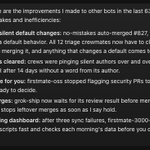
every write-up from me is automatically distilled into my /kun skill and kun grok bot
this may be a bit surprising to hear, but even i myself talk to my own kun bot quite a lot 😄 because it saves me from having to repeat what i already know and believe
see example here - just got kun bot to optimize CI for a repo that’s grown big, and got some instant easy wins, because the bot knows about what i shared in this post yesterday
/kun skill - github.com/kunchenguid/kun
kun bot - x.ai/bot/xK8W0ukRv4iZjglzz-F…


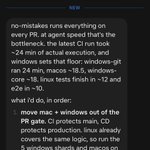
now that we all agreed to not review most of the code any more, CI became the next bottleneck
at agent speed, if our CI pipeline is simply "run all the build, lint, tests", it'll become a major slow down
here are a few things i suggest for how to optimize:
1. balance load between CI and CD
CI protects main branch. CD protects production. if you can tolerate some delay in deploying your main branch to production, then you can do less in CI and do more in CD
for example, for a cross platform app i made my CI pipeline skip most mac and windows tests because linux already covered the same functionality
the tradeoff is occasionally i'd catch a mac or windows-only bug in CD before release, but in exchange, my CI pipeline became 15x faster - well worth it
2. modularize your codebase such that changes are isolated
then you can make your CI only run build, lint, test for the module being touched
this requires careful consideration for cross-module protocols. they should likely be their own modules, so when they do change, you know you probably need to test all dependent modules
3. for large modules, invest in test selection
in CI, try to only run tests that are covering the areas being changed. doing accurate test selection is not easy though, and often requires continuous tuning
i have a nightly loop specifically doing audit of past test runs and tweak my test selection to be more accurate. a big codebase of mine got pretty good at this - 20x faster CI compared to running all tests, and almost never miss any real problem
buyout is the new layoff
who said microsoft can’t innovate any more?

BREAKING: Microsoft, $MSFT, is offering buyouts to 60,000 workers as part of the company’s efforts to cut costs amid AI adoption, per Bloomberg.
Personnel on select teams in the US, Canada, India, and the UK at a vice president level and below will be eligible.
This reflects ~27% of Microsoft's total workforce.
you can make almost any program self-improve btw
step 1: prompt your agent "help me plan comprehensive logging such that we can replay what the user experienced, meaningful internal operations, and visible outcomes"
step 2: setup a daily loop with this prompt "analyze my logs from this program in the past 24h thoroughly, identify broken behaviors, user friction, inefficiencies, and propose improvements sorted by estimated impact"
step 3: watch your code get better every day
if your program collect telemetry from users, you can do aggregated analysis which will give you even better results
Kun Chen retweeted

Took about 5 min to setup @kunchenguid firstmate with slack and my productivity has increased multi fold

a lot of people were impressed by dessa because it’s truly giving a next level voice conversation experience
it’s very impressive indeed - you can listen to the demos on the site and feel the magic yourself
but am i the only one seeing the massive red flags here?
1. this model can’t make tool calls.. that instantly kills almost all practical use cases, right?
2. is it net good or net bad to make AI indistinguishable from human?
block.xyz/dessa
