

Senior Engineer, Ex Klarna, living in Stockholm 🇸🇪
Stockholm, Sweden
Joined October 2007
- Tweets5.4K
- Following1.1K
- Followers386
- Likes3.4K
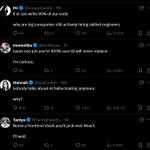





“You’re not programming, you’re just telling what you want to the models!”
And what was high level programming if not telling the compiler what you wanted via a programming language?
Using plain English to program isn’t recent, HyperTalk tried that in 1987.
1
21


Stefano Azzolini retweeted

Many of you don't understand how serious this is, so let me break it down.
In computer science there is a famous kind of puzzle called 3-SAT. You are given a long list of yes-or-no switches and a set of rules about how they must be arranged, and you have to find a combination that satisfies every rule. The obvious way to solve it is to try every combination, but each new switch doubles the number of possibilities, so a puzzle with a few hundred switches would take longer than the age of the universe to brute force.
For decades, the smartest people in the field found clever tricks that made this a little faster, but every trick still hit the same wall: the time required kept exploding as the puzzle grew.
About 25 years ago, two computer scientists, Russell Impagliazzo and Ramamohan Paturi, working with Francis Zane, turned that wall into a formal idea.
They proposed the Exponential Time Hypothesis, which says this explosion is not a failure of human cleverness but a law of nature. No algorithm, however brilliant, will ever solve 3-SAT without the time blowing up exponentially. Nobody could prove it, but almost everyone believed it, and it became one of the foundations of modern computer science.
Researchers used it as a measuring stick. If you could show that solving some other problem quickly would also crack 3-SAT quickly, you had shown that problem was hopelessly hard too. Hundreds of papers, across scheduling, graphs, logic and much more, rest on this one assumption.
Now an internal AI model at OpenAI claims to have broken it. It says it found an algorithm that solves these puzzles meaningfully faster than the hypothesis allows, and it has checked the proof in a computer verification system called Lean.
And here is the remarkable part: the very people who proposed the hypothesis, Impagliazzo and Paturi, along with MIT's Ryan Williams, are now leading the public review of whether a machine has disproved their own idea.
So what happens next? If the disproof holds, a large part of theoretical computer science has to be revisited.
Every result that said "this problem cannot be solved faster, assuming ETH" loses its foundation, and researchers will have to work out which of those walls were real and which were simply where we stopped looking. It does not mean everything becomes easy. The new algorithm is still slow in absolute terms and this is not the famous P versus NP problem being solved.
But it means our map of what is possible was wrong in a place we were very confident about, and it was an AI that redrew it. If the disproof fails, the hypothesis survives and the field breathes out, but we will still have watched an AI produce serious, checkable work on one of the deepest questions in the discipline, closely enough that the founders of the idea had to take it seriously. Either way, something has shifted.

Stefano Azzolini retweeted

Of course it can. Take all 100,000+ games on steam, scrape their descriptions and metadata, semantically plot them in vector space using embeddings, mathematically choose a location in vector space far away from neighbors, convert that back to a description and metadata, boom, brand new ideas ranked by how unlike any other ideas they are.

Stefano Azzolini retweeted

Introducing ChatGPT for Dishwashing
GPT-6 achieves state-of-the-art results on dishwashing benchmarks for long-running jobs and difficult stains.
The Navier–Stokes Millennium Prize Problem is a $1 million challenge about whether the equations describing fluid motion can break down. In this video, I accidentally found a counter-example while trying to optimize my dishwasher. But in reality, OpenAI used 10,000 AI agents to find a proof in 88 hours: openai.com/index/navier-stok…
Parody of the original GPT-6 Astra ad
@OpenAI #ChatGPT_Partner #chatgpt
Credits:
Written and Directed by Joma
Co-Writer - Henry Connor Coan IV @coan_henry
Production by Dauntlus Studios @dauntlus.studios
Producer/Co-Director - Marcus Liew @dauntlus
Camera Operator - Amos Lee @amoselijahlee
Art Director - Alethea Soo @aletheasoo
Art Assistant - Alicia Lim @aliciatkl_
Assistant Editor - GPT-6 Astra
Music: Tensions Run High by Soundridemusic
youtube.com/watch?v=Ly9H63SL…
Stefano Azzolini retweeted

Ms Hamilton coined the term “software engineering”.
news.mit.edu/2026/margaret-h…

Did I made another task management app? Yes.
Will I release it? No.
Because it’s tailored for my requirements and way of working, because there’s tons of those clones around and because of you are just searching for a way to not pay Linear then you shouldn’t be facilitated.
Building you own software will never be a bad thing, avoid paying a fair price to people who lives on it, it’s not.
39

Game Journalist are so bad at gaming that studios started making games playing themselves in fear of bad reviews.
17
Stefano Azzolini retweeted

Burnout is going to be a huge problem!
Working with AI is intense, the mind needs more rest. But AI is so productive that taking rest is costly. The real winners find the right balance.

Stefano Azzolini retweeted
The most ridiculous thing about the AI-coding age is that in the last 20 years programmers accepted otherwise all the kind of shit: terrible frameworks, languages, layers of complexity everywhere, everything super slow. Very very few protested, since destroying the field didn't involve their paycheck.
Stefano Azzolini retweeted
Good programmers state they use models like GPT 6 Astra without obtaining good results: it makes me feel I live in a parallel universe. But the explanation is not that hard: good programming in the past and now requires a different skill set, even if there is some overlap.
Stefano Azzolini retweeted

Theory: there are a lot of people in 'AI' who don't know how computers work, know nearly nothing about cyber security but have suddently decided they have discovered all these new things....
and because it's new to them, and they are super smart, it must be NEW to the world....
-- a theory...

Stefano Azzolini retweeted

Go from idea to a working agent faster with the Agents API.
Build and run cloud agents with the Codex harness, fully managed by OpenAI.
We handle orchestration, long-running sessions, and context management. You focus on what makes your agent unique.
Available in public beta.
Stefano Azzolini retweeted
Btw the Redis story repeats itself: I'm working at DwarfStar for free for the community and because I enjoy it. But I'm receiving criticisms, since people are worried that this will break their AI-richness plans. I want to say to everybody thinking that I should stop that each time you tell me this, I'll double down my efforts towards a completely no profit engine for local inference. Better to shut up basically.