

Content creator Crypto researcher AI builders
🏜️🏜️🏜️
Joined March 2022
- Tweets27.3K
- Following578
- Followers2.3K
- Likes23.1K


no0x retweeted
HOLY SH*T Claude Code can now audit your CLAUDE.md and clean out outdated rules 🔥
Update to v2.1.283+:
claude update
Then run this in your project:
/doctor prompt-audit
It scans your CLAUDE.md, AGENTS.md, custom rules, skills, and commands in .claude/ and ~/.claude/, then flags:
• Prompts written for older models
• Broken links to missing files or commands
• Conflicting instructions across your configs
You get a full breakdown of suggested fixes — nothing changes until you explicitly tell it to apply them.
You can also target specific folders:
/doctor prompt-audit .claude/ skills/deploy
Anthropic recommends keeping individual CLAUDE.md files under 200 lines. If rules conflict, Claude may just pick one at random.
Full CLAUDE.md template + folder structure in the article below.
HOLY SH*T people are still manually wiring Claude into Obsidian as a second brain while the Obsidian CEO already open-sourced the entire setup plan
Here are 4 GitHub repos that do the heavy lifting for you:
→ obsidian skills (by kepano) github.com/kepano/obsidia… Teaches Claude the exact internal mechanics of your vault
→ claude obsidian (by AgriciDaniel) github.com/AgriciDaniel/c… Ready-to-use commands for wiki-links, ingestion, queries and linting
→ obsidian second brain (by eugeniughelbur) github.com/eugeniughelbur… 48 ready-to-run commands for Claude Code, Codex and Gemini
→ second brain starter (by coleam00) github.com/coleam00/secon… Interactive onboarding that builds a personalized 9-step setup plan
Most tutorials floating around still point to dead scripts and broken workflows.
Bookmark this before it disappears.
THIS IS AN ACTUAL F*CKING GOLDMINE 🔥
Went to bed at 1am. Woke up to 14 drafts ready.
212 posts scanned overnight. 9 of them good enough to post as-is.
Total cost: $2.80.
The trick: stop making one expensive model do everything.
→ Cheap model (Haiku) scouts what blew up in your niche while you sleep
→ Mid model (Sonnet) writes the top posts in your voice
→ Expensive model (Opus) only steps in to review and approve
You stop burning Opus tokens on reading 200 posts it doesn’t need to see.
Setup:
claude --agents ./night-shift.json
The night shift:
• Haiku 5.5 (background) → finds the hottest posts
• Sonnet 5.5 (project memory) → writes drafts in your style
• Opus 5.5 (plan mode) → only reviews, rejects weak/duplicate hooks, never writes
Opus only activates when:
• a draft is about to lock
• two drafts use the same hook
• something is about to enter the queue
Model = engine.
Harness = the actual job.
Paste this into Claude Code:
“Build me a content night shift with 3 subagents in .claude/agents:
scout (Haiku 5.5, background): pull the 200 most-engaged posts in my niche from the last 24h.
writer (Sonnet 5.5, memory: project): turn the top 5 into drafts in my voice, using my last 20 posts as reference.
editor (Opus 5.5, plan mode): reject anything with a repeated hook or a claim it can’t verify.
Save approved drafts to drafts/today.md. Show me the setup as a diff first. Nothing runs until I say go.”
Your mornings just got easier.
code.claude.com/docs/en/sub-…
Closed source just stopped meaning "you will never know."
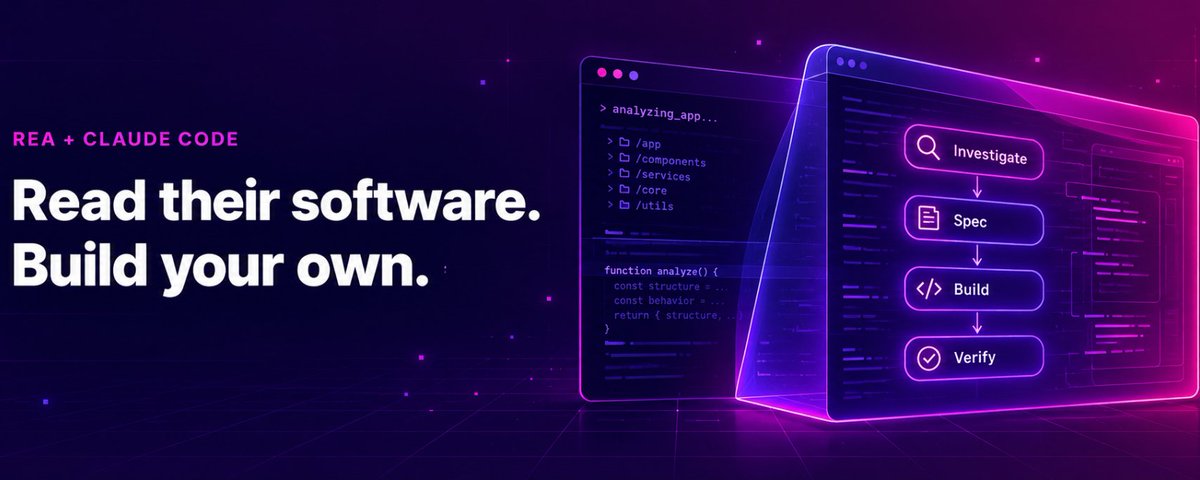
Point Claude Code at any app on your computer and it reads how a feature works inside, with evidence: the file, the function, and what is still unknown. It's called REA (Reverse Engineer Anything). Open-source, MIT license, runs locally.
Here's the whole process:
Install REA and plug it into Claude Code
Pick one app you use every day (Notion, Slack, Obsidian are all fair game)
Ask in plain English how one feature works
Get a clean behavioral spec with no original code
Build your own version from that spec
Compare it with the original and log what's still unknown
The rule: study the original, ship your own.
Most people keep paying for features they could understand in one afternoon.
Full guide with 5 skills and copy-paste prompts is below.
Bookmark this.
I don’t understand why everyone still isn’t doing this
Andrej Karpathy shared a simple idea that hit 25M views: stop using AI to write code for you and start using it to build a second brain.
Point Claude Code at a folder with any materials (articles, transcripts, PDFs) and it automatically analyzes, links, and organizes everything into a living knowledge base that gets smarter the more you feed it.
Here’s how to set it up:
1. Create a new Obsidian vault and open it inside Claude Code
2. Drop in the file with Karpathy’s concept and ask Claude to generate the structure
3. It creates three folders: raw (original files), wiki (generated pages), and CLAUDE.md (instructions)
4. Throw any document into raw and type “ingest this”
5. Then query your entire knowledge base endlessly
Setup takes about 5 minutes. After that, you’ll never stare at an empty prompt again.
Full guide below — bookmark this.
THIS IS CURSED. Claude Opus just rebuilt the new iPhone Duo entirely in code.
141 parts. 0 errors. And it assembles perfectly.
Every part is written as its own function.
After each one, it runs checks:
gaps ≥ 0.05 mm, zero collisions, flex cables bend correctly through the hinge.
If anything fails — it stops and fixes it. Nothing gets placed until it passes.
Titanium frame → logic board → dual batteries → hinge (16 links + 8 gears + 24 magnets) → 48MP camera → speakers → flex cables.
Then it animates the fold to 150° using a real torque curve.
Same verification loop used to rebuild software from reverse engineering — now applied to hardware.
Drop this into Claude Code ↓
“Rebuild [any device] in code, part by part:
1. First give me a full list of parts with dimensions.
2. Make each part its own function and place them one by one.
3. After every part, check gaps (≥ 0.05 mm), collisions, and cable bends. Fix anything that fails.
4. Animate moving parts at the end.
Show me the parts list first. No code until I say ‘start’.”
Swap the phone for a watch, drone, or car.
Same prompt.
Save this. You’ll need it.
this should be illegal. A student from Shanghai put 6 AI tools into one team and told them: “make money while I’m at work.”
zero prompts after 8am.
just boxes and unloading.
opus 5.5 — CEO.
Grok Bot — finds pain points on X.
REA — checks prices in 3 minutes.
Jev — builds and ships on autopilot.
Obsidian — memory.
Dots — connects all 6 into one flow.
budget: $20.
deadline: 12 hours.
rule: only message me if you need money.
at 08:14 they found 640 small shops begging for one thing: someone to reply to DMs at night.
3 hours later REA confirmed every existing tool starts at $49/mo and 71% of reviews say “too complicated.”
opus cut the idea down to one feature, one price: $12/month.
by 16:20 Jev had built the bot, landing page, and checkout.
Grok sent a 20-second demo to 300 shop owners.
at 19:55 Obsidian dropped the report.
I got home to 47 paying shops × $12 = $564/mo. recurring.
from a 12-hour test.
total cost: $17.40.
they only messaged me once — asked for $2 for a second domain.
I said no.
they found a free way.
people still use AI like a search bar.
I used it like a team with a boss, a budget, and a deadline.
while I was carrying boxes — it took a second job for me.
Why is no one talking about this?
I built a $0 digital Chief of Staff and gave it one non-negotiable rule:
“Find me $80,000 a month in new contracts or you’re fired.”
I went to sleep. By morning it had a complete plan waiting for me.
A SpaceX engineer said something that hit 13M+ views:
“I have a Chief of Staff agent. He tracks all my other bots and manages everything.”
A human exec costs ~$350k a year.
Mine runs on a cloud neural engine while my laptop is off.
I set the target. It handles the execution. I only do final approval.
The hard rule:
“Find $80k/month in new deals. Public sources only. Contact nobody without my explicit yes.”
What it did overnight:
→ 8pm — Split the task into 6 blocks and set time slots. I wrote zero code.
→ 10pm — Pulled 450 private medical clinics in Seattle and cut out the big chains.
→ Midnight — Analyzed the rest and picked 40 strongest leads with unique notes on each.
→ 1:30am — Wrote personalized outreach emails for every one. Sent: 0.
→ 3am — Built a one-page offer with real numbers. Price left blank.
→ 7:30am — I manually put $2,000/month. 40 × $2k = $80k potential on the table.
The blank price is the most important part. When AI guesses your pricing, you lose deals.
It repeats this every Monday → ~180 new prospects a month on autopilot.
450 clinics → 40 targets → 1 offer → $80k potential → 0 sent without approval.
In 15 seconds it drops the document with a blank price tag.
While you’re still thinking about it, someone else’s AI CoS is already mapping businesses in your city.
Full setup structure is free below ↓
I don’t understand why everyone still isn’t doing this
Claude + REA opens any program on your computer and shows how every function actually works — down to the exact line of code.
No more trusting docs or someone else’s word.
You verify it yourself.
3 steps:
→ Install REA inside Claude Code with one command
→ Pick the program you use and the function you want to understand
→ Send Claude this:
“Use REA to find out how this function actually works. Show me the evidence from the code, then build my own version and test it.”
After that you’re not guessing anymore.
You see what’s happening under the hood.
Try it tonight on the program you trust the most.
You might not like what you find 🔥
Article here — save it 👇
this grok + jev terminal could make $17k in a single night
the whole desk runs on four layers at once: social signal scraping, on-chain validation, technical filters and fully automated execution — all inside one trading terminal built for speed
grok watches the chatter across x, telegram, discord and reddit in real time
jev handles the quant side: liquidity depth, order flow, entry timing, position sizing and execution
risk locked at 15% of the pool
•5 social platforms feeding the crawler
•11 smart wallets flagged in the token diagnostics
•$860k in visible dex liquidity
•34 fills tracked by the execution panel
•0% buy and sell tax shown in the terminal
•balance curve moving from $48.7k to $57.1k on day 12
spot the clean setup
keep the downside tight
let the execution engine do the rest
It is becoming f*cking dangerous.
Thanks to this exact setup, I automated my work and generated $13,900 two months back
Andrej Karpathy (OpenAI co-founder) blew up with 24M views on a simple shift: quit using AI just to write code — start using it to build a second brain.
Point Claude Code at a folder, drop any PDF, transcript or article inside, and it turns everything into a living wiki that gets smarter every time you add more.
Setup in under 5 minutes:
1. Make an Obsidian vault and open it with Claude Code
2. Paste Karpathy’s wiki prompt and let Claude generate the structure
3. It creates three folders: raw (your sources), wiki (the pages) and
CLAUDE.md (the config)
4. Throw files into raw and type “ingest this”
5. Then just ask questions — your entire knowledge base stays searchable forever
Do this once and stop starting from a blank chat.
Full guide below.
Why is no one talking about this?
An 18-year-old in Shenzhen just built a team of AI agents with Claude Code. No investors. No employees. No degree.
Now it earns him $10,000 every month. It works 24/7, never asks for a day off, and saves him 40+ hours a week.
His secret? He didn't start from scratch.
He used REA to reverse engineer how paid apps work, wrote the behavior down as a spec, and let his agents build his own version.
Then he stacked skills on top: Superpowers, Systematic Debugging, Skill Creator.
Investigate → Spec → Build → Verify.
One evening of setup. A team that never sleeps.
Meanwhile most people are still paying monthly for software already sitting on their disk.
I put the full 6-step protocol and copy-paste prompts in the article above 👆
I still don't understand why everyone isn't doing this.
Why is no one talking about this?
You're paying monthly for apps whose features are already sitting on your disk.
REA (Reverse Engineer Anything) is an open-source MCP server that lets Claude Code read desktop apps, websites, APKs and .NET games. Locally. Every answer comes with evidence: the file, the function, and what's still unknown.
Every locked app is just a puzzle in chains. REA hands your agent the solution.
Closed source used to mean "you'll never know." Now it means "show me the evidence."
The part most people miss is the full loop:
Investigate → Spec → Build → Verify
Add Superpowers, Frontend Design, Systematic Debugging, Context Optimization and Skill Creator, and your agent carries it all the way to a finished product.
The legal line is simple: study the original, ship your own.
Full one-evening protocol and copy-paste prompts in the article below
no0x retweeted
Why is no one talking about this?
Everyone's chasing faster bots. The real edge is the boring part: the system that keeps your bot alive at 3 a.m.
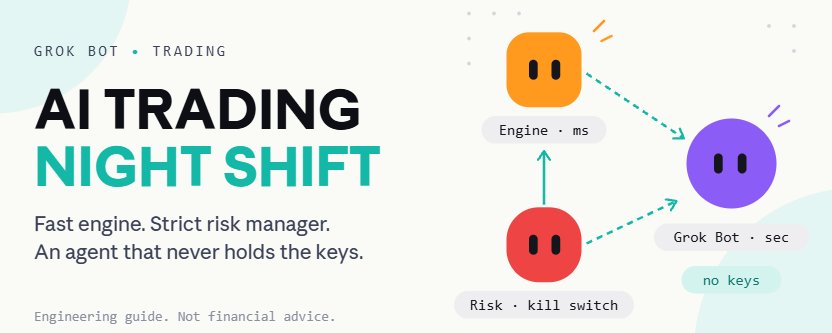
This guide nails it. The trading engine is plain code. The AI never touches the hot path and never holds a trading key. It just watches: heartbeat, latency tails, inventory, PnL. Quiet when things are fine, loud when they're not.
Then the part most people skip: a kill switch, a daily loss limit that stays halted, and stale-data rejection. Weeks on testnet before a single real dollar.
That's the setup. No hype, no "prints money while you sleep." Just a system built to survive while you sleep, with an AI teammate writing the morning brief.
The careful survive. Most people are building the strategy. The winners are building the risk manager.
Bookmark this one.
no0x retweeted
It is becoming f*cking dangerous.
A 20-year-old I know makes $800/month at his day job. Last spring he stopped paying for tools and started reading them.
He pointed Claude Code at the apps he used every day, mapped how they worked, wrote specs in his own words, and had agents rebuild them.
Then he locked each workflow into a skill so he never explained it twice.
Now he runs a small team of bots. One investigates. One builds. One debugs. One verifies. They work while he's at his desk job.
Side income last month: $5,000. Six times his salary.
No degree, no team, no funding.
The scary part isn't the tech. It's that the stack is open source and the whole loop fits into one evening:
Investigate → Spec → Build → Verify.
Most people are still paying monthly for software they could read.
Study the original. Ship your own.
It is becoming f*cking dangerous. 🚨
People are handing AI agents their exchange keys and calling it "automated trading." 🤖💸
Here's what the viral dashboards don't show you:
An AI agent thinks in seconds. Real HFT runs in microseconds. Your agent isn't in the race.
But one person can now run a 24/7 trading operation with a night shift:
⚡ Hot path: plain code, millisecond order book + quoting
🛡 Risk manager: kill switch, sticky daily loss limit, stale-data rejection
🧠 Cold path: Grok Bot, read-only. Monitors health, researches overnight, writes your morning brief
Zero trading keys for the bot. Ever.
The engine trades. The risk manager halts losses because it can't be argued with. The AI keeps watch.
Paper trade first. Testnet for weeks. Test the kill switch.
Most people will give the bot the keys and learn the hard way. A few will build this.
Full guide below 👇
Holy sh*t. This setup is saving me hours every week.
I used to pay monthly for apps whose features were already sitting on my own computer. Motion tools, office suites, charting platforms. It's all just code on disk.
Then I gave Claude Code a skill that used to belong to reverse engineers: REA. It runs locally, and every conclusion comes with evidence: the file, the call, the function, and what's still unknown.
Add 5 Claude skills and the whole loop is covered: Superpowers, Frontend Design, Systematic Debugging, Context Optimization, Skill Creator.
Investigate → Spec → Build → Verify.
What used to cost me an evening in a disassembler now takes one question.
This isn't hacking or piracy. It's clean-room logic: study the original, ship your own.
I put everything into one article: a 6-step one-evening protocol plus copy-paste prompts.
Bookmark it 🔖 and send it to the friend who still pays for five subscriptions.