

@lightetal
Account based inCanada
About this account
- Account based in
- Canada
- Connected via
- United States App Store
Account-level information from X, not a live location or the device used for a specific post.
I’m a PhD researcher @MSFTResearch @Caltech @RPI, prev @NECLabsAmerica @AsariAILabs working on LLM-agents, reasoning, RL, test-time scaling, and code generation
San Francisco, CA
Joined June 2023
- Tweets330
- Following889
- Followers921
- Likes1K




Pinned Tweet
We trained an AI agent on its own explanations, not its code.
It got better at coding.
No teacher. No verifier. No RL updates. No extra context at test time.
Here's how. Links below. 🧵


Jonathan @COLM retweeted

What I read at #COLM2026: the 5 papers I liked most, ranked by community likes:
1. IdeaScientist: agents trained with RL to generate grounded research ideas. @Jiarui_Liu_
nitter.cf/Jiarui_Liu_/status/210…
2. LLM-as-a-Verifier: a weaker model checking a stronger one’s work. @Azaliamirh
nitter.cf/Azaliamirh/status/2108…
3. CORAL: autonomous multi-agent evolution for open-ended discovery. @ao_qu18465
nitter.cf/ao_qu18465/status/2108…
4. Actor-Curator poster. @lightetal
nitter.cf/lightetal/status/21082…
5. GitSwarm: inference that builds on itself across long tasks. @veds_12
nitter.cf/veds_12/status/2108605…
My overall impression is that verification is now the bottleneck for both agents and reasoning. Which COLM paper did I miss?

Excited to share IdeaScientist, our research from my internship at Meta! 🚀
Can AI agents learn to generate novel, grounded scientific ideas?
We introduce IdeaScientist, a framework that trains specialized agents to identify research gaps, discover useful connections across scientific domains, and turn them into concrete research proposals.
🔍 Key findings:
• +14% overall performance over open autoresearch baselines
• 25% improvement in novelty, showing that explicit training can improve scientific ideation
• 75–92% human preference win rates against six open baselines in blind evaluations
• Cross-domain retrieval substantially improves the transfer of ideas between research fields
We also introduce Svalbard Idea Vault, a collection of 2.77M decomposed research ideas for training and evaluating scientific ideation.
📄 Paper: arxiv.org/abs/2610.04074

Our Actor-Curator poster at #COLM26
in case you missed it yesterday :)


Post-training LLMs is like mixing a cocktail:
Too much easy data → no learning
Too much hard data → instability
Wrong balance → collapse
And today, we mix it by hand.
What if the data mixture could be learned instead of hand-tuned?
arxiv.org/abs/2602.20532
🧵👇

Jonathan @COLM retweeted

At #COLM2026? Care about RL and Curriculum Learning for Agents? Do bandit research?
Come chat with us about Actor–Curator this afternoon! 🕟 Today, Oct 7, 4:30–6:30 PM PDT
📍 Poster #100, Franciscan C Hilton San Francisco Union Square

Actor-Curator does self-curriculum design for post-training, by dynamically choosing task difficulty instead of hand-mixing data. Yields up to 80% faster convergence compared to vanilla post-training.
Awesome work by @zhengyao_gu @lightetal @ihazelye @zou_henry43378
Jonathan @COLM retweeted

Shockingly Simple Self-retrospection Improves Agentic Models Without RL
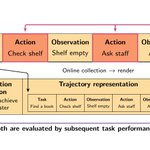
"Can a language-model agent improve its future actions by training only on explanations of its own experience? We investigate this question by studying Retrospection-Only Fine-Tuning (ROFT), a minimal online procedure designed to isolate the effect of explanation-only training on subsequent behavior. The agent attempts a task, observes available feedback, generates a retrospective explanation, and is fine-tuned with a next-token prediction loss on the explanation tokens alone."
link: arxiv.org/abs/2609.35741

At #COLM2026? Come chat about Actor–Curator this afternoon! Happy to talk curriculum learning, bandits, and RL post-training, or just say hi 👋
🕟 Today, Oct 7, 4:30–6:30 PM PDT
📍 Poster #100, Franciscan C
Hilton San Francisco Union Square
Post-training LLMs is like mixing a cocktail:
Too much easy data → no learning
Too much hard data → instability
Wrong balance → collapse
And today, we mix it by hand.
What if the data mixture could be learned instead of hand-tuned?
arxiv.org/abs/2602.20532
🧵👇

I’ll be at @COLM_conf in San Francisco this week presenting our latest work on curriculum learning for RL post-training! #COLM26
Feel free to hit me up if you want to chat about agents, post-training, agentic coding, and self-improvement!
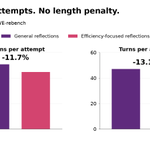
Can a coding agent learn to use fewer tokens and turns, without a length penalty?
We asked it to reflect on how to reach the solution faster, then trained it on those reflections.
11.7% fewer tokens. 13.1% fewer turns.
Compared with training on general reflections.

Retrospections can help steer model behavior without explicit reward shaping.
For details, see arxiv.org/abs/2609.35741

Really great work from @emilianopp_ !

Want to train your SWE agents 2× faster 🏎️💨?
We introduce KV-streams, which, rather than flushing the KV cache on agentic compaction, we preserve it and keep generating. This avoids the re-prefill cost on both the inference engine and the trainer.
Unlike other works that assume a fixed compaction strategy, we show that KV-streams can work with any compaction method in agentic tasks.
Using what we learn from experiments in text-based games. We scale KV-streams to SWE tasks, where we match the performance of re-prefill compaction and full context in half the time 🚀
arxiv.org/pdf/2609.35750
🧵
Jonathan @COLM retweeted

Unexpectedly effective alternative to RL?: provide feedback, let the model contemplate the feedback in chain of though, and then fine-tune with next token prediction on the contemplation tokens. Credit assignment flows back through the full rollout to penalize poorly chosen actions.
Unlike RL, it appears to work even for tasks where all the original rollouts failed.
This could be a game changer.

Shockingly Simple Self-retrospection Improves Agentic Models Without RL
"Can a language-model agent improve its future actions by training only on explanations of its own experience? We investigate this question by studying Retrospection-Only Fine-Tuning (ROFT), a minimal online procedure designed to isolate the effect of explanation-only training on subsequent behavior. The agent attempts a task, observes available feedback, generates a retrospective explanation, and is fine-tuned with a next-token prediction loss on the explanation tokens alone."
link: arxiv.org/abs/2609.35741
Jonathan @COLM retweeted

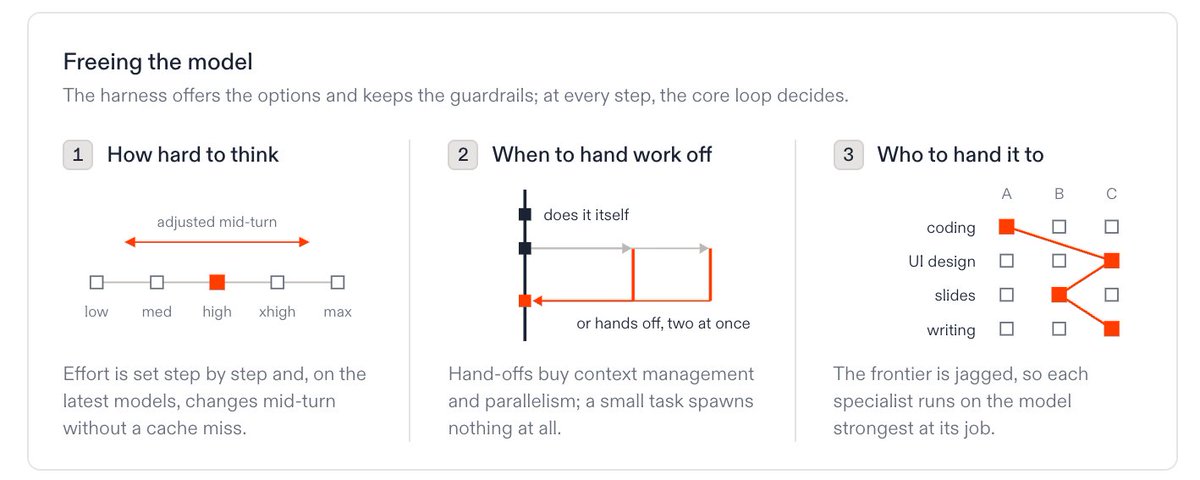
strongly agree with the approach of a minimal harness. if it’s a maximally expressive code-mode agent loop then you can also do some really long-horizon tasks without a memory system and self-improvement without a meta-harness :D arxiv.org/abs/2609.26891


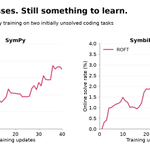
What if I told you an agent could start solving a task after failing all initial attempts?
On two hard coding tasks, training on its own retrospections did exactly that.
No successful example to imitate. A failed attempt can still contain a useful lesson.

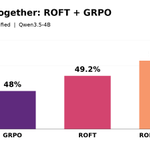
5/6 This isn’t ROFT vs. RL.
Add retrospection training to GRPO and learn from both rewards and explanations.
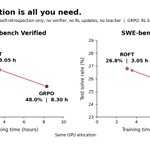
The combination achieved the highest SWE-bench Verified score in our comparison.
Learning to explain complements learning to do.

6/6 Paper & acknowledgments
Huge thanks to my coauthors:
@ccui9 @beanie0__0 @creus_roger @emilianopp_ @Zhengyan_Shi @murefil @Cote_Marc @ericxyuan
@kim__minseon
And thank you @MSFTResearch for supporting this work!
Paper: arxiv.org/abs/2609.35741