

cs phD, physical AI builder | prev: sauron (founder/CTO), zipline, nuro, zoox, academia
San Francisco, CA
Joined June 2012
- Tweets1.9K
- Following381
- Followers980
- Likes4.9K






Pinned Tweet
Many robots have run on two models: a slow one that decides and a fast one that moves. That split is dissolving. What survives is the layer that keeps a robot from falling over, and a check on what it plans to do.

ADS-B FTW!

Sorry for the long-ass post, I did some OSINT shit.
I pulled live public flight feeds, weather radar status, and space weather data to see what's actually going on during today's nationwide FAA grounding.
TL;DR: radar, GPS, and weather sensors are all working fine. What broke is the long-distance communications network that lets the FAA's 22 regional air traffic control centers talk to high-altitude planes and hand them off to each other.
When people think of air traffic control, they picture the glass tower at an airport. Those towers only handle takeoffs, landings, and nearby airspace. Once a plane climbs out, it's handed off to one of 22 regional Air Route Traffic Control Centers (ARTCCs) — giant facilities that manage high-altitude cruising traffic across whole regions of the country.
Normally, those 22 centers are regionally isolated: if one loses power or a local fiber line, neighboring centers absorb or route traffic around it. Having all 22 degrade at once is virtually unheard of because it means a shared national backbone failed, leaving no healthy neighbor to take over.
That's why the FAA's Command Center used such stark, blanket wording ("Due to extraordinary circumstances and for reasons of safety... all airports are ground stopped until further notice"*) — it's standard protocol when a national-level freeze has to happen immediately before engineers even know how long repairs will take ("safety issue" means "oh shit, stop" in aviation circles, unlike with AI companies).
All 22 centers losing comms at once is, indeed, "extraordinary circumstances".
Here's what the live data shows:
1. US airspace is emptying out fast.
Normally on a Friday evening, thousands of planes are in the air over the US. In live tracking data from OpenSky Network, the number of airborne planes over the lower 48 is steadily draining as flights land and no new commercial departures take off:
• 6:36 PM EST: 1,083 airborne
• 6:42 PM EST: 1,035 airborne
• 6:49 PM EST: 990 airborne
There are zero emergency distress codes broadcasting.
2. Major airports are, predictably, stacked.
Looking within 30 miles of major hubs around 6:37 PM EST (`adsb.lol`), almost nothing is moving:
• NYC/JFK area: 8 in the air vs. 67 on the ground
• LAX: 14 in the air vs. 40 on the ground
• Dallas (DFW): 7 vs. 36
• Denver (DEN): 13 vs. 29
• Atlanta (ATL): 5 vs. 25
• Chicago (ORD): 9 vs. 24
• DC (DCA): 8 vs. 22
A lot of the coastal airports had to stop accepting diverts.
3. The few planes still taking off are enlightening.
Across the entire US at 6:36 PM, only aircraft were taking off (that is: below 10,000 feet and climbing). They fell into two clear buckets:
• 3 international widebody jets (`DAL281` out of Seattle, `DAL156` out of NYC, and `AFR71E` out of Newark), matching the FAA's note that international flights are being handled case-by-case.
• Small private planes and a couple of business jets flying under VFR (visual flight rules) — essentially, staying below 18,000 feet, where pilots don't need en-route air traffic control clearances.
Honorable mention to the 1 Coast Guard/military helicopter climbing near Tampa, out of 29 military aircraft tracked nationwide.
4. Weather radar isn't down, and there's no solar storm or GPS jamming.
A lot of people wondered if today's FAA ground stop, rumors of a National Weather Service outage, and Microsoft's 365 outage were all connected. Checking the raw feeds:
• Weather radar: 199 out of 208 US Doppler radar stations are actively sending fresh scans (within the last 15 minutes). The "NWS outage" rumors were website and caching glitches, not offline radar hardware.
• GPS & Space Weather: NOAA space weather is completely quiet (`Kp = 0`), and aircraft GPS accuracy readings across the Midwest and Northeast look totally normal.
• Local airport radar & towers: Local FAA ground-station radar broadcasts and local airport control towers are still up and transmitting.
So, local sensors and local towers are fine.
The failure is specifically in the long-haul telecommunications backbone connecting the FAA's 22 en-route centers to their remote radio sites — which is why en-route controller frequencies went quiet while local towers, weather radars, and low-altitude visual flights kept running.
Federal officials say there's no sign of a cyberattack, so we're waiting on the FAA's technical post-mortem for what tripped the national network.
That doesn't rule out a cyberattack as the root cause of the comms outage; it's a "we don't know".
Shoutout to adsb.lol for their free API.
2
310

Don’t pass up the chance to hear directly from @nurcannsonmezz why your robot’s stack should run entirely in the cloud.

In Austin for CoRL? Orchestral Labs is hard at work building the fastest inference platform for robotics. Come hear our vision this Wednesday at Physical AI Night with @CRV and @lancedb. luma.com/e9menn5c

1
227
Who's the cutest goose in town? 🪿
Can't wait for one of these to waddle over and clean up my daily chaos. Bravo @thehumhuworks and @RobotWorksGoose!

1
9
344
A layer stays separate when it runs faster than the model above can, learns from its own data, or needs its own check. The System 1/System 2 split now has none of these reasons. System 0 has the first two; the plan check exists for the third.
1
32
Frontier models belong offline, generating scenarios and grading runs, and live only when a robot is stuck. The full piece, including what would change my mind, is on Substack: vasuraman.substack.com/p/the…
34
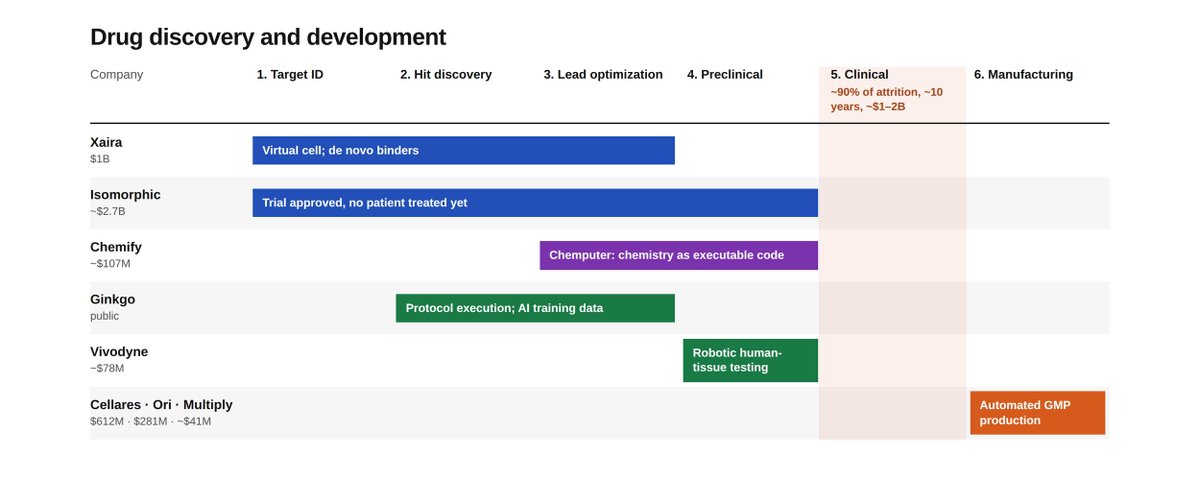
As a roboticist, I wanted to know where robots fit in drug and materials discovery. Funding today goes to the stages where claims are cheapest to test, and even the best lab robots only speed up the cheap part. The expensive part is trials and scale-up.
The middle of the chemistry bench is largely automated. The ends aren't: someone still has to look at a flask and decide whether that's a phase boundary or an emulsion that will never separate.
Photo: GOKLuLe, CC BY-SA 3.0, via Wikimedia Commons

ALT Photo of a separatory funnel holding two liquid layers, with a hazy boundary between them and reflections on the glass.
1
46
This is what people really want from their personal AI assistants, btw.
Observe, understand, act.
This Post is from a suspended account. Learn more
5
1,113
Love to see cracked roboticists like @thehumhuworks putting robots in homes to solve meaningful problems for real people. More of this please.

2
5
658
Truly. And in the time it takes to concede you can’t hit your destination that way, you could have walked there.

my quick and dirty analogy for the model's flavor of jaggedness in 2026 is kind of like...
if you ask for a taxi ride but someone hands you a catapult that is highly pre-aimed on a very small number of destinations in advance
initially, you're super impressed by the speed and distance of transportation, but you can never quite use it to land at your actual freaking destination, no matter how many times you're willing to get thrown flying through the air :/
excuse the dumb analogy but that's the informal version of the intuition

381