
CS PhD @UTAustin. Research @NVIDIA GEAR. CS MS @Stanford. EECS BS @Berkeley_EECS. Opinions are my own.
Joined October 2018
- Tweets38
- Following214
- Followers414
- Likes181



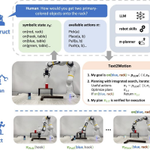
Our latest state-of-the-art robot reward model that shines especially on long-horizon tasks!

Can a robot learn more from the same recordings, and can it choose a better next move without more training?
Introducing Grana: a compositional reward model that tracks progress through mistakes and recovery in long-horizon robot manipulation. Its progress feedback supports both learning from recorded experience and guiding action selection during execution.
Even a successful run can contain mistakes and retries. Grana uses its progress estimates to give more training weight to actions that move the task forward, helping robots learn more from that experience. On real-robot airplane assembly, Grana-weighted training achieved 75% success, compared with 50% for unweighted training on the same data.
In a separate tractor assembly test, the same policy succeeded in 2 of 10 trials on its own and 9 of 10 when Grana helped it choose its next move.
Providing this feedback during execution and across many recorded attempts makes both scoring speed and cost important. Grana runs locally using less than 10 GB of GPU memory, with no API fees. In our benchmark, it returned progress estimates over 200× faster than GPT-6 Astra.
Paper, code, and results: research.nvidia.com/labs/gea… 🧵↓
11
733
Super happy to share GR00T 2, our open world-action robot foundation model, pre-trained on 440k hours of data!
With just an hour of post-training, G2 can cut-and-apply shipping labels, run chemistry lab tasks and assemble toys.

Meet GR00T 2, our new generation of world-action models (WAMs): it imagines how the physical world will unfold and generates the actions that get it there. One model runs on parallel grippers, dexterous hands, and humanoids.
research.nvidia.com/labs/gea…
3
16
632
We'll also be open-sourcing nearly everything (in December)!
The white paper is the longest robotics white-paper I've ever seen (135 pages) and contains a ton of detail: research.nvidia.com/labs/gea…
56

HumanoidMimicGen datasets, simulation benchmark, and policy code are now available at github.com/NVlabs/humanoidmi…. Also accepted to CoRL 2026, see you in Austin!


Kevin Lin retweeted

Check out this scalable data generation pipeline for humanoid loco-manipulation
Thanks Yu @_OutofMemory_ !!

Scale your humanoid motion data with motion planning in other domains, then transfer to real!! - try out the new great work from data gen cizar👑 @linkevin0
What a line of work: DexMimicGen -> CP-Gen -> HumanoidMimicGen!
2
494
Kevin Lin retweeted

Data collection for humanoids requires lots of human effort, especially whole-body demonstrations for loco-manipulation tasks. Excited to announce the latest version of MimicGen - HumanoidMimicGen! Synthetic simulation data generation for humanoid loco-manipulation.
How does it work? HumanoidMimicGen interleaves three pieces:
Locomotion planning, manipulation planning, and demonstrated skill adaptation.
1
5
653
This work was made possible with an awesome team! @AjayMandlekar, @CaelanGarrett, @nc__dev, Yu Fang, @dngxngxng3, @yuqi_xie5, Justin Tran, @DrJimFan, @yukez
Website: humanoidmimicgen.github.io
Arxiv: arxiv.org/abs/2605.27724v1
5
689
If you're training models with data from multiple domains (such as real robot data and simulation data), check out Yu's latest work for a principled guideline on how to choose the mixing ratio!
🤖Co-training is everywhere (sim↔real[e.g. GR00T, LBM], human↔robot[e.g. PI, EgoScale], even non-robot data[e.g. PI, LBM).
But why does it work? How can we improve it further?
Taking sim-and-real imitation learning in diffusion/ flow-based models as the test bed, we performed a rigorous mechanistic analysis, drawing on theoretical insights and multi-layered experiments.
😮Key insight: it’s all about representations.
- Alignment → enables transfer
- Discernibility → enables adaptation
⚖️Both are necessary — it's better to have more aligned representations, but the model must be able to discern the domains. We term this as structured representation alignment.
⬇️Let’s take a deep dive into that:
Paper: arxiv.org/pdf/2604.13645
Website: science-of-co-training.githu…

One neural network to control any humanoid. Neat work!

The most important thing to highlight is, XHugWBC controls arbitrary humanoids instead of existing ones. We show it generalizes to existing embodiments in a zero-shot manner. No more efforts are required to build a new controller for new humanoids.
19
2,425
Tired of collecting robot demos?
🚀 Introducing CP-Gen: geometry-aware data generation for robot learning.
From a single demo, CP-Gen generates thousands of new demonstrations to train visuomotor policies that transfer zero-shot sim-to-real across novel geometries and poses.
Result:
✅ Robust geometry generalization
✅ Zero-shot sim-to-real transfer for multi-stage manipulation tasks
✅ Only one source demonstration required
1
5
454
🌐 Website: cp-gen.github.io
💻 Fully open-source code: github.com/kevin-thankyou-li…
Huge thanks to my collaborators & advisors!
🙏 Varun Ragunath, Andrew McAlinden, @_Aaditya_Prasad, @jimmyyhwu, @yukez, @leto__jean
5
434