



Pinned Tweet
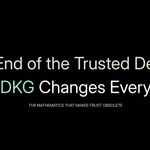
The End of the Trusted Dealer: Why DKG Changes Everything
@RialoHQ is redefining the foundations of digital trust by eliminating the need for a central authority.
The biggest weakness in decentralized systems is often hidden right at the start of the process. In traditional setups, a "Trusted Dealer" is responsible for creating the cryptographic key and then sharing the pieces with everyone else. This means that for a brief moment, one single entity holds the master key. That moment is a massive security risk. If that dealer is compromised or acts maliciously, the security of the entire network vanishes instantly. It is a single point of failure that the industry has accepted for too long.
This is where Distributed Key Generation (DKG) changes the game. It allows a network to build a shared secret together without any single node ever seeing the whole picture. No master key is ever created in one place, not even for a second. Instead, nodes work in parallel to generate their own shares through a collective mathematical process. You are effectively moving from trusting a person or a server to trusting pure, decentralized mathematics. This ensures that the core secret remains untouchable, even if a portion of the network is under direct attack.
The next post in this series will break down the private polynomials that power this mathematical magic!

The Big Crypto Illusion: Anonymity vs Confidentiality
Wearing a mask does not make your secrets invisible.
A lot of people think staying anonymous on chain is enough to stay safe. It is a massive misconception. Think of anonymity like taking your name off your front door. People do not know who lives there, but if the door is wide open, anyone walking by can still see everything inside your house.
Confidentiality is a completely different game. It means locking your actual data in a heavy steel vault. People might see the vault, but the contents remain a total mystery.
Right now, Web3 has a big leak because it often forces users to choose one over the other. The latest blog from Fluton highlights exactly why this is a dangerous setup. To trade safely and keep your financial strategies hidden, you need both the mask and the vault working together.
So how exactly does @FlutonIO lock that vault without breaking the smart contracts? The answer lies in the Fhenix integration, and I will unpack those technical details in the next post.

Breaking Down Rialo's Gauss: The End of Messy Blockchain Upgrades
@RialoHQ recently dropped a fascinating paper on Twitter titled "It's Not a Lie if You Don't Get Caught: Simplifying Reconfiguration in SMR Through Dirty Logs". The title is incredibly catchy, and the mechanics inside outline exactly what the infrastructure space needs right now. I spent some time breaking down the architecture, and I want to share my thoughts on why Gauss is a massive step forward for state machine replication protocols.
The Core Problem: Messy Logs
Usually, in replicated state machines, the consensus log and the execution log are the exact same thing. You put client transactions and network coordination messages (like validator changes or timeout updates) into one single pipe.
When you need to upgrade validator sets or consensus rules, the execution engine has to deal with the mess. The logic becomes heavily entangled. A change in the consensus layer forces a change in the execution layer. In production environments, this causes network downtime and makes protocol upgrades incredibly risky.
The Gauss Solution: Split the Timeline
Gauss fixes this by completely decoupling consensus from execution. It achieves this by introducing two separate logs:
⚪️The Inner Log (The Dirty Log): Think of this as the raw, unfiltered consensus timeline. It holds all the client transactions plus all the background coordination messages.
⚪️The Outer Log (The Clean Log): This is the sanitized version. It only contains executable client transactions.
A deterministic component called the Log Sanitizer sits between them. It filters out all the network coordination noise from the inner log, ensuring the execution engine only ever sees pure client transactions.
The "Lie" in the Architecture
The title of the paper refers to a very clever architectural trick. The execution engine never sees the messy coordination entries. Furthermore, when the network transitions to a new epoch, any lingering transactions from the old configuration that happen after the exact handover boundary are simply ignored by the new outer log.
These leftover transactions must be resubmitted. The system essentially "lies" to the execution layer by hiding the complexity of the consensus switch.
How the Seamless Upgrade Actually Works
Gauss handles system upgrades across three distinct phases without halting the network:
1. Preparation Phase: An EpochChange message kicks things off. New validators prepare their environments and send a Ready signal. Gauss smartly waits for every single validator in the new configuration to be ready. This prevents scenarios where the network stalls because a faulty node signaled readiness but failed to participate.
2. Handover Phase: The system marks a strict boundary right after the final Ready message. Old validators create a signed handover certificate. The magic happens here: the outer log seamlessly switches to reading the new inner log exactly at this boundary.
3. Shutdown Phase: The old configuration does not just vanish. The old validators wait to see a quorum of Done messages in the new configuration. Because of how Byzantine fault tolerance and quorum intersections work, it is mathematically impossible for two conflicting network states to finalize. Once confirmed, the old validators safely shut down.
Why This is Huge for Web3 Infrastructure
This is a total game changer for blockchain systems. Network upgrades usually mean nail-biting downtime, coordinated validator pauses, or complex hard forks.
Gauss allows Rialo to swap consensus mechanisms, change validator sets, and update failure thresholds with zero execution downtime. You can upgrade the consensus engine while the blockchain is still running at full speed. For a system expected to operate long-term under changing technical requirements, making protocol upgrades a standard background event is a massive win.

The Best Blockchain is the One You Don't See.
The crypto industry has a user experience problem. For the last decade, we have forced everyday users to act like cybersecurity experts. Managing 12-word seed phrases, calculating gas fees in volatile tokens, and navigating complex wallet extensions is a massive barrier to entry.
You do not need to understand how TCP/IP works to send an email. You should not need to understand cryptography to trade an asset.
@RialoHQ tackles this through native Account Abstraction.
By pushing the complexity to the backend (The Project 1337 Engine), Rialo is designed to make the blockchain layer completely invisible to the end user.
Instead of dealing with gas tokens, users can experience sponsored transactions or pay fees in the token they are trading (like USDC). Instead of vulnerable seed phrases, accounts can leverage smart contract logic for recovery, social logins, and multi-signature security directly at the protocol level.
The goal is a Web2 user experience powered by a Web3 settlement engine.
When institutional capital and retail users can interact with real-world assets on-chain without ever realizing they are using a blockchain, that is when true mass adoption happens. Rialo is building the interface for that exact future.

Meet Nox!
Nox is the ancient spirit of the night, ruling the unseen world with total silence and insane speed. I wanted to design a mascot that truly captures what @FlutonIO is all about. Pure privacy and zero friction.
She stalks through the blocks without leaving a single trace. That glowing blue eye on the clean black silhouette just gives me exactly the hype energy our community needs right now.


The Center of Gravity: Why @RialoHQ is Unifying Global Markets.
There is a massive inefficiency bleeding global finance today: Liquidity Fragmentation.
Right now, capital is scattered. Gold trades in one market, equities trade in another, and digital assets are fragmented across dozens of isolated blockchains. If capital wants to move, it faces high fees, slow settlements, and clunky infrastructure. Building another isolated network does not solve this.
Rialo takes a completely different approach.
Instead of acting as just another isolated chain, the protocol is designed as a foundational execution layer. It acts like a gravitational pull for global liquidity. By natively supporting Real World Assets (RWAs) alongside digital capital, Rialo brings commodities, stocks, and crypto into a single, unified environment.
The architecture abstracts away the complex bridging mechanics. For institutional capital, it simply feels like one deep, highly liquid market where assets can interact seamlessly.
Fragmentation is the enemy of efficiency. Unifying that liquidity is exactly what the next generation of finance requires, and Rialo is positioning itself at the absolute center of this shift.

We rarely see projects completely skip the generic meta to focus on 200 purely hand drawn artworks with deep storytelling and that alone makes this an absolute must have for me.

Tatsu
A digital collection of 200 1/1 hand-drawn anime-inspired art, each rooted in deep lore
Own a piece of this world
Apply → tatsu.nyc/quest
WL spots are highly limited❕️
Breaking the Speed Limit: Why Sequential Blockchains Are Obsolete.
Speed implies physics. In the world of legacy blockchains, there is a hard limit. It is called "Sequential Execution."
Think of the EVM like a single-lane road. No matter how fast the engine is, every transaction must wait for the one before it to finish. If the car in front stops, the whole line stops. This architecture was fine for 2015, but it cannot handle the volume of global finance today.
@RialoHQ creates a new standard with Parallel Execution.
The protocol abandons the single-lane approach. Instead, Rialo's architecture processes thousands of transactions simultaneously across multiple threads. It is not just "faster"; it is structurally superior.
While legacy chains struggle to push 15-30 TPS (Transactions Per Second), Rialo removes the bottleneck entirely, targeting 100,000+ TPS.
This isn't just a faster car in the same traffic. It is a new engine designed to break the sound barrier.

Rialo x Keplr
The recent news about @keplrwallet officially joining the @RialoHQ ecosystem is seriously bullish. When I look at new chains preparing for Mainnet, the first thing I check is the user tooling. You can have the best tech in the world, but if users have to struggle with clunky or obscure wallets, adoption hits a wall immediately.
Integrating Keplr right now changes that dynamic completely.
Keplr is arguably the premier gateway for the interchain world. It is fast, reliable, and most crypto natives already have it installed. By securing this support as they move toward the Mainnet launch, Rialo is removing a huge friction point. Users won't need to learn a new tool to interact with the first "Real-World Blockchain." They can just plug in and go.
This partnership also tells me the team is laser-focused on the transition from Testnet to live dApps. They clearly want the onboarding process to be intuitive and secure from the very first second.
For a project aiming to bridge real-world value on-chain, accessibility is everything. You cannot expect mass adoption if the interface is hard to use. This move guarantees that when the doors finally open, the user experience will be top tier. I am genuinely excited to see this roll out.

We are thrilled to announce that @keplrwallet is officially joining the Rialo ecosystem! 🤝
As we advance toward our Mainnet launch, Keplr will serve as a portal for users to interact with the first "Real-World Blockchain."
By integrating one of the world's leading multichain wallets, we're making sure that the transition from Testnet to live dApps is seamless, secure, and intuitive.
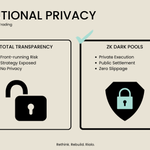
Total Transparency is a Trap. Why Institutional Money Needs @RialoHQ
Transparency is a feature for retail, but for institutional capital, it is often a bug.
Imagine you are a hedge fund trying to enter a large position. On a standard transparent ledger, the moment you broadcast your transaction, the entire world sees it. Arbitrage bots spot your trade, front-run you, and you end up paying a premium. Your strategy is exposed before it even settles.
This is the main reason why trillions of dollars in traditional finance are hesitant to move on-chain. They cannot afford "Total Exposure."
Rialo solves this paradox with ZK Architecture.
By leveraging Zero-Knowledge proofs, Rialo allows what we call "On-Chain Dark Pools." Institutions can cryptographically prove they have the funds and that the transaction is valid, without revealing their specific strategy to the public network.
The concept is simple: Public Verification, Private Execution.
Rialo is building the bridge that Wall Street has been waiting for. It allows them to play by the rules of DeFi without showing their hand to the entire table.

Stop Bridging, Start Intending: The Magic of @FlutonIO
In the first part of this series, we talked about how messy the interchain world currently is. Today, I want to show you exactly how Fluton fixes that by changing the way we interact with crypto.
The Intent-Based Future.
Most of us are used to the old way. You want to move funds, so you find a bridge, approve tokens, sign multiple transactions, pay gas on İki different chains, and pray everything goes right. It is exhausting and stressful.
Fluton flips the script.
Instead of doing all the manual work, you just state your "intent." Think of it like a smart GPS. You do not need to know every single road or turn to get to your destination; you just put the address in and let the system find the best route.
With Fluton, you simply say what you want to achieve, like "I want my USDC on Ethereum to become TIA on Celestia."
That is it. You do not need to worry about the technical steps or the bridges in between. Fluton’s sophisticated solver network handles the complexity behind the scenes to find the fastest and most secure path for you.
This is not just a small upgrade; it is a total shift in user experience. We are moving away from being "operators" who have to know everything about blockchain tech, and finally becoming "users" who just get things done.
The best part? This happens with maximum privacy and speed.
Ready to see how the tech makes this possible? In Part 3, we are diving into the secret sauce: Union and IBC.
Stay tuned.

Why Your Smart Contracts Are Dragging Anchor? (And How We Cut the Chain)
We need to talk about "overhead."
In the classic EVM model, your code goes through so many translation layers before it actually runs on the machine. It is like trying to have a conversation through three different translators. It works, but it is slow, expensive, and inefficient.
Especially when we talk about Zero-Knowledge (ZK) proofs, this inefficiency becomes a massive problem. Proving complexity on traditional architectures is extremely high.
This is why @RialoHQ runs on RISC-V.
RISC-V is not just another virtual machine. It is a standard instruction set architecture (ISA). It is the same language that modern hardware speaks. By using RISC-V, we remove the translation layers. We get closer to the "metal."
What does this mean for a developer?
🔶Speed: Your contracts execute with significantly less computational overhead.
🔶ZK-Native: Generating proofs becomes faster because the architecture is optimized for the math, not fighting against it.
🔶Auditability: Standard architecture means standard security tools work out of the box.
We are not just optimizing the software. We are aligning the entire protocol with the future of computing hardware.

BNB Chain x @billions_ntwk
The Billions team is absolutely crushing it right now. They just announced that Billions is officially live on BNB Chain. If you know me, you know I’m all about real utility, and this integration is exactly what the space needs. Bringing a privacy-focused identity layer to an ecosystem as massive and fast as BNB Chain is huge.
Let’s break down why this matters for us.
First off, the user experience is seamless. You can now verify that you are a unique human directly on BNB Chain using just your phone. It takes seconds. The best part is the privacy tech behind it. They use zero-knowledge proofs, which is non-negotiable for me. It means you prove you are real without ever sharing your actual private data or uploading sensitive docs to a random server. Your data stays with you. Period.
This effectively solves the "bot problem" for everyone on BNB Chain. Think about it. We have all seen airdrops getting farmed to death or governance votes being manipulated by thousands of fake wallets. With Billions now native on the chain, developers can easily filter out the noise. They can ensure rewards and voting power go to actual, unique humans like us. It makes the whole ecosystem fairer and more sustainable.
For developers and projects, this is a massive unlock. They get a "verify once, use everywhere" infrastructure. Once we verify our identity, we can use that proof across different DeFi apps, games, and platforms on the network without doing the same boring checks over and over.
It is also worth mentioning why BNB Chain is the perfect home for this. The low gas fees and high speed mean that proving your humanity doesn't cost a fortune or take forever. It makes on-chain identity actually accessible for the average user, not just whales.
Billions is seriously building the universal trust layer we have been waiting for. Seeing them expand to BNB Chain shows they are ready for mass adoption. I am super bullish on what this brings to the table. Real humans, real value, zero compromised privacy. Let’s go.

Why Are We Still Coding Like It’s 2015? The RISC-V Revolution with @RialoHQ
We talk a lot about mass adoption for users, but what about mass adoption for builders?
Right now, crypto is stuck behind a massive barrier. To build on most chains, you have to learn Solidity. It is a niche language for a niche environment (the EVM). This creates a massive bottleneck. There are maybe 200,000 active Solidity devs in the world. Compare that to the 25 million+ developers using C++, Rust, and Go in Web2.
We are keeping the world's best engineering talent locked out of Web3.
This is why Rialo's architecture is a game-changer. By building on top of RISC-V, Rialo becomes a polyglot protocol. It means you don't have to learn a new language to build here. If you know Rust, you can ship code on Rialo today.
We are tearing down the "Solidity Wall." We are opening the doors to millions of battle-tested engineers from traditional tech. They can bring their existing toolkits, libraries, and expertise directly on-chain.
This isn't just a technical feature. It's an adoption strategy. The next killer dApp won't just be written in Solidity. It might be written in Rust by a dev who just migrated from Google.


Fluton Discord Role Update
The energy in the Fluton ecosystem has been crazy lately. With so many new faces joining, the team just dropped a massive update to the Discord role structure. It is not just about being here anymore; it is about impact.
If you have been looking for a way to stand out, now is the time to lock in.
The standout here is the "Encrypted" role. This is a limited, manually assigned tag for members who truly bring value. It is arguably the most prestigious spot right now.
If you are making content, "Fluton Creator" is where you want to be. For the event winners, there is "Rumble Legend".
It is a solid move to organize the server better. Check the announcements channel to see where you fit in.
Let’s build. discord.gg/fluton

i’m finally a member of the Super OG club too!
it feels so great to see my hard work for @billions_ntwk being appreciated like this. a huge thank you to the Billions team for welcoming me into the Super OG club. also, i want to give a special shout-out to the @Billions_TR team, they’re doing such a killer job.
keeping at it... much love.

The Privacy Revolution: @billions_ntwk x @0xMiden
Here is why the new partnership between Billions and Miden is a massive deal for the future of on-chain identity and user privacy.
This collaboration is a huge win for anyone who cares about staying private. For a long time, we have been stuck with a bad choice. You either stay totally anonymous and skip compliance, or you doxx yourself completely just to use a platform. That dilemma is finally over.
By bringing the ZK identity stack to Miden, Billions is making sovereign identity a reality for applications. Most current identity models are honestly pretty scary. They force you to hand over biometrics or sensitive data to services that act like a black box. This new approach proves that privacy is non-negotiable.
The process is actually simple and makes a lot of sense. You scan your ID and pass a check, then you receive a ZK proof of your identity. Most importantly, the user data is deleted immediately. You can then use that proof to verify things like your age or residency without ever showing your personal details again.
For the builders out there, this changes everything. You can now integrate KYC and AML checks on Miden without ever touching sensitive user info. That means no storing passport scans and no managing risky databases. Billions takes away the liability while you get the verification you need. This is the exact kind of infrastructure we need to move the space forward.
@azeemk @jgonzalezferrer


Build the Future with @knidosxyz
Knidos is an awesome venture studio focused on building cool stuff together in the Web3 world. It is the perfect place to connect with creators and make a real impact while being part of a super supportive crew. You definitely don’t want to miss out on the energy and the big projects coming up next.
Join the community here: guild.xyz/knidosxyz

The Future of Interchain is @FlutonIO
If you have been in DeFi for more than a week, you already know the struggle.
Right now, liquidity is scattered everywhere. We have amazing projects on dozens of different chains, but they all feel like isolated islands. Moving your assets from point A to point B usually involves sketchy bridges, high fees, and a lot of waiting around hoping your funds actually arrive.
It is messy, it is slow, and honestly, it is holding all of us back.
This is exactly why I am so excited to start talking about Fluton.
Fluton is not just another protocol adding to the noise. It is built to solve the biggest headache in Web3: Liquidity Fragmentation. By using the power of Union and IBC, Fluton creates a world where you do not have to worry about which chain your assets are on.
Imagine a future where cross-chain moves are instant, safe, and actually easy to use. No more jumping through hoops or taking unnecessary risks with your capital.
We are moving toward an "intent-based" world where you just say what you want to do, and Fluton handles the heavy lifting in the background.
This is just the beginning of the series. Over the next few days, I will be breaking down exactly how Fluton works and why its approach to privacy and speed is a total game changer for the entire ecosystem.
The interchain future is bright and it starts here. Stay tuned for Part 2.
